Dax Function: T.INV
 Reviewed by Neetu Singla — Founder, Lets Viz Technologies — AI & Data Consultant. Last reviewed June 5, 2026.
Category: Statistical Functions
The T.INV function in Power BI is a DAX statistical function used to calculate the inverse of the Student’s t-distribution. This function returns the t-value corresponding to a specified probability and degrees of freedom, making it useful for hypothesis testing and confidence interval estimation.
Purpose
The purpose of the T.INV function is to determine the critical t-value for a given cumulative probability in the t-distribution. It is widely used in statistical analysis to find thresholds or critical points in one-tailed tests.
Type of Calculations
Inverse T-Distribution: The function performs calculations to return the t-value associated with a specified cumulative probability in the distribution.
Practical Use Cases
Hypothesis Testing: Identify the critical t-value for rejecting or accepting a null hypothesis.
Confidence Intervals: Calculate the margin of error based on the t-distribution.
Decision Thresholds: Establish thresholds for risk assessments or quality control.
T.INV(<probability>, <deg_freedom>)</deg_freedom></probability>
| Parameter | Type | Description |
|---|---|---|
Probability | Scalar | A numeric value between 0 and 1 representing the cumulative probability. |
Deg_freedom | Scalar | The degrees of freedom, typically n−1n – 1, where nn is the sample size. Must be ≥ 1. |
How Does T.INV Dax Works
The T.INV function operates by determining the t-value such that the cumulative probability up to this value matches the input Probability. This calculation relies on the inverse cumulative distribution function (CDF) for the t-distribution:
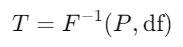
Where:
T = t-value.
P = cumulative probability.
df = degrees of freedom.
What Does It Return?
Type: Decimal number.
Meaning: The t-value corresponding to the specified cumulative probability in the t-distribution.
When Should We Use It?
Statistical Analysis: When critical t-values are required for analysis.
Research Studies: To determine thresholds in experimental data.
Error Margins: Compute precise t-values for estimating confidence intervals.
Examples
Basic Usage :
T.INV(0.975, 10)
Result: Returns the t-value corresponding to a cumulative probability of 0.975 with 10 degrees of freedom (used for a 95% confidence level in two-tailed tests).
Dynamic Probability Calculation
T.INV(AVERAGE(Sales[Probability]), 20)
Result: Computes the t-value dynamically based on average probabilities from a column and 20 degrees of freedom.
Advanced Usage with Filtering
CALCULATE(T.INV(0.05, SUMX(Sales, Sales[Samples]) - 1), FILTER(Sales, Sales[Region] = "East"))
Result: Returns the critical t-value for the East region using dynamically calculated degrees of freedom.
Tips and Tricks
Combine with T.DIST: Use T.DIST to verify or visualize the cumulative probability corresponding to the t-value.
Tail-Specific Testing: Pair with T.INV.RT for right-tailed tests to avoid confusion.
Valid Inputs: Ensure
Probabilitylies strictly between 0 and 1 to prevent errors.
Potential Pitfalls
Invalid
Probabilityvalues outside [0, 1] will result in errors.Incorrect degrees of freedom may lead to inaccurate t-values.
Performance Impact of T.INV DAX Function:
Efficient for small to medium datasets.
Ensure pre-aggregated data for better performance in large datasets.
Related Functions You Might Need
Want to Learn More?
For more information, check out the official Microsoft documentation for T.INV You can also experiment with this function in your Power BI reports to explore its capabilities.
Unlock the true value of Power BI by turning your data into meaningful insights with the support of our dedicated consulting team. Whether it’s navigating advanced DAX functions, designing user-friendly dashboards, or enhancing the efficiency of your data models, our seasoned Power BI experts provide solutions customized to your business objectives. Explore our Power BI Consulting Services page to discover how we can help your organization make smarter, data-driven decisions.
It calculates the critical t-value corresponding to a given cumulative probability in the t-distribution.
T.INV computes the t-value for one-tailed tests, while T.INV.2T is used for two-tailed tests.
Yes, but probabilities near these limits yield extreme t-values, reflecting rare outcomes.
The function will return an error if degrees of freedom are less than 1.
It helps compute the margin of error by finding t-values associated with a specified confidence level.
Need Power BI help in a real engagement?
Our team writes DAX like this every day for SaaS finance and ops teams. Refresh monitoring, change requests with a 2-business-day SLA, and a named analyst on retainer — or scoped hourly help if you just need a fix.
Named analyst2-day SLAFrom $5K/mo