Dax Function: BETA.INV
 Reviewed by Neetu Singla — Founder, Lets Viz Technologies — AI & Data Consultant. Last reviewed June 5, 2026.
Category: Statistical Functions
The BETA.INV function in Power BI is a statistical function used to calculate the inverse of the cumulative beta probability distribution. Essentially, it determines the value of x for a given cumulative probability (p) based on the beta distribution.
Purpose of the Function
Primary Objective: Calculate the value of a variable that corresponds to a given cumulative probability.
Type of Calculations: Performs inverse calculations for the cumulative distribution function (CDF) of the beta distribution.
Practical Use Cases:
Risk analysis and decision-making based on probabilities.
Determining thresholds for probabilities in constrained scenarios.
Predictive modeling for values within specific ranges.
BETA.INV(probability, alpha, beta, [lower_bound], [upper_bound])
| Parameter | Type | Description |
|---|---|---|
probability | Scalar | The probability for which to calculate the inverse value (must be between 0 and 1). |
alpha | Scalar | A parameter of the beta distribution that controls the shape (must be > 0). |
beta | Scalar | A parameter of the beta distribution that controls the shape (must be > 0). |
[lower_bound] | Scalar | The lower bound of the range for the beta distribution (default is 0). |
[upper_bound] | Scalar | The upper bound of the range for the beta distribution (default is 1). |
How Does BETA.INV Dax Works
The BETA.INV function calculates the value of x that satisfies:
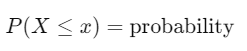
Where:
P(X ≤ x) is the cumulative distribution function (CDF) of the beta distribution.
α and β are the shape parameters of the distribution.
The range of X is defined by
lower_boundandupper_bound.
Mathematical Principle
The beta distribution is derived using the beta function B(α,β), and the inverse calculation involves finding the point at which the cumulative probability equals the input value.
What Does It Return?
Returns a numerical value representing the x corresponding to the given cumulative probability in the specified beta distribution.
When Should We Use It?
Use
BETA.INVto find critical values in probability modeling.Ideal for hypothesis testing and determining confidence intervals.
Applicable when you need to “reverse-engineer” a value based on a known probability.
Examples
Basic Usage :
Find the value of x where the cumulative probability is 0.75, with α = 2, β = 3, and default bounds:
BETA.INV(0.75, 2, 3)
Output: 0.573 (the value of x corresponding to the 75th percentile).
Custom Bounds
Find the inverse value for the same parameters but with bounds [1,10][1, 10]:
BETA.INV(0.75, 2, 3, 1, 10)
Output: 6.146 (adjusted for the specified range).
Advanced Usage
Combine BETA.INV with other DAX functions to calculate threshold values dynamically:
IF(SUM(Table[Value]) > BETA.INV(0.8, 2, 5), "Exceeds Threshold", "Below Threshold")
This checks if the sum of a column exceeds the 80th percentile threshold of the beta distribution.
Tips and Tricks
Understand the Parameters: Experiment with
alphaandbetato model different scenarios. Higher values of these parameters create a more concentrated distribution.Ensure Proper Bounds: If the bounds are incorrect, the function might return unexpected results or errors.
Probabilities Between 0 and 1: The
probabilityparameter must always be within this range; otherwise, the function returns an error.
Potential Pitfalls
The function will return an error if:
probabilityis not between 0 and 1.alphaorbetais less than or equal to 0.
Large or small values of
alphaandbetamay lead to numerical instability.
Performance Impact of BETA.INV DAX Function:
Efficient for small and medium-sized datasets.
Avoid unnecessary recalculations by storing results in variables when used in measures or calculated columns.
Related Functions You Might Need
Want to Learn More?
For more information, check out the official Microsoft documentation for BETA.INV You can also experiment with this function in your Power BI reports to explore its capabilities.
Unlock the full capabilities of Power BI and elevate your data insights with our specialized consulting services. Whether you need guidance on advanced DAX functions like those highlighted here, support in designing interactive dashboards, or expertise in optimizing data models for enhanced performance, our experienced Power BI consultants are equipped to deliver customized solutions for your business. Explore our Power BI Consulting Services page to discover how we can help your organization make smarter, data-driven decisions.
It calculates the value corresponding to a given cumulative probability in a beta distribution.
Yes, you can specify lower_bound and upper_bound to customize the range.
probability must be between 0 and 1, and alpha and beta must be greater than 0.
Use it to determine threshold values or critical points in risk analysis or statistical modeling.
BETA.INV calculates the inverse (value for a probability), while BETA.DIST calculates the distribution value for a given input.
Need Power BI help in a real engagement?
Our team writes DAX like this every day for SaaS finance and ops teams. Refresh monitoring, change requests with a 2-business-day SLA, and a named analyst on retainer — or scoped hourly help if you just need a fix.
Named analyst2-day SLAFrom $5K/mo