Dax Function: CHISQ.DIST.RT
 Reviewed by Neetu Singla — Founder, Lets Viz Technologies — AI & Data Consultant. Last reviewed June 5, 2026.
Category: Statistical Functions
The CHISQ.DIST.RT function in Power BI is a statistical function that calculates the right-tailed probability of the chi-squared distribution for a given value and degrees of freedom. It is primarily used in hypothesis testing to determine how extreme a value is in the context of a chi-squared distribution.
Purpose
To compute the probability of observing a value as extreme as, or more extreme than, a given chi-squared value in a right-tailed test.
Type of Calculations
Performs cumulative probability calculations on the tail of the chi-squared distribution.
Practical Use Cases
- Determining the p-value for chi-squared tests (e.g., Chi-Square Goodness of Fit).
- Assessing statistical significance in hypothesis testing.
- Computing probabilities for model validation and variance analysis.
CHISQ.DIST.RT(x, deg_freedom)
| Parameter | Type | Description |
|---|---|---|
x | Scalar | The chi-squared value for which the right-tailed probability is calculated. |
deg_freedom | Scalar | The degrees of freedom. Must be greater than 0. |
How Does CHISQ.DIST.RT Dax Works
The CHISQ.DIST.RT function calculates:
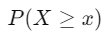
Where:
X is the chi-squared random variable.
x is the observed chi-squared value.
P( X ≥ x ) represents the cumulative probability in the right tail.
Mathematical Principle
The chi-squared distribution describes the sum of the squares of independent standard normal variables. The right-tailed probability quantifies how extreme a given value is, relative to the tail of the distribution.
What Does It Return?
The function returns a numerical value:
Represents the probability P( X ≥ x ), where X follows a chi-squared distribution with the specified degrees of freedom.
The result lies between 0 and 1.
When Should We Use It?
Use
CHISQ.DIST.RTto determine p-values in statistical hypothesis testing.Ideal for right-tailed chi-squared tests, such as Goodness of Fit or Independence tests.
Helpful in validating statistical models by analyzing variance or deviations.
Examples
Basic Usage :
Calculate the right-tailed probability for a chi-squared value of 10 with 4 degrees of freedom:
CHISQ.DIST.RT(10, 4)
Output: Approximately 0.04043, representing the probability of observing a value ≥ 10 under the specified conditions.
Column Usage
Apply the function to compute probabilities for a column of chi-squared values:
CHISQ.DIST.RT(Table[ChiSquaredValues], 3)
This calculates the right-tailed probability for each value in the ChiSquaredValues column with 3 degrees of freedom.
Advanced Usage
Combine CHISQ.DIST.RT with other DAX functions to dynamically assess p-values:
IF(CHISQ.DIST.RT(SUM(Table[TestStat]), 5) < 0.05, "Significant", "Not Significant")
This evaluates whether the test statistic is significant at a 5% level for 5 degrees of freedom.
Tips and Tricks
Choose Degrees of Freedom Carefully: Ensure the
deg_freedomparameter accurately reflects the context of the test.Interpret Results Correctly: A small output value indicates that the observed result is unlikely under the null hypothesis, suggesting statistical significance.
Avoid Invalid Inputs: Ensure
xis non-negative anddeg_freedomis positive.
Potential Pitfalls
Negative Inputs: The function will return an error if
xis negative.Degrees of Freedom: Incorrectly specified degrees of freedom can lead to misleading results.
Performance Impact of CHISQ.DIST.RT DAX Function:
Optimized for single value calculations, but performance may degrade when applied to very large datasets with dynamic parameters.
Pre-calculate probabilities for frequently used values to improve query performance.
Related Functions You Might Need
CHISQ.DIST: Calculates the cumulative distribution function (CDF) or probability density function (PDF) for the chi-squared distribution.
CHISQ.INV.RT: Calculates the critical value (inverse) for the right-tailed chi-squared distribution.
CHISQ.INV: Calculates the inverse for the left-tailed chi-squared distribution.
Want to Learn More?
For more information, check out the official Microsoft documentation for CHISQ.DIST.RT You can also experiment with this function in your Power BI reports to explore its capabilities.
Unlock the full capabilities of Power BI and elevate your data insights with our specialized consulting services. Whether you need guidance on advanced DAX functions like those highlighted here, support in designing interactive dashboards, or expertise in optimizing data models for enhanced performance, our experienced Power BI consultants are equipped to deliver customized solutions for your business. Explore our Power BI Consulting Services page to discover how we can help your organization make smarter, data-driven decisions.
It calculates the right-tailed probability for a given chi-squared value and degrees of freedom.
Use it for hypothesis testing, such as Goodness of Fit or Independence tests.
The output is the probability of observing a chi-squared value as extreme as, or more extreme than, the input value.
The chi-squared value must be non-negative, and degrees of freedom must be positive.
Yes, it can calculate probabilities for columns of chi-squared values.
Need Power BI help in a real engagement?
Our team writes DAX like this every day for SaaS finance and ops teams. Refresh monitoring, change requests with a 2-business-day SLA, and a named analyst on retainer — or scoped hourly help if you just need a fix.
Named analyst2-day SLAFrom $5K/mo