Tableau Function: ATAN
 Reviewed by Neetu Singla — Founder, Lets Viz Technologies — AI & Data Consultant. Last reviewed July 3, 2026.
Tableau Function: ATAN
Category: Number Functions
The ATAN() function in Tableau returns the arctangent (inverse tangent) of a given number.
It computes the angle (in radians) whose tangent is equal to the input number.
Purpose
The ATAN() function is used to find the angle corresponding to a tangent ratio. It is an essential function in trigonometry, geometry, data modeling, and geospatial analysis where calculating angles, slopes, or directional bearings is required.
Type of Calculation
ATAN() performs a trigonometric inverse operation.
It converts a tangent value (a ratio of two sides in a right triangle) into its corresponding angle.
The returned angle is measured in radians, and it lies within the range −π/2 to π/2 (approximately −1.5708 to +1.5708 radians).
Practical Use Cases
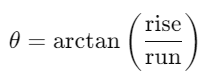
Computing angles or slopes based on tangent ratios (rise/run).
Determining direction or bearing in spatial and mapping analyses.
Modeling rotational, wave, or circular motion in scientific data.
Building custom geometrical or trigonometric calculations.
Calculating gradients or inclines in engineering and physics dashboards.
ATAN(number)
| Parameter | Type | Description |
|---|---|---|
number | Numeric (scalar, column, or expression) | The numeric tangent ratio (can be any real number) for which the arctangent (angle) will be calculated. |
How It Works?
Mathematically, ATAN(x) is the inverse of the tangent function.
If:
then:
That means ATAN(x) gives the angle θ for which the tangent is x.
| Input (x) | Output (θ = ATAN(x)) | Approx. Radians | Equivalent Degrees |
|---|---|---|---|
| -1 | -π/4 | -0.7854 | -45° |
| 0 | 0 | 0 | 0° |
| 1 | π/4 | 0.7854 | 45° |
The ATAN() function can handle any real number, unlike ASIN() and ACOS(), which are limited to inputs between −1 and 1.
What Does It Return?
Type: Numeric
Meaning: Returns the angle in radians whose tangent equals the given number.
Range: −π/2 ≤ result ≤ π/2 (approximately −1.5708 ≤ result ≤ +1.5708)
When Should We Use It?
Use ATAN() when you need to:
Derive angles from tangent values or ratios.
Calculate slopes, gradients, or inclinations in datasets.
Perform directional or geospatial computations (e.g., bearings).
Build physics or engineering models involving angular velocity or tilt.
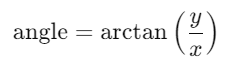
Convert Cartesian coordinates into polar coordinates (angle component).
Basic Usage
ATAN(1)
Result: 0.7854 radians (≈ 45°)
Column Usage
ATAN([Tangent Value])
This returns the arctangent angle for each value in the [Tangent Value] field, typically representing a slope or tangent ratio.
Advanced Usage
Compute the angle between two coordinates (e.g., for mapping or geometry):
DEGREES(ATAN(([Y2] - [Y1]) / ([X2] - [X1])))
This calculates the angle (in degrees) between two points (X1, Y1) and (X2, Y2) using their coordinate differences.
Formula concept:
Tips and Tricks
Use
DEGREES()to convert radians to degrees:DEGREES(ATAN([x]))Unlike
ASIN()andACOS(),ATAN()accepts any numeric input (no −1 to 1 restriction).Combine with
ATAN2(y, x)for quadrant-aware angle calculations (handles signs of both x and y).Useful in polar coordinate conversions:
Related Functions You Might Need
ATAN2(y, x)– Returns the angle (in radians) between the positive x-axis and the point (x, y).TAN(number)– Returns the tangent of an angle.ASIN(number)– Returns the arcsine of a number.ACOS(number)– Returns the arccosine of a number.DEGREES(number)– Converts radians to degrees.RADIANS(number)– Converts degrees to radians.
We’ve got plenty of resources to help you master Tableau functions. For more details, check out the official Tableau documentation. Or, if you’re ready for more practice, let’s dive into related functions and build your Tableau skills further!
If you’re ready to harness the full power of Tableau and elevate your data analytics capabilities, our expert Tableau consulting services are here to guide you. Whether you need support with building advanced calculated fields, creating dynamic visual dashboards, or optimizing your data sources for peak performance, our team of experienced Tableau consultants delivers customized solutions designed for your business needs. Visit our Tableau Consulting page to discover how we can help your organization turn data into impactful, insight-driven decisions.
It returns the arctangent (inverse tangent) of a number — the angle in radians whose tangent is the given value.
ATAN() accepts any real number, positive or negative.
It returns radians. Use DEGREES() to convert to degrees.
Yes. ATAN() works with numeric fields, constants, or calculated expressions.
ATAN() handles one input (a tangent ratio), while ATAN2(y, x) handles two inputs (y and x coordinates) and accounts for the correct angle quadrant.
Working with Tableau — or thinking about Power BI?
We work both sides. Tableau-certified for production work and complex calcs, and we've shipped 12+ Tableau-to-Power BI migrations with 100% parity testing and 30–60% license savings.
Tableau-certified12+ migrations100% parity