Zoho CRM vs HubSpot for Growing Businesses: 2026 Guide
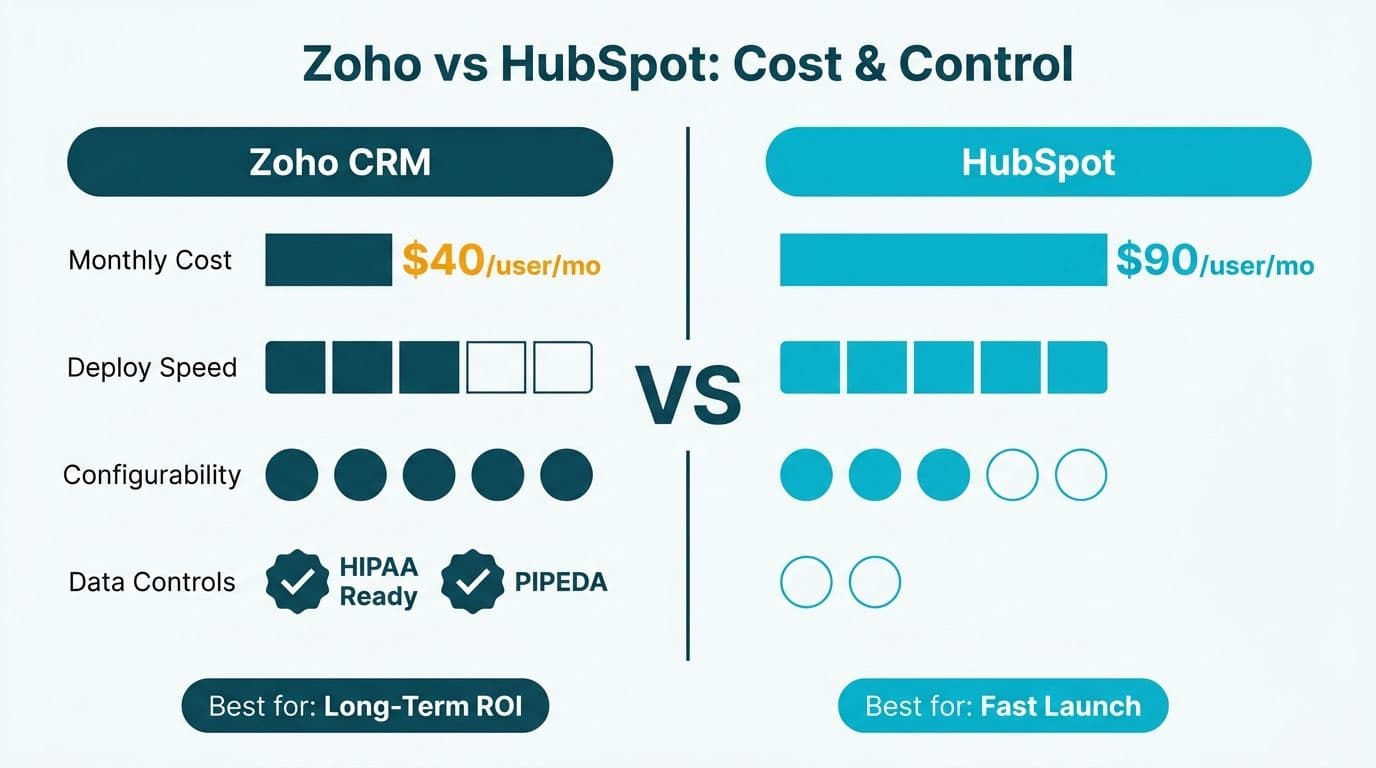
For $5M-$50M businesses comparing CRM platforms, Zoho CRM delivers materially lower total cost of ownership and deeper workflow configurability, while HubSpot offers faster out-of-the-box deployment at a premium price. US and Canadian teams in healthcare and finance - where HIPAA and PIPEDA shape vendor selection - will find Zoho's data controls more adaptable to regulated operations. HubSpot wins on deployment speed; Zoho wins on long-term economics and configurability.
Key Takeaways
Zoho CRM Enterprise lists at approximately $40/user/month versus HubSpot Sales Hub Professional at $90/user/month - Zoho's per-seat list price is less than half HubSpot's at the equivalent tier
HubSpot's hub-based model escalates total cost rapidly when marketing automation, service, and CMS modules are added
Both platforms offer HIPAA-eligible configurations and GDPR tooling; Canadian PIPEDA and data residency requirements are better served by Zoho
Implementation complexity is higher for Zoho (reflecting greater configurability), but 5-year TCO typically favors Zoho by 40-50% for teams of 25 seats or more
The migration effort score between live platforms sits at 7/10 in either direction - plan 10-16 weeks for a clean transition
How Do Zoho CRM and HubSpot Compare for Growing Businesses?
Growing businesses in the $5M-$50M revenue range face a specific CRM dilemma: they need enterprise-grade features without enterprise pricing, and a platform that can scale without forcing a costly migration in three years.
Zoho CRM anchors the Zoho One ecosystem - more than 50 integrated business applications spanning ERP, finance, HR, analytics, and marketing automation. For an operations-led organization that wants to consolidate its technology stack under a single vendor, this integration depth is a structural advantage. A mid-market US healthcare technology company can run patient relationship management alongside Zoho Analytics, Zoho Books, and Zoho Campaigns within a single subscription.
HubSpot is built around the inbound marketing philosophy. Its CRM, CMS, marketing automation, and service hubs are tightly integrated but modular - each hub is a separately paid tier, and cost compounds as additional modules are activated. A UK fintech firm scaling its SDR team will find HubSpot's starter tiers attractive early on, but the cost curve accelerates sharply past 10-15 users.
Engaging a qualified Zoho consulting services partner typically begins with a platform selection analysis rather than a configuration brief. The foundational question is whether your growth model is marketing-led or operations-led. Marketing-led organizations - where pipeline generation depends on inbound content, email sequences, and ad attribution - extract more immediate value from HubSpot's native tooling. Operations-led teams managing complex deal cycles, regulatory workflows, or multi-department approval processes will find Zoho's configurability and economics more sustainable over a five-year horizon.
Feature parity between the two platforms has narrowed substantially through 2026. Both now offer pipeline management, contact scoring, email sequences, territory management, and AI-assisted forecasting — HubSpot through its Breeze AI suite and Zoho through its Zia intelligence layer, which is embedded across CRM modules and the broader Zoho One stack. The differentiation lies in total cost, customization ceiling, and ecosystem breadth.
What Does Each Platform Really Cost? A True TCO Breakdown
Headline licensing is rarely the full picture. The table below compares typical all-in costs for a 25-seat mid-market team over five years, including implementation, training, and common add-on modules.
| Cost Component | Zoho CRM Enterprise | HubSpot Sales Hub Pro |
|---|---|---|
| License (per user/month, list price) | $40 | $90 |
| Annual license cost (25 seats) | $12,000 | $27,000 |
| Implementation (partner-led) | $8,000-$20,000 | $5,000-$12,000 |
| Year 1 training | $3,000-$6,000 | $2,000-$4,000 |
| Integration development | $5,000-$15,000 | $3,000-$8,000 |
| Add-on modules (marketing, analytics) | $6,000-$18,000/yr | $22,800-$48,000/yr |
| 5-Year TCO estimate (25 seats) | $100,000-$160,000 | $185,000-$310,000 |
*Prices as of July 2026. Add-on estimates reflect typical mid-market configurations. Actual costs vary by region and negotiated discounts.*
Three factors shape this range:
HubSpot's hub model compounds costs. Each hub - Marketing, Sales, Service, CMS, Operations - is a separately priced tier. A 25-seat team needing marketing automation alongside a service desk purchases two or three hubs simultaneously. UK and EU buyers should factor in VAT on SaaS subscriptions.
Zoho One consolidates spend. Zoho One bundles 50+ applications at approximately $37/user/month (annual, as of mid-2026), compressing five-year TCO for teams already using multiple Zoho applications. A Canadian manufacturing company running Zoho CRM alongside Zoho Books and Zoho Analytics can consolidate onto Zoho One and reduce per-application cost meaningfully.
Implementation costs invert over time. HubSpot's lower implementation cost reflects faster default configuration. Zoho's higher upfront cost reflects deeper customization capability. For regulated data handling or multi-stage approval workflows, that investment typically recovers within year two or three. The Zoho consultant cost guide for 2026 covers typical engagement ranges by project scope.
How Complex Is Implementation? Zoho CRM vs HubSpot
Implementation complexity depends on three variables: platform configurability, data migration scope, and change management requirements.
Platform configurability. Zoho CRM's custom modules, Blueprint workflow automation, and Deluge scripting language enable deep process configuration aligned to specific business logic. That flexibility requires a thorough discovery and design phase before build begins. HubSpot's implementation is structurally faster because the platform imposes standardized patterns - deal stages, contact properties, and workflow triggers follow well-established templates with limited deviation.
Data migration. The Zoho CRM data migration guide covering import, deduplication, and validation outlines how structured this process needs to be. For businesses migrating from legacy systems or spreadsheets, expect 6-10 weeks for a clean migration of 50,000+ contacts with custom field mapping - regardless of destination platform.
End-user adoption. HubSpot's interface reduces resistance in sales team onboarding. It is intuitive for non-technical users without significant training investment. Zoho CRM's interface is capable but configuration-dependent; organizations achieve stronger adoption when training is treated as a real cost line.
| Implementation Factor | Zoho CRM | HubSpot |
|---|---|---|
| Platform configuration depth | 8/10 | 4/10 |
| Data migration complexity | 6/10 | 5/10 |
| Integration build effort | 7/10 | 5/10 |
| End-user adoption complexity | 5/10 | 3/10 |
| **Overall implementation score** | **6.5/10** | **4.3/10** |
*Higher score = more complex. Greater complexity reflects greater configurability, not a platform defect.*
A US SaaS finance team moving from spreadsheets to Zoho CRM should budget 8-12 weeks with an experienced implementation partner - largely because custom approval workflows, field-level access controls, and multi-stage pipeline logic require a design phase before build begins. The same team deploying HubSpot can be operational in 4-6 weeks - at higher long-term license cost and with less flexibility when compliance requirements push beyond the platform's standard deal and contact property templates.
Which Platform Fits Healthcare and Finance Compliance Requirements?
Compliance is a first-order factor for mid-market healthcare and finance teams - not a secondary filter applied after platform selection.
HIPAA (US Healthcare). Both Zoho CRM and HubSpot offer HIPAA-eligible configurations and will sign Business Associate Agreements. Zoho's custom module architecture allows Protected Health Information (PHI) fields to be isolated with granular, field-level access controls. HubSpot's BAA covers core CRM and Marketing Hub features, but the precise scope warrants careful review with compliance counsel before PHI enters the platform.
PIPEDA and provincial privacy law (Canada). Organizations subject to PIPEDA - and increasingly to Quebec's Law 25, British Columbia's PIPA, and Alberta's PIPA - need explicit data residency commitments and data processing agreements. Zoho offers Canadian data center options aligned to provincial requirements. A Canadian financial services firm with PIPEDA obligations will typically find Zoho's data localization options more clearly defined than HubSpot's at the time of contract.
GDPR (UK and EU). Both platforms support GDPR-compliant configurations including data subject access request workflows and consent management. UK organizations should confirm that Standard Contractual Clauses cover UK GDPR separately from EU GDPR - a practical consideration for post-Brexit data transfers. HubSpot's consent tooling is native to its Marketing Hub. Zoho's GDPR features require module-level configuration but are fully capable.
SOC 2 and ISO 27001. Both platforms hold SOC 2 Type II compliance. Zoho additionally holds ISO 27001 certification. Request current compliance documentation and audit scope definitions during your evaluation - certificates carry renewal dates and coverage boundaries that matter in audit contexts.
Decision Matrix: Zoho CRM vs HubSpot for Growing Businesses
Use this matrix to map your business priorities to the right platform. Rate each factor's importance to your organization (High, Medium, or Low), then count how many High-priority items fall in each column.
| Decision Factor | Zoho CRM Wins | HubSpot Wins | Tied |
|---|---|---|---|
| 5-year license TCO (25+ seats) | X | ||
| Deployment speed (time to go-live) | X | ||
| Customization and workflow depth | X | ||
| End-user UX and adoption ease | X | ||
| Inbound marketing automation | X | ||
| Ecosystem breadth (ERP, finance, HR) | X | ||
| Canadian data residency (PIPEDA) | X | ||
| HIPAA-eligible configuration | X | ||
| GDPR consent management | X | ||
| Pricing predictability at scale | X | ||
| AI-assisted forecasting | X | ||
| Native analytics and reporting | X |
Reading the matrix: If four or more of your High-priority items fall in the Zoho column - particularly TCO, customization depth, or data residency - Zoho CRM is the stronger long-term fit. If deployment speed and inbound marketing automation are both High-priority, HubSpot's near-term premium may be justifiable.
For a three-way comparison that adds a major enterprise CRM alternative, the Zoho CRM vs enterprise CRM implementation guide covers similar decision criteria with additional depth on pricing models and configuration complexity.
What Is the Migration Effort Score? How to Self-Qualify Before Committing
The migration effort score helps you assess switching risk before signing a contract. Moving CRM platforms after 12-24 months of live data accumulation is expensive - in technology cost, consultant fees, and sales productivity lost during the transition window.
| Migration Scenario | Effort Score | Estimated Timeline | Primary Risk |
|---|---|---|---|
| Spreadsheets or legacy system to Zoho CRM | 5/10 | 6-10 weeks | Field mapping, deduplication |
| Spreadsheets or legacy system to HubSpot | 4/10 | 4-8 weeks | Contact property limits |
| HubSpot to Zoho CRM | 7/10 | 10-16 weeks | Deal/pipeline schema differences |
| Zoho CRM to HubSpot | 7/10 | 10-14 weeks | Custom module translation |
| Enterprise CRM to Zoho CRM | 8/10 | 14-20 weeks | Object model complexity |
| Enterprise CRM to HubSpot | 7/10 | 12-18 weeks | Custom object mapping |
*Timeline estimates assume 25-100 seat teams with 2-5 years of accumulated CRM data. Heavily customized instances extend timelines.*
The scoring carries practical implications. Greenfield deployments - first-time CRM implementations from spreadsheets or a basic contact database - are the lowest-effort entry point for either platform (4-5/10). A well-run project can go live in six to ten weeks. Platform switches mid-cycle score 7-8/10 in either direction and require dedicated project management, a realistic timeline, and executive sponsorship to keep sales teams productive during cutover.
For CIOs assessing long-term platform risk, Zoho's lower license economics reduce the financial penalty of an eventual migration. HubSpot's higher all-in cost raises the stakes of the initial decision. If your team is currently on the Zoho CRM free plan and evaluating whether to upgrade or switch to HubSpot, the in-ecosystem upgrade path carries substantially lower migration burden than a full platform switch.
---
About Lets Viz: Lets Viz is a data analytics and CRM consulting firm serving US healthcare organizations, Canadian financial services companies, UK fintech firms, and global SaaS businesses since 2020. With a 5.0 Clutch rating, the team specializes in CRM platform selection, implementation, and data migration for mid-market teams operating in regulated industries.
Ready to make the right CRM decision for your organization? Our Zoho consulting services cover the full cycle from platform selection through go-live. Or evaluate the platform first: Try Zoho CRM free before committing to a full rollout.