Zoho CRM for Healthcare Patient Relationship Management
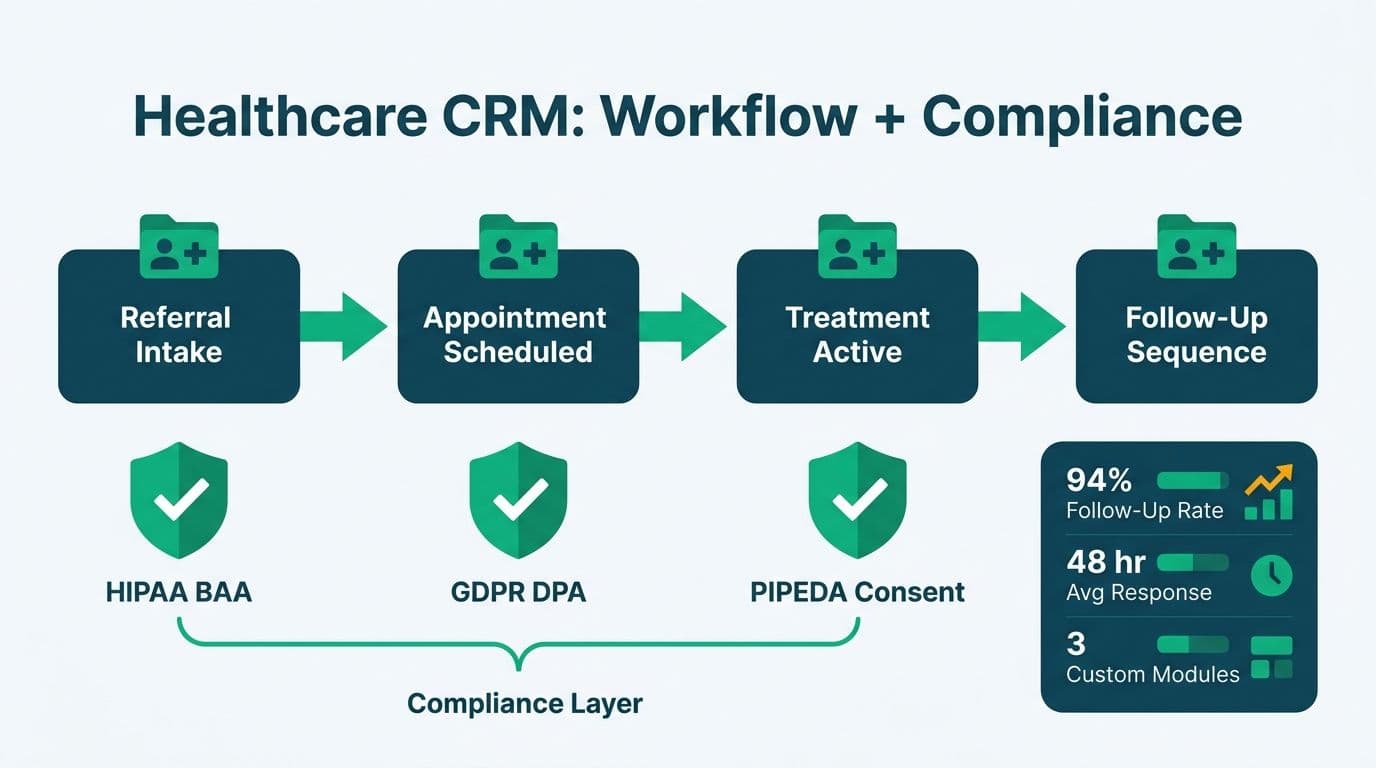
Zoho CRM can be configured for healthcare patient relationship management by mapping clinical workflows - referral tracking, appointment pipelines, and follow-up sequences - onto its custom modules, while meeting HIPAA obligations through Zoho's signed Business Associate Agreement (BAA), GDPR requirements via its Data Processing Agreement, and PIPEDA through configurable consent and retention controls. The right configuration balances operational efficiency with regulatory compliance from day one.
Key Takeaways
Zoho CRM supports HIPAA, GDPR, and PIPEDA compliance through BAA signing, Data Processing Agreements, and configurable data controls.
Custom modules replace generic "Leads" and "Contacts" with Patients, Referrals, and Care Episodes to match clinical workflows.
Field-level encryption, role-based permissions, and audit logs are the three configuration pillars for regulated healthcare data.
Zoho CRM's native integrations with telephony, EHR connectors, and Zoho Analytics enable end-to-end referral tracking without requiring third-party middleware.
Mid-market clinics and health-tech firms should engage a qualified implementation partner to avoid misconfiguration that creates compliance exposure.
How Does Zoho CRM for Healthcare Patient Relationship Management Work?
Zoho CRM adapts to healthcare by replacing its default sales pipeline with custom modules that mirror how patients move through a clinical or administrative journey. A referral arriving at a specialist clinic enters the system as a Referral record linked to a Patient contact, with a pipeline stage advancing from "Referred" to "Appointment Booked" to "Consultation Complete" - each stage triggering automated follow-up tasks for the care coordinator.
This configurability is what makes Zoho CRM a practical choice for healthcare organizations. Rather than purchasing a vertically-specific CRM that locks you into one vendor's EHR assumptions, Zoho CRM gives mid-market providers the flexibility to model their exact workflow without writing code - which is why our Zoho CRM consulting engagements with healthcare clients consistently start with module design before any automation is built.
A typical mid-market US health system configuration includes:
A Patients module (renamed from Contacts) with PHI fields encrypted at rest
A Referrals module linked via lookup fields to both the referring provider and the receiving care team
A Care Episodes module for tracking multi-visit or multi-service engagements
Workflow automations that trigger appointment reminders via Zoho's built-in email and SMS channels
UK allied health providers and Canadian physiotherapy networks use structurally identical configurations, with GDPR and PIPEDA consent fields added to the patient intake form to meet local requirements.
What HIPAA, GDPR, and PIPEDA Compliance Does Zoho CRM Support?
Zoho CRM's compliance posture differs by jurisdiction. Understanding which legal instrument governs your organization determines how you configure the platform - and which contractual documents you need from Zoho before loading any patient data.
US healthcare organizations subject to HIPAA can obtain a signed Business Associate Agreement (BAA) from Zoho, which classifies Zoho as a Business Associate under 45 CFR Part 164. The BAA covers Zoho CRM at Enterprise tier and above, and Zoho One. Per Zoho's published security documentation (2026), data is encrypted in transit (TLS 1.2+) and at rest (AES-256), and all access is logged in the audit trail. Organizations must still configure field-level encryption for designated PHI fields and restrict access using IP restrictions and profile-based permissions - the BAA does not substitute for internal configuration hygiene.
UK and EU organizations subject to GDPR can execute a Data Processing Agreement (DPA) with Zoho under Article 28. Zoho's EU data centers in Ireland and the Netherlands allow organizations to elect EU-only data residency, satisfying the data transfer restrictions in GDPR Chapter V. Post-Brexit, the UK GDPR runs parallel to EU GDPR, and Zoho's DPA covers both jurisdictions.
Canadian organizations subject to PIPEDA - and increasingly to Quebec's Law 25, which introduced stricter obligations from 2023 - need to configure explicit consent capture at intake, set data retention schedules that delete or anonymize records after the retention period, and ensure cross-border data transfers to Zoho's US infrastructure are covered by contractual safeguards. Zoho's DPA satisfies this requirement, but the configuration work of building consent fields and retention automation into the CRM remains with the implementing organization.
| Requirement | HIPAA (US) | GDPR (UK/EU) | PIPEDA (Canada) |
|---|---|---|---|
| Vendor agreement | Business Associate Agreement | Data Processing Agreement | DPA as contractual safeguard |
| Data residency option | US data centers | EU data centers (Ireland/Netherlands) | Configurable; cross-border covered by DPA |
| Encryption standard | AES-256 at rest, TLS in transit | AES-256 at rest, TLS in transit | AES-256 at rest, TLS in transit |
| Audit log | Mandatory (§164.312) | Recommended (Art. 32) | Recommended |
| Right to erasure | Not applicable | Mandatory (Art. 17) | Deletion on consent withdrawal |
| Consent capture | Authorization form (§164.508) | Granular opt-in per purpose | Express consent required |
| Breach notification | 60 days to HHS; patients if 500+ affected | 72 hours to supervisory authority | Notify if real risk of significant harm |
The broader principles of privacy-by-design data governance - particularly for organizations that feed CRM data into analytics layers - are covered in our GDPR compliant SaaS financial reporting checklist.
How Do You Configure Zoho CRM for Patient and Referral Tracking?
Configuration for patient relationship management follows a logical sequence: data model first, permissions second, automation third. Reversing that order is the most common source of compliance gaps in healthcare CRM implementations.
Step 1: Rename and extend standard modules
Map Zoho CRM's default modules onto clinical entities:
Contacts becomes Patients (add DOB, MRN, insurance payer, consent date, preferred language)
Accounts becomes Facilities or Referring Practices
Deals becomes Care Episodes or Referral Engagements
Leads becomes Prospective Patients or Inbound Referrals
Step 2: Build the referral pipeline
Create a custom pipeline under the Care Episodes module with stages that reflect your care coordination process. A US specialist clinic might use: Referral Received - Chart Review - Appointment Booked - Consultation - Treatment Plan - Discharged. A UK community health network might add a "GP Approval" stage before Appointment Booked to reflect NHS referral authorization requirements. Each stage transition enforces required fields using Zoho CRM's Blueprint feature - its built-in process engine that prevents records from advancing until specified criteria are met.
Step 3: Field-level encryption
Navigate to Setup - Security Control - Encryption and designate PHI fields (insurance ID, clinical notes, date of birth) for encryption. Note that encrypted fields cannot be used in workflow criteria or reports - design your data model with this constraint in mind before applying encryption, as reversing it requires data export and re-import.
Step 4: Role-based access and IP restrictions
Create CRM profiles for each staff role: Care Coordinator, Billing Admin, Clinical Lead, and Read-Only Auditor. Each profile grants access only to the modules and field-level data the role requires. Enable IP Restrictions to limit CRM login to clinic IP ranges or VPN. For US organizations, document these controls in your Security Rule Risk Assessment as required under HIPAA §164.308(a)(1).
Step 5: Audit trail and data retention
Zoho CRM's audit log records every create, edit, and delete action with timestamp and user ID. Export and archive these logs monthly for HIPAA and GDPR defensibility. For GDPR and PIPEDA, configure data retention rules under Zoho's GDPR Compliance module to flag records past their retention period for deletion review.
For a broader implementation walkthrough covering the full Zoho ecosystem, the Zoho One implementation consultant guide covers project sequencing that applies equally to CRM-only healthcare rollouts.
How Do You Set Up Lead Scoring in Zoho CRM for Healthcare Referral Pipelines?
In healthcare CRM, lead scoring reframes around referral prioritization and patient engagement likelihood rather than purchase intent. Zoho CRM's native Scoring Rules (Setup - CRM Settings - Scoring Rules) allow you to assign positive and negative scores based on field values, activity history, and engagement signals.
A US specialist clinic might configure a scoring model that awards:
+20 points: referral source is a contracted primary care network
+15 points: patient insurance verified in-network
+10 points: patient opened appointment confirmation email within 24 hours
-10 points: no response after two outreach attempts in five business days
-20 points: patient listed as "do not contact" (HIPAA opt-out on file)
A Canadian physiotherapy network could apply a structurally identical model with a provincial health card verification field as a +15 signal, and a PIPEDA-compliant consent status check as a mandatory gate before any automated outreach fires - preventing contact with patients who have not given express consent.
Scores surface in list views and dashboards, letting care coordinators prioritize their daily call list without manual judgment calls. For Enterprise tier users, the Zia AI assistant can layer predictive scoring on top of rule-based scoring, identifying patterns in historical appointment conversion data to surface patients most likely to follow through. A UK-based mental health provider, for example, could train Zia on six months of referral-to-intake conversion history to predict which inbound referrals need same-day outreach - particularly valuable given that healthcare no-show rates in specialty care typically run 20–30 percent, and same-day outreach to high-risk referrals is one of the highest-leverage levers a care coordinator has to move that number.
What Are the Best Zoho CRM Integrations for Healthcare Providers?
Zoho CRM's integration ecosystem reduces the manual data entry that creates both operational friction and compliance risk in healthcare settings.
Telephony and communication: Zoho PhoneBridge connects CRM with major VoIP providers, logging every inbound and outbound call against the patient record automatically. This creates a complete contact history without manual entry - critical for demonstrating HIPAA-compliant communication records and for GDPR accountability under Article 5(2).
EHR and practice management: Zoho's REST API and Deluge scripting language allow bidirectional sync with custom EHR systems - patient demographics push from EHR to CRM at registration, and appointment outcomes write back at episode close. A UK-based allied health firm using a bespoke EHR can use this pattern to enforce GDPR data minimization: only the fields required for relationship management flow into CRM, not full clinical records.
Analytics and reporting: Zoho Analytics connects natively to Zoho CRM and surfaces referral conversion rates, time-to-appointment, and care coordinator performance in real time. For organizations that layer operational healthcare data across multiple systems, our hospital patient flow and bed capacity dashboard guide demonstrates how CRM pipeline data can be combined with operational metrics in a unified BI view.
Document and consent management: Zoho Sign integrates with CRM to send, capture, and store consent forms against the patient record - satisfying HIPAA's authorization requirement (§164.508), GDPR's documented consent requirement (Art. 7), and PIPEDA's express consent requirement without a separate document management system.
How Does Zoho CRM Compare to Other CRM Platforms for Healthcare?
The comparison below focuses on criteria most relevant to mid-market healthcare organizations evaluating their options - compliance architecture, configuration flexibility, and total cost of ownership rather than feature-list depth.
| Criterion | Zoho CRM (Enterprise) | Comparable Mid-Market CRM |
|---|---|---|
| BAA availability | Yes (Enterprise and above) | Varies by vendor and pricing tier |
| GDPR DPA with EU data residency | Yes (Ireland/Netherlands) | Typically available; check data center options |
| PIPEDA contractual coverage | Yes via DPA | Typically available |
| Custom modules without code | Up to 10 in Enterprise tier | Limited at equivalent price points |
| Native process enforcement | Built-in Blueprint | Often requires third-party workflow tool |
| Built-in telephony logging | Yes (PhoneBridge) | Often requires third-party integration |
| Consent and signature management | Native (Zoho Sign) | Usually requires third-party |
| Pricing model | Per-user per-month, predictable | Often tiered with usage-based overages |
For organizations weighing a mid-market CRM against enterprise alternatives at significantly higher price points, the Zoho CRM vs Salesforce comparison covers the build-or-buy decision framework that applies to healthcare as much as any other sector.
Healthcare organizations should request BAA terms in writing before committing to any vendor, regardless of that vendor's HIPAA marketing claims. Compliance readiness at the contract level and configuration hygiene in practice are two distinct issues.
What Should Healthcare Organizations Budget for Zoho CRM Maintenance and Support?
Zoho CRM Enterprise licensing (2026 pricing) is billed per user per month on annual terms. At approximately $40–45 per user per month billed annually, a 30-user clinic pays roughly $14,400–$16,200 per year in licensing alone - typically 40–60 percent of total first-year implementation cost once configuration, compliance review, and integration work are factored in. Healthcare organizations should budget beyond licensing for three cost categories that are frequently underestimated at project outset.
Configuration maintenance: Custom modules, blueprints, and automation rules need updates as clinical workflows evolve. A care coordinator process that changes following a clinical audit requires corresponding CRM updates - typically handled by a trained internal CRM admin or an external partner on a monthly retainer.
Compliance review cycles: HIPAA Risk Assessments (required annually under §164.308(a)(1)) should include a review of CRM configuration, user access logs, and BAA currency. GDPR Article 35 Data Protection Impact Assessments may be required when processing creates high risk for data subjects. Canadian Law 25 requires a Privacy Impact Assessment for new personal information processing systems. Budget for these reviews even when internal compliance teams are qualified to conduct them.
Integration maintenance: API connectors between CRM and EHR, telephony, and analytics systems require updates when either platform upgrades. An EHR vendor releasing a new API version can break a referral sync that was working reliably for two years - and remediation costs typically exceed the original integration build.
A mid-market US clinic with 20 to 50 CRM users typically needs a part-time CRM admin role or a monthly managed services retainer. UK health-tech firms and Canadian allied health networks at similar scale often find a shared-service model - where one implementation partner manages CRM across multiple client organizations - delivers better per-user value than a dedicated internal resource.
---
About Lets Viz: Lets Viz has delivered data analytics, CRM implementation, and compliance-aware BI projects for US healthcare organizations, UK fintech firms, Canadian manufacturing companies, and global SaaS businesses since 2020. With a 5.0 Clutch rating, our team brings certified Zoho implementation expertise alongside HIPAA, GDPR, and PIPEDA configuration experience across mid-market engagements.
Ready to configure Zoho CRM for your clinical or health-tech workflows? Our Zoho CRM consulting team covers configuration design, compliance alignment, and ongoing support - or Try Zoho CRM free to explore the platform before you commit.