Zoho CRM vs Salesforce: Which Should You Implement?
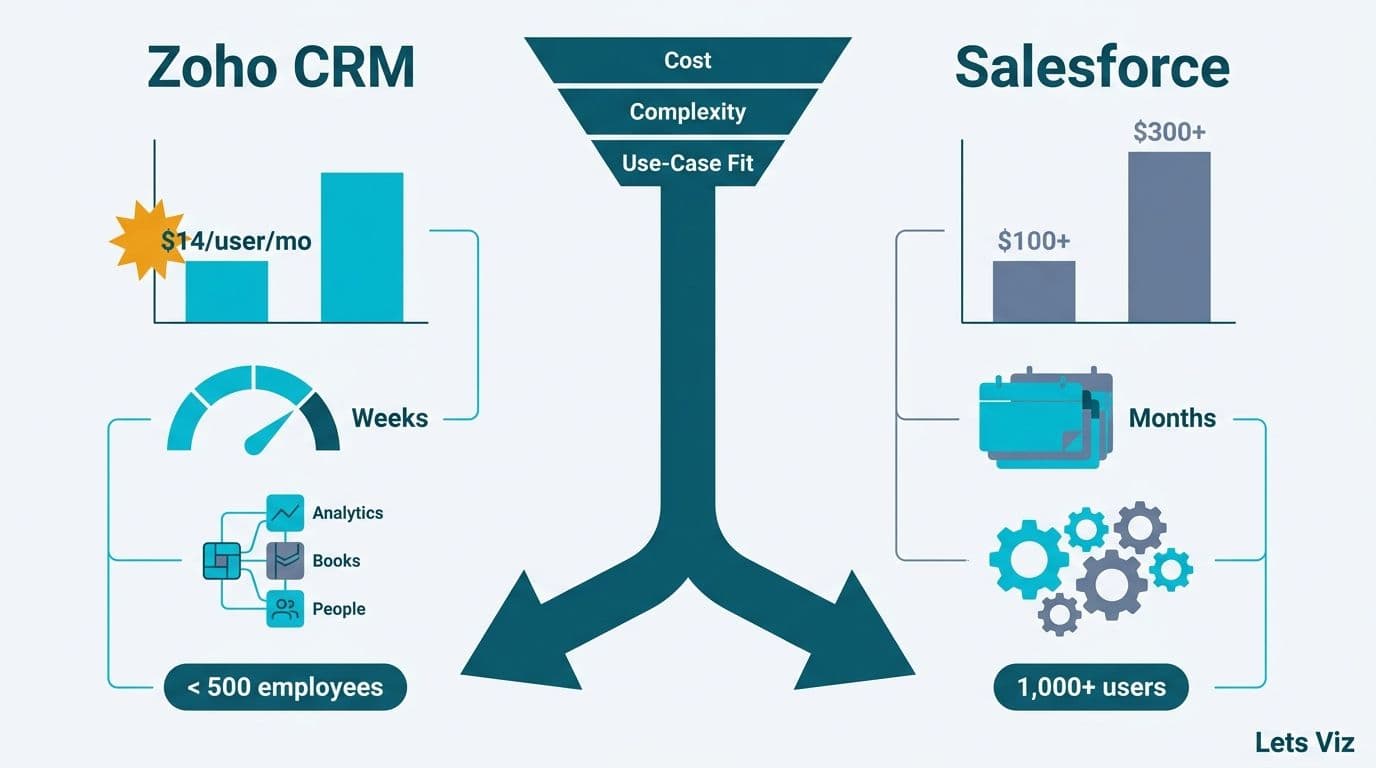
For most mid-market organizations with under 500 employees, Zoho CRM delivers a stronger return than Salesforce. It costs significantly less per seat, deploys in weeks rather than months, and integrates natively with accounting, analytics, and HR tools across the Zoho ecosystem. Salesforce earns its premium for organizations with 1,000+ users, dedicated admin teams, and complex enterprise architecture requirements. The decision hinges on three variables: total cost, implementation complexity, and use-case fit.
Key Takeaways
Zoho CRM's per-seat pricing starts at $14/user/month; Salesforce Sales Cloud Enterprise starts at $165/user/month, with add-ons required for most enterprise features.
Total three-year cost of ownership for a 50-seat team is typically $130,000-$220,000 on Zoho CRM versus $450,000-$900,000 on Salesforce.
Both platforms support HIPAA, GDPR, and PIPEDA compliance, but Salesforce requires paid add-ons for full coverage while Zoho CRM includes compliance tools in its Enterprise tier.
Zoho CRM deployments typically reach go-live in 8-12 weeks; Salesforce enterprise rollouts average 6-18 months.
For small and mid-market B2B teams also evaluating Pipedrive, Zoho CRM offers deeper automation, broader ecosystem integration, and comparable per-seat pricing - while Pipedrive's GDPR-native defaults give it a setup-time advantage for lean EU teams with straightforward compliance requirements.
For healthcare and finance teams across the US, UK, and Canada, Zoho CRM offers a compelling combination of compliance coverage and lower operational overhead.
What Is the Core Difference Between Zoho CRM and Salesforce?
Zoho CRM is purpose-built for the mid-market: affordable, fast to deploy, and deeply integrated with a native suite of 50+ business applications. Salesforce is an enterprise platform designed for maximum configurability across large, complex organizations - and priced accordingly.
Both platforms handle the fundamentals: contact management, pipeline tracking, email automation, and sales forecasting. The difference surfaces in total cost, technology overhead, and the internal resources required to run each platform at full capability.
Zoho CRM's Enterprise tier bundles workflow automation, territory management, advanced analytics, multi-currency support, and AI-powered lead scoring into a single license. On Salesforce, each of those capabilities often corresponds to a separate product tier or add-on - which is why like-for-like feature comparisons routinely show a 3x-5x cost gap before implementation fees are counted.
A US healthcare IT firm conducting a formal vendor RFP in early 2026 found that matching Zoho CRM Enterprise's feature set on Salesforce required licenses from two separate product families, increasing the annual per-user cost by more than 300%. Engaging a specialist team from Zoho consulting services during the RFP phase helped them build an accurate apples-to-apples comparison before signing any contract.
How Do Zoho CRM and Salesforce Compare on Total Cost of Ownership?
The real decision variable is not the per-seat list price but the total three-year cost - including implementation, ongoing administration, and integration licenses. The gap between the two platforms widens substantially once all cost categories are included.
| Cost Category | Zoho CRM Enterprise (50 seats) | Salesforce Sales Cloud Enterprise (50 seats) |
|---|---|---|
| Annual license cost | $24,000 ($40/user/month) | $99,000 ($165/user/month) |
| Implementation (typical) | $8,000 - $20,000 | $40,000 - $120,000 |
| Annual admin cost (0.5-1 FTE) | $30,000 - $50,000 | $80,000 - $160,000 |
| Middleware and integration licenses | Minimal (native Zoho stack) | $5,000 - $30,000/year |
| Training and change management | $2,000 - $8,000 | $10,000 - $40,000 |
| **3-Year TCO estimate** | **$130,000 - $220,000** | **$450,000 - $900,000** |
*Estimates based on published vendor pricing and typical consulting engagement data as of 2026. Costs vary by configuration and geography.*
According to Future Market Insights, the global AI consulting services market was valued at USD 11.07 billion in 2025 and is projected to reach USD 90.99 billion by 2035, at a 26.2% compound annual growth rate - a forecast tracking on pace as of late 2026. Much of that growth reflects mid-market organizations moving to integrated, lower-cost platforms that eliminate the middleware sprawl driving up enterprise CRM bills. Zoho CRM Customization Cost for Small Business: 2026 Guide provides a detailed per-module pricing breakdown for organizations under 100 seats.
Zoho CRM vs Salesforce: Which Should You Implement for Healthcare and Finance?
Healthcare and finance carry the highest compliance stakes of any CRM deployment. Platform choice directly affects your regulatory posture - and the ongoing cost of maintaining it.
US Healthcare: HIPAA and BAA Requirements
US healthcare organizations must secure a signed Business Associate Agreement (BAA) from their CRM vendor before processing any PHI. Zoho CRM offers a HIPAA-compliant configuration with BAA on Professional and Enterprise tiers, covering encryption at rest and in transit, detailed audit logs, and role-based access controls. Salesforce delivers HIPAA compliance through its Health Cloud product - a premium-priced add-on above the base Sales Cloud license.
For a 50-seat US medical group comparing both platforms in 2026, adding Health Cloud to an equivalent Salesforce configuration increased the annual software bill by approximately $45,000. Zoho CRM's all-in Enterprise pricing covered the same HIPAA requirements without an additional product tier.
Canadian Healthcare: PIPEDA and Provincial Privacy Law
Canadian organizations subject to PIPEDA and provincial privacy legislation - PHIPA in Ontario and HIA in Alberta - require documented data processing agreements and, in many cases, data residency within Canada. Both platforms support Canadian cloud regions, but Zoho CRM's pricing for that configuration is substantially lower, and its compliance documentation is available without a paid professional services engagement.
US and UK Finance: SOC 2 and GDPR
US finance teams with SOC 2 audit requirements can reference Zoho CRM's SOC 2 Type II certification, which covers enterprise infrastructure at no add-on cost. For UK and EU firms operating under GDPR, Zoho provides signed Data Processing Agreements and right-to-erasure workflows as part of its standard Enterprise license. Salesforce meets GDPR requirements but typically requires its Shield add-on ($25/user/month above the base license) to activate the event monitoring and audit trail depth that compliance officers and external auditors require - adding approximately $15,000 per year to a 50-seat deployment's software bill before any other compliance tooling is included.
According to Market Research Future (2025), the Healthcare Financial Analytics Market is projected to grow at an 8.58% CAGR from 2025 to 2035, driven by regulatory change and the shift toward value-based care. CRM platforms are increasingly central to that analytics infrastructure as patient revenue forecasting and prior authorization workflows become data-intensive. AI Analytics Use Cases in Healthcare Finance: 2026 Guide examines how mid-market teams are wiring CRM data into financial and clinical dashboards.
When Does Salesforce Make Sense Over Zoho CRM?
Salesforce has genuine advantages for a specific, well-defined organizational profile - and an honest comparison requires acknowledging them.
Salesforce earns its cost premium when the organization has more than 1,000 CRM users and requires multi-org architecture; a dedicated Salesforce administrator and developer team is already in place; the sales process depends on deeply custom objects or the AppExchange ecosystem (7,000+ third-party applications); or the company requires Marketing Cloud, Financial Services Cloud, or an industry-specific cloud that has no direct Zoho equivalent.
A US enterprise software company with 2,000 sales reps and established AppExchange integrations evaluated Zoho CRM in early 2026 and correctly concluded that migration would break workflows they depended on. Salesforce was the right decision for their profile.
Contrast that with a Canadian manufacturing firm with 120 sales reps that evaluated both platforms in early 2026. Every capability they required - territory management, multi-currency, CPQ-light quoting, and pipeline analytics - shipped natively in Zoho CRM Enterprise. Their first-year total cost was 68% lower than the equivalent Salesforce configuration.
The honest truth is that Salesforce's qualifying profile describes a small fraction of mid-market organizations. Most SMBs below 500 seats, without dedicated Salesforce development teams, pay a significant premium for depth they cannot operationalize.
How Does Zoho CRM Compare to Pipedrive for Small and Mid-Market B2B Teams?
For small and mid-market B2B teams that have already ruled out Salesforce on cost, the zoho crm vs pipedrive for small business comparison becomes the next natural decision point. Both platforms target organizations under 500 seats and carry similar entry-level price tags, but they diverge meaningfully on automation depth, compliance architecture, and ecosystem breadth.
Pricing depth. Pipedrive's Essential plan starts at $14/user/month, matching Zoho CRM's Standard tier entry point. At the growth tier, Pipedrive Professional runs $49/user/month while Zoho CRM Enterprise sits at $40/user/month with substantially more bundled automation and AI capability. A 25-seat B2B team on Pipedrive Professional pays approximately $14,700 per year in license fees; the equivalent Zoho CRM Enterprise configuration costs $12,000. The gap widens further when Pipedrive add-ons are counted: LeadBooster, Campaigns, and Web Visitors carry separate fees for capabilities Zoho CRM includes natively or covers through the broader Zoho ecosystem at lower incremental cost.
Automation capabilities. Pipedrive's automation is pipeline-centric and fast to configure for straightforward B2B sequences - lead assignment, deal stage triggers, and follow-up scheduling. Zoho CRM's automation layer is considerably more extensive: Blueprint (guided process enforcement), Workflow Rules, Approval Processes, and Zia AI-driven lead scoring address use cases that Pipedrive cannot handle natively without connecting Zapier or Make. For B2B teams with territory-based routing, multi-step approval chains, or complex lead scoring requirements, Zoho CRM's automation depth is a material operational advantage.
GDPR compliance: Pipedrive's native architecture vs Zoho's configurable controls. Pipedrive was built with GDPR as a design constraint from the start - EU data residency, consent logging, and right-to-erasure workflows ship out of the box. For UK and EU B2B teams with standard GDPR obligations and lean operations, that native architecture reduces initial compliance configuration time. Zoho CRM takes a configurable approach: Data Processing Agreements, right-to-erasure tools, and field-level encryption are all available in Enterprise tier, but require deliberate setup rather than out-of-the-box defaults. For teams with a dedicated privacy or compliance contact, the practical gap is small. For very lean teams, Pipedrive's native model reduces initial setup overhead.
Regional support. Zoho CRM's regional office presence - US, UK, UAE, Australia, India, and Japan - provides time-zone-aligned support for mid-market teams in APAC and the Middle East. Pipedrive's support is primarily Estonia-based with global English coverage. For North American and Western European B2B teams the support experience is comparable; for APAC or Middle East teams, Zoho CRM's regional footprint is a clear advantage.
The practical conclusion for small B2B teams: Pipedrive is worth considering when the primary requirement is a clean, fast-to-adopt pipeline tool with GDPR-native defaults and the team does not need deep automation or a broader application ecosystem. Zoho CRM wins on total value when automation sophistication, compliance configurability, multi-currency support, and the broader Zoho One ecosystem are in scope - which describes most growing B2B teams beyond the early startup stage.
How Complex Is the CRM Implementation and Onboarding Process?
Implementation complexity determines whether a CRM project delivers ROI within the current budget cycle or becomes a multi-year drain. Zoho CRM reaches production-ready state faster because it requires less custom development to deliver the same feature baseline.
Zoho CRM typical implementation timeline (50-seat rollout):
Weeks 1-2: Data migration, field mapping, user provisioning, and pipeline configuration
Weeks 3-4: Workflow automation, email integration, and lead assignment rules
Weeks 5-6: Reporting dashboards and API integrations with ERP, billing, and marketing tools
Weeks 7-8: User training, user acceptance testing, and go-live
Total elapsed time: 8-12 weeks for most mid-market organizations with clean source data.
Salesforce enterprise implementations at comparable scope routinely run 6-18 months, require certified Salesforce administrators and Apex developers, and generate $40,000-$120,000 in professional services fees before the first user logs in productively.
Zoho CRM's Canvas feature further reduces adoption friction by allowing team leaders to redesign record layouts without writing code - cutting frontline training time significantly compared to standard Salesforce Lightning page configuration. For UK fintech teams under regulatory pressure to deploy quickly, that difference in onboarding speed frequently becomes the deciding factor.
What Reporting and Analytics Does Each CRM Platform Offer?
Reporting capability is increasingly a primary evaluation criterion for CIOs and finance directors, not a secondary feature. Decision-makers need pipeline-to-revenue visibility without building a separate analytics infrastructure on top of their CRM investment.
Zoho CRM's built-in reports cover pipeline velocity, activity tracking, revenue forecasting, and team performance. Its reporting depth expands significantly when paired with Zoho Analytics, which delivers self-service BI dashboards, cohort analysis, and cross-application data blending across CRM, Books, Desk, and other Zoho modules. For teams currently running CRM reporting in spreadsheets, the comparison of Zoho Analytics vs Excel for business reporting consistently shows that a dedicated BI layer handles data volumes, automated refresh, and multi-user concurrent access in ways that spreadsheets cannot match at scale.
From a budget perspective, Zoho Analytics consultant cost for a mid-market dashboard build typically ranges from $5,000 to $20,000 - well below what a comparable Salesforce analytics project requires once Tableau licensing and onboarding are included. Salesforce's native reporting is strong for pipeline and forecast tracking, but its analytics ceiling within the base license is limited, and the path to advanced analytics routes through Tableau's separate licensing and onboarding track.
According to medinsight.com (2025), the leading themes shaping healthcare analytics throughout 2025 were value-based care, AI-driven analytics, and payer analytics innovation - all domains where a connected CRM-and-analytics architecture produces measurable improvements in revenue cycle visibility and care delivery efficiency.
Making the Final Decision: A Practical Framework
Use the following criteria to produce a data-driven platform recommendation for your specific organization.
Choose Zoho CRM if:
Your organization has under 500 CRM users
Three-year TCO must stay below $250,000 for a 50-seat team
You need HIPAA, GDPR, or PIPEDA compliance at controlled cost without paying for add-on product tiers
You need a go-live within 90 days
You are already using - or plan to adopt - Zoho Books, Zoho Desk, Zoho Campaigns, or the broader Zoho One bundle
You do not have a dedicated CRM development team in-house
Choose Salesforce if:
Your user base exceeds 1,000 and your process requires multi-org architecture
You have existing AppExchange integrations that represent genuine switching costs
You need Marketing Cloud, Financial Services Cloud, or an industry cloud Zoho does not replicate
A dedicated Salesforce administrator and developer team is budgeted for the long term
What Is Zoho One and Is It Worth It for Small Business? provides context on how the broader Zoho application suite compounds the value of a Zoho CRM rollout for organizations considering platform consolidation.
---
About Lets Viz: Lets Viz has delivered CRM implementation and data analytics engagements for US healthcare providers, UK fintech firms, Canadian manufacturers, and global SaaS companies since 2020. With a 5.0 Clutch rating, our team brings hands-on implementation experience with Zoho's full product suite - helping mid-market organizations move faster and spend less than comparable Salesforce engagements require.
Ready to determine which platform fits your organization? Our Zoho consulting services team will scope your implementation, model TCO for your specific headcount and industry, and deliver a vendor-neutral recommendation before you sign any contract.