Power BI Consulting Cost in 2026: Real Ranges, Engagement Models, and What Actually Drives the Variance

Most "Power BI consulting cost" answers online are pitched as "it depends" — and then never get specific. That's not useful when you're the finance lead writing a budget request, the CFO trying to compare a consultant quote against an in-house hire, or the operations leader deciding whether $40,000 for a project is reasonable.
The honest answer is more specific: Power BI consulting cost depends almost entirely on the engagement model, not on the consultant. The same dashboard built by the same person can cost $4,000 as a fixed-fee project, $9,000 hourly, or roughly $1,500/month amortized inside a managed retainer — because what you're really paying for is different in each model.
This guide covers the four engagement models you'll see in practice, the real 2026 public-market ranges for each, what actually drives the variance, and when each model pays back versus the alternatives.
The four engagement models (and what each actually charges for)
Before any number makes sense, the model matters. Most confusion in Power BI pricing comes from comparing quotes that aren't structurally comparable.
| Model | Typical 2026 range (USD) | What you're paying for | Best fit |
|---|---|---|---|
| Hourly | $80–$200/hour | The consultant's time. Scope and outcome are your responsibility. | Small, well-scoped fixes; ad-hoc DAX or report tweaks; bug-hunting |
| Fixed-fee project | $5,000–$75,000 | A defined deliverable (X dashboards by Y date). Risk is on the consultant. | One-off builds, MVPs, migrations, scoped deliverables |
| Managed retainer | From $5,000/month (100 hrs) or $8,000/month (160 hrs) — comparable to industry $8,000+ | An ongoing function — dashboards, pipelines, monitoring, SLA on changes | Companies that need Power BI to evolve continuously, not be built once |
| FTE alternative (employer of record / staff aug) | $120,000–$200,000/year all-in | A full-time Power BI specialist embedded in your team | Companies with enough scope to keep one person busy 100% of the time |
Hourly: $80–$200/hour
Independent specialists in the US typically run $100–$200/hour. Offshore equivalents from India, the Philippines, or Eastern Europe quote $40–$90/hour for the same work. Boutique BI firms generally bill $150–$250/hour blended (analyst plus a senior reviewer).
Hourly is the most common model for small fixes — a broken DAX measure, an export that needs reformatting, a single dashboard tweak. It's also the most expensive way to buy any deliverable larger than 10 hours of work, because all the project-management overhead falls on you and there's no cap on scope creep.
Fixed-fee projects: $5,000–$75,000
A typical scoped project — three to five dashboards on an existing data source — runs $5,000–$25,000 for an independent consultant or boutique firm. Mid-size builds (8–15 dashboards, integration with two or three sources, basic governance setup) run $20,000–$50,000. Enterprise-scale projects with custom data modeling, RLS configuration, and Power BI Premium capacity tuning run $50,000–$150,000.
Fixed-fee transfers the scope risk from you to the consultant. The trade-off is that good fixed-fee quotes include a change order clause: if the scope changes, the price changes. Cheap fixed-fee quotes typically don't, which is how a "$15,000 dashboard project" becomes a $40,000 invoice six months in.
Managed retainers: industry $8,000+/month, our pricing from $5,000/month
Retainers price the relationship, not the deliverable. You're paying for ongoing capacity (typically 80–160 hours per month from a named team), pipeline monitoring, change-request SLAs, and the institutional memory of a team that already understands your stack.
Industry-standard managed retainers from US boutique BI firms start around $8,000/month for a single named analyst with a strategic advisor. Larger or more complex stacks run $15,000–$30,000/month — annual cost $96,000–$360,000. We anchor our own Managed Power BI retainer priced in line with the industry baseline: $5,000/month for 100 hours of capacity, or $8,000/month for 160 hours, with the same named-team and SLA structure. The pricing reflects our team composition, not a quality compromise.
FTE alternative: $120,000–$200,000/year all-in
A US-based full-time Power BI specialist costs $110,000–$160,000 in base salary, plus 20–30% in benefits, taxes, equipment, and onboarding. All-in cost lands at $130,000–$200,000 per year. Senior data analytics leads with Power BI specialty go higher — $180,000–$240,000 all-in is normal in major US metros.
This is the right model when there's enough work to keep one person at full utilization. The math breaks when there isn't: a half-utilized FTE is one of the most expensive ways to buy Power BI capacity.
What actually drives the variance
Two consultants quoting the same project can come in 3× apart on price. The variance is rarely about the consultant — it's about what's actually in scope.
1. Workbook count and complexity
A dashboard with five visuals on a clean SQL view is a different deliverable than a dashboard with eighteen visuals, dynamic measures, custom tooltips, and bookmarks. Most quotes assume "average" complexity, but you're paying for actual.
A useful estimate: a single dashboard at moderate complexity is 8–15 hours of build time once the semantic model exists. At the boutique-firm rate of $150/hour blended, that's $1,200–$2,250 per dashboard. Quotes meaningfully under that range usually mean the data model already exists and the consultant only has to build the visuals — which works if true, fails badly if not.
2. Data source complexity
Dashboards on a clean Snowflake or Azure SQL warehouse cost half as much as the equivalent dashboards built on raw Salesforce, Stripe, NetSuite, and HubSpot APIs joined through Power Query. The cost isn't in the dashboard — it's in the integration plumbing.
For SaaS finance teams specifically, the Stripe + Salesforce + NetSuite combination tends to be the most expensive integration to get right because the three systems disagree on revenue recognition timing. Most projects underestimate this. Our Power BI for SaaS Finance service exists specifically because we've shipped this exact integration combination 12+ times.
3. Whether the semantic model already exists
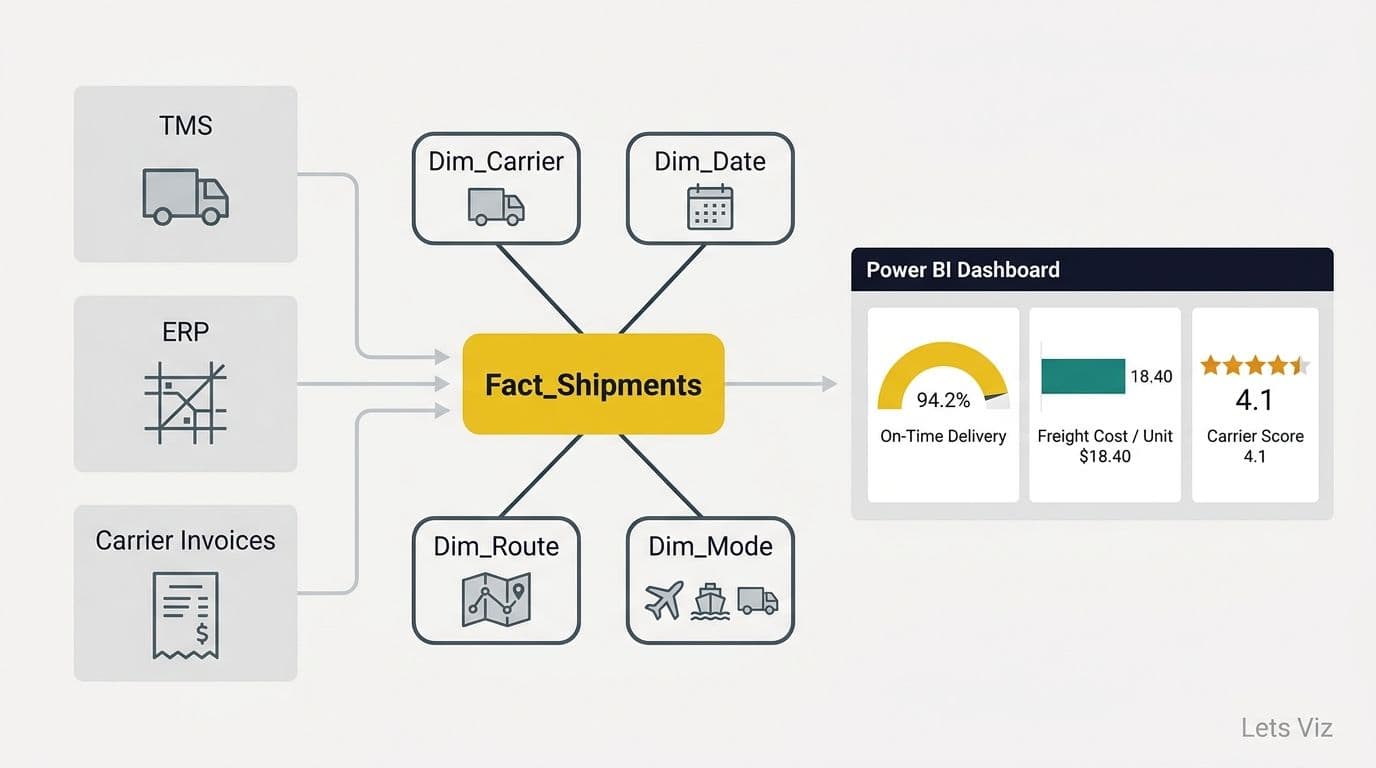
If you have a working Power BI semantic model — properly designed star schema, clean DAX measures, role-playing dimensions — adding new dashboards on top is fast and cheap. If you don't, the first dashboard project quietly becomes a "build the data model first" project, which can double the timeline and budget.
Honest consultants will ask about your current semantic model in the first call. Quotes that don't ask are quotes that will surprise you in week three.
4. Urgency
"We need this by Tuesday" pricing is real. Most boutique firms charge a 25–50% premium for projects with a fixed deadline under four weeks. Independent specialists sometimes refuse rush work entirely. The fix is starting earlier; the alternative is paying the rush premium or accepting later delivery.
5. Geography and team composition
US-onshore teams cost more than nearshore (LatAm, Eastern Europe), which cost more than offshore (India, Philippines). The cost variance is real — sometimes 3× — but so is the variance in communication overhead, time-zone alignment, and finance-domain literacy. Cheaper isn't always cheaper once you account for re-work.
The hidden cost of the cheapest option
The most expensive Power BI deliverable is the one you have to throw away and rebuild. This happens more often than you'd think with the cheapest tier of vendors, and the failure mode is consistent enough to be predictable.
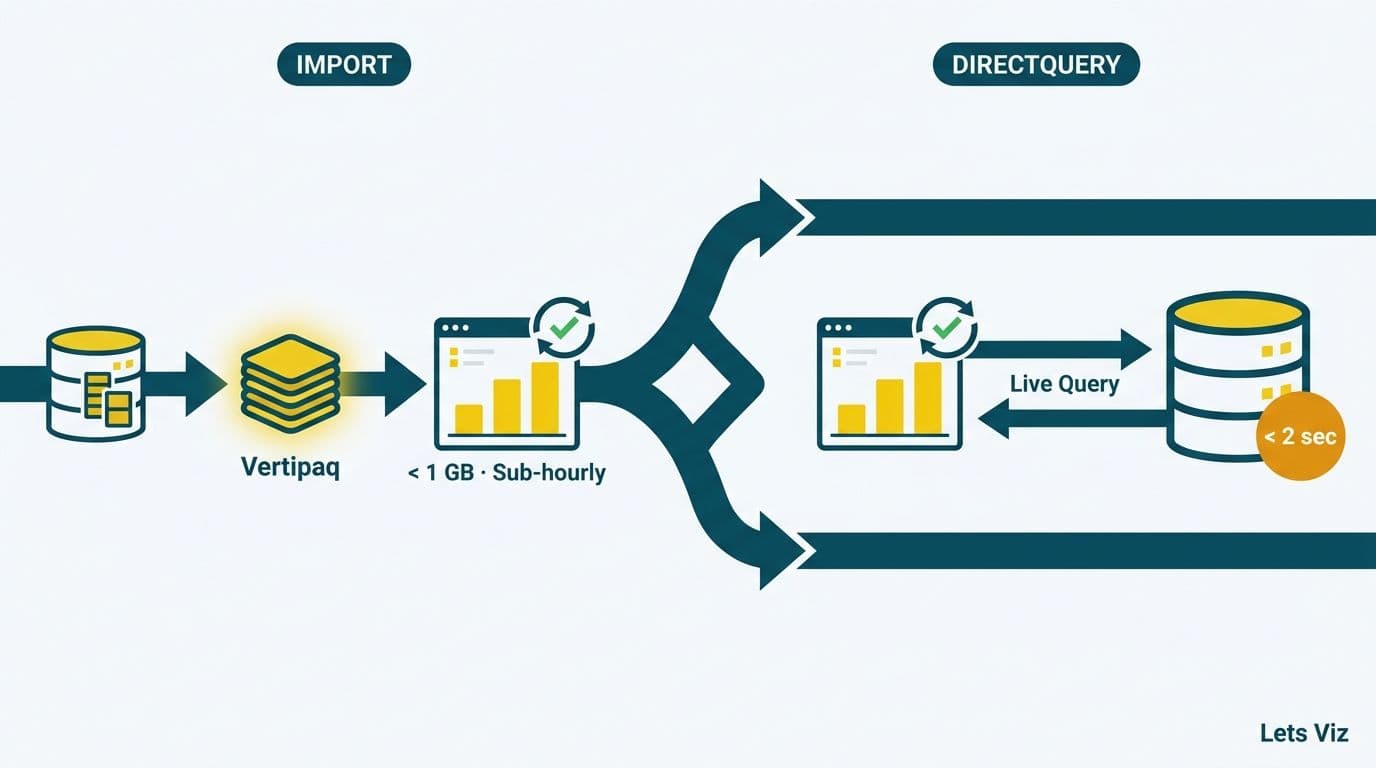
A $40/hour offshore quote that ships dashboards in four weeks usually means the dashboards look right but the data model underneath is unsound: no proper dimension tables, calculated columns where measures should exist, DirectQuery joins that hit production at every refresh. The dashboards work for the demo. They start failing two months in when business users ask the second wave of questions and discover that adding a new metric requires rebuilding the model from scratch.
The total cost of the cheap-then-rebuild pattern usually exceeds doing it correctly once at boutique-firm rates. We've inherited four projects in 2025 alone from teams that started with a $15,000 cheap-vendor build, hit the rebuild wall, and ended up paying another $35,000–$60,000 to redo the foundation.
The honest version: cheap is fine for ad-hoc fixes and well-scoped reports on existing data models. It's risky for the foundation work — semantic model design, data source integration, governance setup — where the cost of getting it wrong compounds for years.
When does each model actually pay back?
The honest decision criteria, model by model:
Hourly pays back when:
- You have a small, well-scoped task (under 10 hours)
- You have an internal analyst who can manage the engagement
- You don't expect the work to grow beyond the initial ask
- Examples: "fix this broken measure," "translate one Tableau dashboard," "review my DAX before I deploy"
Fixed-fee project pays back when:
- The scope is genuinely defined (not "build us some dashboards")
- The deliverable matters — it's worth paying a premium for predictability
- You don't yet need ongoing Power BI capacity
- Examples: dashboard MVP, one-time migration, reporting package for an investor update
Managed retainer pays back when:
- Your dashboards need to evolve month-over-month (pricing changes, new products, new investors asking for new cuts)
- You can't afford a full-time hire but the work would justify one
- You want SLA-backed change requests, not a queue of email asks
- You'd benefit from a strategic advisor, not just a builder
- Examples: SaaS finance teams running monthly board prep, RevOps teams with weekly executive review cadence
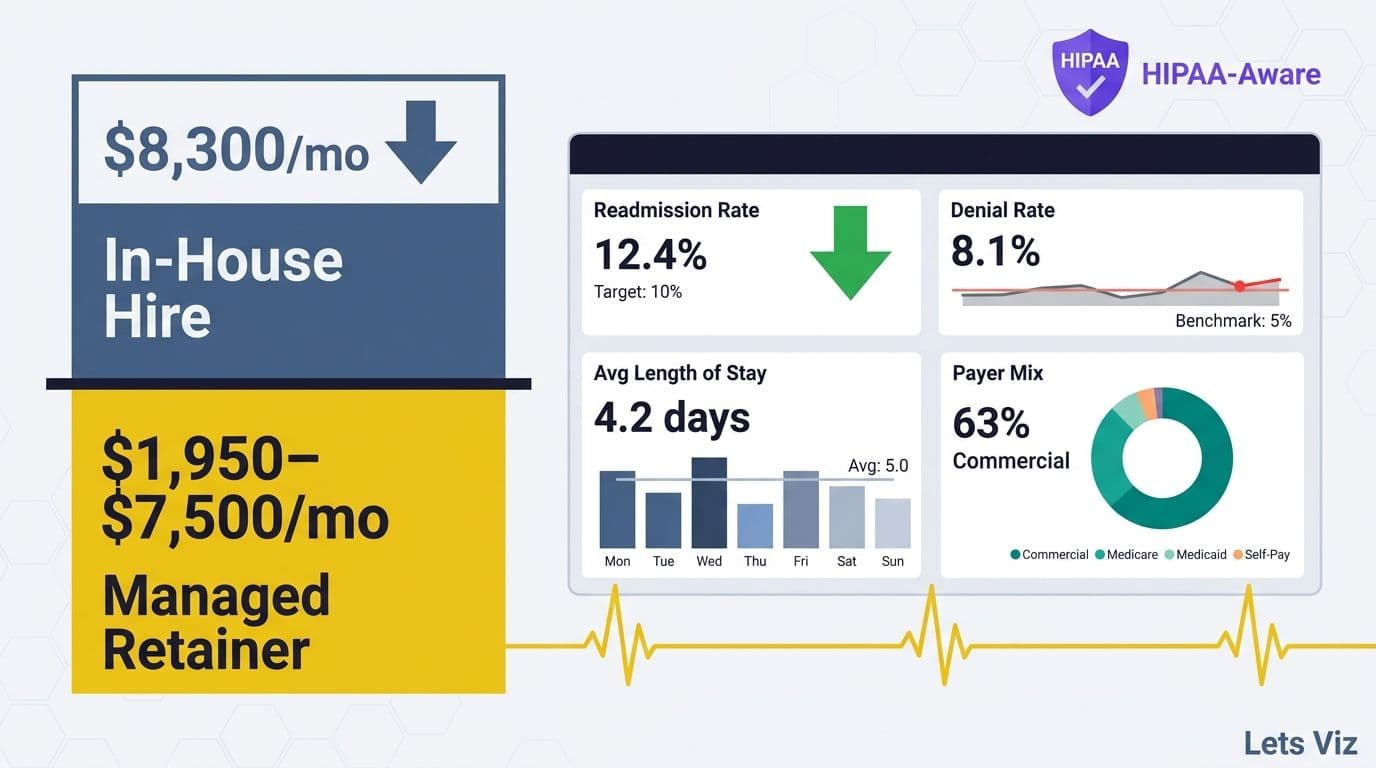
Break-even math: a $5,000/month retainer ($60K/year) runs roughly a third to half the cost of an FTE ($130K–$200K all-in). Even the $8,000/month tier ($96K/year) typically runs less than the all-in FTE cost. For most 50–200 person SaaS companies, the retainer is structurally cheaper than hiring on day one — the question becomes whether you have enough work to keep an FTE 100% utilized, and most don't.
FTE pays back when:
- You have enough Power BI scope to keep one person fully busy
- The institutional knowledge of an embedded team member matters more than flexibility
- You want career-path retention (analyst progression, internal mobility)
- Examples: 500+ person companies with a dedicated BI team, regulated industries that require staff-level data access
What we charge and why
Our own pricing maps to the four models above:
- Managed Power BI retainer — $5,000/month for 100 hours or $8,000/month for 160 hours. Includes a named analyst, a strategic advisor, pipeline monitoring, and a 2-business-day SLA on change requests. Designed for SaaS finance, RevOps, and operations teams that need Power BI to keep evolving. Industry-standard pricing for the same scope is $8,000+/month.
- Tableau to Power BI migration — fixed-fee, typically $25,000–$110,000 over 10–14 weeks depending on workbook count. Translation-first methodology with contractually guaranteed KPI parity. Most clients convert to a managed retainer after cutover.
- Power BI Consultant service — fixed-fee project work. Dashboard MVPs, DAX optimization, scoped builds. Range depends on workbook count and data source complexity.
We do offer hourly engagements at $50/hour for narrowly-scoped work — well below the US independent-specialist range of $100–$200/hour. We keep the rate low because we still believe in the limits of the hourly model: it rewards inefficiency, the consultant who takes longer earns more, and beyond ~10 hours the project-management overhead falls back on you. For anything larger than a small fix, our retainer or fixed-fee engagements ship more predictably.
FAQ
What is the average hourly rate for a Power BI consultant in 2026?
The typical Power BI consultant rate in 2026 is $100–$200/hour for independent US specialists, which is the most common benchmark when comparing quotes. Boutique firms blend $150–$250/hour. Offshore equivalents quote $40–$90/hour. The variance reflects experience, geography, and team structure — not necessarily quality.
How much does a Power BI dashboard cost to build?
A single dashboard of moderate complexity, built on an existing semantic model, runs $1,200–$2,250 in build time. A first dashboard on a new data source — where the team also has to design the semantic model — runs significantly more, often $5,000–$15,000, because most of the cost is the underlying data work, not the visual layer.
Is hiring a Power BI consultant cheaper than hiring a full-time Power BI developer?
For most 50–200 person companies, yes — substantially so. A managed retainer at $5,000–$8,000/month ($60K–$96K/year) is roughly a third to a half the cost of a full-time US Power BI specialist ($130K–$200K all-in) — and gives you a team rather than a single hire, no recruitment time, no training time, and no risk of the role going unfilled if they leave. The math flips only when you have enough scope to keep an FTE fully utilized year-round, which most 50–200 person SaaS finance teams don't.
How do I know if a Power BI quote is reasonable?
Check three things: (1) Does the quote ask about your current semantic model and data sources before pricing? Quotes that don't ask are quotes that will surprise you. (2) Does it include a change-order clause for scope changes? (3) Are the consultants named individuals you can interview, or a rotating pool? The cheapest quote that fails any of these tests is rarely actually cheap.
Can I get a Power BI project done for under $5,000?
Sometimes — for a single, well-scoped dashboard built on a clean existing data source by an independent specialist. Almost never for anything involving a new integration, multiple dashboards, or governance setup. If you're being quoted under $5,000 for anything described as "a Power BI project," ask exactly what's included; the answer usually reveals significant assumptions about your current data model.
What does a Power BI Premium implementation cost?
Power BI Premium Per User (PPU) licensing is $24/user/month. Premium capacity (P1) starts at $5,000/month for the license alone. Implementation cost on top of that — semantic model setup, RLS configuration, capacity sizing, governance — typically runs $20,000–$80,000 depending on scope. Microsoft Fabric F-SKUs are a separate pricing tier that can replace Premium for organizations consolidating to OneLake.
How does Power BI consulting cost compare to Tableau consulting?
Roughly equivalent on services pricing — the consultant rates are similar — but the underlying license costs differ substantially. Power BI Pro has been listed at $14/user/month (check Microsoft's current pricing page for 2026 changes) and is bundled with most Microsoft 365 E5 licenses, so the marginal cost per viewer is often zero. Tableau Creator is $75/user/month with no equivalent bundling. For a 100-seat deployment, the all-in delta is roughly $30,000–$70,000 per year. See our Tableau to Power BI migration guide for the full cost breakdown.
What's the cheapest legitimate way to get Power BI help?
For a one-time small task, our $50/hour hourly engagement covers it — well below the US independent-specialist range of $100–$200/hour. For ongoing work, a managed retainer at $5,000/month (100 hrs) is the cheapest model that scales — it amortizes the high-cost foundation work (semantic model, governance, integrations) across many dashboards instead of charging for it on every project. Industry-standard retainers at $8,000+/month deliver the same scope but with more overhead.
The Power BI consulting cost question rarely has a single answer because the right model depends on what you're actually trying to accomplish. The pricing is honest once you know which model fits — hourly for small fixes, fixed-fee for scoped projects, retainer for ongoing function, FTE for fully-utilized in-house need.
If you're scoping a Power BI engagement and want a second opinion on the right model and a realistic cost range for your specific situation, book a 30-minute call. We'll look at your stack and tell you honestly which engagement model fits — including when the answer is "you don't need us, here's what to ask the next vendor you talk to."