Zoho CRM Pricing Plans Compared: Standard to Ultimate (2026)
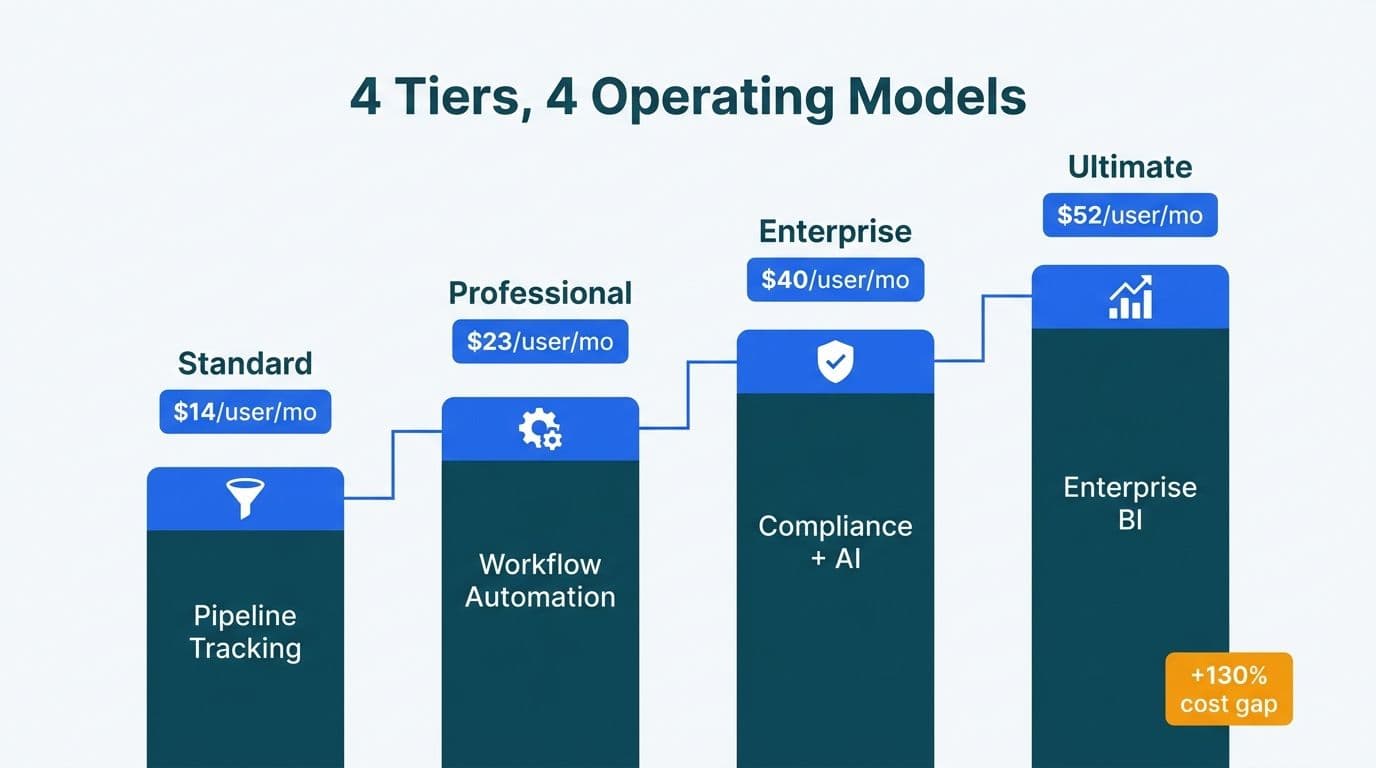
Zoho CRM offers four paid tiers - Standard ($14/user/month), Professional ($23), Enterprise ($40), and Ultimate ($52) - billed annually in USD. The tiers are not simply feature unlocks; they represent fundamentally different operating models. Standard handles basic pipeline tracking. Professional automates sales workflows. Enterprise enforces compliance controls and AI-driven forecasting. Ultimate adds enterprise-grade BI and the highest API throughput. Choosing the wrong tier either leaves capability on the table or inflates licence costs by 30-130%.
Key Takeaways
Standard ($14/user/month) covers pipeline basics for teams with fewer than 20 seats and simple sales processes
Professional ($23) adds workflow automation, lead scoring, and the Blueprint module - the tier where mid-market sales teams see the strongest ROI
Enterprise ($40) is the compliance pivot point: required for HIPAA BAA availability, GDPR data residency controls, and full PIPEDA audit logs
Ultimate ($52) adds Zoho Analytics Advanced and 25,000 API calls per day; it justifies the premium at roughly 75+ seats where analytics consolidation savings offset the per-seat premium
Per-seat cost in GBP and CAD follows Zoho's published local pricing and differs from simple currency conversion
How Do Zoho CRM Pricing Plans Compare? The Four Tiers at a Glance
Zoho CRM's paid tiers build on a free plan limited to 3 users and minimal features - covered in Zoho CRM Free Plan Limitations vs Paid: 2026 Breakdown. The four paid plans on annual billing are:
| Plan | USD/user/month | GBP/user/month | CAD/user/month | Key Addition |
|---|---|---|---|---|
| Standard | $14 | £10 | CA$19 | Pipeline management, basic automation |
| Professional | $23 | £16 | CA$31 | Workflow rules, lead scoring, Blueprint |
| Enterprise | $40 | £28 | CA$54 | Zia AI, compliance controls, custom modules |
| Ultimate | $52 | £37 | CA$70 | Advanced BI, 25,000 API calls/day |
*Source: Zoho published local pricing, annual billing, 2026. Verify current rates at zoho.com/crm/pricing.html before preparing a budget.*
Month-to-month billing adds approximately 25-35% to each tier's per-seat cost. Annual commitment is standard for teams with stable headcount.
All four tiers include standard CRM modules (Leads, Contacts, Accounts, Deals, Activities), role-based access controls, web-to-lead capture, and mobile access. The differences lie in automation depth, AI availability, compliance controls, and API capacity.
Teams working with a Zoho consulting services partner typically confirm tier selection during the discovery phase, since the plan affects implementation scope, data model design, and integration architecture directly.
What Features Separate Standard from Professional in Zoho CRM?
Standard gives a team a functional CRM: pipeline visualization, basic email integration, document library, custom fields, and up to 5 workflow automation rules per module. It handles what small sales teams need - tracking leads, logging calls, and moving deals through a defined stage sequence.
Professional is where sales automation becomes meaningful. Key additions over Standard:
Workflow automation: up to 25 rules per module (vs. 5 in Standard), enabling multi-step follow-up sequences triggered by time or action
Scoring rules: automatic lead and deal scoring based on demographic and behavioral criteria, updated in real time
Sales signals: buyer intent notifications from email opens, form submissions, website visits, and call logs
Blueprint: Zoho's structured process engine that enforces sequential stage gates with mandatory fields - detailed in How to Build a Zoho CRM Blueprint for Sales Process Automation
Advanced reports and dashboards: cohort analysis, funnel reports, and custom KPI boards unavailable in Standard
Inventory management: products, price books, quotes, and sales orders managed within CRM
For a US SaaS company with 25 sales representatives running a demo-first outreach model, the difference is tangible. Standard requires manual follow-up tracking after each interaction; Professional automates the follow-up sequence, scores the lead after each touchpoint, and alerts the representative when a prospect revisits the pricing page.
The per-seat premium for Professional over Standard is $9/user/month. For a 20-seat team, that is $2,160 annually. A representative deployment - standardized follow-up sequences, automated lead scoring, and Blueprint stage gates replacing manual checklist tracking - typically eliminates 4-6 hours of administrative work per representative per week; at an average blended sales salary, that recovered time returns the tier premium within six to eight weeks.
For teams evaluating how Zoho CRM mid-tier capabilities compare against other enterprise CRM platforms at comparable price points, our Zoho CRM vs Salesforce comparison provides a detailed cross-platform feature map.
When Does Enterprise Justify Its Cost Over Professional?
Enterprise ($40/user/month) crosses a qualitative threshold, moving Zoho CRM from a sales tool into a configurable business operating platform. The additions that drive Enterprise adoption:
Zia AI: predictive lead and deal scoring, anomaly detection, next-best-action recommendations, and sentiment analysis on emails and calls
Custom modules and sub-forms: build industry-specific data models - patient outreach workflows, financial account structures, regulatory filing trackers - without separate databases
Multi-user portals: client-facing self-service access with role-controlled data visibility
Territory management: geographic and account-based hierarchies with automated assignment rules
Sandbox environment: a full CRM staging environment for testing configuration changes before production release
Advanced customization: Canvas layout builder, client scripts, and Deluge custom functions
The compliance dimension is the decisive factor for healthcare and finance buyers. Enterprise is the minimum tier for:
US healthcare organizations requiring a HIPAA Business Associate Agreement (BAA) - mandatory for any CRM touching PHI-adjacent data including patient outreach records, care coordination notes, and enrollment status fields
UK and EU businesses requiring Zoho's GDPR Data Processing Agreement (DPA) with EU data center selection, reducing cross-border transfer risk under post-Schrems II rules; for the reporting layer that sits alongside these controls, our GDPR Compliant SaaS Financial Reporting checklist covers the adjacent technology requirements
Canadian organizations subject to PIPEDA - and Quebec's Law 25, which added GDPR-style consent and breach notification requirements - needing granular access logs, retention controls, and subject access request capability
A UK fintech firm managing FCA-supervised advisory workflows cannot safely operate below Enterprise. The audit trail depth, IP restriction controls, and data residency options available in Enterprise are absent from Standard and Professional.
Enterprise also raises API rate limits to 5,000 calls per day per organization (as of 2026) - compared to 1,000 on Standard - which matters when Zoho CRM connects to an ERP system, data warehouse, or marketing automation platform.
What Makes Ultimate the Right Tier - and When Is It Overkill?
Ultimate ($52/user/month) adds three primary capabilities over Enterprise:
1. Zoho Analytics - Advanced edition: a full BI layer enabling cross-departmental reporting that blends CRM pipeline data with finance, customer success, and marketing datasets
2. Enhanced Zia AI capacity: higher model refresh rates and additional email intelligence features
3. Increased storage and API throughput: 5 GB per organization (vs. 1 GB in Enterprise) and 25,000 API calls per day
The financial logic for Ultimate is straightforward at scale. At 75 users, the annual incremental cost over Enterprise is ($52 - $40) x 75 x 12 = $10,800 USD. If Zoho Analytics Advanced replaces a standalone BI subscription - a Tableau Viewer license at 75 seats runs $14,000-18,000 annually in 2026; a Looker contract at that scale typically starts at $25,000 - Ultimate reaches break-even or better on analytics consolidation alone. Below 40 users, that calculation rarely works - the analytics capability exists but the per-seat premium exceeds the tool consolidation savings.
When Ultimate is the right call: a US financial services firm with 100+ revenue-producing staff, a connected CRM-to-ERP data pipeline, and board-level reporting requirements benefits from Ultimate's analytics engine. Blending CRM pipeline data with finance and client success datasets eliminates the spreadsheet-based board reporting that consumes finance team hours every quarter.
When Ultimate is overkill: a 30-seat professional services agency with a single-product pipeline and no multi-department data blending requirement will find Enterprise covers everything they need. They pay an additional $1,440 per seat annually for capabilities that remain unused.
For the total cost picture including implementation and ongoing administration, our guide on how much a Zoho consultant costs in 2026 covers engagement economics alongside licence costs.
How Do Zoho CRM Pricing Plans Address Healthcare and Finance Compliance?
Compliance requirements should be the first filter in plan selection, not the last. The compliance feature map by tier:
| Requirement | Standard | Professional | Enterprise | Ultimate |
|---|---|---|---|---|
| HIPAA BAA available | No | No | Yes | Yes |
| GDPR DPA + data residency | No | No | Yes | Yes |
| PIPEDA full audit trail | No | No | Yes | Yes |
| Field-level access controls | No | No | Yes | Yes |
| IP restriction by user role | No | No | Yes | Yes |
| Sandbox for config testing | No | No | Yes | Yes |
US healthcare context: a hospital network's patient outreach team or a health insurance broker managing producer CRM data must operate at Enterprise minimum. The HIPAA BAA makes Zoho a covered Business Associate, creating the contractual data protection obligation that absence of a BAA leaves entirely unaddressed. Without it, the organization bears unmitigated breach liability for any PHI-adjacent data processed through the CRM.
UK and EU finance context: under GDPR Article 28, using a data processor without a signed DPA exposes the data controller to regulatory liability. Enterprise provides the DPA and EU data center selection. UK firms handling EU client data face additional adequacy considerations post-Brexit; Enterprise's data residency controls are the practical mechanism for managing that exposure.
Canadian compliance context: PIPEDA requires demonstrable accountability for personal data. Quebec's Law 25 adds consent and breach notification requirements similar to GDPR. A Canadian healthcare-adjacent company - a medical devices distributor, pharmacy benefits manager, or health benefits brokerage - needs Enterprise's granular field-level permissions and full audit trail to defend PIPEDA compliance in a regulatory review. Standard and Professional cannot provide this depth.
Which Zoho CRM Plan Matches Your Company Size? A Decision Tree
Work through this sequence to identify the right tier before committing to a licence:
Step 1 - Are you subject to HIPAA, GDPR, or PIPEDA compliance requirements?
Yes: Enterprise is the minimum (skip to Step 4). No: continue to Step 2.
Step 2 - How many users will access Zoho CRM?
Fewer than 5: Free or Standard. 5-20 users: continue to Step 3. 21-75 users: Professional or Enterprise (apply Step 1 compliance check). 75+ users: Enterprise or Ultimate (continue to Step 3).
Step 3 - Do you need workflow automation beyond 5 rules, lead scoring, or Blueprint stage gates?
Yes: Professional (or Enterprise if compliance applies). No: Standard.
Step 4 - Do you require cross-departmental BI reporting or more than 10,000 API calls per day?
Yes: Ultimate. No: Enterprise.
Tier selection by company profile:
| Company Profile | Recommended Tier |
|---|---|
| Startup, under 10 reps, simple pipeline | Standard |
| Growing B2B team, 10-40 reps, multi-touch sales | Professional |
| Mid-market firm with compliance requirements | Enterprise |
| 75+ seats, board-level BI, high-volume API integrations | Ultimate |
| US healthcare organization with PHI-adjacent CRM data | Enterprise (HIPAA BAA required) |
| UK fintech with FCA-supervised advisory workflows | Enterprise (GDPR DPA + data residency) |
| Canadian professional services firm under PIPEDA | Enterprise (full audit trail) |
The teams that over-specify - landing on Ultimate when Enterprise suffices - are typically evaluating against a feature checklist rather than their actual workflow requirements. The teams that under-specify usually discover the gap mid-implementation when Blueprint, sandbox, or compliance controls require a licence upgrade at the worst possible moment.
Our Zoho CRM Implementation Checklist maps configuration scope to each tier, so teams can validate plan selection before signing a licence agreement.
---
About Lets Viz: Lets Viz has delivered Zoho CRM implementations and analytics solutions since 2020, working with clients across US healthcare, UK fintech, Canadian manufacturing, and global SaaS. Our Zoho practice holds a 5.0 Clutch rating and covers the full stack - from tier selection and compliance configuration through custom module development and managed support.
Ready to confirm the right Zoho CRM plan before signing a licence? Our Zoho consulting services team runs a structured discovery process to match plan, seat count, and configuration scope to your sales process and compliance environment. Try Zoho CRM free →