AI Analytics Use Cases in Healthcare Finance: 2026 Guide
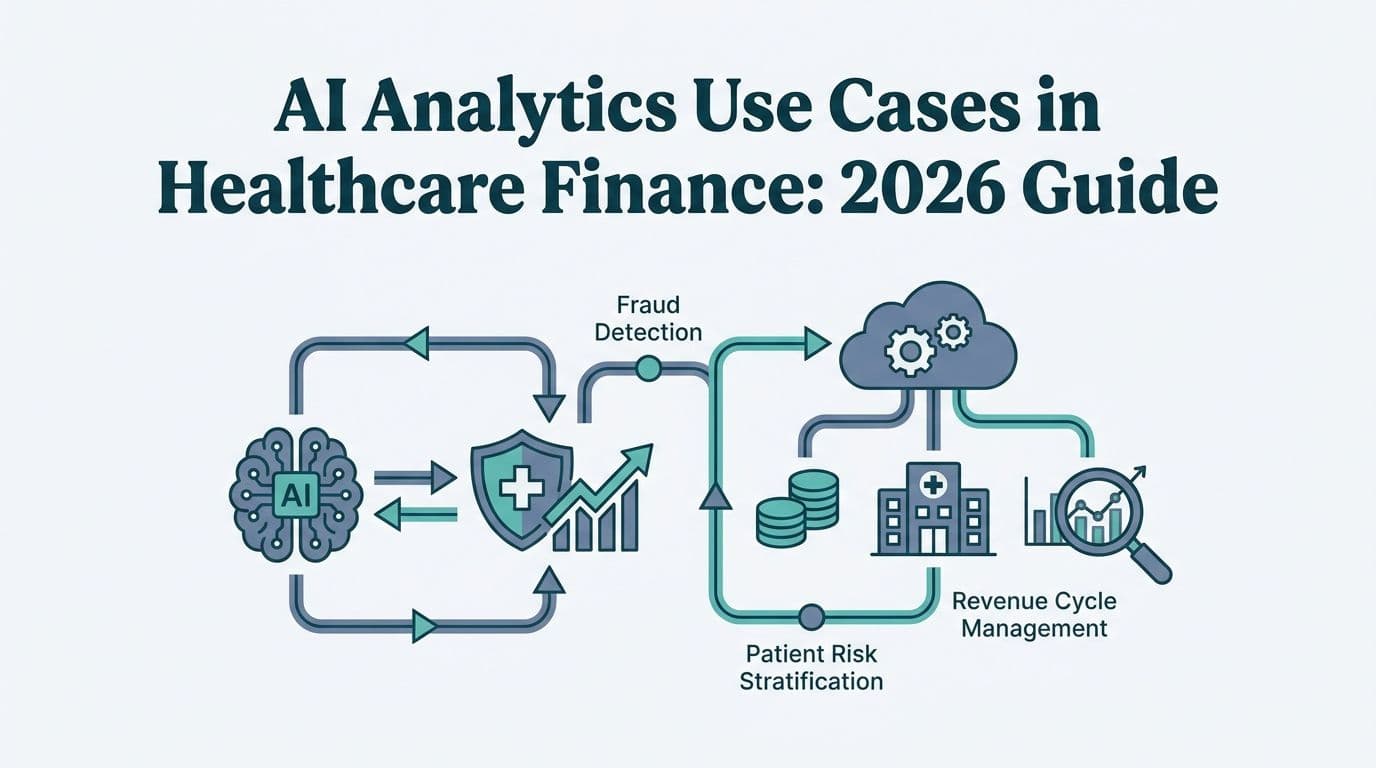
AI analytics use cases in healthcare finance span six core domains - revenue cycle automation, claims denial prediction, supply chain cost optimization, payer mix analysis, value-based care performance tracking, and fraud detection. For hospital CFOs and finance directors, each domain maps to a concrete, board-defensible outcome: reduced days-in-accounts-receivable, lower denial write-off rates, or improved contractual compliance. The ROI case is operational, not speculative.
Key Takeaways
AI addresses six distinct financial challenges facing hospital finance teams: RCM automation, denial prediction, supply analytics, payer mix optimization, value-based care, and fraud detection.
Revenue cycle automation and claims denial prediction deliver the fastest, most auditable financial returns.
The Healthcare Financial Analytics Market is growing at an 8.58% CAGR through 2035 — a trajectory that accelerating health system AI investment in 2026 is on pace to match or exceed.
Platform decisions - Power BI import mode vs. DirectQuery, DAX modeling, and natural language Q&A - determine AI feasibility before a single dashboard is built.
CFOs who define measurable KPIs before deployment close the loop between AI investment and auditable financial improvement.
Lets Viz builds custom AI automation solutions that cut manual processing time by 40-60% within 90 days -- across finance, healthcare, and operations workflows.
What Are the Top AI Analytics Use Cases in Healthcare Finance?
Hospital finance departments face a compound operational problem: rising labor costs, increasing payer complexity, mounting regulatory requirements, and margin compression that leaves little room for inefficiency. AI analytics addresses each pressure point with a distinct, measurable intervention.
According to Market Research Future, the Healthcare Financial Analytics Market is projected to grow at an 8.58% CAGR from 2025 to 2035, driven by technological advancement, regulatory pressure, and the increasing availability of structured claims and clinical data. That trajectory reflects real investment decisions being made at the CFO and board level - not analyst projections from a future that has not yet arrived.
The six use cases hospital CFOs prioritize in 2026:
1. Revenue cycle automation - Intelligent claim scrubbing, prior authorization prediction, and automated payment posting eliminate manual bottlenecks across the billing lifecycle.
2. Claims denial prediction - Machine learning models score each claim for denial risk before submission, reducing first-pass denial rates and protecting net revenue.
3. Supply chain cost analytics - Variance analysis across clinical supply spend by department identifies overspend and contract non-compliance at the line level.
4. Payer mix optimization - Modeling contractual rates against actual reimbursement outcomes surfaces underpayments and informs renegotiation strategy.
5. Value-based care (VBC) performance tracking - Aligning clinical outcomes data with financial incentives lets finance teams manage total cost of care against capitated or shared-savings targets.
6. Fraud, waste, and abuse (FWA) detection - Anomaly detection across billing codes and utilization patterns flags outliers that manual audit processes consistently miss.
For a framework mapping each use case to the specific metrics it should drive, what metrics should a healthcare analytics dashboard track provides a structure grounded in operational practice.
How Does AI Reduce Costs in Hospital Revenue Cycle Management?
Revenue cycle management (RCM) is where AI delivers the fastest, most measurable financial savings. Traditional RCM relies on manual claim review, reactive denial management, and siloed payer data - each a predictable source of delay and preventable write-off.
AI restructures the economics: predictive models score each claim for denial risk before it exits the system. Intelligent routing sends high-risk claims to specialist reviewers while clean claims process automatically. The result is compression in days-in-accounts-receivable (days-in-AR) - the metric hospital CFOs monitor most closely because it directly affects operating cash flow.
The AI consulting services market, which reached USD 11.07 billion in 2025 per Future Market Insights, is on track to hit USD 90.99 billion by 2035 at a 26.2% CAGR — with healthcare RCM automation and operational AI accounting for the fastest-growing segment as of mid-2026, driven in part by CMS reimbursement rule changes that took effect in January 2026 and increased the compliance burden on payer contract management. That pace of investment reflects genuine, auditable ROI capture.
The table below maps specific RCM functions to their AI capability and expected measurable outcome:
| RCM Function | AI Capability | Measurable Outcome |
|---|---|---|
| Prior authorization | Eligibility check automation and approval probability scoring | 30-50% reduction in auth processing time |
| Claim scrubbing | Pre-submission denial risk scoring by payer and CPT code | 15-25% drop in first-pass denial rate |
| Payment posting | Automated remittance matching and exception flagging | 40-60% reduction in manual posting hours |
| Denial management | Root-cause clustering by payer, procedure, and facility | Faster appeal cycle, higher overturn rate |
| AR follow-up | Prioritized work queues ranked by payer aging and collection probability | 10-20% improvement in net collection rate |
Finance teams building these workflows inside Power BI will find that how to build a Power BI financial dashboard for healthcare covers the data model, refresh strategy, and RCM-specific DAX measures in practical detail.
What Does Claims Denial Prediction Look Like in Practice?
Claims denial is the largest source of preventable revenue leakage in most health systems. The national average denial rate runs between 10-15% of submitted claims, and a significant share of those denials are never appealed - representing permanent write-off that falls directly to operating margin.
AI-based denial prediction models are trained on historical claim data segmented by payer, procedure code (CPT), diagnosis code (ICD-10), patient coverage type, and facility. The model identifies which code and coverage combinations have historically triggered denials and generates a real-time risk score for every claim entering the submission queue.
MedInsight (2025) identified AI-driven analytics as one of three defining themes in healthcare financial operations, alongside value-based care and payer analytics innovation — a classification that has since been validated: by mid-2026, health systems that deployed denial prediction models in 2024–2025 are reporting first-pass denial rates of 5–8%, down from a pre-deployment baseline of 12–15%, with leading deployments recovering an estimated $1.5–2.5M in net revenue annually that would otherwise have been written off. The question for most CFOs is no longer whether to implement denial prediction, but how quickly it can be integrated into existing claim submission workflows.
Implementation follows a predictable three-phase pattern. In phase one, the model ingests two to three years of historical claim data and surfaces the top denial drivers by payer and code combination. In phase two, the risk score is integrated into the submission workflow as either a dashboard alert or an automated hold queue. In phase three, the model is retrained quarterly as payer rules evolve, compounding precision gains over time.
The compliance layer is equally important. Any AI analytics system processing patient billing data must satisfy HIPAA requirements for access controls, audit logging, and data de-identification. The HIPAA-compliant analytics dashboard best practices checklist details the configuration requirements governing these environments - including row-level security, sensitivity labels, and data loss prevention policies applicable to Power BI deployments.
How Should Healthcare Finance Teams Choose Their Analytics Platform?
The analytics platform decision shapes downstream feasibility across every use case: data freshness, model complexity, AI feature availability, and total cost of ownership. For mid-market health systems, the choice also intersects with enterprise Microsoft agreements, existing data warehouse infrastructure, and IT resource constraints that rarely appear in vendor comparisons.
For organizations migrating off legacy environments, Power BI has become the dominant platform for healthcare finance analytics due to its Microsoft 365 integration, AI-native feature set, and five-year TCO advantage over on-premises alternatives. Several configuration decisions affect AI feasibility from the outset.
Import mode vs. DirectQuery: The choice between Power BI import mode vs. DirectQuery determines data freshness and query performance at scale. Import mode loads a compressed dataset into Power BI's in-memory engine - optimal for large historical claim datasets where real-time refresh is not critical. DirectQuery queries the source database live on each interaction, which suits real-time AR dashboards but demands a well-optimized data warehouse. Most healthcare finance deployments use a hybrid approach: import mode for historical trend analysis, DirectQuery for live operational metrics.
DAX for healthcare financial modeling: The SUMX iterator function in Power BI DAX evaluates a financial expression row by row across a table - essential for calculating net revenue per claim, cost per encounter, or contribution margin per service line. This is distinct from SUM, which applies an aggregate directly to a column. The CROSSFILTER DAX function controls how filter context propagates across table relationships, which becomes critical when modeling payer contracts against actual payment data spread across multiple fact tables in a hospital data model.
Natural language queries: Finance directors who need ad hoc answers without writing DAX can enable Power BI Q&A natural language queries, allowing questions phrased in plain English against live financial data. Enabling this feature requires clean field naming conventions, custom synonym configuration for clinical and billing terminology, and a well-structured semantic model.
Cognos to Power BI migration: For teams migrating from Cognos Report Studio, the concept mapping involves translating Cognos List Reports into Power BI table visuals, Cognos Query Studio functionality into Power BI's Explore and Q&A features, and Cognos dimensional hierarchies into Power BI model hierarchies governed by DAX. The Cognos vs. Power BI total cost of ownership comparison at the mid-market level consistently favors Power BI once per-user licensing, on-premises server costs, and upgrade cycles are modeled over five years.
For a practical guide to AI-native Power BI capabilities in healthcare finance environments, AI-powered Power BI consulting for finance teams covers the configuration and governance decisions that define a production-ready analytics environment.
What Measurable Outcomes Should Hospital CFOs Track After AI Deployment?
AI analytics projects in healthcare finance fail most often not because the technology underperforms, but because success criteria were undefined before deployment began. CFOs who anchor each initiative to three to five operational KPIs from the outset are substantially more likely to close the loop between AI investment and auditable financial improvement.
The table below maps each use case to a typical baseline and target improvement range:
| Metric | AI Use Case | Typical Baseline | Target Post-AI |
|---|---|---|---|
| Days-in-AR | Revenue cycle automation | 45-55 days | Reduce by 5-10 days |
| First-pass denial rate | Claims denial prediction | 10-15% | Reduce to 5-8% |
| Cost-per-claim processed | RCM automation | $25-$35 | Reduce by 20-30% |
| Prior auth approval rate | Authorization automation | 70-80% | Increase to 85-90% |
| Payer underpayment identification | Contract analytics | Variable | Surface underpayments above 2% |
| Total cost of care (VBC) | Value-based care analytics | Varies by contract | Bring within shared-savings threshold |
Value-based care performance adds a second tier of financial accountability that is frequently overlooked in AI deployment plans. Quality-adjusted revenue, total cost of care per attributed patient, and risk adjustment accuracy are financial metrics - not merely clinical ones - and they require an analytics stack capable of joining claims data with clinical and population health data across care settings in near real time.
For CFOs structuring these performance frameworks ahead of their annual budget cycle, AI analytics for healthcare finance teams provides a structured approach to the 2026 planning process, including KPI ownership models and board-reporting templates.
When Should a Healthcare Organization Move from Legacy Reporting to AI Analytics?
The migration trigger is typically one of three events: a failed audit that exposed gaps in financial visibility, a payer contract renegotiation that revealed an absence of reliable reimbursement data, or a leadership transition that brings in a CFO with higher expectations for predictive analytics.
Legacy systems - whether on-premises reporting platforms or Excel-based models that accumulated a decade of workarounds - share a common structural failure: they answer last quarter's questions. AI analytics is designed to answer next quarter's questions, which requires a fundamentally different data architecture and a different operating relationship between finance, IT, and clinical leadership.
The migration economics also merit scrutiny. For mid-market health systems asking how much does Cognos to Power BI migration cost, the range typically spans $50,000 to $250,000 depending on report complexity, data warehouse maturity, and migration phasing. That investment is routinely recovered within two to three fiscal years through RCM efficiency gains alone - and in 2026, with labor costs for manual billing staff running 12–18% above 2023 baselines, the effective payback window has compressed to 18–24 months for mid-sized health systems operating above 45 days-in-AR.
A phased migration preserves continuity through monthly close cycles while progressively replacing legacy reports with Power BI equivalents. The AI consulting for healthcare data analytics 2026 guide outlines how to structure a phased transition that minimizes disruption to financial close while building toward an AI-integrated reporting environment that supports both retrospective analysis and real-time operational decisions.
---
If your organization is ready to move from reactive financial reporting to predictive operational analytics, Custom AI automation and consulting provides the end-to-end expertise to design, build, and deploy AI analytics systems calibrated to healthcare finance workflows.
---
About Lets Viz: Lets Viz has been delivering data analytics and AI consulting to healthcare and financial services organizations since 2020, with deep expertise in Power BI, revenue cycle analytics, payer contract modeling, and AI automation strategy. Our team has guided mid-market health systems, specialty practices, and financial services firms through the shift from legacy BI to AI-native operations, combining technical implementation depth with board-level financial storytelling.