Zoho Creator vs Microsoft Power Apps: Low-Code Comparison
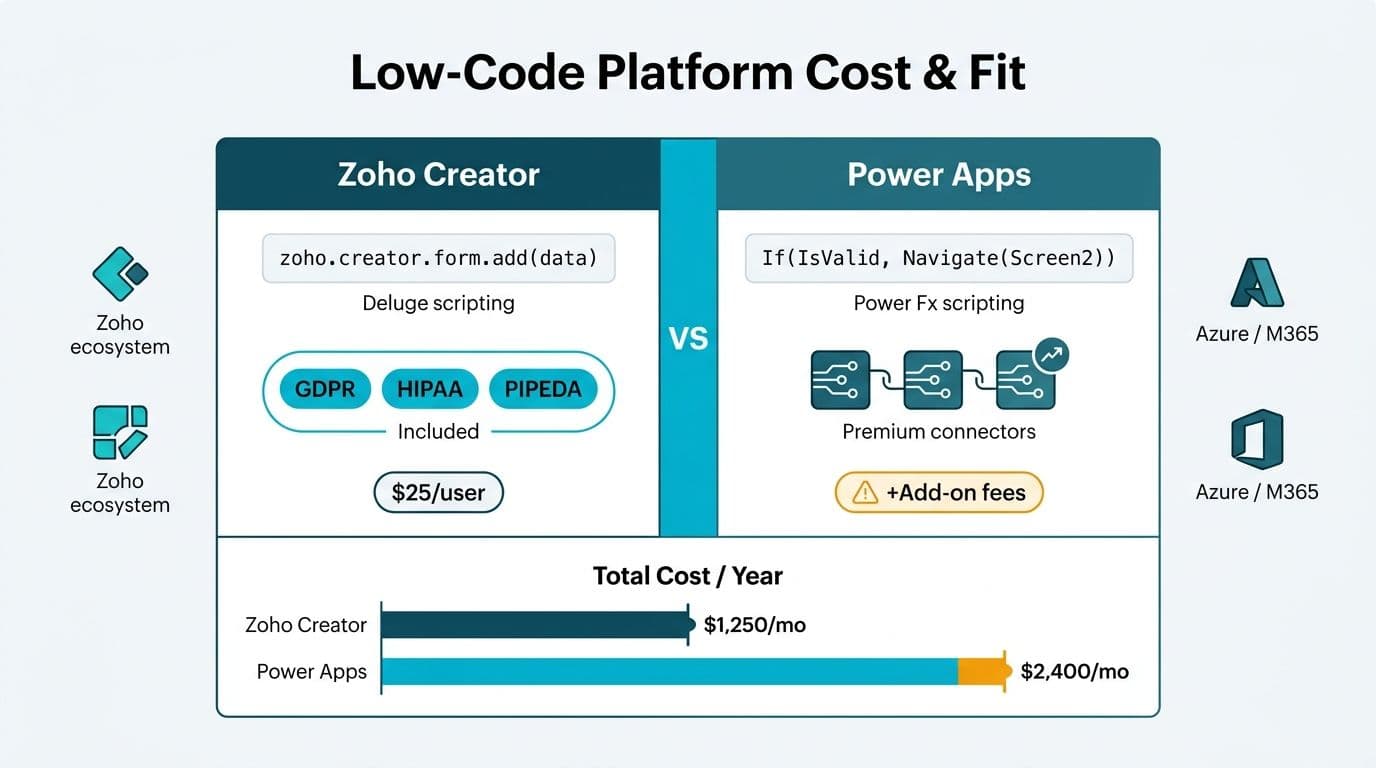
Zoho Creator suits mid-market teams embedded in the Zoho ecosystem - lower per-user pricing, a gentler scripting curve with Deluge, and compliance certifications covering GDPR, HIPAA BAAs, and PIPEDA included without add-on tier requirements. Microsoft Power Apps integrates deeper across Azure and Microsoft 365, but total cost rises quickly once premium connectors and Power Automate flows enter the picture.
Key Takeaways
- Zoho Creator's per-user pricing is lower at scale for Zoho-native teams; Power Apps total cost rises with premium connector and Power Automate licensing fees
- Deluge scripting is more accessible for citizen developers; Power Fx rewards teams already proficient in Excel or the Microsoft Power Platform
- Both platforms publish GDPR, HIPAA, and PIPEDA documentation, but Zoho includes BAA coverage without an enterprise-tier contract minimum
- Power Apps offers broader connectors into Microsoft 365, Azure, and enterprise ERP; Zoho Creator connects natively across the full Zoho One suite
- Vendor lock-in is higher on Power Apps due to layered connector, Dataverse, and licensing dependencies
How Does Pricing Compare: Zoho Creator vs Microsoft Power Apps?
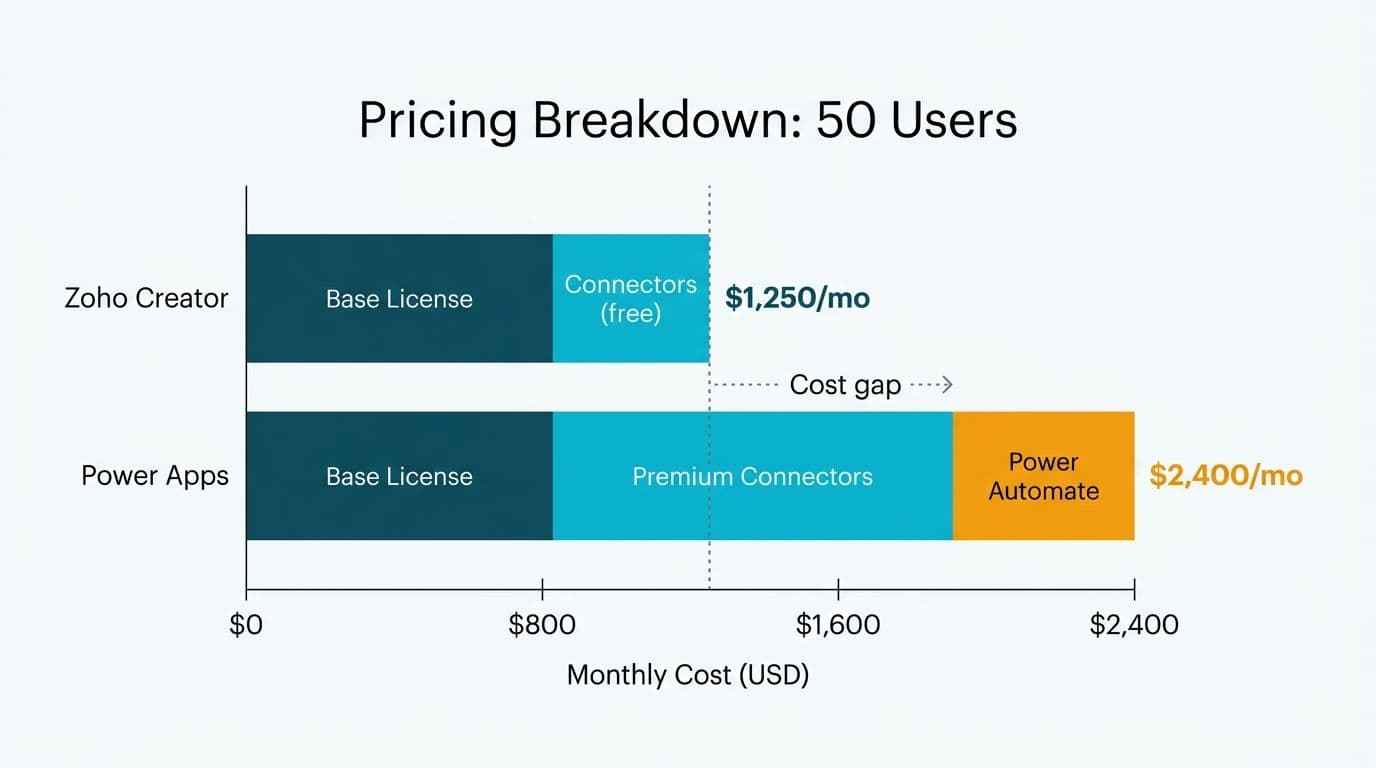
Pricing is the fastest differentiator for mid-market ops and IT teams. Zoho Creator Professional starts at approximately $20 per user per month billed annually, including unlimited apps, workflows, and Zoho suite connectors, per Zoho's 2026 pricing documentation. Power Apps Premium is also $20 per user per month per Microsoft's 2026 licensing documentation - but that excludes Power Automate Premium (approximately $15 per user per month) and premium connector fees for enterprise data sources. For a 50-seat team requiring two or three enterprise connections, the effective Power Apps per-seat cost runs materially above the headline figure.
Our Zoho consulting services team regularly finds that connector and automation licensing are the two most common sources of budget overrun in Power Apps deployments.
| Dimension | Zoho Creator (2026) | Microsoft Power Apps (2026) |
|---|---|---|
| Base price (per user/month, annual) | From ~$8 (Standard) to ~$20 (Professional) | $20 Premium; $10/user/month per-app plan |
| Automation licensing | Included (Deluge workflows) | Power Automate Premium: +$15/user/month |
| Premium connectors | None - all Zoho connectors included | Per-connector fees for 200+ premium sources |
| Enterprise bundle | Zoho One suite available | Microsoft 365 / Copilot Studio add-ons extra |
| Free tier | Yes (up to 3 users, limited apps) | Yes (basic canvas apps in Microsoft 365) |
*Sources: Zoho pricing documentation (2026); Microsoft Power Platform licensing documentation (2026). Verify with each vendor before budgeting.*
How Deep Is the Integration Ecosystem for Each Platform?
Power Apps leads on raw connector count. Microsoft's Power Platform catalog listed over 900 data sources as of 2026, covering major ERP, EHR, and cloud platforms used in US healthcare and financial services. For a UK fintech firm already running Teams, SharePoint, and Azure Active Directory, Power Apps connectors are largely pre-licensed through existing Microsoft agreements.
Zoho Creator's native story is narrowest for teams outside Zoho One - but deepest for those within it. Zoho CRM, Zoho Books, Zoho Desk, Zoho Analytics, and more than two dozen Zoho applications connect without connector licensing or token management. For external systems, Creator supports REST API calls, webhooks, and an expanding official integration library. The Zoho Analytics integrations connector map (2026) illustrates the breadth of data sources available across the Zoho platform.
A Canadian manufacturing company evaluating low-code for shop-floor exception tracking faces a different calculus than a US SaaS finance team on Google Workspace. If the stack is predominantly Microsoft, Power Apps wins on integration friction. If the stack is predominantly Zoho, Creator wins on depth and zero connector surcharges. For a walkthrough of a Zoho-native build, the Zoho Creator custom app guide covers data model design and Deluge workflow architecture.
Deluge vs Power Fx: Which Scripting Language Fits Your Team?
Deluge (Zoho's Data Enriched Language for Universal Grid Environment) is imperative and statement-driven - its syntax reads closer to Python than to spreadsheet formulas, keeps business logic in a single script block, and is debuggable directly in Zoho's built-in IDE. A finance analyst with SQL experience adapts to Deluge faster than to Power Fx.
Power Fx is Microsoft's declarative, Excel-formula-based language. For Excel power users, the initial curve is shallow for simple forms and read-heavy dashboards. Complex logic - multi-step approvals, conditional routing, async API calls - requires switching into Power Automate, adding a second tool, a second debugging surface, and additional licensing.
For finance operations teams looking to automate month-end financial close workflows, Deluge's single-script model keeps approval and posting logic concentrated and auditable. Power Automate achieves the same outcome but distributes it across multiple canvases that require separate maintenance cycles. A UK fintech team without dedicated developers will generally find Deluge easier to extend across a two-year app lifecycle.
What Is the Vendor Lock-In Risk With Each Platform?
Both platforms create lock-in through structurally different mechanisms.
Zoho Creator lock-in is ecosystem lock-in. Deluge scripts are not portable to other platforms. Exiting Zoho means rewriting applications. However, data export is unrestricted - Creator supports CSV, Excel, and API export without row caps or UI-level restrictions.
Power Apps lock-in is multi-layered. Logic lives in Power Fx and Power Automate flows across separate surfaces. Data in Dataverse is exportable but requires deliberate tooling. Connector dependencies mean a Microsoft pricing or deprecation change breaks downstream apps. The licensing stack - Premium, per-app, Copilot Studio, Power Automate Premium - creates budget exposure with each Microsoft revision cycle.
We encountered a direct illustration of Microsoft ecosystem data portability limits in a client engagement. A book distributor needed to export all 5,042,721 billing rows from their Power BI reporting model - a Microsoft product in the same Power Platform family as Power Apps - and discovered that the visual export caps at 30,000 rows in CSV format. We bypassed the UI-layer limit by connecting directly to the underlying model engine and streamed the full dataset out at approximately one million rows per minute. The same pattern of UI-layer constraints obscuring technically accessible data is worth stress-testing before committing a core operational dataset to Dataverse.
For compliance-sensitive US healthcare or Canadian financial services teams, data portability affects your ability to respond to data subject access requests under HIPAA, GDPR, or PIPEDA without depending on a vendor's export tooling.
How Do Zoho Creator and Power Apps Compare on GDPR, HIPAA, and PIPEDA Compliance?
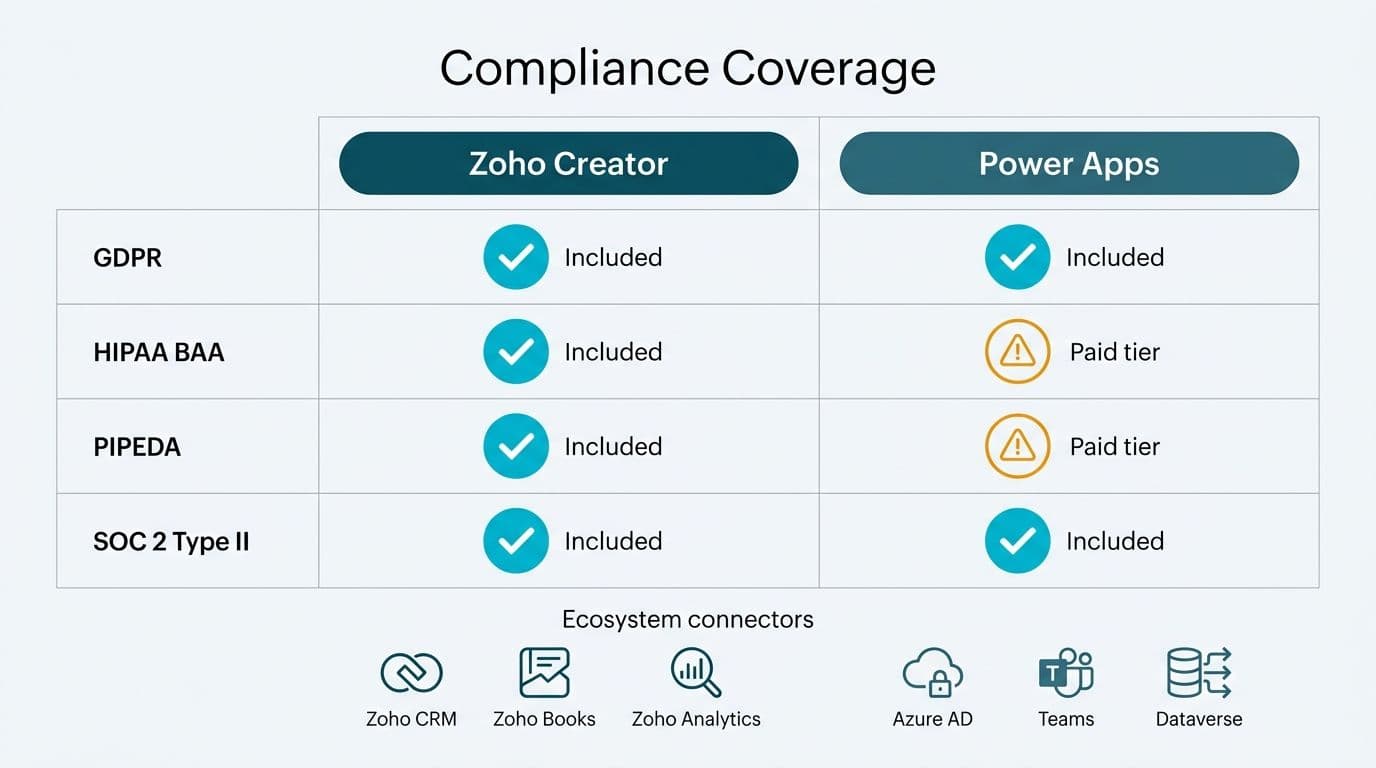
Both platforms publish certifications, but coverage details and contract accessibility differ in ways that matter to smaller organisations.
GDPR (UK and EU): Both Zoho and Microsoft publish Data Processing Agreements meeting GDPR requirements. Zoho offers EU data residency for Creator, documented in the Zoho Creator GDPR compliance and data residency guide. Microsoft provides EU Data Boundary commitments under enterprise agreements. For a UK fintech firm building customer portals under GDPR obligations, due diligence should focus on sub-processor chains and AI-feature data handling.
HIPAA (US healthcare): Both platforms sign Business Associate Agreements. Microsoft's BAA is tied to volume licensing agreements typically associated with enterprise contracts. Zoho's BAA is available to paid Creator customers without an enterprise minimum, per Zoho's compliance documentation (2026) - a material difference for a 60-physician US ambulatory practice that may not reach Microsoft's enterprise threshold.
PIPEDA (Canada): Both publish PIPEDA-aligned privacy terms. A Canadian financial services firm should confirm data residency options directly - Microsoft Azure Canada Central and East regions are available; Zoho's Canadian data residency for Creator should be verified with the vendor at contract time. For a framework covering all three regimes, the healthcare IT compliance guide covering HIPAA, GDPR, and PIPEDA provides a methodology that applies directly to low-code platform procurement.
| Compliance Dimension | Zoho Creator | Microsoft Power Apps |
|---|---|---|
| GDPR Data Processing Agreement | Yes | Yes |
| EU data residency | Yes (configurable) | Yes (EU Data Boundary) |
| HIPAA BAA | Yes (paid plans, no enterprise minimum) | Yes (enterprise volume licensing) |
| PIPEDA compliance documentation | Yes | Yes |
| SOC 2 Type II | Yes | Yes |
| ISO 27001 | Yes | Yes |
| FedRAMP (US government) | Limited | Yes (Government Cloud) |
*Sources: Zoho Trust Center (2026); Microsoft Trust Center (2026). Verify current scope before contracting.*
Zoho Creator vs Power Apps: Which Low-Code Platform Fits Mid-Market Teams?
The decision comes down to stack alignment, team composition, and total cost tolerance.
Choose Zoho Creator when:
- Your organisation already uses Zoho CRM, Zoho Books, or other Zoho One products - native integration eliminates connector fees and friction
- Citizen developers are not Excel power users and will build more reliably in Deluge's readable syntax
- HIPAA BAA or GDPR DPA access must fall below enterprise contract thresholds
- Your IT team prefers a single vendor relationship rather than managing multiple Microsoft licensing agreements
Choose Power Apps when:
- Your organisation runs Microsoft 365, Azure Active Directory, Teams, and SharePoint - connectors are largely pre-licensed
- Your team has existing Power Platform expertise and Power Fx proficiency
- Applications need certified enterprise connectors into SAP, Oracle, or other major ERP systems
- You are a US public sector entity requiring FedRAMP-authorised infrastructure
A US SaaS company managing sales and finance entirely in Zoho would find Power Apps architecturally misaligned - it introduces a second identity layer, a second data store, and connector fees for data that already lives in Zoho CRM and Zoho Books. A UK fintech firm running Teams, SharePoint, and Azure SQL would find Power Apps integration friction genuinely lower. Working with a certified Zoho implementation partner during platform selection reduces the risk of choosing a path whose licensing architecture only becomes apparent after the build has started.
---
About Lets Viz: Lets Viz is a data and automation consulting firm serving clients across US healthcare, UK fintech, Canadian manufacturing, and global SaaS since 2020. The team holds a 5.0 rating on Clutch and specialises in Zoho platform implementations, Power BI managed services, and compliance-aligned analytics architecture for mid-market organisations.
If you are evaluating Zoho Creator against Power Apps for a mid-market or compliance-sensitive deployment, our Zoho consulting services team can scope a platform assessment and build a licensing and architecture roadmap before you commit to either platform.