ServiceNow ITSM for Healthcare IT Teams: HIPAA, GDPR & PIPEDA
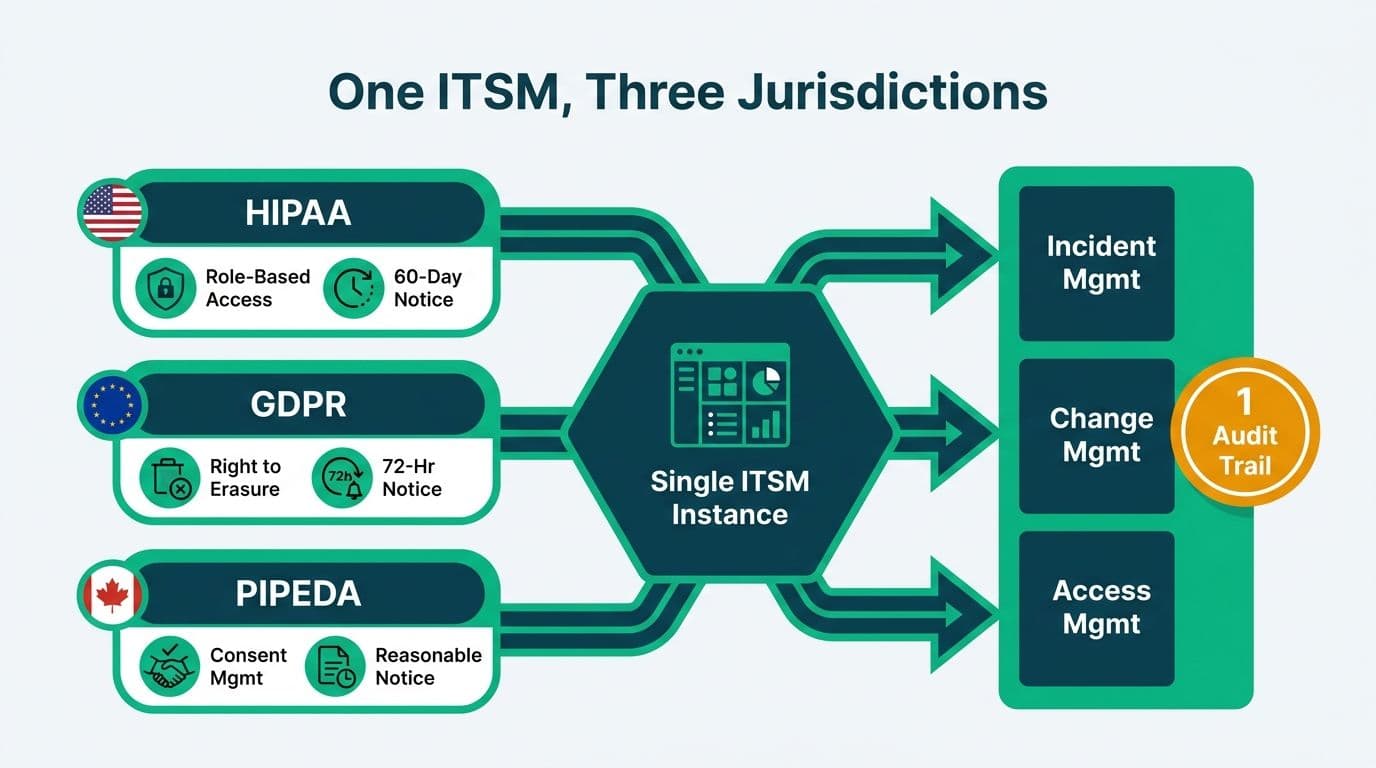
Healthcare IT teams running multi-jurisdictional operations face a specific configuration problem: HIPAA, GDPR, and PIPEDA each impose distinct requirements around data handling, breach notification, and patient rights, yet a single ServiceNow instance must satisfy all three without creating parallel workflows that multiply audit burden. When configured correctly, one unified ITSM environment can enforce jurisdiction-aware controls across incident, change, and access management simultaneously.
Key Takeaways
ServiceNow's role-based access controls, audit logging, and data classification fields provide the technical foundation for HIPAA, GDPR, and PIPEDA compliance.
Each regulation imposes distinct breach notification timelines and data subject rights that require separate workflow branches within a single instance.
The self-service portal must be scoped with user_criteria conditions and field-level masking to prevent inadvertent PHI or PII exposure.
Change management approval chains should include a mandatory compliance review gate before any system touching protected data is modified.
A phased implementation - incident management first, then change, then access controls - limits compliance risk at each stage.
Why Do Healthcare IT Teams Need a Unified ITSM Compliance Strategy?
Healthcare organizations operating across the US, Canada, and the EU cannot treat compliance as a regional silo. A US hospital network that acquires a Canadian clinic inherits PIPEDA obligations alongside existing HIPAA requirements. A UK NHS trust integrating with a US research partner must satisfy GDPR transfer restrictions and contractual HIPAA safeguard provisions simultaneously.
Managing these obligations through separate point tools creates audit risk: controls become inconsistent, log formats diverge, and breach response timelines are tracked in disconnected spreadsheets. ServiceNow ITSM - when properly configured - serves as a single control plane that enforces jurisdiction-aware rules without requiring separate instances per country. Organizations approaching this configuration for the first time benefit from the regulatory mapping expertise that ServiceNow consulting services provide, particularly when multiple jurisdictions are in scope from day one.
How Does ServiceNow ITSM Map to HIPAA, GDPR, and PIPEDA Requirements?
The three regulations share a common core - access control, audit trails, breach notification, and individual data rights - but differ in specifics that translate into distinct configuration choices.
| Requirement | HIPAA (US) | GDPR (EU/UK) | PIPEDA (Canada) |
|---|---|---|---|
| Data subject rights | Patient access to records | Right to access, erasure, portability | Right to access; correction; consent withdrawal |
| Breach notification | 60 days to HHS (45 CFR §164.412) | 72 hours to supervisory authority | As expeditiously as possible |
| Access control basis | Minimum necessary standard | Lawful basis plus data minimization | Need-to-know, purpose limitation |
| Audit trail retention | 6 years (45 CFR §164.312) | Aligned to data retention policy | Retained only as long as purpose requires |
| Vendor agreement | Business Associate Agreement | Data Processing Agreement | Contractual accountability required |
This mapping drives four concrete decisions in ServiceNow: data classification tagging on Configuration Items, role-based ACL scope, audit log retention policy, and workflow branching for breach notifications and data rights requests.
For a broader view of what ServiceNow's platform offers beyond ITSM, the CIO's complete platform guide covers the GRC, Security Operations, and HR modules that extend this compliance posture across the enterprise.
How Do You Configure ServiceNow ITSM for Healthcare IT Teams?
Incident management is the highest-frequency workflow in healthcare ITSM and therefore the highest compliance exposure. Every ticket that captures a symptom related to a clinical system potentially touches PHI under HIPAA or personal health information under PIPEDA.
Data classification at intake
Add a Data Classification field to the Incident form with values including "Contains PHI," "Contains PII - non-PHI," and "Non-sensitive." Use a client-side script to auto-populate this field when the Affected CI belongs to a clinical application group. This removes the burden of manual classification from Tier 1 analysts - the platform decides based on the Configuration Item, not analyst judgment.
A US hospital network using an EHR platform would map all clinical application CIs to the PHI classification automatically. Incidents touching those CIs then inherit restricted viewing rights, with sensitive fields masked for analysts lacking the appropriate data role.
Role-based access and minimum necessary
HIPAA's minimum necessary standard (45 CFR §164.514(d)) requires that access to PHI be limited to what is needed to perform a function. In ServiceNow, table-level ACLs using `gs.hasRole()` conditions enforce this without requiring separate tables. Clinical detail fields should be invisible to Tier 1 analysts and visible only to Tier 2 engineers and compliance officers. The same ACL structure satisfies PIPEDA's need-to-know and purpose limitation principles under Schedule 1, Clause 4.5 - the configuration is identical; the regulatory documentation of the rationale in the audit log is what makes it defensible under either regime.
Breach notification workflow
Build a Security Breach sub-category on the Incident form. When selected, the workflow creates a Privacy Officer task with a jurisdiction-aware due date: 72 hours for GDPR-scope incidents, an internal escalation trigger for HIPAA (with the 60-day regulatory clock running in parallel), and a prompt-response flag for PIPEDA. A jurisdiction multi-select field on the incident drives the branching logic. A UK NHS trust and a US academic medical center using the same instance trigger the same workflow; the jurisdiction field controls which notification timelines apply.
What Does a Compliant Change Management Workflow Look Like?
Change management is where compliance risk concentrates in healthcare IT. An unauthorized or insufficiently reviewed change to a clinical system can expose PHI, disrupt care delivery, and trigger audit findings simultaneously.
Compliance gate in the approval chain
Standard change workflows route to Change Advisory Board members. For healthcare teams, add an explicit Compliance Review task as a mandatory predecessor to CAB approval for any Normal or Emergency change affecting a clinical CI. The Privacy and Security Officer must sign off that the change does not introduce new PHI access points or alter data retention behavior. ServiceNow's Approval Policy configuration enforces this at the workflow engine level - not as an advisory step.
Risk scoring for clinical CIs
Assign a risk score multiplier to CIs tagged as clinical systems. ServiceNow's built-in risk calculator accepts custom inputs via the `risk_score` field on the Change Request. A change to an EHR integration interface should score materially higher than a change to an HR application, triggering stricter approval requirements automatically rather than relying on analyst judgment.
Emergency change documentation
Configure Emergency Change templates to auto-create a Post-Implementation Review task with a 24-hour due date. The task documents what changed, who authorized it, and which PHI-adjacent systems were affected. Apply field-level protection to the closed Change Request record to make that documentation immutable - a control that surfaces in both HIPAA Security Rule risk analyses and GDPR Article 32 technical controls documentation.
How Should Healthcare Teams Configure the ServiceNow Self-Service Portal?
The servicenow itsm self service portal setup for healthcare requires tighter catalog scoping than most industries. By default, the Service Portal exposes all active catalog items to all authenticated users. Healthcare organizations must restrict both item visibility and field content.
Catalog scoping by role
Apply `user_criteria` conditions to each catalog item so clinical staff see items relevant to clinical systems, IT administrators see the full catalog, and finance staff see neither. This prevents a front-desk employee from inadvertently raising a ticket that reveals access to a colleague's record - an internal HIPAA exposure risk that organizations frequently overlook during portal configuration.
Consent logging for multi-jurisdictional users
For Canadian users under PIPEDA, add a consent disclosure banner to the portal login page and capture a consent acknowledgment on first use. Store the timestamp and user ID in a dedicated consent log table - this record serves as evidence in a PIPEDA complaint investigation. For EU staff under GDPR, adapt the same mechanism and add a Data Subject Request catalog item that routes to the Privacy Officer breach workflow, creating an end-to-end audit trail from portal interaction to formal notification.
Self-service portal best practices for field masking
Implement a server-side script that strips common PHI patterns from free-text fields before records are committed to the database. This backstop can be cited in a HIPAA Security Rule risk analysis as a reasonable administrative safeguard against inadvertent PHI submission by end users unfamiliar with data handling requirements.
How Do You Manage Employee Data Privacy in ServiceNow HRSD Under GDPR, HIPAA, and PIPEDA?
Healthcare organizations using ServiceNow HRSD (Human Resources Service Delivery) face a privacy challenge distinct from clinical ITSM workflows: employee records sit at the intersection of employment law, healthcare sector regulations, and multi-jurisdictional data privacy requirements. HR and IT compliance leads managing servicenow hrsd employee data privacy under GDPR, HIPAA, and PIPEDA must configure four controls in concert - field-level encryption, data residency, audit trails, and consent workflows - to meet all three frameworks from a single instance.
Field-level encryption
HRSD stores sensitive employee data - national ID numbers, salary details, medical leave records, and background check results - that qualifies as special-category personal data under GDPR Article 9 and may fall under HIPAA business associate agreement scope when stored on the same instance as clinical PHI. Enable field-level encryption on HR Case and Employee Profile tables for any field holding sensitive-category data. In ServiceNow, this is configured through the Data Encryption module: designate the target fields, assign an encryption context tied to the HR Admin role, and establish a key rotation schedule aligned to your risk register - annually at minimum to satisfy GDPR Article 32's requirement for appropriate technical measures.
Data residency settings
GDPR Article 44 prohibits transferring EU employee personal data to jurisdictions without an adequate protection mechanism. For healthcare organizations running a single global ServiceNow instance, configure instance data residency to an EU data center for EU staff records, or use ServiceNow's Data Boundary feature to pin HRSD tables to the appropriate regional node. Canadian employees' data subject to PIPEDA requires parallel treatment: the OPC's accountability principle requires that data transferred across borders receive equivalent protection, documented in a transfer impact assessment. Map each HRSD table to its correct data residency zone at provisioning - changing residency post-launch requires a formal change request and re-validation against the risk register.
Audit trails for HR case access
Configure table-level auditing on HR Cases, Employee Profiles, and any HRSD table holding special-category personal data. The audit log must capture who accessed the record, from which role, and which fields were viewed or modified - not merely that a record was opened. For GDPR-scope employees, these logs serve as evidence of Article 5(1)(f) integrity and confidentiality compliance. For HIPAA-scope employees whose records may include health-related leave data, the same log satisfies Security Rule §164.312(b) audit control requirements. Retain HRSD audit logs for six years to match the HIPAA retention floor; purge EU employee records per the schedule documented in your GDPR Record of Processing Activities.
Consent workflows
PIPEDA and GDPR both require that employees understand what personal data is collected and for what purpose. Build a consent workflow in HRSD triggered at employee onboarding: the workflow presents a data processing disclosure, captures an explicit acknowledgment, timestamps the response, and stores it in a dedicated consent log table separate from the HR Case record. For EU employees, the workflow must also surface the right to withdraw consent for non-mandatory processing - such as inclusion in workforce analytics dashboards - and route withdrawal requests to the Privacy Officer for action within 30 days. PIPEDA's consent requirement is functionally equivalent; the same workflow branch handles Canadian employees with jurisdiction-appropriate disclosure language, keeping the configuration overhead minimal while satisfying both regimes.
ServiceNow ITSM Implementation Checklist for Healthcare Compliance
A structured servicenow itsm implementation checklist reduces the risk of compliance gaps surfacing after go-live. Sequence the phases - incident management first, then change, then access controls and portal - to limit blast radius at each stage.
Pre-configuration
Map all Configuration Items to PHI/PII classification
Define the minimum role set: Tier 1, Tier 2, Privacy Officer, CAB member
Obtain a Business Associate Agreement from ServiceNow's Trust portal before storing any PHI
Confirm instance data residency (US, EU, or Canadian region) and document in the risk register
Identify all jurisdictions in scope: HIPAA, GDPR, PIPEDA, or a combination
Incident Management
Add Data Classification field with auto-population script tied to CI group membership
Configure ACLs to enforce minimum necessary on PHI-classified incidents
Build Security Breach sub-category with jurisdiction-aware notification workflow
Set audit log retention to 6 years minimum for HIPAA-scope records
Change Management
Add Compliance Review task as mandatory CAB predecessor for clinical CI changes
Configure risk score multiplier for clinical system CIs
Create Emergency Change template with 24-hour Post-Implementation Review task
Apply field-level protection to closed Change Request records
Self-Service Portal
Scope catalog items using user_criteria conditions by role
Add consent disclosure and acknowledgment logging for PIPEDA and GDPR users
Implement server-side PHI-pattern stripping on free-text fields
Build Data Subject Request item routing to Privacy Officer workflow
HRSD Employee Data Privacy
Enable field-level encryption on HR Case and Employee Profile tables for special-category data fields
Pin HRSD tables to the correct regional data residency node at provisioning
Configure table-level auditing on all HRSD tables holding sensitive personal data
Build onboarding consent workflow with jurisdiction-branching for GDPR and PIPEDA employees
For organizations assessing their data infrastructure readiness before beginning configuration, a free BI readiness assessment can surface governance gaps that affect ITSM compliance posture downstream.
How Does ServiceNow Compare to Jira Service Management for Healthcare Compliance?
Healthcare IT directors evaluating servicenow vs jira service management for regulated environments face a clear decision point: does the native compliance depth of ServiceNow justify the licensing premium over lighter alternatives? When the evaluation criteria include data residency, audit logging depth, and access controls tested against GDPR, HIPAA, and PIPEDA across all three regulated regions, the gap between the platforms widens considerably.
| Capability | ServiceNow ITSM | Jira Service Management |
|---|---|---|
| BAA availability | Yes, via ServiceNow Trust portal | Requires enterprise cloud agreement |
| Data residency options | US, EU, and CA regions selectable at provisioning | EU residency on enterprise tier; Canadian residency limited |
| Audit log completeness | Field-level audit trail with role, timestamp, and field value | Standard admin audit logs; field-level PHI access trails require custom scripting |
| Native PHI access controls | Field-level ACLs, role-based field masking | Basic audit log; PHI controls require custom build |
| GDPR data subject request workflow | Configurable natively or via GRC module | Requires third-party plugin or custom development |
| PIPEDA consent logging | Configurable via platform scripting | No native support |
| Change advisory board workflow | Native, with approval policy engine | Available, less mature |
| Clinical CI classification | Native CMDB with classification fields | Limited CMDB; primarily a software asset tool |
For teams running a direct servicenow vs jira service management gdpr hipaa compliance evaluation, data residency is typically the first technical control that legal and privacy teams examine. ServiceNow's selectable US, EU, and Canadian data center regions satisfy GDPR Article 44 transfer restrictions and PIPEDA's accountability principle without contractual workarounds - the region is locked at instance provisioning and documented in the shared risk register. Atlassian Cloud offers EU data residency at enterprise tier, but granular Canadian region selection remains less mature as of mid-2026, which creates friction for health authorities processing data subject to both PIPEDA and provincial health privacy legislation simultaneously.
Audit logging depth is the second differentiator. ServiceNow captures field-level changes with actor role, timestamp, previous value, and new value in a tamper-evident log - the precise evidence format OCR investigators, ICO reviewers, and OPC complaint investigators request. Jira's standard logs cover administrative actions adequately, but field-level PHI access trails require custom development, narrowing the licensing cost differential for any team that needs full auditability under HIPAA Security Rule Section 164.312(b).
For software engineering teams in a health-tech SaaS company with minimal direct PHI exposure, a lighter ITSM tool may be cost-appropriate. The decision pivots on whether IT workflows regularly touch PHI. When they do, ServiceNow's native compliance depth reduces the custom development cost of achieving regulatory parity. The ServiceNow implementation cost breakdown for 2026 provides licensing and configuration cost context for mid-market healthcare organizations making this decision.
How Do You Build the ROI Business Case for Healthcare ITSM?
The servicenow itsm roi business case in healthcare rests on three quantifiable levers: reduced audit preparation time, compressed breach investigation cycles, and avoided penalty exposure.
Audit preparation: A correctly configured ServiceNow instance produces point-in-time reports of who accessed which PHI-adjacent record, when, and from which role - exportable in minutes rather than weeks of manual log review. This compresses OCR audit response preparation materially and provides defensible evidence without bespoke extract scripts.
Breach investigation: The structured workflow above compresses the time from detection to regulated notification. For GDPR, the difference between a 72-hour notification and a late filing is the difference between a regulatory warning and a material fine under Article 83. For HIPAA, documented workflow evidence demonstrates good-faith compliance to OCR investigators.
Avoided penalty exposure: Frame the investment as penalty avoidance in CFO presentations rather than compliance overhead. Document fines issued by OCR (US), the ICO (UK), and the OPC (Canada) against peer organizations as the baseline risk that the ITSM configuration investment offsets. A Canadian health authority considering PIPEDA readiness can use OPC enforcement decisions as concrete reference points for the financial exposure the platform controls.
Organizations that have already built HIPAA-compliant reporting infrastructure should align the ITSM layer with existing tooling to maintain a consistent compliance posture end to end. The HIPAA compliant BI tools guide covers the reporting side of that alignment.
---
About Lets Viz: Lets Viz has delivered data analytics and platform consulting for US healthcare, UK fintech, Canadian manufacturing, and global SaaS clients since 2020, earning a 5.0 rating on Clutch. Our ServiceNow practice combines technical configuration expertise with regulatory mapping across HIPAA, GDPR, and PIPEDA, helping hospital and health-system IT teams build a defensible multi-jurisdiction compliance posture within a single unified instance.
Ready to configure ServiceNow ITSM for your multi-regulation healthcare environment? ServiceNow consulting services from Lets Viz cover compliance mapping, platform configuration, and phased deployment for hospital and health-system IT teams.