AI Automation Agency Pricing 2026: What Buyers Pay
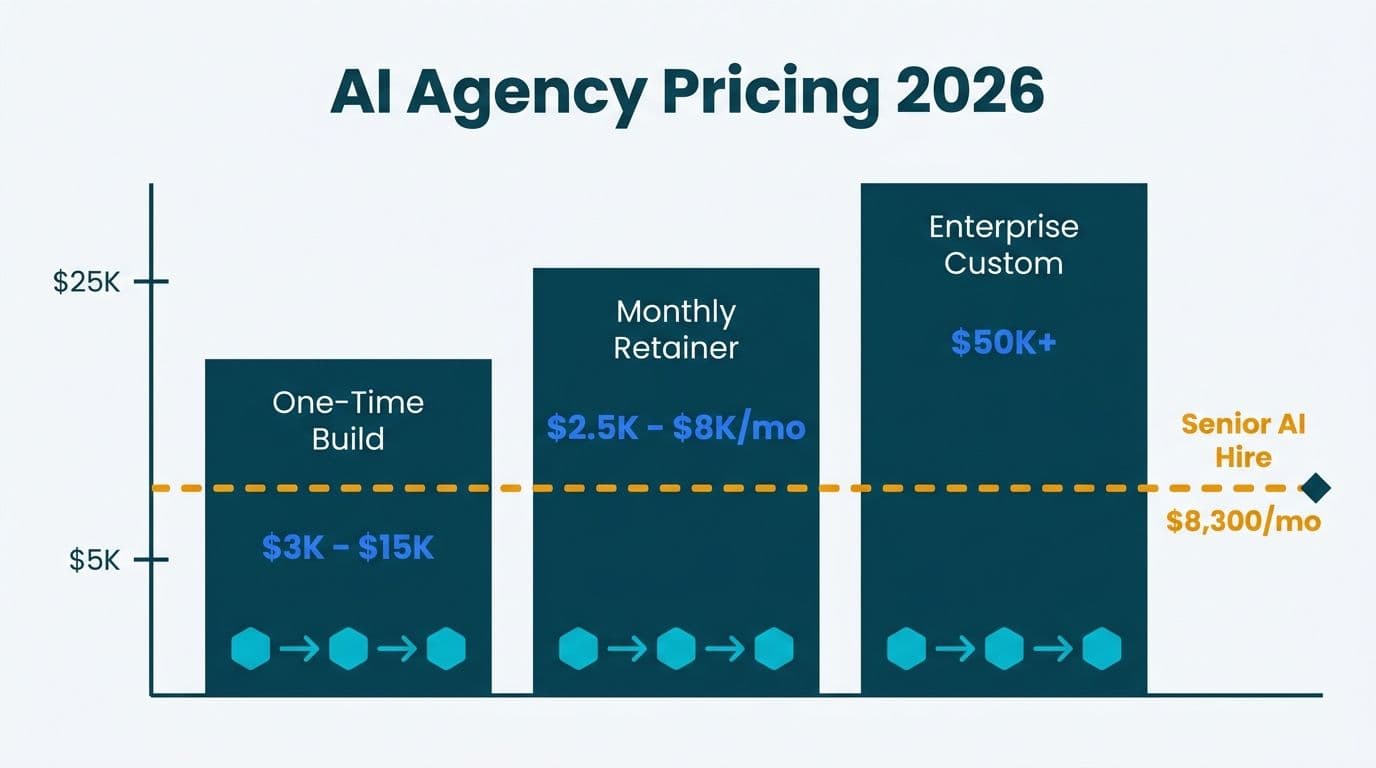
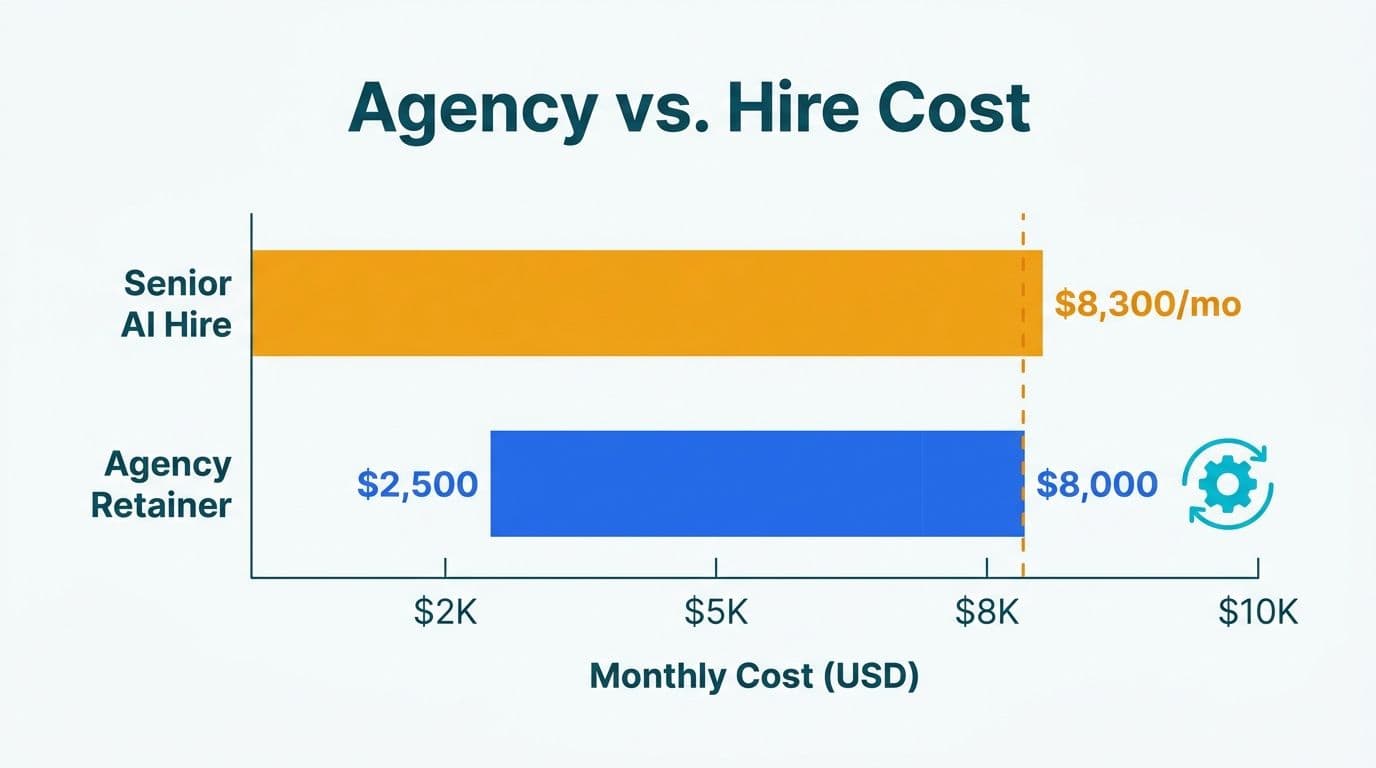
AI automation agency pricing in 2026 ranges from $3,000 for a focused workflow build to $50,000+ for a custom multi-agent system. Most mid-market projects land between those poles: one-time builds run $3,000-$15,000, ongoing retainers $2,500-$8,000/month. For context, a fully-loaded senior AI automation hire costs roughly $8,300/month before they ship a single workflow.
Who This Is For
This page is for buyers in one of these situations:
- You have 2-10 manual processes eating analyst, operations, or finance team hours and want a realistic cost range before engaging a vendor.
- You are a CIO, data team lead, or finance director at a mid-market company in the US, Canada, or UK/EU with budget authority and a 90-day window to demonstrate ROI.
- You are weighing agency vs. in-house hire for AI automation and want an honest comparison.
- You have already automated simpler tasks with off-the-shelf tools and now need LLM integration or multi-step agent logic that those tools cannot handle cleanly.
This is NOT a fit if:
- You need a single trigger connecting two SaaS tools - that is a self-serve problem at $50/month, not a consulting engagement.
- You are building a dedicated internal AI team long-term; an agency retainer should be a bridge to that, not a permanent substitute.
AI Automation Agency Pricing 2026: What the Numbers Look Like
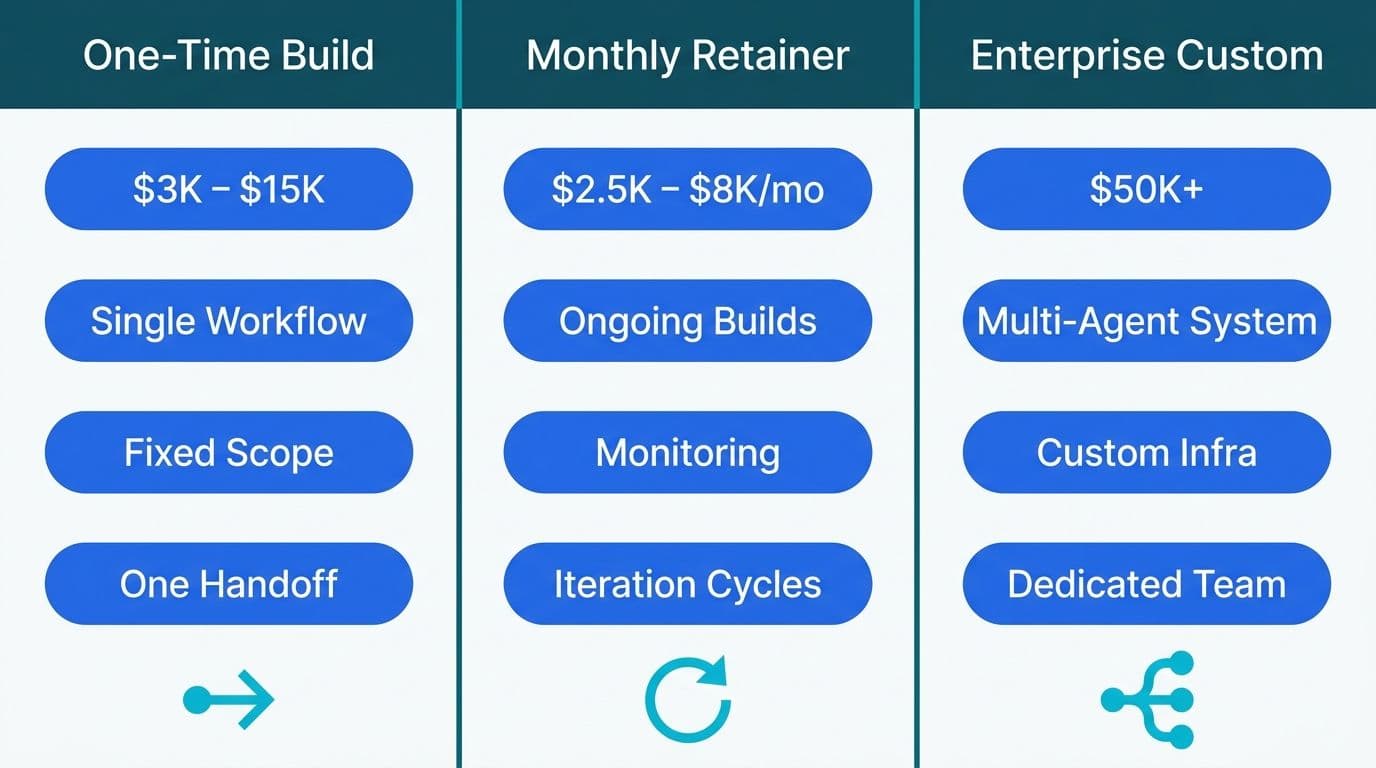
| Engagement Type | Typical Range | Best Fit |
|---|---|---|
| Workflow automation build (n8n/Make/Zapier + LLM) | $3,000-$15,000 one-time | 1-5 processes, defined scope |
| Custom AI agent development (LangChain/Claude/OpenAI) | $10,000-$50,000+ one-time | Multi-step reasoning, complex logic |
| AI automation retainer | $2,500-$8,000/mo | Monitoring, iteration, new launches |
| Hourly consulting (discovery, audits, architecture) | $150-$250/hr | Advisory without ongoing commitment |
| Full-time senior AI developer (in-house, fully loaded) | ~$8,300/mo (~$100k/yr) | Long-term internal team building |
The in-house break-even: a retainer at $4,000/month is roughly half the cost of a fully-loaded senior hire - without the 60-90 day recruiting timeline, benefits overhead, or single-person knowledge risk.
What Drives AI Automation Agency Pricing Up or Down?
Process count and complexity is the primary cost driver. A single-process build with one trigger, one output, and two integrations scopes cleanly at the low end of the $3,000-$15,000 range. Add five processes with branching logic, error handling, and LLM decision steps, and you are at the high end or beyond.
LLM integration adds scope, not just API cost. A workflow that routes customer service tickets by semantic category is not the same build as one that reads a PDF contract and extracts structured fields with confidence scoring. Prompt engineering, output validation, and edge-case handling take real engineering hours.
Compliance environment matters significantly. HIPAA-compliant automation in the US requires audit logging, access controls, and a Business Associate Agreement (BAA) with any SaaS tool in the chain. UK and EU buyers need GDPR-compliant data handling throughout - specifying where data is processed, stored, and deleted, and often requiring EU data residency for any LLM calls involving personal data. Canadian clients fall under PIPEDA (and Quebec's Law 25), which adds consent tracking and breach notification requirements. These compliance layers should be scoped explicitly upfront, not discovered mid-build.
Integration count - how many systems need to exchange data - directly affects build time. Three systems (CRM, ERP, email) is a different project from ten.
What Working With Us Looks Like
Our AI automation consulting practice follows a structured delivery model designed to get you to a production-ready automation without open-ended hourly billing.
Weeks 1-2: Discovery and process mapping. We interview your team leads, map the manual process end-to-end, and identify where automation breaks cleanly and where it needs a human checkpoint. You receive a scoped proposal with a fixed price or a capped time-and-materials range before any build work begins.
Weeks 3-5: Build and internal testing. Workflows are built in staging, connected to sandbox credentials, and stress-tested against real-looking data. Edge cases are documented and handled, not left for post-launch discovery.
Week 6: Handoff and parallel run. The automation runs alongside the manual process for one week. Your team flags anything that does not match expected output. Discrepancies are resolved before the manual process is retired.
Ongoing (retainer clients): monitoring, iteration, and expansion. A retainer at $2,500-$8,000/month covers error monitoring, adjustments when upstream APIs change, and launching the next automation on the roadmap.
One principle we carry into every build: agents must verify outcomes, not outputs. We once ran a system that marked 26+ site-performance fix tasks as resolved - because a human had read the recommendation, not because code had shipped. Google's Core Web Vitals report stayed flat at 405 flagged URLs. Every automation we deliver now includes an outcome verification step built into the workflow, not bolted on later.
Before launching any automation, the AI workflow automation pre-launch checklist is worth a read.
One-Time Build vs. Retainer: Which Engagement Model Fits?
One-time build fits when the process is stable and well-defined - a monthly financial reconciliation, a quarterly compliance report pulling from two known sources, or a one-way data sync between systems you are not planning to change.
Retainer fits when you have a backlog of automation candidates, when upstream SaaS APIs change regularly, or when you want an on-call resource to monitor and iterate. Our n8n finance workflow automation examples show what an ongoing automation roadmap looks like for a finance team in practice.
A middle path that works well: a fixed-scope build contract with an optional 90-day monitoring add-on at a flat monthly fee. You own the build; you pay for support only while the process stabilizes.
Zoho Creator vs. Microsoft Power Apps: Does Platform Choice Affect Consulting Costs?
For buyers evaluating Zoho Creator vs. Microsoft Power Apps for business, the automation consulting layer is separate from the platform license. Zoho Creator is typically lower-cost to license and favors Zoho-native workflows and smaller teams. Power Apps integrates more deeply with Microsoft 365 and Azure environments, which matters if your stack is already Microsoft-heavy.
Zoho Creator's GDPR compliance and data residency configuration are documented in Zoho's Data Processing Addendum (2025 edition) - directly relevant for UK, EU, and Canadian buyers who need to know where data is processed. For building a custom approval workflow in Zoho Creator, the low-code environment means faster iteration at lower hourly rates than a fully custom build. Zoho Creator is also a strong fit for professional services firms running project-based operations without a large IT team. See our Zoho Creator use-case breakdown for industry-specific examples, and Zoho Analytics pricing and plan limits if you are comparing licensing costs across platforms.
Healthcare and Finance: What the Compliance Layer Costs
HIPAA compliance in the US does not add a fixed dollar amount, but it consistently pushes engagements toward the upper end of any price band. Expect additional scope for audit logging infrastructure, BAA review, and access control documentation. For a healthcare automation covering patient scheduling or claims routing, scoping the compliance layer explicitly at kickoff prevents budget surprises mid-build.
For finance directors in Canada, PIPEDA-compliant automation requires documenting exactly what data is touched, retained, and accessible - and under Quebec's Law 25, explicit consent workflows are mandatory. In the UK and EU, GDPR Article 30 record-keeping and data minimisation review are baseline requirements for any automation that processes personal data. We have delivered AI workflow automation for healthcare operations across US and Canadian environments, and the compliance layer is built in from day one, not retrofitted.
Looker Studio Alongside Automation: Monitoring What Your Workflows Produce
Some buyers also need a reporting layer to monitor what their automations are producing. A Looker Studio dashboard for healthcare compliance reporting or a Looker Studio financial dashboard can connect directly to the data your automations write, turning a manual compilation task into a live view.
A standard Looker Studio project (3-5 connected reports) runs $2,000-$6,000 one-time. If BigQuery is in the data pipeline, the build is $5,000-$15,000. On the Looker Studio template vs. custom dashboard for small business question: templates cut build time but rarely match your exact data structure without rework. Our Looker Studio consultant cost guide for 2026 covers the full breakdown, and the Looker Studio vs. Power BI 2026 decision guide covers the platform comparison without a sales angle.
Three Objections Buyers Raise - and Honest Answers
"We'll just hire someone." A fully-loaded senior AI automation developer costs roughly $8,300/month before you write a job description. Recruiting takes 60-90 days in a competitive market. An agency can start within two weeks, deliver a working automation in four to six weeks, and cost significantly less per month on a retainer until your volume of work justifies the full-time hire. At that point, the documentation we produce during delivery becomes onboarding material for your new employee.
"We're worried about lock-in." Everything we build runs in your environment, on your credentials, in tools you license. We use open-source orchestration layers (n8n, LangChain) where possible to avoid proprietary lock-in. Retainers are month-to-month after the initial build contract - you are not buying access to a black box.
"An offshore agency quoted us half the price." That quote may be accurate for the build itself. The difference shows up in compliance handling (HIPAA, GDPR, PIPEDA), communication quality during the parallel run, and what happens when an upstream API changes at 2am in your timezone. For healthcare and finance buyers who carry regulatory exposure, a gap in data handling is not a budget line to optimise.
Ready to scope a specific process or want a second opinion on a proposal you have received? Our AI automation consulting team will map out a fixed-price build and tell you honestly whether a simpler tool would serve you better.
Get a Number Before the Call
If you want a rough estimate before booking a conversation, the instant project cost calculator gives you a scoped range based on process count, integration complexity, and compliance requirements. Most buyers use it to sanity-check a vendor quote they have already received.
When you are ready to move from range to a fixed-price proposal, book a free discovery call through our AI automation consulting page. We will scope the first process, deliver a proposal within five business days, and tell you honestly whether the work fits a retainer or is better as a one-off build.
---
About Lets Viz: Lets Viz has delivered data automation and analytics consulting since 2020 for clients in healthcare, SaaS, finance, and agency sectors across the US, Canada, and UK. We hold a 5.0 rating on Clutch and specialise in mid-market engagements where compliance requirements, data quality, and measurable ROI are non-negotiable.