AI Workflow Automation Mistakes: Pre-Launch Checklist
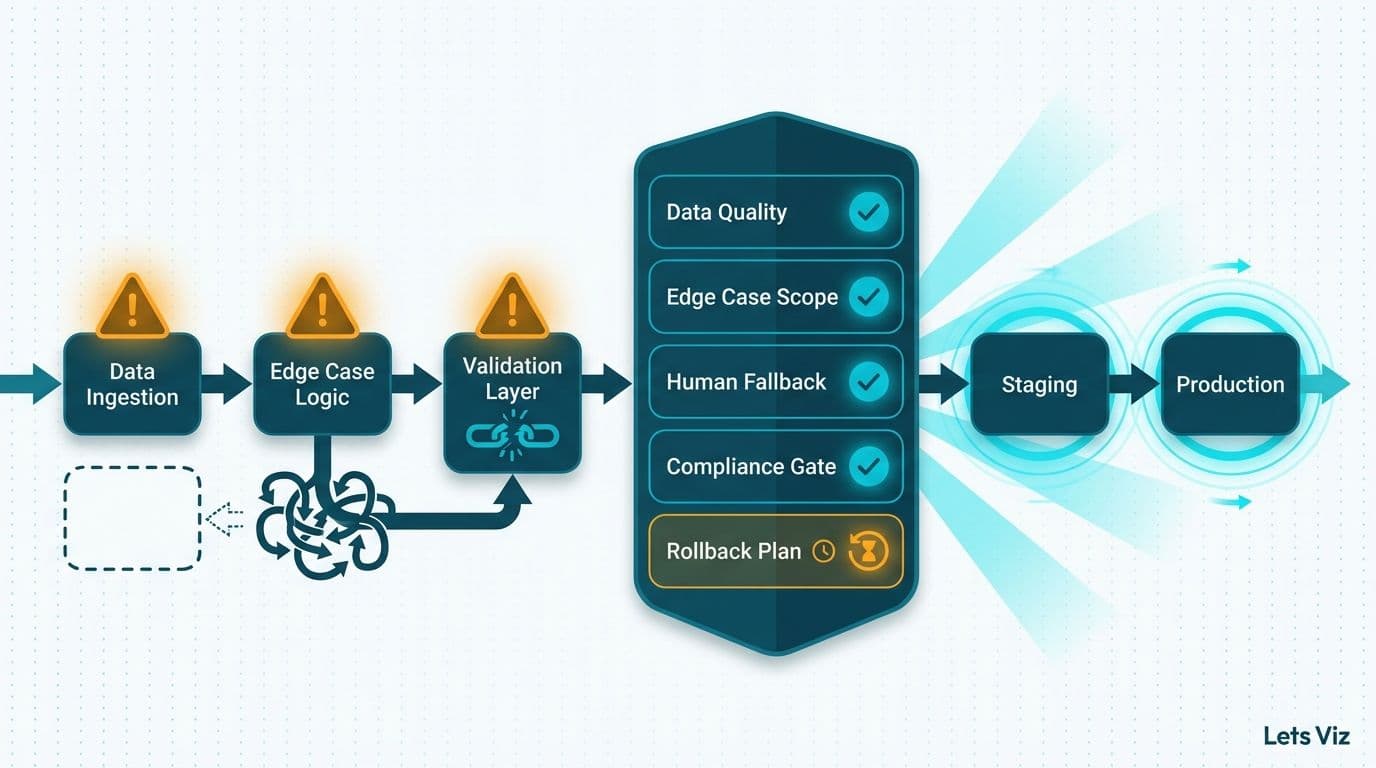
The most common AI workflow automation mistakes - over-automating edge cases, skipping data-quality validation, and omitting human-in-the-loop fallbacks - cost mid-market teams months of rework. Healthcare and finance organizations face the greatest exposure because errors cascade through compliance-sensitive processes. A structured pre-launch checklist catches most failures before a single workflow touches production.
Key Takeaways
Over-automating rare edge cases is the single most expensive implementation error in healthcare and finance AI projects.
Skipping upstream data-quality checks invalidates every downstream output an automated workflow produces.
Human-in-the-loop fallbacks are legally required in US (HIPAA), UK/EU (GDPR Article 22), and Canadian (PIPEDA) environments.
The build-vs-buy decision shapes long-term maintenance cost more than the initial license fee for mid-market finance automation.
A 12-point pre-launch checklist catches critical failures before production deployment and protects audit trail integrity.
What Are the Most Costly AI Workflow Automation Mistakes?
The three patterns that dominate post-implementation reviews are: automating before the data is clean, expanding scope to cover every edge case before core flows stabilize, and deploying without a defined fallback for when the model produces a low-confidence output.
According to Future Market Insights (as of 2026), the global AI consulting services market is estimated at approximately USD 14.5 billion and is projected to surpass USD 90 billion by 2035. That pace of adoption creates institutional pressure to deploy fast - and speed is the primary enabler of all three mistakes. In 2026, the proliferation of no-code and generative AI workflow tools has accelerated this effect: teams that previously needed weeks to add an automation branch can now configure one in hours, compressing the gap between "good idea" and "fragile production logic" to almost nothing.
Over-automating edge cases is typically the first sign a project is drifting. A US healthcare revenue cycle team that successfully automates 95% of claims adjudication will often try to capture the remaining 5% - complex multi-payer denials, coordination-of-benefits disputes, and late-charge adjustments. The effort to automate that last slice routinely costs three times the budget spent on the first 95%, and the resulting logic is fragile, difficult to test, and nearly impossible to audit.
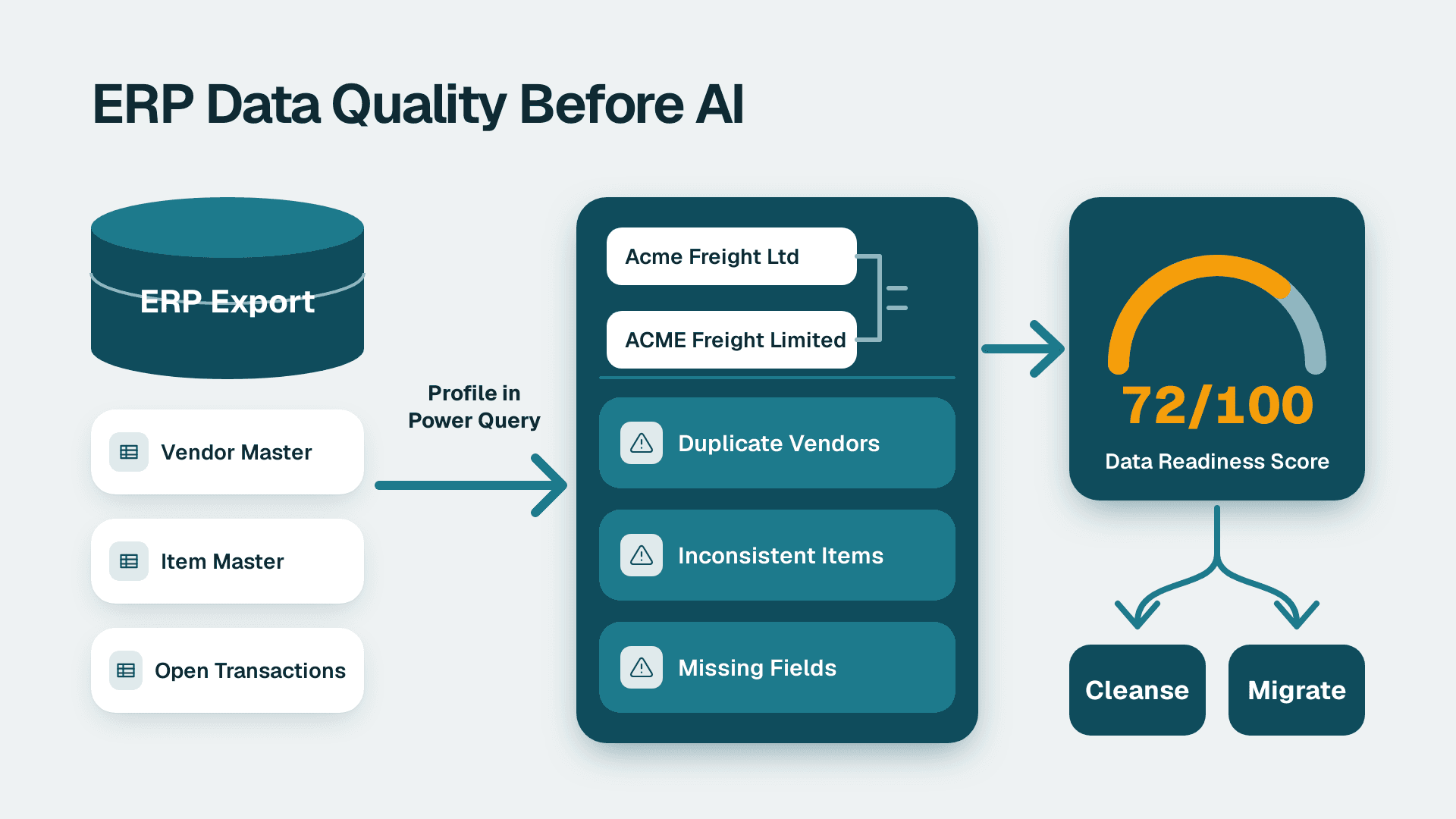
Skipping data-quality checks is the second pattern. AI accounts payable automation for finance teams consistently underperforms because invoices arrive in inconsistent formats - varying vendor name conventions, missing PO reference numbers, and duplicate line items from re-sends. No model tuning compensates for corrupted or incomplete input data. The data pipeline must be treated as a first-class engineering problem, not a prerequisite addressed after core automation logic is built.
No human-in-the-loop fallback is the third. Under GDPR Article 22, EU residents have the right not to be subject to solely automated decisions with legal or significant effects. Under PIPEDA in Canada, organizations must be able to explain automated decisions to affected individuals. Under HIPAA in the US, automated workflows touching protected health information attract scrutiny during audits. A fallback route to a human reviewer is not optional in regulated industries - it is a compliance expectation in virtually every major jurisdiction.
Organizations that engage Custom AI automation services early in the project lifecycle typically resolve all three issues during the scoping workshop, before a single line of workflow logic is written.
Why Do Finance Teams Fail at AI Accounts Payable Automation?
Finance teams most often fail at AI accounts payable automation because they automate exception handling before straight-through processing is stable, and they underestimate the data normalisation effort required upstream.
A World Economic Forum review spanning over 50 financial services institutions found that data readiness - not model sophistication - was the primary differentiator between automation programs that delivered ROI and those that required costly remediation.
Consider a UK fintech firm processing roughly 40,000 invoices per month that attempted to automate three-way PO matching using a machine learning classifier trained on 18 months of historical data. The model performed well in test environments but degraded rapidly in production when a new vendor onboarding process introduced address format variations it had never encountered. The root cause was not model quality - it was the absence of a data-normalisation layer between the ERP feed and the automation engine. Under GDPR, the firm also had to ensure that vendor personal data flowing through the pipeline was covered by a Data Processing Agreement with every third-party tool involved.
Common failure modes in AP automation:
Inconsistent vendor master data: Duplicate supplier records cause the model to route invoices to incorrect approval paths.
Missing approval-hierarchy encoding: Invoices above defined thresholds require multi-level sign-off; automation tools that do not reflect this create compliance gaps.
No exception queue with SLA: When the model flags a low-confidence match, invoices can stall indefinitely if no monitored human queue exists.
Uncontrolled scope creep: Teams add new document types - credit memos, expense claims, intercompany bills - before the original invoice flow is stable.
For finance teams that want real-time visibility into how their AP automation pipeline is performing, our AI-Powered Power BI Consulting for Finance Teams resource covers how to layer dashboards over automation workflows to surface failure modes before they become backlogs.
What Finance Tasks Cannot Be Automated With AI?
Knowing the automation boundary is as important as knowing what to automate. Misidentifying that boundary is itself one of the most common AI workflow automation mistakes practitioners make when scoping a new project.
The Healthcare Financial Analytics Market is projected to grow at an 8.58% CAGR from 2026 to 2035, according to Market Research Future (as of 2026) - growth driven in part by the recognition that analytics and human judgment, not full automation, are the appropriate tools for many complex financial decisions.
| Finance Task | Why Automation Fails | Recommended Approach |
|---|---|---|
| Complex tax judgment calls | Requires jurisdictional interpretation and professional liability | AI-assisted research; licensed professional sign-off |
| Vendor contract negotiation | Relational, contextual, and legally binding | AI summarises terms; human negotiates |
| Board-level financial narrative | Requires strategic context and stakeholder nuance | AI drafts; CFO edits and approves |
| Whistleblower and fraud investigations | Chain-of-custody evidence integrity required | Human-led; AI flags anomalies |
| Multi-entity consolidation with complex intercompany eliminations | High complexity and material misstatement risk | Semi-automated with mandatory human review gate |
| Related-party transaction disclosures | Regulatory interpretation required across jurisdictions | AI-assisted; legal review mandatory |
The practical rule: AI is a force-multiplier for volume-based, rule-bounded tasks - recurring journal entries, bank reconciliations, invoice matching, and expense categorisation. It is not a substitute for professional judgment in tasks where regulatory interpretation, contextual nuance, or fiduciary accountability are required.
For a rigorous framework on evaluating which automation investments justify the cost, the CFO's Framework for Measuring AI Analytics ROI provides a practical financial evaluation methodology.
How Do You Automate the Month-End Close Process Without Breaking Audit Trails?
Automating the month-end close with AI is achievable, but only when automation preserves an immutable audit trail and a human review gate sits before any journal entry posts.
A 2026 review of healthcare finance investment priorities by Definitive Healthcare identified AI-driven analytics as the leading investment theme for the second consecutive year, with month-end close automation and real-time variance analysis topping the list of planned deployments across healthcare finance teams.
The standard implementation sequence for a compliant month-end close:
1. Data extraction and validation - Pull the trial balance, sub-ledger feeds, and bank statements. Run data-quality checks for missing account codes, unexpected zero balances, and duplicate transactions. No automation proceeds on data that fails validation.
2. Automated reconciliation - Apply high-confidence matching rules for predictable items such as intercompany eliminations for known entity pairs and recurring bank transactions. Flag low-confidence items directly to a human review queue.
3. Accrual calculation - Apply rule-based logic for predictable recurring items such as rent, software subscriptions, and payroll accruals. Flag any item above a defined materiality threshold for human review before posting.
4. Flux analysis and variance commentary - AI compares current period to prior period and prior year, then generates draft variance commentary for the finance team to review and edit before distribution.
5. Human review and sign-off gate - No journal entry posts until a credentialed reviewer approves. This step is non-negotiable under SOX Section 302 and 404 for US public company subsidiaries, under IFRS for UK and EU entities, and under ASPE or IFRS for Canadian issuers.
A Canadian manufacturing company that implemented this sequence using n8n as the orchestration layer reduced its month-end close from 11 days to 4 days. The automation itself took two weeks to configure. Cleaning the chart-of-accounts mapping and deduplicating the vendor master took six weeks. That ratio - three times as long on data quality as on automation logic - is consistent with what most mid-market implementations experience.
n8n finance workflow automation examples like this work well because the platform connects ERP APIs, spreadsheet inputs, and approval routing without requiring custom code for every connector. The key is treating n8n as the sequencing and routing layer, not the data-quality layer. Data quality must be engineered separately as a dedicated pipeline stage.
The guide to automating monthly financial reporting in Power BI covers the downstream reporting layer that complements a close automation workflow.
Build vs Buy: Which Finance Automation Approach Fits Mid-Market Companies?
For most mid-market companies in healthcare and finance, a hybrid approach - buying a platform for orchestration and building the business-logic layer on top - outperforms both pure-build and pure-buy strategies.
Recent market research (as of 2026) projects the global AI consulting and support services market expanding at a 31.6% CAGR through 2030, reflecting a shift toward implementation expertise over off-the-shelf licensing. The market is growing because purchasing a platform without the capability to configure it for your specific data environment and compliance requirements delivers little measurable value.
| Dimension | Pure Buy (SaaS) | Pure Build (Custom Code) | Hybrid (Platform + Custom Logic) |
|---|---|---|---|
| Time to first working workflow | 2-6 weeks | 3-6 months | 4-10 weeks |
| Upfront cost | Low (subscription) | High (engineering hours) | Medium |
| Customisation flexibility | Low | High | High |
| Ongoing maintenance burden | Vendor | Internal team | Shared |
| Audit trail control | Varies by vendor | Full | Full |
| HIPAA/GDPR compliance | Vendor BAA or DPA required | Internal controls | Vendor agreement plus internal controls |
| Best suited for | Standardised, commodity workflows | Highly proprietary logic | Most mid-market scenarios |
The build-vs-buy decision for finance automation at mid-market companies typically hinges on two questions: How proprietary is the business logic? And does the internal team have the capacity to maintain custom code through staff turnover?
A US SaaS finance team that chose a pure-build approach for accounts payable automation spent 14 months building what a hybrid approach would have delivered in 10 weeks — and then spent an additional 30% of the original build cost every year on maintenance, primarily because custom vendor-API integrations required patching each time a supplier updated their EDI format or invoice schema. By month 18, ongoing maintenance had consumed more engineering hours than the initial build itself. That hidden maintenance multiplier is the figure most teams fail to model when comparing pure-build cost against a hybrid platform subscription.
For healthcare organizations, compliance adds a critical dimension: any vendor platform that processes patient financial data must execute a Business Associate Agreement (BAA) under HIPAA. UK and EU equivalents are GDPR Data Processing Agreements (DPAs). Canadian organizations under PIPEDA must document what personal data flows through the automation, the legal basis for processing, and the applicable retention schedule.
The Pre-Launch Checklist: 12 Questions Before Any AI Workflow Goes Live
This checklist applies to any AI workflow automation deployment in healthcare or finance. Treat any item answered negatively as a launch blocker.
Data Readiness
[ ] Is the upstream data source validated for completeness and consistency before the workflow consumes it?
[ ] Is there a documented data-quality threshold below which the workflow pauses and routes the item to a human reviewer?
[ ] Are all vendor, patient, or client identifiers deduplicated in the master data source?
[ ] Has the data schema been reviewed for HIPAA (US), GDPR (UK/EU), or PIPEDA (Canada) compliance obligations?
Scope Control
[ ] Is the automation scoped to the 80-90% of transaction volume that follows a predictable pattern, with edge cases routed to a human queue?
[ ] Has a subject matter expert signed off on the boundary between automatable and non-automatable cases?
[ ] Is there a governed process for adding new edge cases to scope rather than patching them ad hoc in production?
Human-in-the-Loop
[ ] Does every automated decision path have a defined fallback route to a human reviewer?
[ ] Is there a documented SLA for the human exception queue so that flagged items do not stall silently?
[ ] Are approval hierarchies and materiality thresholds encoded in the workflow configuration, not assumed?
Compliance and Audit
[ ] Does the automation produce an immutable, timestamped audit log of every decision and every action taken?
[ ] Have legal or compliance stakeholders reviewed and approved the automated decision logic before go-live?
For healthcare organizations building the data governance layer that underpins compliant automation, the HIPAA-Compliant Analytics Dashboard Best Practices Checklist provides the governance framework for the underlying data infrastructure.
Ready to implement AI workflow automation without the costly mistakes? The team behind Custom AI automation services at Lets Viz works with mid-market healthcare and finance organizations to design compliant, production-ready automation - scoped correctly from the first workshop session.
---
About Lets Viz: Lets Viz has delivered AI analytics and automation consulting since 2020, serving US healthcare organizations, UK fintech firms, Canadian manufacturing companies, and global SaaS businesses. Rated 5.0 on Clutch, the team specializes in compliant, production-ready implementations that balance automation depth with the human oversight requirements of HIPAA, GDPR, and PIPEDA frameworks.