AI Audit for Wholesale Distributors: A Practical Guide
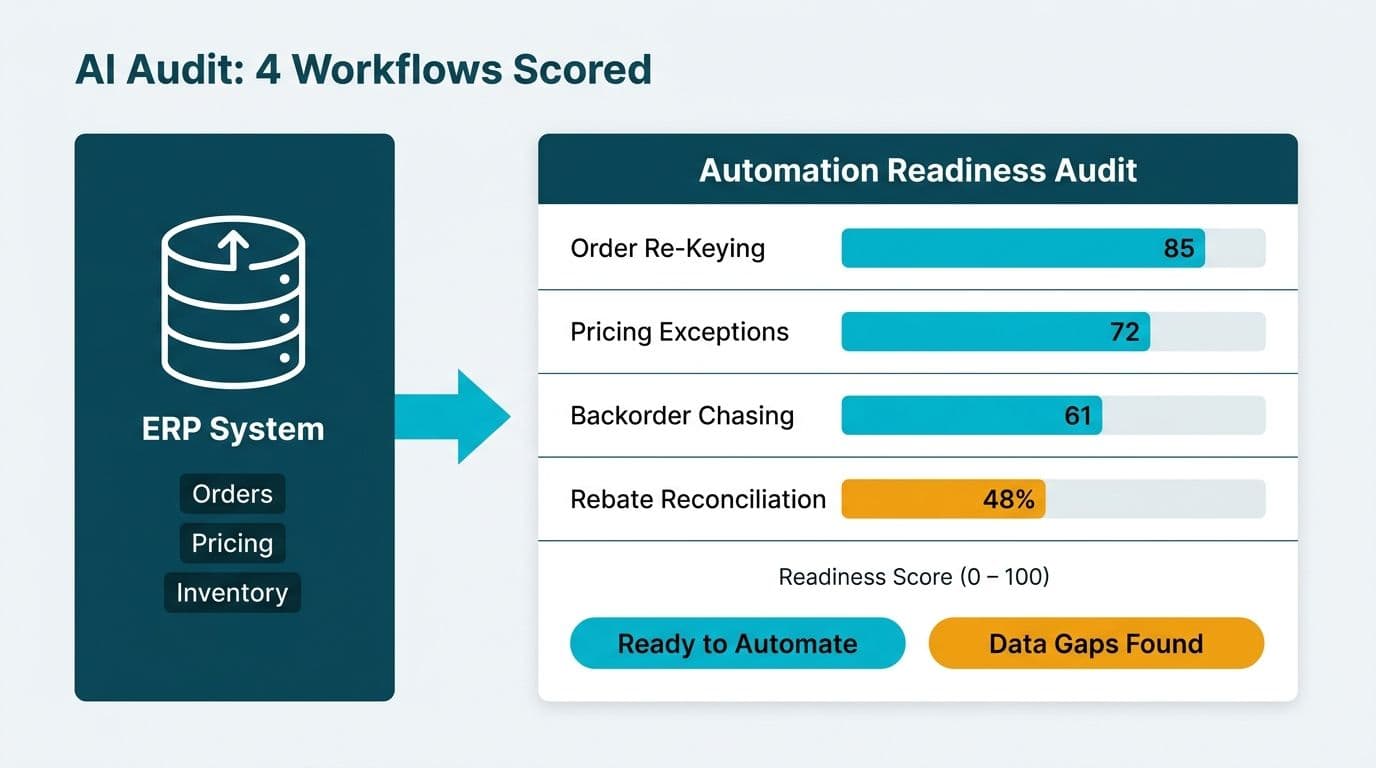
An AI audit for wholesale distributors examines your back-office workflows - order re-keying, pricing exceptions, backorder management, and rebate reconciliation - and scores each for automation readiness against your actual transaction data. Unlike a generic digital transformation review, it is grounded in what your ERP already captures, which workflows generate the most re-keying labor, and where data quality gaps would block a model before it ever runs.
Key Takeaways
Order-to-invoice re-keying, pricing exception emails, backorder chasing, and rebate reconciliation are the four highest-ROI workflows to prioritize in a wholesale distribution AI audit.
Epicor P21 exposes both an OData reporting API and direct MSSQL access, so your transaction data is reachable without a platform partnership or additional ISV middleware.
An AI audit scores each workflow on data accessibility, data quality, process consistency, and transaction volume before recommending any tooling or vendor.
Compliance obligations differ by geography: SOC 2 for US distributors, GDPR for UK and EU operations, PIPEDA for Canadian 3PLs - an audit maps these before automation begins.
A fixed-scope audit produces a prioritized shortlist of two or three automations with clear effort and payback estimates, not a 40-page roadmap that collects dust.
What Is an AI Audit for Wholesale Distributors?
An AI audit for wholesale distributors is a structured diagnostic - typically five to ten business days - that maps your back-office workflows against your actual data infrastructure and produces a ranked list of automation candidates. The output is not a vendor pitch deck. It is a workflow-by-workflow assessment of what is automatable today, what requires data remediation first, and what should stay manual because the process is too irregular or low-volume to justify a model.
The questions it asks are operational, not technical: How many order lines per week are re-keyed by hand? How many pricing exception emails are processed each month, and is the approval decision captured in the ERP or only in a sent-items folder? What percentage of vendor invoices match POs automatically versus requiring a human touch? The answers determine where AI delivers payback in months rather than years.
An AI audit is also distinct from a proof-of-concept. A POC answers "can this technology work?" An audit answers "should we build this, and if so, in what order?" Operations directors who skip the audit and go straight to a POC frequently discover mid-build that data quality makes the initial use case far harder than a lower-priority one would have been.
If your operation runs on Epicor P21, beginning with a structured AI readiness assessment (fixed price, 5 days) before committing to any tooling is the most cost-effective sequence - the data access picture alone shapes which solutions are viable without additional integration spend.
Which Back-Office Workflows Should a Wholesale Distributor Audit First?
The four workflows that consistently generate the highest audit findings in wholesale distribution and logistics are order-to-invoice re-keying, pricing exception handling, backorder chasing, and rebate reconciliation. Each has a different readiness profile, and sequencing matters.
Order-to-invoice re-keying is typically the entry point. Orders arrive via email, EDI, a customer portal, or phone, and a staff member manually transcribes them into the ERP. P21 stores the resulting order data in structured tables, but the source document - the email or PDF - lives in an inbox or file share. The gap between unstructured source and structured destination is where document AI and extraction models deliver fast returns. The audit establishes what proportion of order sources are already structured (EDI customers) versus unstructured (email-PDF customers), because the ROI calculation differs sharply between them.
Pricing exceptions handled by email present a different challenge. The exception request is unstructured, the approval is often informal, and the resulting price override may or may not be logged into P21 with a reason code. AI can flag exceptions that lack a reason code, route approvals through a structured workflow, and maintain an audit trail - but only after the audit establishes how many exceptions occur per month and what proportion of approvals are recorded in the ERP at all.
Backorder chasing is labor-intensive and repetitive. Staff contact suppliers for ETAs, log them against open POs, and update customers. P21's open PO data is well-structured and queryable. The bottleneck is the round-trip with suppliers who respond via email or PDF acknowledgements. An AI solution here combines supplier email parsing with automated P21 updates - but the audit must confirm that supplier response patterns are consistent enough to extract from reliably.
Rebate reconciliation is the most complex. Vendor programs arrive as spreadsheets or PDFs, and earned amounts must be calculated against purchase history in P21. The audit establishes how many programs are active, how frequently terms change, and whether vendor-reported figures can be cross-checked against P21 purchase data systematically.
For a detailed look at the accounts payable dimension of this problem, see AI Automation for Accounts Payable: A Process Walkthrough.
How Does Epicor P21's Data Access Change the AI Readiness Picture?
Epicor P21 exposes two access paths that most distributors underuse: an OData reporting API and direct MSSQL connections. The OData endpoint allows any BI tool or automation platform to query order headers, line items, open POs, pricing records, and inventory positions without a custom integration build. Direct MSSQL access goes further - it opens the full schema for complex joins, historical trend analysis, and custom extracts the OData surface may not expose.
This eliminates the common objection that "the data is locked in the ERP." For P21 shops, the data is queryable today, from outside the application, without a reseller or platform-partnership agreement. OData is the better choice for read-only reporting integrations because it respects P21's application-layer security model and avoids database-level credentials. MSSQL suits complex historical analysis or joins involving tables the OData layer does not expose - such as custom pricing history tables or rebate-related fields added by a P21 ISV.
Common data quality findings in P21 implementations include blanked reason codes on pricing exception records (meaning any model trained on that data learns to approve exceptions without justification), duplicate customer and supplier master records that inflate apparent order volume, and unit-of-measure inconsistencies - cases versus eaches - that break rebate reconciliation calculations when P21 purchase history is joined to vendor spreadsheets.
Connecting a reporting layer directly to P21 via OData or MSSQL surfaces these issues before any automation is commissioned. For integrating that layer with a broader analytics platform, How to Connect AI Workflow Automation to Power BI covers the relevant connection patterns.
What Does a 5-Day AI Audit for Wholesale Distributors Actually Cover?
A fixed-scope audit applies four dimensions to each workflow: data accessibility, data quality, process consistency, and transaction volume. The table below shows how the four priority workflows typically score.
| Workflow | P21 Data Coverage | Typical Data Quality Gap | Process Consistency | Volume for ROI | Priority |
|---|---|---|---|---|---|
| Order re-keying | Partial - output in P21; source in email or file share | Source document format varies by customer | Medium - EDI is structured; email-PDF is not | 50+ lines/day | High |
| Pricing exceptions | Partial - override recorded; reason code often absent | Reason codes blank in majority of records | Low - approval path varies by rep and tier | 30+ exceptions/month | Medium-High |
| Backorder chasing | High - open PO data is structured and current | ETAs not consistently logged back; supplier format varies | Medium - internal process stable; supplier response is not | 20+ open POs/week | High |
| Rebate reconciliation | Partial - purchase history clean; program terms not in P21 | Vendor documents inconsistent in format and structure | Low - rules differ significantly by vendor | Depends on rebate value vs. labor cost | Medium |
Days one and two cover data access verification: connecting to P21, pulling representative samples, and assessing field completeness. Days three and four involve structured interviews with operations and finance staff to document the actual workflow steps as practiced today, not as written in the procedure manual. Day five produces the ranked shortlist with effort estimates, payback ranges, and a data remediation plan for any workflow that does not yet meet the quality threshold.
A US distributor should also confirm during the access phase that any cloud processing of customer or vendor data aligns with existing data handling agreements - particularly where transaction data flows outside the P21 environment for the first time.
How Do Pricing Exceptions and Rebate Reconciliation Score for Automation Readiness?
These two workflows score lower than order re-keying or backorder chasing, but for different reasons - and identifying the specific gap determines the right remediation path.
Pricing exceptions fail on process consistency. If the approval path varies by sales representative, by customer tier, or by deal urgency, and reason codes are not consistently recorded in P21, a model trained on that data replicates the inconsistency rather than resolving it. Standardization must come first: a defined approval matrix, required reason codes, and a consistent recording step back into the ERP. For a US distributor managing more than 30 exception requests per month with a history of undocumented price cuts compressing margin, the remediation investment is typically worthwhile. A documented approval trail also supports audit defense under SOC 2 controls.
Rebate reconciliation fails on data accessibility outside P21. The vendor's calculation arrives in a document the ERP was not designed to ingest, and program terms change quarterly. AI assistance follows two stages: first, extract and structure the vendor program library (tiers, calculation basis, eligible SKUs, period definitions); second, cross-check earned rebates against P21 purchase data and flag discrepancies. The audit determines whether stage one is a prerequisite before stage two delivers value, or whether a clean subset of programs can be piloted immediately.
A UK distributor building a document processing pipeline for supplier correspondence should map which fields constitute personal data under the UK GDPR before ingestion - contact names and email addresses embedded in rebate confirmation letters require a lawful basis for processing even in a back-office context. A Canadian 3PL deploying supplier communication automation for backorder chasing should confirm under PIPEDA that supplier contact details are covered by a purpose communicated at collection - a gap identified during the audit takes hours to resolve but weeks if escalated to legal after deployment.
For the financial case behind these prioritization decisions, AI Automation Business Case for Finance Leaders: ROI Framework provides a structured template that translates back-office labor cost into automation ROI.
What Compliance Checkpoints Should the Audit Include for US, UK, and Canadian Operations?
Compliance requirements differ by geography, and mapping them during the audit avoids expensive remediation after an automation is already built.
US distributors and 3PLs handling customer financial data or vendor payment information in a cloud automation layer should evaluate SOC 2 Type II alignment as part of their vendor selection. The audit should identify whether proposed workflows create new data retention or access-logging requirements, and whether any workflow processes regulated financial data such as ACH instructions embedded in supplier invoices. Multi-state freight brokerages may also face state-level data privacy obligations depending on the personal information they handle.
UK and EU distributors must account for GDPR Article 22 when any automated system makes or materially influences decisions affecting named individuals - for example, pricing automation applied to named-account customers. Supplier-facing automation is typically lower-risk under GDPR because counterparties are usually legal entities rather than natural persons, though this should be confirmed where sole traders appear in the supplier base.
Canadian 3PLs and freight brokerages are subject to PIPEDA at the federal level and provincial privacy laws in Quebec (Law 25), Alberta, and British Columbia. If a workflow ingests supplier or customer emails to extract order or shipment data, PIPEDA's consent and purpose-limitation requirements apply. The audit should document what personal data each proposed workflow touches and whether existing privacy notices cover the new processing purpose.
Across all three geographies, the most useful compliance artifact from the audit is a data-flow diagram for each proposed automation: what enters, where it is processed, how long it is retained, and who can access it. This serves both the privacy review and the security assessment without duplicating effort.
Ready to see which back-office workflows in your distribution or logistics operation are genuinely ready for automation? Our AI readiness assessment (fixed price, 5 days) scores each workflow against the four dimensions above and delivers a prioritized shortlist with payback estimates - before you commit to any tooling or implementation partner. If you run Epicor P21, we can review during the assessment whether OData or MSSQL access is available in your environment; the right access path depends on your setup and security requirements.
---
About Lets Viz: Lets Viz is a data analytics and AI consulting firm serving US healthcare, UK fintech, Canadian manufacturing, and global SaaS businesses since 2020, with a 5.0 Clutch rating from verified client engagements. Our wholesale distribution audits are grounded in live transaction data - we connect to your actual ERP, map your real workflow steps, and deliver findings based on what your operation does today, not what the implementation guide says it should.