Zoho One Finance Modules Review for CFO and Finance Teams
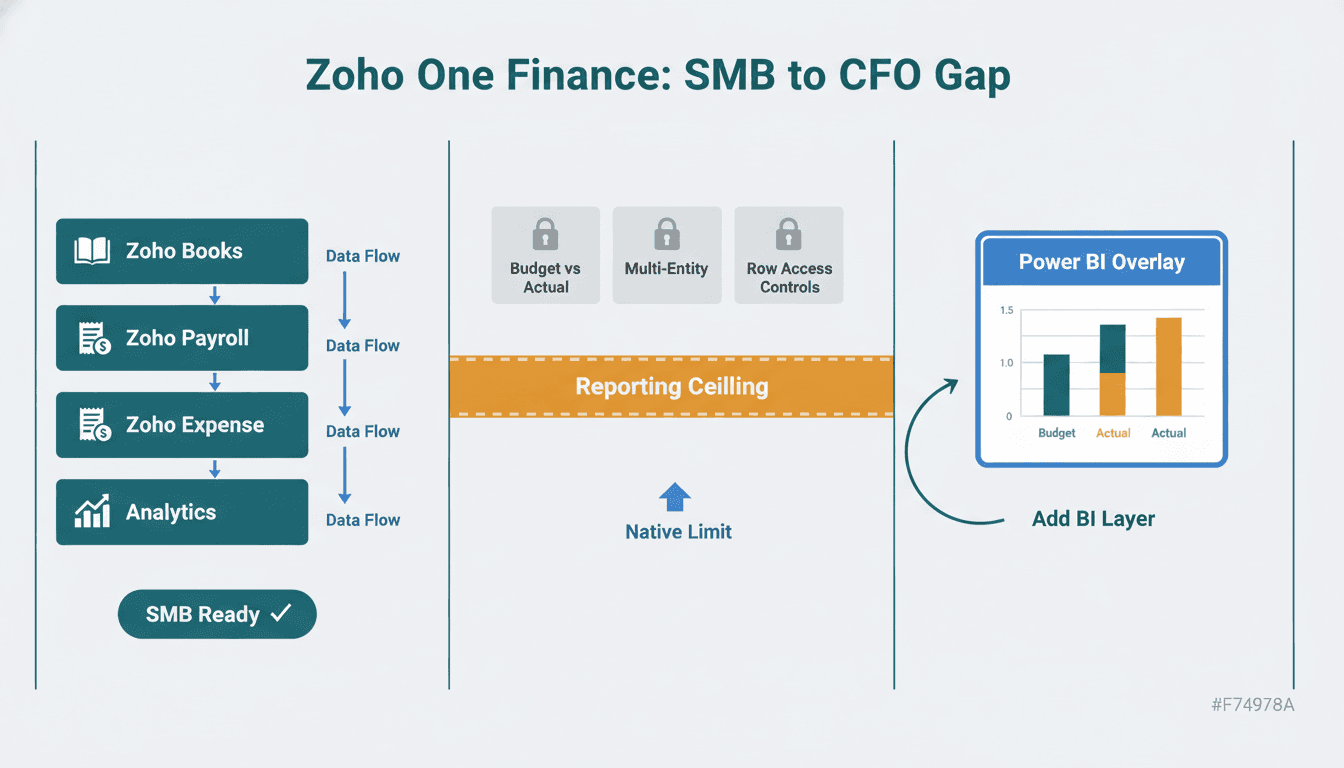
Zoho One's finance modules - Books, Payroll, Expense, and Analytics - cover the core accounting and operations workflow competently for SMB teams and early-stage mid-market companies. The suite earns its bundled-licence value through integrated data flow and unified administration. The reporting ceiling becomes visible at CFO-level analysis: budget-vs-actual variance, multi-entity consolidation, and row-level access controls require either a Zoho Analytics workaround or a dedicated BI layer on top.
Key Takeaways
- Zoho One's finance suite suits teams under roughly 100 employees well; mid-market companies encounter reporting gaps as complexity grows.
- Zoho Books handles core accounting competently but lacks native multi-entity consolidation for group-level reporting.
- Zoho Payroll covers US, Canadian, and UK compliance but provides limited dimensional data for FP&A headcount analysis.
- Zoho Analytics supports operational dashboards but falls short on DAX-depth calculations, model-level row-level security, and multi-source federation.
- The most effective mid-market architecture uses Zoho One as the operational system of record and Power BI as the CFO reporting layer.
What Finance Modules Are Included in Zoho One?
Zoho One bundles four finance-facing applications under a single per-user licence. Zoho Books handles the general ledger, accounts payable, accounts receivable, multi-currency invoicing, and statutory tax filings. Zoho Payroll processes salaries, tax remittances, and direct deposit for US, Canadian, UK, Indian, and UAE workforces. Zoho Expense manages receipt capture, travel policy enforcement, and multi-level approval workflows. Zoho Analytics serves as the integrated BI layer, pulling from all three transactional modules without a separate ETL step.
That shared data layer is Zoho One's most practical architectural advantage: a transaction posted in Books appears in Analytics without a manual export or scheduled sync job. For finance teams evaluating whether to supplement this with a dedicated BI platform, Power BI for SaaS finance teams explains where the Zoho Analytics layer ends and enterprise-grade reporting begins - the distinction that determines how much transformation work sits downstream.
| Module | Core Function | SMB Fit | Mid-Market Gap |
|---|---|---|---|
| Zoho Books | GL, AP/AR, multi-currency, VAT/GST | Strong | No native multi-entity consolidation |
| Zoho Payroll | Payroll processing, tax filing, direct deposit | Strong (US, CA, UK) | Thin dimensional headcount analytics |
| Zoho Expense | Receipt OCR, approvals, per-diem | Strong | Complex policy exception reporting |
| Zoho Analytics | Dashboards, blended reports, templates | Adequate for operations | Limited calculations, RLS, multi-source |
How Does Zoho Books Perform for SMB and Mid-Market Accounting?
Zoho Books handles the full accounting cycle for SMB teams without supplemental tools. Double-entry bookkeeping, bank reconciliation, multi-currency invoicing, and VAT/GST returns for UK, EU, and Canadian entities are supported natively. Per Zoho's 2025 product documentation, Books connects to bank feeds for major financial institutions across the US, UK, and Canada - practical coverage for cross-border SaaS businesses managing revenue in multiple currencies.
The ceiling appears with group consolidation. A UK fintech group operating entities in London and Dublin must export trial balances from each Books organisation and consolidate outside the platform. There is no inter-company elimination engine, no minority-interest calculation, and no unified group P&L view. Finance directors at Series B and C companies consistently name this as the inflection point where Books transitions from adequate to limiting.
GDPR considerations apply directly to UK and EU finance teams: Zoho offers an EU data centre for Books deployments, and organisations should confirm data residency configuration against Article 28 controller-processor agreements before go-live. Canadian companies handling personal financial data operate under PIPEDA obligations and should document data retention policies at implementation rather than retrospectively.
What Do Zoho Payroll and Expense Deliver for Finance Teams?
Zoho Payroll's core strength is compliance automation. Per the 2025 Zoho Payroll release documentation, tax tables for all 50 US states and CRA remittance schedules for Canadian employers update on Zoho's release cycle. Direct deposit, W-2 generation, and Canadian T4 filing are included. For a 60-person SaaS company with employees across multiple US states and a Canadian entity, this eliminates meaningful compliance overhead without a separate payroll vendor.
The reporting gap is dimensional depth. Payroll data exports as cost-centre totals; correlating payroll expense to ARR cohorts, product-line headcount, or department-level burn requires either a Zoho Analytics custom view or an external model. US SaaS finance teams calculating CAC payback periods or Rule-of-40 metrics routinely find that payroll arrives in their models as a single aggregated figure with no product-line breakdown - a structural consequence of how Zoho Payroll structures its data exports.
Zoho Expense handles receipt OCR with reasonable accuracy and multi-level approval workflows for teams with standard travel policies. Tiered per-diem rates by geography, mileage reimbursement that varies by vehicle class, and multi-currency receipts reconciled against budget categories require either Zoho Analytics or a dedicated budget vs actual variance model built against the Expense API.
One lesson from our own client work reinforces why validating native metrics matters before presenting to leadership. In a Zoho Desk engagement, the platform stored 0 hours for tickets that had never received a response - making every unanswered ticket appear as an instant resolution. We rebuilt the metric on real response data and validated it row for row across 105,704 records with zero mismatches before going live. The Expense parallel is zero-value lines for declined submissions that inflate policy-violation counts unless explicitly filtered. Finance teams building compliance reports should validate aggregation logic against raw export data before the first leadership review.
Where Does Zoho One Finance Reporting Fall Short for CFOs?
Zoho Analytics competes adequately with mid-range BI tools for operational visualization and pre-built finance templates. Three gaps surface consistently when finance teams push toward CFO-level requirements.
Calculated measures and time intelligence. Zoho Analytics supports column-level formulas but lacks the expression depth needed for complex time-series analysis - year-over-year comparisons with partial-period adjustments, rolling 12-month revenue, and cohort-based retention curves. The DAX CALCULATE function for FP&A analysis illustrates the modelling depth that becomes accessible in a dedicated BI tool. Teams building budget vs actual variance analysis power bi models find this gap material at mid-market scale.
Row-level security. Enterprise finance teams need access policies that enforce which entities, departments, or cost centres a user can see regardless of how a report is shared. Power bi row level security finance reporting patterns define RLS roles in the semantic model so access rules persist through every distribution channel. Zoho Analytics supports user-level filters, but enforcement requires manual setup per view rather than model-level definition. For a US SaaS company maintaining SOC 2 Type II certification, auditors expect documented, model-enforced access controls - a standard Zoho Analytics does not yet fully satisfy.
Multi-source federation. Mid-market finance teams rarely operate entirely inside Zoho. CRM pipeline data, support ticket cost allocation, and product usage metrics all belong on a complete CFO dashboard. Connector depth and refresh performance in Zoho Analytics are narrower than what microsoft fabric architecture finance reporting designs support. Our comparison of Microsoft Fabric vs Looker covers these trade-offs for teams considering a centralised data layer. When finance leaders compare looker studio vs power bi for finance reporting alternatives to Zoho Analytics, the dedicated BI platforms consistently outperform once a team exceeds 100 employees or requires auditable access governance.
Zoho One Finance Modules Review: Native Reporting vs. Power BI Overlay
The most effective mid-market architecture runs Zoho One as the operational system of record and Power BI as the strategic reporting layer. Books, Payroll, and Expense handle the daily transaction cycle; Power BI handles board-ready P&L, consolidated variance reports, and CFO dashboards with proper time intelligence and access governance.
This hybrid works because Zoho exposes all three modules through REST APIs and Zoho Analytics connectors. A finance team can sync actuals from Books into a Power BI semantic model on a scheduled refresh, combine them with budget data from a planning tool or spreadsheet, and deliver a budget vs actuals dashboard power bi that updates automatically - without replacing Zoho as the operational source of truth.
Licensing decisions at this stage often centre on power bi pro vs premium per user for finance reporting. For a 15-person finance team sharing reports with a 60-person leadership group, Pro per user is typically sufficient. Premium Per User becomes relevant when the organisation needs paginated financial statements, large model storage for multi-year datasets, or advanced AI features. The power bi desktop vs power bi service for finance teams distinction is simpler in practice: Desktop is the authoring tool where the semantic model is built; Service is the scheduled refresh and distribution platform where RLS is applied before reports reach leadership. Our guide on Power BI RLS for data protection covers governance configuration for teams managing sensitive financial data under SOC 2 or GDPR requirements.
For teams looking to automate the data flow between Zoho Books and the reporting layer, automating month-end financial close with AI tools covers how automation reduces the manual extract steps that otherwise consume finance team time each month-end.
When Does a Zoho Consultant Add Real Value for Finance Teams?
A Zoho consultant accelerates return on investment at three inflection points: initial configuration, reporting architecture design, and data quality remediation.
Initial configuration shapes analytics capability for years after go-live. Chart of accounts structure in Zoho Books determines how granularly Analytics - or Power BI - can slice P&L by dimension. A consultant experienced with SaaS finance builds in department tags, product-line dimensions, and project codes from day one. Without this groundwork, a 50-person company typically discovers at Series B that its revenue sits in a single line item with no product breakdown - a rework project that touches every historical transaction and delays the close cycle.
Reporting architecture is where consultants who bridge Zoho and enterprise BI earn their fee. Designing incremental data refresh, error handling for API sync failures, and RLS role structures is a one-time investment that compounds over years. A Canadian manufacturing company adding a US subsidiary to its Zoho Books setup should require only a dimension table update, not a full report rebuild - but that outcome depends on deliberate schema design at the outset.
Data quality remediation is often the most urgent engagement. Silent issues - zero values stored where nulls belong, custom field mappings that silently drop records, duplicate transaction lines from API sync errors - surface only when a CFO asks a question the dashboard was not designed to answer. Catching and documenting these before a board presentation is substantially cheaper than correcting the narrative afterward. Teams working with Zoho Analytics consulting services typically begin with a data model audit that maps every reported metric back to its source transaction, validates the aggregation logic, and documents filter rules so the finance team can maintain reports independently.
---
About Lets Viz: Lets Viz is a data analytics and BI consultancy serving US healthcare, UK fintech, Canadian manufacturing, and global SaaS finance teams since 2020. Rated 5.0 on Clutch, the team specialises in Power BI, Microsoft Fabric, and Zoho Analytics implementations that connect operational systems to CFO-ready reporting layers. Our work spans initial Zoho configuration, Power BI semantic model design, and ongoing managed analytics services across North America and Europe.
If your finance team is running Zoho One and reaching the reporting ceiling, Power BI for SaaS finance teams outlines how we layer enterprise BI on top of your existing Zoho stack to deliver board-ready dashboards without migrating your operational system. To discuss your specific Zoho configuration, speak with a Zoho consultant. Not yet on Zoho One? Try Zoho One free →