Microsoft Fabric vs Looker: Enterprise Data Platform Guide
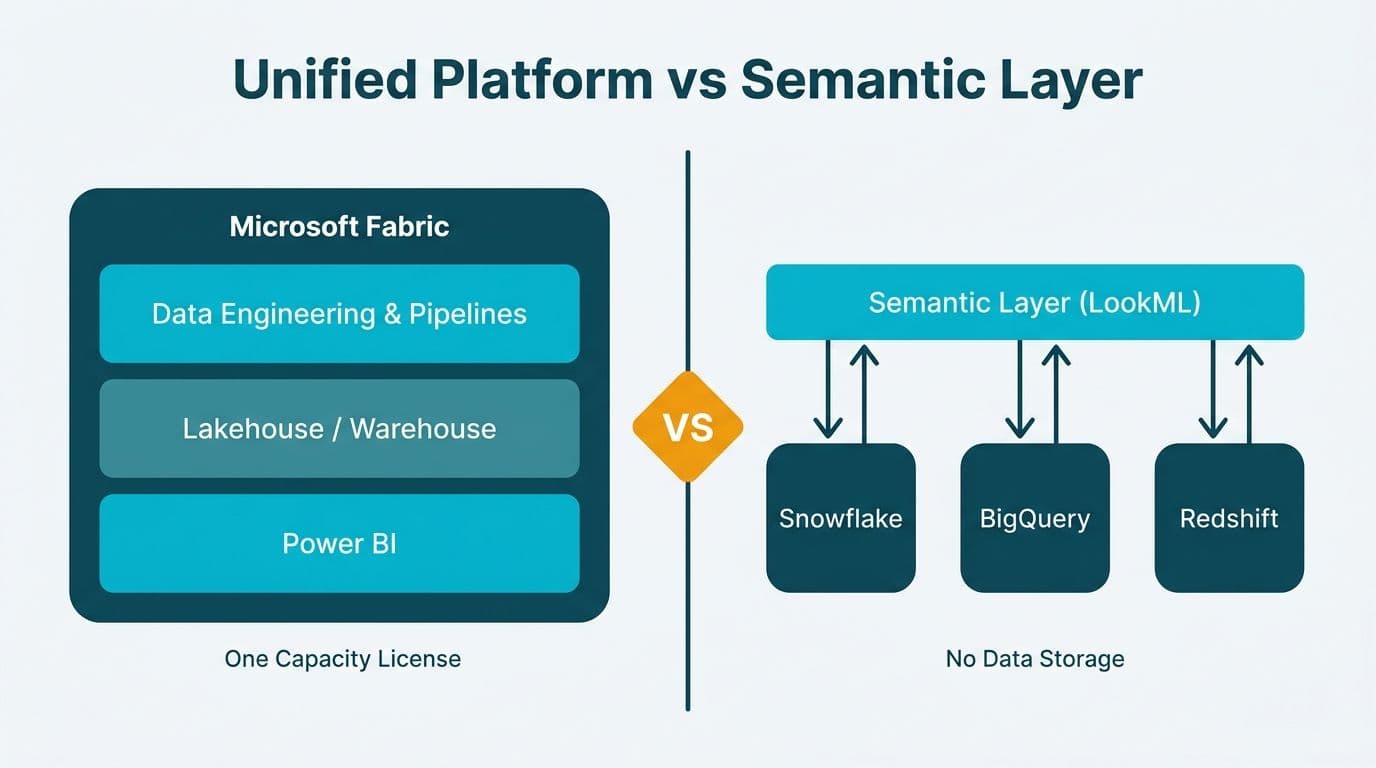
Microsoft Fabric and Looker solve fundamentally different enterprise analytics problems. Fabric is a unified lakehouse platform combining data engineering, warehousing, and Power BI under a single Microsoft-licensed capacity. Looker - Google Cloud's enterprise semantic layer - governs metric definitions across any SQL warehouse without storing data. Organizations on Microsoft 365 and Azure typically find Fabric's total cost of ownership lower; multi-cloud teams often favor Looker's governed metric flexibility.
Key Takeaways
- Microsoft Fabric unifies data engineering, pipelines, warehousing, real-time intelligence, and Power BI under one capacity-based license on OneLake - no separate warehouse or pipeline service required.
- Looker is a semantic layer BI tool, not a data platform: it generates SQL and pushes it to an external warehouse (BigQuery, Snowflake, Redshift) without storing or processing data itself.
- Compliance coverage is broadly equivalent - both platforms carry HIPAA, SOC 2, GDPR, and ISO 27001 certifications - but Fabric's Purview integration gives Microsoft-stack enterprises a single governance control plane.
- Total cost of ownership favors Fabric for organizations on Azure MACC agreements; Looker's per-seat viewer pricing can undercut Fabric's capacity overhead for large read-heavy deployments on existing Google Cloud warehouse contracts.
- Hybrid deployments are increasingly common: some enterprises run Fabric for data engineering and Power BI while Looker's LookML semantic layer governs cross-warehouse metric definitions consumed by multiple product and data teams.
What Is Microsoft Fabric and How Does It Differ from Looker?
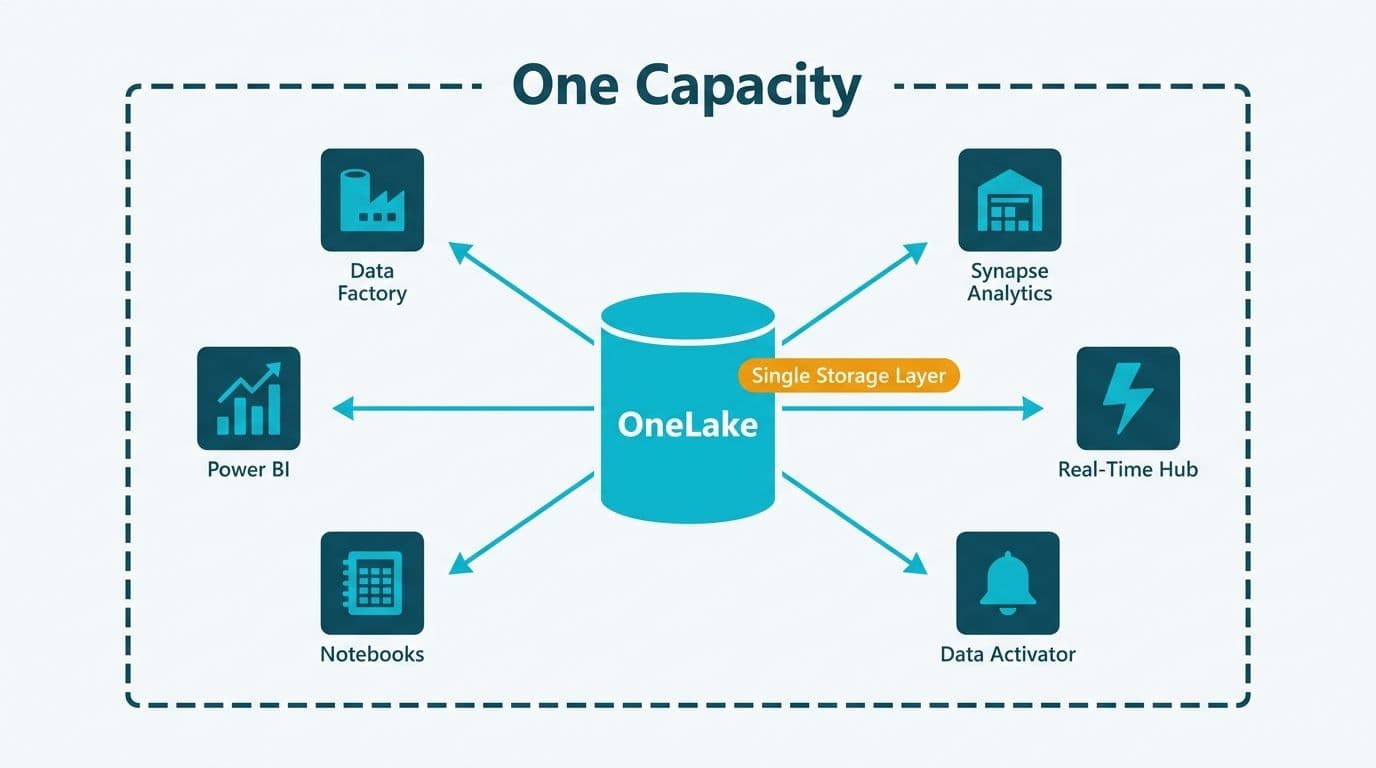
Microsoft Fabric (generally available since November 2023, per Microsoft's product documentation) is an end-to-end analytics platform built on a unified storage layer called OneLake. It integrates six workloads into a single capacity-billed environment: Data Engineering (Apache Spark notebooks and Lakehouses), Data Factory (pipelines and Dataflows Gen2), Data Warehouse (a T-SQL endpoint over Delta Parquet files), Data Science (ML experiments), Real-Time Intelligence (event streaming and KQL databases), and Power BI (reporting and visualization). Engineers and analysts share the same storage layer - a Spark notebook writes a Delta table that a Power BI report reads directly, with no data movement and no separate warehouse contract.
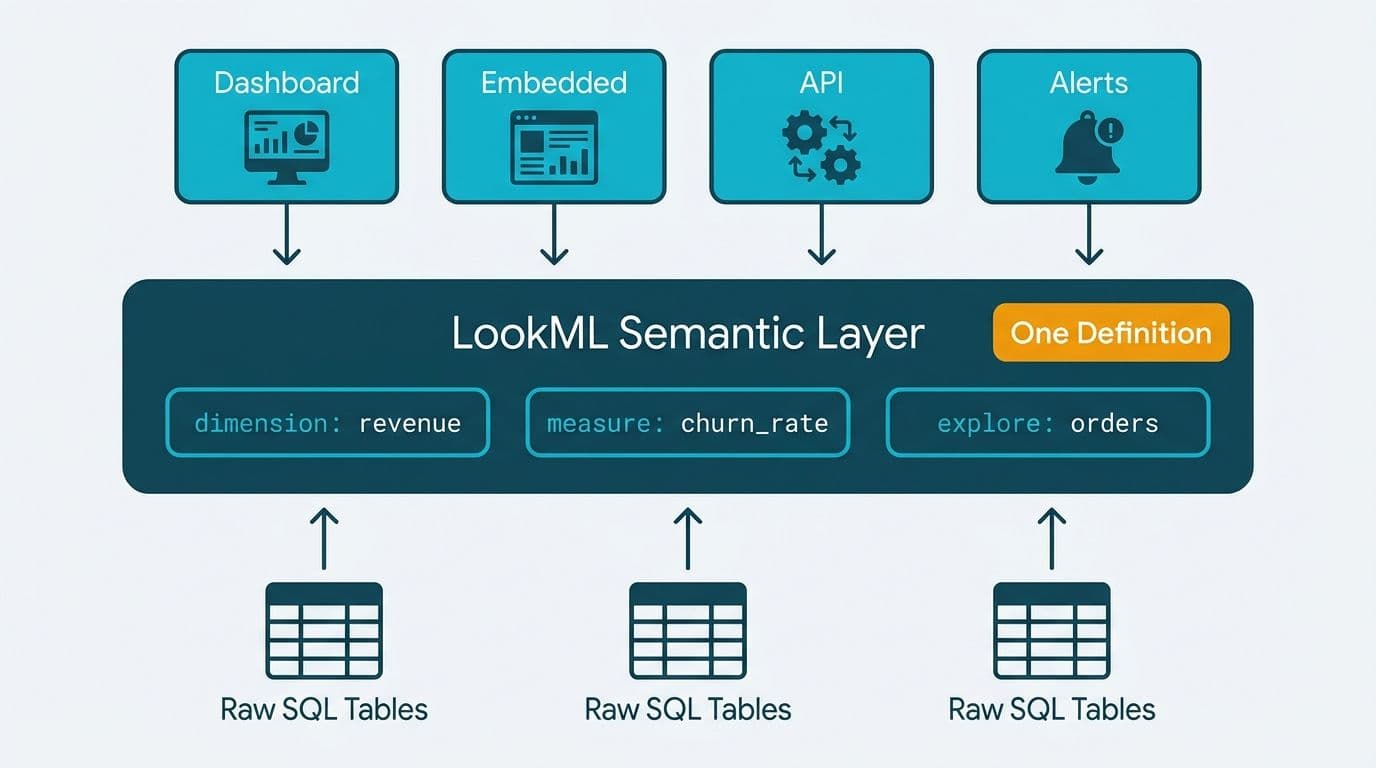
Looker (Google Cloud, available as a managed SaaS and a Google Cloud Marketplace offering) takes a different architectural stance. Its core product is LookML, a version-controlled, Git-backed modeling language that defines metrics, dimensions, and relationships once and enforces them across every query. Looker does not store or process data - it generates SQL and pushes it to the underlying warehouse. This makes it inherently multi-cloud and warehouse-agnostic, connecting to BigQuery, Snowflake, Redshift, or any SQL-compatible engine.
Note that Looker Studio - Google's free self-service reporting product - is an entirely separate product from Looker enterprise. Looker Studio is closer in positioning to Power BI Desktop as a self-service visualization layer; Looker enterprise with LookML is the governed platform relevant to enterprise architecture decisions.
For teams evaluating Microsoft Fabric vs Power BI differences for analytics teams, the key distinction is that Fabric is the platform layer and Power BI is the consumption layer within it. Running standalone Power BI Pro licenses means using the BI visualization tool without the broader Fabric capacity infrastructure; migrating to Fabric adds data engineering, warehousing, and real-time workloads around the same reports, typically eliminating scheduled refresh dependencies through direct OneLake reads.
Before modeling platform costs, use the Instant project cost calculator to scope your data engineering and BI workloads and estimate implementation investment before committing to a vendor.
Microsoft Fabric vs Looker: Enterprise Data Platform Feature Comparison
The table below maps the key dimensions enterprise architects evaluate when choosing between these two platforms:
| Dimension | Microsoft Fabric | Looker (Google Cloud) |
|---|---|---|
| **Architecture** | Unified lakehouse (OneLake); integrated compute and storage | Semantic layer over any SQL warehouse; no data storage or processing |
| **Query engine** | Apache Spark + T-SQL endpoint (Delta Parquet) | LookML-generated SQL pushed to BigQuery, Snowflake, Redshift, or other |
| **Built-in BI** | Power BI (native, included in capacity license) | Looker Explore; Looker Studio is a separate free self-service product |
| **Data engineering** | Pipelines, Dataflows Gen2, Spark notebooks, Copy Tool | Requires external orchestration (dbt, Airflow, or equivalent) |
| **Semantic modeling** | Power BI semantic model with DAX measures | LookML (Git-versioned, CI/CD-compatible, warehouse-agnostic) |
| **Licensing model** | F-SKU / P-SKU capacity billing (per CU/hour or reserved) | Per-seat viewer + per-developer seat on Google Cloud Marketplace |
| **Compliance certs** | HIPAA, SOC 2 Type II, GDPR, ISO 27001 (Azure infrastructure) | HIPAA, SOC 2 Type II, GDPR, ISO 27001 (Google Cloud infrastructure) |
| **Governance tooling** | Microsoft Purview (native, unified with M365 estate) | LookML content validation + external data catalogs |
| **Best fit** | Microsoft 365 and Azure-native organizations | Multi-cloud teams; metric-first data platforms; Google Cloud-native shops |
For a deeper look at Fabric's internal workload model, our Microsoft Fabric architecture components guide maps each service to its OneLake role and explains how the workloads interact at the infrastructure level.
How Do Microsoft Fabric and Looker Handle Compliance and Governance?
Both platforms achieve broadly equivalent regulatory certifications through their underlying cloud infrastructure, but the governance experience differs materially for regulated industries.
Microsoft Fabric integrates natively with Microsoft Purview, meaning data classification, sensitivity labeling, and access policy enforcement operate from a single control plane that also covers SharePoint, Teams, and Dynamics 365. For a US healthcare organization operating under HIPAA, Fabric inherits Azure's Business Associate Agreement coverage (confirmed in Microsoft's 2025 Trust Center documentation). For a UK fintech firm processing customer financial data under UK GDPR, Purview's lineage tracking and data map capabilities simplify Article 30 record-of-processing requirements. For a Canadian manufacturing company subject to PIPEDA, Microsoft's Azure regions in Canada Central and Canada East provide in-country data residency without additional configuration.
Looker relies on Google Cloud's compliance posture - equally comprehensive in certifications - but metric governance lives specifically in LookML. Because LookML is Git-versioned, teams can enforce a mandatory code-review workflow before any new metric definition ships to production. A UK fintech engineering team, for example, can require two approvals on any pull request that changes a revenue or customer-count metric. This is a governance discipline that Power BI's DAX-based semantic model does not enforce natively, making it particularly valuable where metric accuracy is a regulated output - financial reporting, clinical analytics, or payer data under HIPAA.
The practical distinction is one of breadth versus precision. Fabric's Purview-backed governance scales horizontally across the entire Microsoft enterprise estate. Looker's LookML-based governance scales vertically into the precision and auditability of individual metric definitions. For regulated-industry enterprises with large Microsoft footprints, Purview's breadth typically wins. For data platform teams building a shared metrics layer consumed by multiple BI tools and autonomous product teams, LookML's rigor is the stronger choice.
Our Power BI governance best practices checklist covers access-control and sensitivity-label configuration applicable whether you run a pure Fabric environment or a hybrid Fabric-Looker setup.
When Should Your Enterprise Choose Microsoft Fabric?
Fabric is the stronger default when your organization meets most of the following criteria:
You are already invested in the Microsoft ecosystem. Fabric capacity licenses stack on existing Azure MACC (Microsoft Azure Consumption Commitment) agreements, and Microsoft 365 E5 customers receive Power BI Premium Per User at no additional cost. Adding F64 Fabric capacity to an existing Azure contract typically costs less than running equivalent compute, storage, and pipeline services as separate line items.
Your data engineering and BI teams share infrastructure. A Spark notebook in a Fabric Lakehouse writes a Delta table that a Power BI report reads directly - no copy, no additional pipeline, no separate warehouse contract. For an FP&A team at a US SaaS company running Power BI with Azure Data Factory pipelines, consolidating onto Fabric eliminates at least two separate billing items while simplifying the security boundary.
You need real-time analytics alongside historical reporting. Fabric's Real-Time Intelligence workload ingests event streams and makes them queryable through the same T-SQL endpoint used for batch data, eliminating the need for a separate streaming stack. Our Microsoft Fabric real-time analytics guide covers architecture patterns for operational and IoT use cases.
Your analysts use Power BI and your engineers use T-SQL or PySpark. Fabric does not require Spark expertise for most BI workloads. Teams that already know T-SQL can query the Warehouse endpoint directly with no new tooling investment. This matters particularly in mid-market US healthcare and Canadian manufacturing environments where the data engineering team is small and cannot absorb a steep LookML learning curve.
For finance teams evaluating Fabric for FP&A, the Fabric Lakehouse Finance Analytics guide shows how budget-to-actuals pipelines map to Fabric workloads in practice.
When Does Looker Make More Sense for Your Enterprise Stack?
Looker earns its place when the primary evaluation criteria shift from platform consolidation to cross-warehouse flexibility and metric governance precision.
Your data stack is genuinely multi-cloud. A UK fintech firm running Snowflake on AWS for transactional processing, BigQuery for marketing analytics, and a legacy Redshift cluster for historical data cannot consolidate all three into OneLake without substantial rearchitecting. Looker connects to all three simultaneously, allowing a single LookML project to define metrics across all sources and surface them in a unified Explore interface - no migration required.
Metric consistency is your primary data quality problem. When separate teams maintain parallel Power BI semantic models with divergent definitions of "conversion rate" or "monthly active users," leadership loses confidence in dashboards. LookML enforces a single metric definition through code review: the number either ships through the review gate or it does not. For a global SaaS company with engineering teams across multiple time zones, this discipline prevents metric drift in ways that Purview policy alone cannot address.
You are building embedded analytics in a customer-facing product. Looker's embed SDK - signed URL and iframe embedding with row-level security - is widely deployed by SaaS product teams offering multi-tenant analytics to enterprise customers. Power BI Embedded on Fabric supports similar scenarios, but capacity-model pricing for ISV deployments requires careful scenario modeling, particularly at lower seat counts where the per-user economics differ significantly.
Your team uses dbt for data transformation. For teams already committed to dbt's version-controlled, test-gated transformation layer, Looker's LookML feels like a natural extension of the same philosophy: define transformations in dbt, define metrics in LookML, version-control both in Git. The workflow integrates cleanly with CI/CD pipelines and developer tooling teams already operate.
How Do Total Costs Compare Between Microsoft Fabric and Looker?
Licensing structures differ enough that direct price comparisons are only meaningful within a specific organization's workload and existing contract context. The figures below reflect list-price structures from official Microsoft and Google Cloud pricing pages (2025).
Microsoft Fabric charges by Fabric Capacity Unit (CU) per hour, bundling compute, storage, and pipeline execution into a single bill that scales with workload intensity rather than user count. Entry F2 capacity (2 CUs, suitable for development environments and small teams) starts at approximately $0.36/CU/hour on Azure pay-as-you-go pricing in US East regions. An F64 capacity - appropriate for a 50-150 seat enterprise deployment with moderate workloads - is billed at approximately $4.17/CU/hour. Power BI Pro licenses ($10/user/month at list price) remain required for report consumers below the F64 capacity threshold unless using A-SKU or P-SKU licensing structures. Reserved capacity pricing reduces costs significantly for predictable production workloads. Our detailed Microsoft Fabric pricing guide covers F-SKU versus P-SKU tradeoffs across deployment profiles.
Looker is licensed per seat through Google Cloud Marketplace (2025 pricing documentation). Viewer seats - for end users consuming dashboards without creating or modifying content - are priced substantially lower per head than developer or analyst seats. This structure makes Looker cost-competitive for read-heavy deployments with few content creators and large consumer populations. However, Looker's total cost of ownership must include the underlying warehouse compute separately: BigQuery, Snowflake, or Redshift costs are not bundled in the Looker license, whereas Fabric's capacity billing covers compute, storage, and pipeline execution in a single charge.
Rough heuristic for decision-makers: organizations under 200 seats on Azure MACC agreements will typically find Fabric cheaper all-in. Organizations with 500 or more viewers on existing Google Cloud or Snowflake contracts may find Looker's viewer-seat model more cost-effective for pure BI consumption workloads. A hybrid architecture - Fabric for data engineering and Power BI, Looker for cross-warehouse semantic governance - is increasingly common in organizations managing inherited multi-cloud estates following M&A activity.
Which Platform Is Right for Your Enterprise in 2026?
For most enterprise organizations, the decision reduces to three diagnostic questions:
What is your primary cloud infrastructure? If the answer is Azure or Microsoft 365, the consolidation economics of Fabric are difficult to argue against. If the answer is Google Cloud, or a warehouse-first stack on Snowflake spanning multiple clouds, Looker's agnosticism is a genuine architectural advantage rather than a marketing claim.
Where does your hardest analytics problem live - in the data layer or the metric layer? If your engineering team spends more time moving, transforming, and modeling data than defining and governing metrics, Fabric's integrated lakehouse addresses the bottleneck directly. If your hardest problem is that twelve teams define "customer" twelve different ways across independent dashboards, LookML's governance model solves something Fabric does not.
What are your compliance and data residency requirements? Both platforms handle HIPAA (US), UK GDPR, and PIPEDA (Canada) through their cloud infrastructure, but Fabric's Purview integration makes audit evidence collection meaningfully easier for organizations already using Microsoft tools for identity, email, and document management. For a Canadian manufacturing company with strict PIPEDA data residency obligations, Fabric's Azure Canada regions require no additional configuration; a Google Cloud-hosted Looker deployment requires deliberate BigQuery regional configuration to achieve equivalent residency.
Teams that have not yet mapped their current BI infrastructure against these questions can use the free BI readiness assessment to identify gaps before committing to a major platform investment.
---
About Lets Viz: Lets Viz has delivered data analytics and BI platform consulting since 2020, working with US healthcare providers, UK fintech firms, Canadian manufacturing companies, and global SaaS organizations. The practice holds a 5.0 Clutch rating and specializes in Microsoft Fabric, Power BI governance, and enterprise data architecture implementations across regulated industries where accuracy and compliance are non-negotiable.
Use the Instant project cost calculator to model your Microsoft Fabric or Looker implementation cost - scope, team size, and compliance requirements included - before committing to a platform decision.