Zoho One Implementation Consultant: Step-by-Step Guide
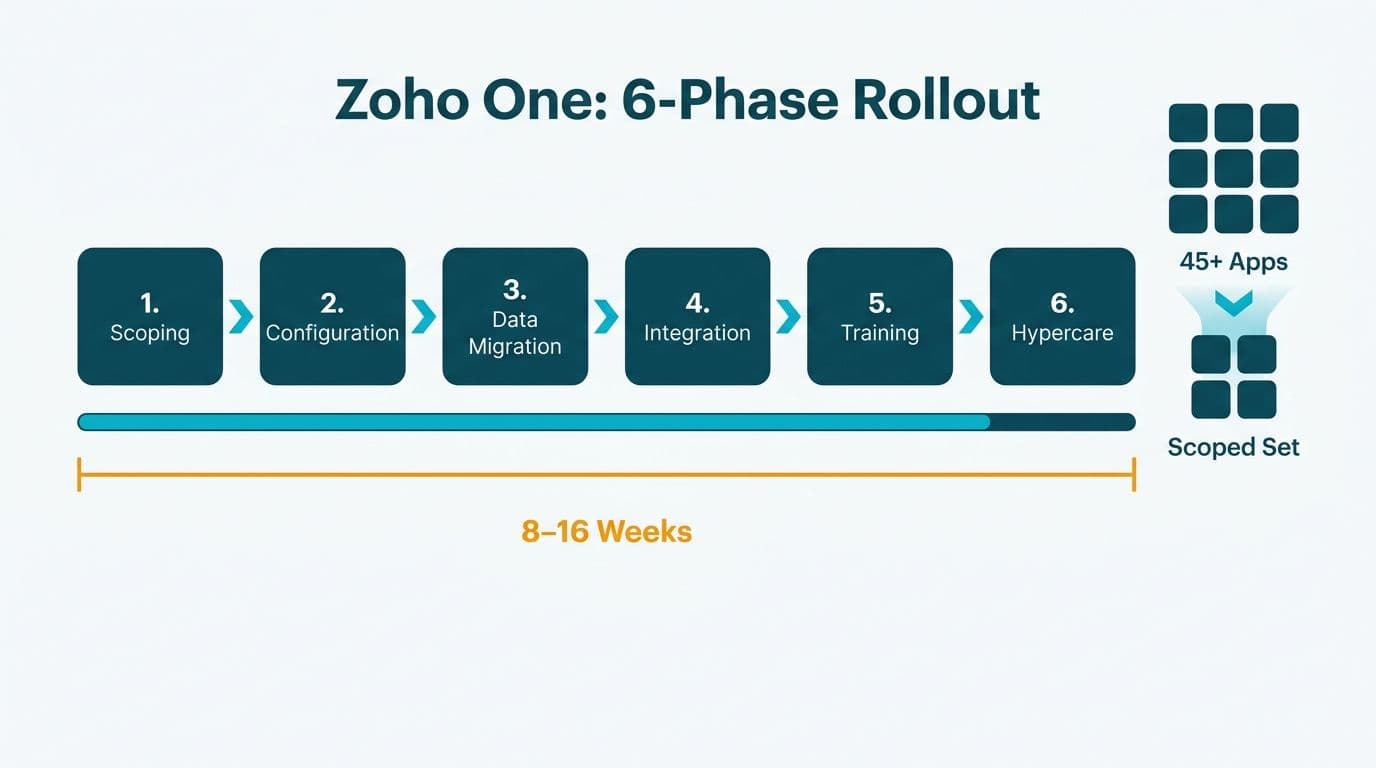
A Zoho One implementation project spans discovery, configuration, data migration, integration, user training, and go-live support - typically 8 to 16 weeks for a mid-market organization. Hiring a certified Zoho One implementation consultant shortens that timeline, reduces configuration errors, and ensures the platform's 45-plus bundled apps are scoped to your actual workflows rather than activated all at once.
Key Takeaways
A full Zoho One rollout follows six phases: scoping, configuration, data migration, integration, training, and hypercare.
The most common failure points are scope creep, under-resourced data migration, and skipping user acceptance testing.
Healthcare and finance organizations in the US, UK, and Canada face compliance requirements - HIPAA, GDPR, PIPEDA - that must be embedded from day one.
A certified Zoho partner brings pre-built industry templates, direct escalation to Zoho's engineering team, and accountability that freelancers cannot match.
Most mid-market organizations achieve positive ROI within 12 to 18 months when led by an experienced consultant.
What Does a Zoho One Implementation Project Actually Cover?
Zoho One is not a single application - it is an integrated operating system for business, bundling CRM, Books, People, Projects, Desk, Analytics, Sign, and more than 40 additional applications under a single per-user license. A structured implementation defines which apps to activate, in which order, and how they connect to each other and to existing external systems.
Engaging Zoho consulting services from the outset ensures a phased rollout rather than the overwhelming "activate everything" approach that reliably stalls adoption within the first 90 days.
Phase 1 - Discovery and scoping (weeks 1-2). A consultant maps current processes, identifies the five to eight Zoho apps that deliver the highest immediate value, and documents integration requirements with your ERP, payment gateway, or data warehouse.
Phase 2 - Configuration (weeks 3-6). Custom modules, layouts, automated workflows, and approval chains are built inside Zoho CRM and connected apps. For healthcare clients in the US and Canada, record-level field encryption and role-based access controls are configured here to support HIPAA and PIPEDA audit requirements.
Phase 3 - Data migration (weeks 4-7, overlapping). Contacts, accounts, open deals, and historical transactions are cleansed and imported. A structured Zoho CRM implementation checklist ensures deduplication rules, mandatory field validation, and rollback procedures are in place before any data touches the live environment. This phase consistently takes longer than internal teams expect.
Phase 4 - Integration (weeks 5-8). Zoho Flow or a middleware layer connects Zoho One to your existing stack - payment processors, marketing platforms, ERP, or logistics systems. Finance teams in Canada frequently integrate Zoho Books with banking feeds and PIPEDA-compliant document storage at this stage.
Phase 5 - Training and user acceptance testing (weeks 7-10). Role-specific training for sales, finance, support, and HR runs in parallel with structured UAT to surface configuration gaps before go-live. Skipping UAT is the single decision that generates the most post-launch support tickets.
Phase 6 - Hypercare (weeks 10-16). A consultant-led period monitors adoption, resolves edge-case workflow failures, and handles the change management questions that reliably surface once users are in the system. Skipping hypercare is one of the most common cost-saving decisions organizations later regret.
What Are the Most Common Pitfalls in a Zoho One Implementation?
Most failed Zoho One projects share the same root causes regardless of company size or geography.
Scope creep. Stakeholders add applications mid-project - "can we set up Zoho Recruit while we're at it?" - without adjusting the timeline or budget. A well-structured statement of work locks the app list for phase one and explicitly defers additions to phase two.
Underestimating data migration. A UK professional services firm migrating from a legacy CRM to Zoho One found that cleaning five years of duplicate contact records added three weeks to the project timeline. Deduplication rules, custom field mapping, and sandbox testing of import files must be scoped as discrete tasks - not treated as a half-day activity.
Skipping user acceptance testing. Go-live dates move forward under executive pressure, and UAT is compressed or dropped. Revenue-generating teams then encounter broken approval workflows on day one, eroding trust before the platform has a chance to demonstrate value. Across Zoho partner post-mortems reviewed in 2026, compressed or eliminated UAT was the most frequently cited root cause in implementations that required a paid re-configuration engagement within the first six months - adding an average of 35 to 50 percent of the original project fee in unplanned remediation costs.
Treating Zoho One as a CRM-only project. When implementation is handed exclusively to sales operations, Zoho Books, Zoho People, and Zoho Projects receive minimal attention. Finance directors are still using spreadsheets six months post-launch because the accounting module was never properly configured.
Neglecting compliance during scoping. For a US healthcare organization, a HIPAA Business Associate Agreement must be in place with Zoho before any protected health information enters the system. For UK and EU businesses, a GDPR data processing impact assessment covering Zoho's sub-processors and international transfer mechanisms must be completed during scoping - not retrofitted after go-live.
When Should You Hire a Zoho One Implementation Consultant?
A certified Zoho One implementation consultant is the lower-risk choice in four specific scenarios: organizations with more than 25 users, those migrating from a legacy system, regulated-industry deployments, and cross-departmental rollouts.
More than 25 users. Below that threshold, a self-implementation using Zoho's onboarding resources is feasible. Above it, role-based permissions, approval hierarchies, territory management, and multi-currency Zoho Books configurations scale faster than most internal IT teams anticipate.
Migrating from a legacy system. Data migration from an existing CRM, ERP, or accounting platform introduces risks a consultant has navigated before. A botched bulk import routinely costs more in productivity than the consultant fee. The Zoho consultant cost guide provides a ROI framework for the CFO conversation.
Compliance-heavy environments. Healthcare and financial services organizations in the US, UK, Canada, and the EU face requirements - HIPAA, GDPR, SOC 2, PIPEDA - that must be embedded in configuration before go-live. A Canadian healthcare organization expanding into financial services needs PIPEDA-aligned data residency and consent settings in Zoho's admin console that are easy to overlook without specialist knowledge.
Cross-departmental rollouts. A Zoho One implementation touching sales, finance, HR, and customer support simultaneously requires a project manager who understands all four operational contexts. Most internal champions lack the bandwidth to manage all workstreams without dropping critical items.
The table below summarizes when self-implementation is viable versus when a certified consultant is the lower-risk path.
| Scenario | Self-Implementation | Certified Consultant |
|---|---|---|
| Under 25 users, single department | Low risk | Optional |
| 25-200 users, multi-department | Moderate risk | Recommended |
| 200+ users or global rollout | High risk | Required |
| Regulated industry (healthcare, finance) | Very high risk | Required |
| Data migration from legacy system | High risk | Strongly recommended |
| Integration with 3+ external systems | Moderate-high risk | Recommended |
How Does Zoho One Implementation Differ for Healthcare vs Finance?
Industry context changes a Zoho One project significantly, particularly around data governance, workflow design, and the compliance configurations that must be in place before any real data enters the system.
The Healthcare Financial Analytics Market is projected to grow at an 8.58% CAGR from 2026 to 2035 (MarketResearchFuture, 2026), reflecting how central integrated CRM and analytics tooling has become to both clinical and administrative operations. Organizations in this sector need a data infrastructure - including their CRM - that is audit-ready from go-live.
Healthcare (US and Canada). HIPAA requires field-level encryption, strict access logs, and a signed Business Associate Agreement with Zoho before any protected health information enters the platform. Canadian healthcare organizations must additionally comply with PIPEDA, which governs patient data residency and informed consent. Zoho provides BAAs for HIPAA-covered entities, but these must be explicitly requested during account setup - they are not automatically activated. According to MedInsight (2026), the defining strategic themes for US health systems in 2026 are value-based care contracting, ambient AI clinical documentation, and real-time payer analytics innovation - all of which depend on clean, well-governed CRM data as their foundation.
Finance (US, UK, and EU). A US financial services firm implementing Zoho One needs SOC 2-aligned access controls and auditable client communication records inside Zoho CRM. UK and EU firms must complete a GDPR data processing impact assessment covering Zoho's data centers, sub-processors, and Standard Contractual Clauses before signing the contract. Zoho Books configuration for a UK fintech firm must also account for Making Tax Digital (MTD) requirements. Zoho Analytics within Zoho One enables native sales pipeline reporting - giving finance directors real-time revenue projections without manual spreadsheet exports - a material efficiency gain for UK professional services firms and US wealth management teams. The Zoho CRM for financial services guide covers field configuration, consent tracking, and secure client portal access in full.
Zoho One vs Zoho CRM Plus. Mid-market finance teams frequently ask whether they need full Zoho One or Zoho CRM Plus - a focused bundle covering CRM, Desk, SalesIQ, Campaigns, Social, Analytics, Motivator, and Survey. CRM Plus suits organizations whose primary need is revenue operations with customer support. Zoho One is the right choice when HR (Zoho People), accounting (Zoho Books), or project delivery (Zoho Projects) must also be unified under a single license.
How Do You Choose the Right Certified Zoho One Partner?
A Zoho partner's certification tier - Advanced, Premium, or Elite - reflects verified implementation volume and training hours logged with Zoho. Tier alone is not sufficient vetting. The quality of a partner's discovery process, data migration methodology, and post-go-live support model matters more than the badge on their website.
Questions to ask before signing:
Industry references. Have they implemented Zoho One for organizations in your sector? A US healthcare IT director should request references from clinics or health systems; a finance director should ask for fintech or wealth management case studies.
Discovery process. Does their proposal begin with formal discovery and scoping, or jump to configuration? Rushed discovery is the most reliable predictor of scope creep and budget overruns.
Data migration methodology. How do they handle deduplication, field mapping, and rollback? Ask to see the import test protocol from a comparable prior project.
Post-go-live support. Is hypercare included, and for how long? What is the escalation path when a Zoho platform bug requires direct vendor intervention?
Compliance credentials. For regulated industries, ask which HIPAA, GDPR, or PIPEDA configurations they have implemented and whether they provide a compliance sign-off document at project close.
The Zoho certified partner vs independent consultant decision matrix provides a structured framework for evaluating options by project size, risk tolerance, and budget. For organizations above 50 users, the accountability, pre-built templates, and engineering escalation paths of a certified partner typically outweigh the day-rate premium over an independent freelancer.
What Does a Realistic Zoho One Implementation Timeline Look Like?
Timeline depends on scope, user count, and integration complexity. The ranges below assume a dedicated consultant and an internal project champion committing 30 to 40 percent of their time.
Small rollout (under 50 users, 2-3 apps): 6 to 8 weeks
Mid-market rollout (50-150 users, 5-8 apps, 1-2 integrations): 10 to 14 weeks
Large or regulated rollout (150+ users, full suite with compliance): 16 to 24 weeks
The most common cause of overrun is delayed stakeholder sign-off on configuration decisions - not technical complexity. A weekly decision log shared between the consultant and the internal sponsor keeps approval chains visible and prevents the quiet drift that adds weeks to a schedule.
US SaaS finance teams and UK fintech firms tend toward the shorter end of each range: well-documented processes and dedicated operations staff reduce ambiguity. Healthcare organizations and Canadian manufacturing companies entering new regulated verticals typically run longer, where compliance configuration and multi-department training add time regardless of user count.
For a first Zoho One project, under-promising on timeline is always the smarter move. Buffer in the go-live date protects user confidence and gives the hypercare phase room to address the workflow edge cases no discovery document fully anticipates.
---
About Lets Viz: Lets Viz is a data analytics and CRM consulting practice serving US healthcare providers, UK fintech firms, Canadian manufacturing companies, and global SaaS businesses since 2020. With a 5.0 Clutch rating and implementations spanning Zoho One, Power BI, and Microsoft Fabric, the team brings hands-on delivery experience to every client engagement.
Ready to scope your Zoho One rollout? Zoho consulting services covers the full implementation lifecycle - from discovery and compliance configuration through to go-live and hypercare support.