Zoho Certified Partner vs Independent Consultant: Decision Matrix
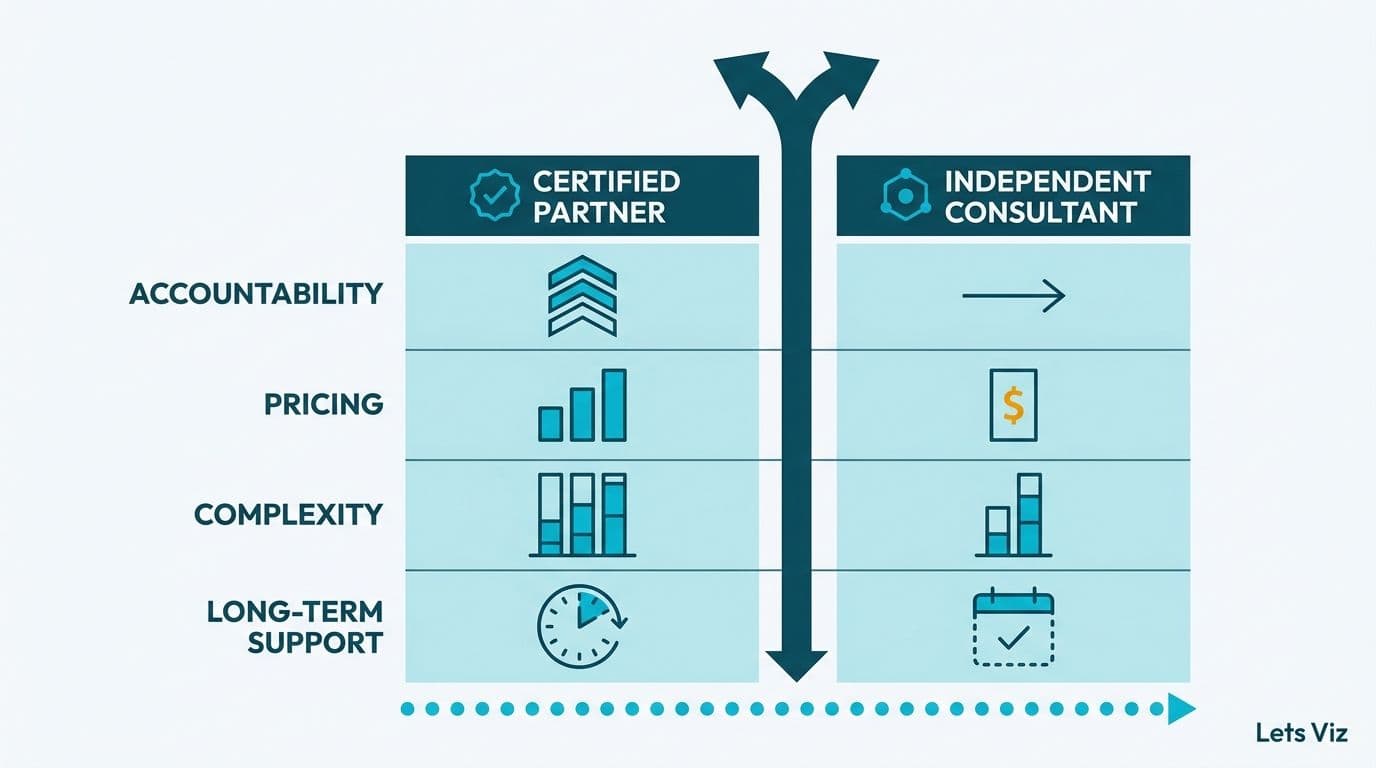
Choosing between a Zoho certified partner and an independent Zoho consultant comes down to four variables: accountability structure, pricing, project complexity, and long-term support access. Certified partners carry Zoho's formal backing and defined SLAs; independent consultants typically offer lower rates and more flexible engagement terms. For most mid-market healthcare and finance teams, the right choice depends on deal size, regulatory exposure, and internal IT capacity.
Key Takeaways
Zoho certified partners operate under Zoho's formal program with structured escalation paths and third-party accountability; independent consultants have no equivalent backstop.
Independent consultants typically charge 20-35% less on day rates but lack access to partner-priority Zoho support queues.
Multi-module deployments and regulated-industry projects generally favor certified partners due to team structure and compliance documentation depth.
Long-term support continuity is a structural risk with solo consultants; key-person dependency can stall operations at the worst possible moment.
Healthcare and finance teams should evaluate HIPAA alignment and data governance posture before selecting either path.
Lets Viz offers Zoho consulting services for businesses implementing Zoho One, Zoho CRM, and the full Zoho suite across US, UK, and Canadian markets.
What Is a Zoho Certified Partner - and What Does Certification Actually Mean?
A Zoho certified partner is a firm that has completed Zoho's authorized training curriculum, passed product-specific certification exams, and agreed to Zoho's partner code of conduct. Partner tiers - typically Authorized, Advanced, and Premium - reflect a combination of active deployed seats, customer satisfaction scores, and support resolution rates. The higher the tier, the more rigorous the ongoing performance requirements Zoho enforces.
Certification carries operational weight that the label alone does not communicate. Certified partners receive direct escalation access to Zoho's technical support engineering team, bypassing the standard customer queue entirely. They also gain dedicated partner account managers who provide early-stage roadmap briefings, access to beta features before general release, and co-marketing resources. In regulated verticals where a misconfigured automation or broken data pipeline carries compliance cost, that direct line to Zoho's engineering organization is not a marketing benefit - it is a risk management tool.
An independent Zoho consultant is typically a practitioner who built Zoho expertise through hands-on project work, often after leaving a partner agency. They configure the same CRM that a certified partner would, but their support tickets route through the standard customer queue with no escalation priority, and there is no third party accountable for their work product.
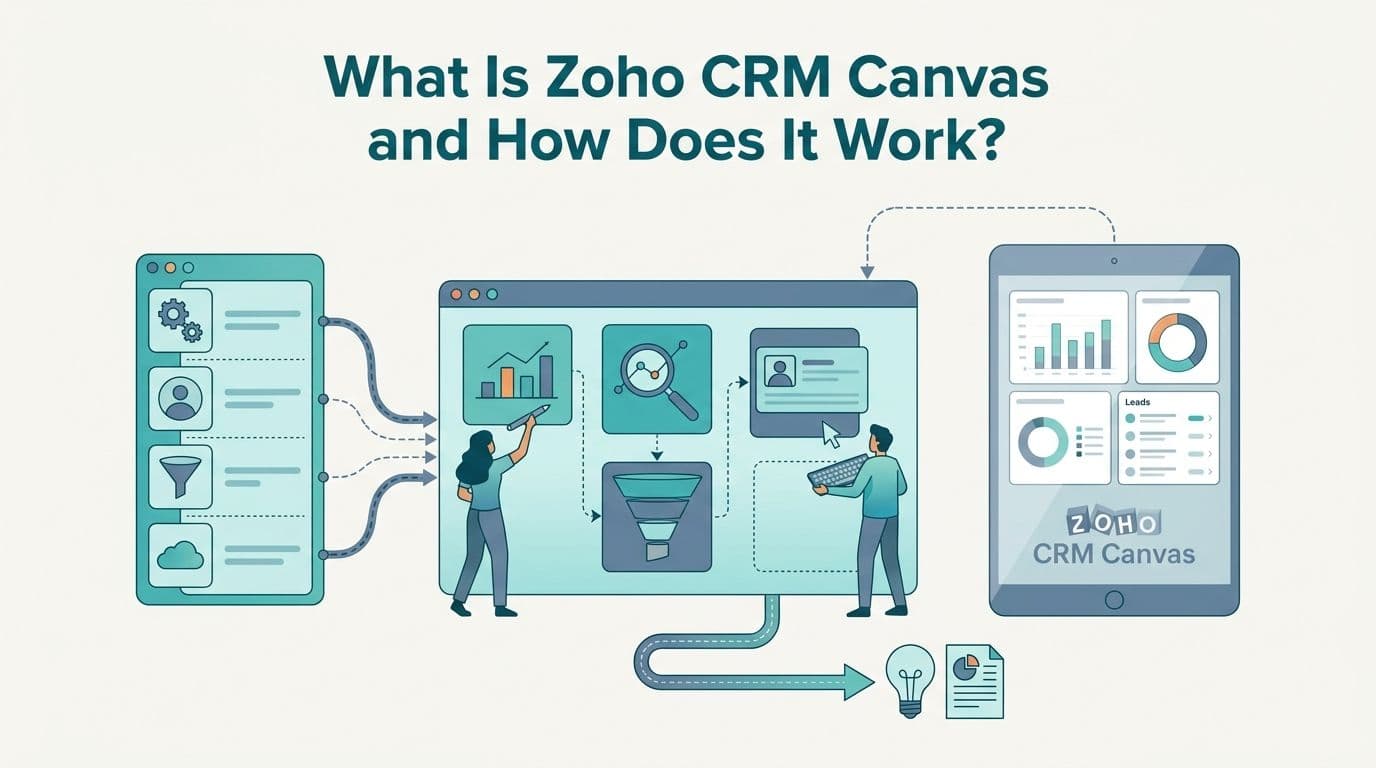
For a closer look at how Zoho's interface and customization layer shapes implementation choices, see What Is Zoho CRM Canvas and How Does It Work?.
Zoho Certified Partner vs Independent Zoho Consultant: The Full Decision Matrix
The table below maps both provider types across the dimensions that most frequently determine mid-market buying decisions. Use it as a structured starting point before evaluating individual vendors.
| Dimension | Zoho Certified Partner | Independent Zoho Consultant |
|---|---|---|
| **Accountability** | SLA-backed, governed by Zoho's partner program; disputes have a formal escalation path | Personal accountability only; no third-party backstop |
| **Pricing (North America)** | Typically $150-$250/hr; higher project minimums | Typically $90-$150/hr; more negotiable scope |
| **Licensing Leverage** | Partners often hold direct Zoho pricing agreements with volume discount access | Standard customer pricing; no volume leverage |
| **Project Complexity Fit** | Strong for multi-module, cross-departmental, enterprise-grade deployments | Strong for single-module projects, tactical fixes, and budget-constrained pilots |
| **Long-Term Support** | Defined SLA tiers, named CSMs, and team-based coverage during individual absence | Dependent on consultant availability; key-person risk is real |
| **Regulatory Alignment** | Partners typically maintain documented compliance frameworks (HIPAA, SOC 2 review) | Varies widely by individual; due diligence falls on the buyer |
| **Zoho Roadmap Access** | Early access to product previews and beta features | Standard release notes only |
| **Onboarding Speed** | Team-based; faster ramp for complex, multi-workstream scopes | Solo; often faster for narrow, precisely defined scopes |
| **Documentation Quality** | Formal change logs, handover docs, and UAT sign-off typically included as standard | Varies; often lighter on formal deliverables without explicit scope requirements |
This matrix is a framework, not a verdict. A highly experienced independent consultant can outperform a lower-tier certified partner on a well-defined single-module project. The certification tier itself - not just the partner label - carries meaningful signal about team depth and support infrastructure.
How Do Pricing and Zoho CRM Implementation Cost Compare Between the Two?
Zoho CRM implementation cost for mid-market companies typically ranges from $15,000 to $80,000 for a full CRM deployment, depending on user count, integration complexity, and data migration volume. Certified partners frequently price at the upper end of that range; independent consultants commonly come in 20-35% lower on service fees.
The cost gap narrows considerably when you account for the total engagement picture. Certified partners often hold direct Zoho licensing agreements that reduce annual subscription cost at 50-plus seat counts, partially offsetting the higher service fee. Formal project management, structured change control, and handover documentation - standard at most certified partner firms - are sometimes excluded from independent engagements and cost more if added after the fact.
The largest hidden variable is remediation cost. A misconfigured workflow, a broken data mapping, or an unsupported custom function that forces a partial re-implementation routinely costs more than the original fee gap between provider types — in practice, remediation engagements discovered in year two commonly run 40–60% of the original implementation fee. A common real-world pattern: a healthcare team that skips formal field standardization during CRM setup discovers 18-24 months later that pipeline reports are unreliable due to inconsistent picklist values — a remediation engagement that typically runs $10,000-$25,000 in consultant fees, entirely erasing the savings from choosing the lower-cost option upfront. Following zoho crm best practices for sales teams - including field standardization, pipeline stage definitions, and activity logging conventions - is a core implementation deliverable that separates well-scoped projects from ones requiring expensive cleanup six months post-launch.
According to Future Market Insights (2026), the AI consulting services market has crossed USD 13.9 billion as of 2026 and is forecast to reach USD 90.99 billion by 2035 at a 26.2% CAGR, reflecting accelerating enterprise demand for credentialed, accountable consulting relationships. Procurement teams across healthcare and finance are increasingly scrutinizing consultant credentials before signing statements of work - a trend that benefits certified partners with verifiable track records.
For a component-level breakdown of where Zoho implementation budget typically lands, see our detailed guide to Zoho CRM customization cost.
How Long Does Zoho CRM Implementation Take With Each Provider Type?
How long a Zoho CRM implementation takes depends primarily on scope, but provider type significantly affects schedule risk and resilience. A solo independent consultant running a 100-seat deployment is a single point of failure at every milestone. A certified partner firm assigns a team: a project lead, a Zoho-certified admin, and often a data engineer for migration and ETL work - allowing parallel workstreams that compress timelines on complex scopes.
Typical timelines by scope:
Single-module CRM, under 20 users: 4-8 weeks with either provider type; independent consultants can move faster due to lower coordination overhead
Mid-market CRM with workflow automation setup: 10-16 weeks; partner teams typically compress this by 2-3 weeks through parallel workstreams
Zoho One multi-module deployment: 16-30 weeks; certified partners are the structurally safer choice given cross-module integration dependencies
Healthcare or finance with compliance documentation: Add 2-4 weeks for formal UAT, data governance review, and sign-off documentation regardless of provider type
Knowing how to import and map data in Zoho CRM is a core milestone in every implementation. Field mapping errors, duplicate detection misconfiguration, and incorrect picklist value hierarchies account for a disproportionate share of post-go-live support escalations. Certified partners typically run a formal data audit before migration; independent consultants may skip this step to stay within budget constraints.
Setting up zoho crm workflow automation correctly from day one also matters for long-term cost efficiency. Every manual workaround embedded in an early configuration becomes a maintenance burden that compounds over time and typically requires paid consultant hours to unwind.
When Does Project Complexity Tip the Decision Toward a Certified Partner?
Certified partners are structurally better suited to projects where two or more of the following conditions apply:
Multiple Zoho modules are in scope - CRM, Books, Desk, Analytics, Projects, or Sign - requiring cross-application data consistency and coordinated rollout
Custom API integrations connect Zoho to an ERP, billing system, data warehouse, or clinical application
Blueprint-level workflow design is required rather than basic workflow rules
User count exceeds 50 across departments, geographies, or business units
Regulatory documentation - SOC 2 evidence packs, HIPAA Business Associate Agreement support, or audit trail configuration - must be produced alongside the deployment itself
The distinction between Zoho CRM workflow rules vs blueprints is a useful proxy for project complexity. Workflow rules are linear event triggers that fire when a condition is met. Blueprints are stateful, stage-gated approval flows with mandatory transition conditions and enforcement logic. A consultant comfortable designing and debugging blueprints at scale is operating at a meaningfully different complexity level than one focused on basic automations - and Zoho's certified partner program tests for that competency directly.
Healthcare organizations face elevated stakes on every dimension of this decision. According to Market Research Future (2026), the Healthcare Financial Analytics Market is projected to grow at an 8.58% CAGR from 2026 to 2035, driven by technological advancement and tightening regulatory requirements. That growth is generating demand for deeply integrated CRM-to-analytics pipelines where configuration accuracy directly affects reporting quality and reimbursement accuracy. For teams making those infrastructure investments, HIPAA-compliant analytics practices should be embedded in the implementation process from the start - not retrofitted after go-live under remediation budget pressure.
What Does Long-Term Support Look Like With Each Provider Type?
Long-term support is where the certified partner vs independent consultant decision is most asymmetric - and where mid-market buyers most frequently report post-implementation regret when they chose the lower-cost option without fully modeling what ongoing support would require.
Certified partner support structure:
Named account or customer success manager (CSM) for ongoing requests and proactive check-ins
Defined SLA response windows - typically 4-8 business hours for critical issues on supported tiers
Access to Zoho's partner-priority support queue for technical escalations that require engineering involvement
Team-based coverage during individual consultant absence, vacation, or departure
Structured onboarding for new users as the organization grows
Independent consultant support structure:
Direct access to a senior practitioner who carries deep institutional knowledge of your specific configuration
Often faster response for routine requests because there is no ticketing layer between client and expert
Variable availability during high-demand periods or when the consultant carries multiple simultaneous engagements
Key-person risk: if the consultant exits the market, becomes unavailable, or deprioritizes your account, continuity depends entirely on documentation quality left behind
For finance teams running Zoho CRM as the operational backbone of revenue workflows, key-person risk is a material business continuity concern. The right question before signing is not whether the consultant will be available next month but what the CRM environment looks like if they are unavailable for 90 days. That question deserves a concrete answer in writing before the engagement begins.
MedInsight (2026) noted that through the first half of 2026, healthcare organizations continued to prioritize value-based care analytics and AI-driven workflow improvements as strategic imperatives, with budget allocations for CRM-integrated analytics up an estimated 21% year-over-year. In that environment, CRM data quality and process integrity are directly tied to reimbursement accuracy - which means a support gap is not just an IT inconvenience; it is a potential revenue exposure with measurable downstream consequences.
For more on how consulting model selection intersects with broader analytics infrastructure decisions in regulated industries, see AI Consulting for Healthcare Data Analytics.
Which Option Is Right for Healthcare and Finance Teams in the US and Canada?
For healthcare organizations, certified partners are the structurally correct default. PHI handling requirements, HIPAA Business Associate Agreement documentation, and the need for audit-ready configuration evidence create a compliance surface that individual consultants rarely cover with the rigor that legal and procurement teams require. Due diligence burden is substantially lower with a certified partner that already maintains documented compliance frameworks reviewed against current regulatory standards.
For finance teams, the decision is more context-dependent. Mid-market finance directors often scope more bounded Zoho projects - a CRM for a wealth management team, a pipeline tracker for a commercial lending desk, or a contact management layer for an advisory practice. In those scenarios, an experienced independent consultant with deep sector knowledge can deliver strong outcomes at 20-35% lower cost, particularly when the internal IT team can absorb tier-1 Zoho support.
A practical decision rule for mid-market buyers:
Choose a certified partner when:
Your deployment spans more than one Zoho module
Your data includes PHI, PII, or regulated financial information
You require integration with financial or clinical enterprise systems
Your internal team cannot absorb first-line Zoho support independently
Long-term scalability and defined SLAs are non-negotiable business requirements
Choose an independent consultant when:
Your scope is a single, well-defined module with a bounded user population
Your team has existing Zoho experience and can handle routine day-to-day support
Budget constraints make the fee differential a decisive factor in the business case
You need deep vertical specialization in a niche that generalist partner firms may not serve well
Understanding zoho crm use cases for professional services firms - and which use cases require partner-level support infrastructure vs. which can be safely handled by a skilled independent - is central to making this call correctly before signing a statement of work.
If you are evaluating Zoho implementation options for a healthcare or finance project, Zoho consulting services from Lets Viz offers transparent scoping, documented compliance alignment, and a team model that eliminates key-person risk from day one.
---
About Lets Viz: Lets Viz is a data analytics and CRM consulting firm that has served mid-market healthcare and finance organizations across the US and Canada since 2020. Our team holds credentials across Zoho, Microsoft Fabric, and Power BI, with a track record of HIPAA-aligned CRM implementations and finance-grade workflow automation. We advise CIOs, data team leads, and finance directors on vendor selection, implementation strategy, and long-term analytics infrastructure - grounded in hands-on delivery experience across both regulated industries.
---