AI Consulting for Healthcare Data Analytics: 2026 Guide
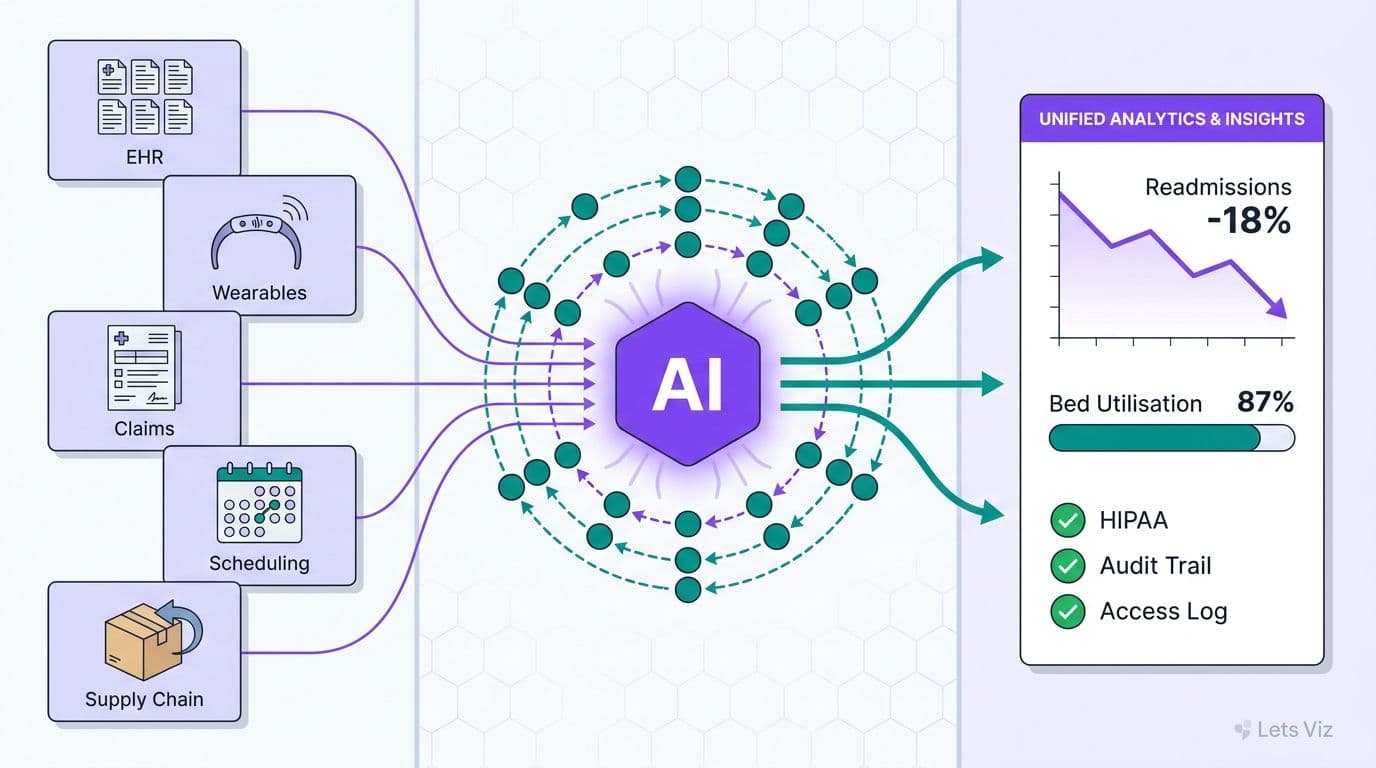
Healthcare organisations are generating unprecedented volumes of data - electronic health records, wearable device outputs, insurance claims, scheduling information, and supply chain transactions. Yet the majority of that data sits in disconnected silos, making it difficult to act on and easy to misinterpret. AI consulting for healthcare data analytics is the discipline that bridges the gap: turning raw clinical and operational data into insights that reduce preventable readmissions, sharpen capacity management, and create an auditable foundation for regulatory compliance.
This guide is written for digital transformation leads, CFOs, and clinical operations directors evaluating an AI analytics strategy in 2026. It examines where AI is delivering measurable results in healthcare today, what responsible implementation looks like, and how to select an AI consulting firm capable of navigating the sector's particular complexity.
The Business Case for AI and Analytics in Healthcare
The scale of investment in AI consulting services signals the strategic direction clearly. According to Future Market Insights, the global AI consulting services market was valued at USD 11.07 billion in 2025 and is projected to reach USD 90.99 billion by 2035 - a compound annual growth rate of 26.2%, placing the implied 2026 market at approximately USD 14 billion. With mid-2026 investment tracking approximately 28% ahead of the prior year baseline, healthcare remains one of the primary engines of expansion, as health systems accelerate investment in predictive analytics, clinical decision support, and automated compliance monitoring.
The underlying drivers are structural. Value-based care contracts require providers to demonstrate outcomes rather than activity volumes. Payer negotiations increasingly favour health systems that can produce clean data and verifiable efficiency metrics. And patient safety expectations, amplified by years of post-pandemic scrutiny, mean that operational decisions must be grounded in evidence rather than intuition or legacy rule sets that no longer reflect the patient population being served.
An experienced AI consulting firm brings three capabilities that most health systems lack internally: the data engineering expertise to unify clinical and operational data sources, the modelling capability to surface actionable insights from that unified data, and the governance frameworks required to keep models auditable and explainable to regulators and clinical governance committees alike.
For leaders building the internal business case, our business intelligence overview outlines the foundational concepts that underpin any enterprise analytics programme and will help frame the conversation with clinical and operational stakeholders before an AI consulting engagement begins.
How AI Consulting Reduces Hospital Readmissions
Unplanned readmissions are expensive, penalised under most value-based care frameworks, and - critically - largely preventable. Predictive readmission models analyse a wide range of variables at the point of discharge: comorbidities, social determinants of health, prior admission history, medication adherence signals, post-discharge care availability, and the completeness of transition plans. The output is a patient-level risk score that care coordinators can act on before the patient leaves the facility.
Predictive Discharge Planning
Modern AI platforms ingest structured EHR data alongside unstructured clinical notes, using natural language processing to surface risk signals that structured fields do not capture. High-risk patients trigger an alert in the care coordination workflow - not a report requiring manual interpretation. Teams can schedule a home health visit, arrange transport to a follow-up appointment, or route the patient to a community health worker before discharge, based on a prioritised list generated automatically by the model.
Population-Level Risk Stratification
For health systems managing thousands of discharges each month, manual risk stratification is not scalable without adding significant clinical headcount. AI models extend that capacity without proportional cost increases. Importantly, they can be recalibrated continuously as population health patterns shift - something static rule sets built on administrative data cannot achieve.
MedInsight identified three converging themes in healthcare analytics that have solidified into 2026: value-based care (VBC), AI-driven analytics, and payer analytics innovation. Readmission reduction sits at the intersection of all three - it is simultaneously a clinical outcome, a contractual performance metric, and a cost variable that payers monitor closely across their provider networks.
For organisations exploring AI adoption more broadly, our guide to AI automation for SMEs in India, UK, and the US demonstrates how the same predictive modelling principles translate across industries and organisational scales.
Optimising Capacity and Workforce Planning with AI
Bed management and workforce scheduling are perennial operational pain points in healthcare delivery. Both are, at their core, demand forecasting problems - and that is precisely where AI-driven analytics has delivered its most consistent results across health system implementations to date.
AI-Driven Bed Management and Patient Flow
Capacity optimisation platforms use historical admissions data, seasonal demand curves, elective procedure schedules, and emergency department arrival patterns to generate bed demand forecasts at 4-hour, 24-hour, and 7-day horizons. Bed managers shift from reactive firefighting to anticipatory reallocation, moving resources before pressure peaks rather than scrambling to respond after they do.
The same models identify systemic bottlenecks: which wards consistently discharge late in the day, which procedure types generate predictable downstream bed pressure, and where float staff should be pre-positioned. Health systems using AI-driven capacity tools report measurable reductions in corridor wait times, cancelled elective procedures, and costly underutilisation of high-capital clinical infrastructure.
Workforce Scheduling and Labour Cost Control
Labour typically represents 50-60% of a hospital's total operating expenditure. AI workforce scheduling tools match shift patterns to demand forecasts while accounting for skill mix requirements, contractual obligations, and staff preferences. Early adopters report reductions of 15-25% in agency and overtime spend - for a 500-bed health system running $35 million in annual agency costs, a 20% reduction frees $7 million for direct care investment. That saving flows directly to the operating margin, making workforce analytics one of the highest-return AI applications available to healthcare finance teams today. In 2026, with registered nurse vacancy rates still running above 10% in many US markets and NHS bank shift costs at record levels, the cost discipline that AI scheduling delivers has become a strategic necessity rather than an operational nicety.
Mature implementations extend this further, combining workforce analytics with real-time patient acuity data to match staffing ratios to actual clinical complexity rather than relying on static ratios established during annual planning cycles.
Meeting Healthcare Compliance Requirements Through AI
Regulatory compliance in healthcare is non-negotiable, and the consequences of failure - financial penalty, loss of accreditation, litigation, and reputational damage - can be existential for provider organisations. AI analytics is increasingly central to compliance strategy, not only because it improves data accuracy, but because it creates the structured audit infrastructure that regulators expect to see.
Audit Trails and Data Governance
Responsible AI consulting services treat data governance as a core programme deliverable from day one. Every model input, every prediction, and every decision influenced by that prediction should be logged, timestamped, and retrievable for regulatory review. Health systems operating under HIPAA in the United States, GDPR in Europe, or the NHS Data Security and Protection Toolkit in the United Kingdom need to demonstrate that their AI systems meet those standards continuously - not just at initial deployment.
A well-architected data platform creates an immutable audit trail. It also enables rapid response to regulatory enquiries: instead of a weeks-long manual review, compliance teams can query a structured log within hours and produce the documentation regulators need.
Clinical Coding Accuracy and Revenue Integrity
Inaccurate clinical coding costs health systems both revenue and compliance standing. AI-assisted coding tools review clinical documentation and flag cases where assigned codes appear inconsistent with the documented diagnosis, procedure type, or acuity level. This reduces claim denial rates, lowers audit exposure, and improves the accuracy of data feeding population health reporting and clinical research programmes.
According to Market Research Future (2026), the Healthcare Financial Analytics market is projected to grow at a 9.1% CAGR through 2035, driven by technological advancement and the increasing complexity of regulatory requirements. Clinical coding accuracy and financial analytics automation are two of the primary use cases propelling that market expansion.
Which Looker Studio Data Sources Satisfy HIPAA, GDPR, and PIPEDA for Clinical Dashboards?
As healthcare organisations standardise on Google's analytics stack, a practical compliance question has risen to the top of the implementation agenda: which Looker Studio data sources are viable for clinical dashboards, and under what configuration does each meet HIPAA, GDPR, and PIPEDA? The answer depends on connector choice, data-residency region settings, and whether a Business Associate Agreement (BAA) is in place with Google - and the differences between connectors are significant enough to determine programme feasibility.
BigQuery as the recommended compliant backend
BigQuery is the appropriate data source for any Looker Studio clinical dashboard that may surface protected health information (PHI). Google's BAA covers BigQuery under its Google Cloud Healthcare offering, provided datasets are stored in a BAA-covered region. For HIPAA purposes, US organisations should pin datasets to single-region US locations - us-central1, us-east1, or us-east4 - rather than the multi-region US bucket, which provides weaker data-residency assurance. GDPR-compliant deployments in the European Economic Area should use EU single regions such as europe-west1 or europe-west4, explicitly avoiding the broader multi-region EU option when cross-border transfer exposure needs to be minimised for sensitive health data categories. Canadian organisations operating under PIPEDA can satisfy domestic data-residency expectations by using Google Cloud's northamerica-northeast1 (Montreal) region for all PHI-containing datasets.
BigQuery's native audit logging through Cloud Audit Logs captures every query, every row-level access event, and every data export - creating the immutable access record that HIPAA's Technical Safeguard requirements and GDPR's accountability principle both mandate. These logs integrate into Google Cloud's Security Command Center and can be forwarded to long-term storage for the minimum six-year HIPAA retention period, giving compliance teams a queryable chain of custody for every interaction with clinical data.
Google Sheets: where the BAA gap creates risk
Google Sheets as a Looker Studio connector presents a materially different compliance picture. Google's BAA does not extend to Google Workspace productivity applications, including Sheets. Connecting a clinical dashboard directly to a Sheet that contains identifiable patient records therefore creates a BAA coverage gap - the PHI exists outside the covered service boundary, regardless of how access to the Sheet is controlled. The standard workaround is to reserve Sheets connectors for de-identified or aggregated operational metrics: bed occupancy rates, appointment volumes, non-identifiable cost summaries, and similar KPIs. All PHI-containing source data must remain in BigQuery under the BAA. This is a configuration discipline question, not a platform limitation, but it requires deliberate governance rather than ad hoc connector choice.
PHI access control and row-level security
Looker Studio inherits access permissions from the underlying BigQuery dataset, but this inheritance requires explicit configuration to be effective. Row-level security policies implemented in BigQuery - using row access policies tied to Google identity groups - carry through to Looker Studio reports, ensuring a dashboard shared with a ward manager surfaces only the patient cohort relevant to that ward rather than the full dataset. Without row-level policies, a permissioned Looker Studio report can inadvertently expose a broader data scope than the clinical role warrants. The recommended architecture for Looker Studio healthcare analytics compliance programmes is: PHI in BigQuery under the BAA in a single-region compliant location, row-level security enforced at the dataset layer before any report is shared, Looker Studio reports distributed via Google Groups aligned to clinical roles, and Cloud Audit Logs retained for the full regulatory period. This configuration gives compliance teams the audit logging, data-residency assurance, and access control granularity that HIPAA, GDPR, and PIPEDA all require from a clinical dashboard platform.
Power BI HIPAA Compliance for Healthcare Analytics: Platform Comparison Checklist
Healthcare IT decision-makers frequently need a consolidated reference rather than separate vendor documentation searches to compare analytics platforms. The four criteria that determine clinical dashboard feasibility are BAA availability, PHI storage controls, audit log depth, and GDPR Article 28 / PIPEDA processor coverage. The checklist below summarises the current position for the three platforms most commonly shortlisted in 2026.
| Criterion | Power BI (Microsoft Fabric) | Looker Studio + BigQuery | Tableau + Snowflake |
|---|---|---|---|
| **BAA availability** | Yes - Microsoft's HIPAA BAA covers Power BI Premium and Fabric capacity workspaces | Yes - Google Cloud BAA covers BigQuery; Looker Studio inherits coverage when BigQuery is the sole data source | Yes - Snowflake BAA available; Tableau Cloud BAA available on request for covered workloads |
| **PHI storage controls** | Azure region pinning required (e.g. East US, Canada Central); customer-managed encryption keys via Azure Key Vault; local .pbix files fall outside the BAA boundary | Single-region BigQuery dataset location required (us-central1, europe-west1, northamerica-northeast1); CMEK available; multi-region US/EU buckets should be avoided for PHI | Snowflake single-region deployment required; Tableau extracts must remain in BAA-covered compute; Tableau Public is out of scope for any PHI |
| **Audit log depth** | Microsoft Purview logs all dataset access, report views, export events, and semantic model queries; exportable to Azure Monitor / Log Analytics; six-year retention policy configurable | Cloud Audit Logs capture every BigQuery query, row-level access event, and data export; integrate with Security Command Center; forward to Cloud Storage for six-year HIPAA retention | Snowflake Access History table logs all queries and data access; Tableau activity logs via site admin; custom pipeline required for long-term retention |
| **GDPR Art 28 / PIPEDA processor** | Microsoft Products and Services DPA serves as the Article 28 processor agreement; applies to Fabric and Power BI; Canada Central / Canada East Azure regions for PIPEDA data residency | Google Cloud DPA serves as the Article 28 processor agreement for BigQuery; northamerica-northeast1 (Montreal) for PIPEDA residency | Snowflake and Tableau both publish DPAs covering the processor relationship; Canadian Snowflake region available for PIPEDA residency |
Configuring Power BI for HIPAA-compliant clinical dashboards
For organisations already standardised on Microsoft 365 and Azure, Power BI HIPAA compliance for healthcare analytics is achievable within Microsoft Fabric, provided four configuration steps are enforced. First, pin the Fabric workspace to a single Azure region rather than accepting the default multi-geo assignment - multi-geo deployments can route compute across regional boundaries that weaken data-residency assurance and complicate audit reporting. Second, enable customer-managed encryption keys via Azure Key Vault for any semantic model that processes PHI. Third, implement row-level security (RLS) in the semantic model before any report is shared, so that a clinical dashboard distributed to a ward manager exposes only the patient cohort relevant to that role rather than the full dataset. Fourth, route all audit log events to a Log Analytics workspace with a retention policy of at minimum six years to satisfy HIPAA's Technical Safeguard requirements.
Microsoft's GDPR Article 28 processor relationship is established through the Microsoft Products and Services Data Protection Addendum, which applies automatically to enterprise agreement customers and covers Power BI and Fabric workloads. For PIPEDA, the Canada Central and Canada East Azure regions satisfy domestic data-residency expectations, and the same DPA governs the processor relationship under Canadian privacy law.
The one gap specific to Power BI that auditors consistently flag: Power BI Desktop files saved locally to unmanaged endpoints sit outside the BAA boundary. Any PHI that flows through a local .pbix file and is not immediately published to a Fabric workspace creates a coverage gap. Data governance policies should explicitly prohibit local PHI extracts and enforce publish-to-workspace as the only permitted development workflow for clinical dashboards.
Power BI EHR Integration for Healthcare Analytics: Connecting Epic, Cerner, and FHIR Data
Power BI EHR integration for healthcare analytics starts at the API layer of the source system. Epic, Cerner (now Oracle Health), and Meditech expose data through two distinct channels that each require a different connection strategy in Power BI - the HL7 FHIR R4 API for interoperable clinical resources, and the structured relational reporting database (Epic Clarity, Cerner PowerInsight) for high-volume analytical extracts. Getting this architecture right determines whether scheduled refreshes are reliable, whether PHI is handled within the BAA boundary at every stage, and whether the resulting semantic model is performant enough for clinical teams to trust.
Connecting via HL7 FHIR R4 APIs
Epic's FHIR R4 endpoint, accessed through the SMART on FHIR authorisation framework, and Cerner's Millennium FHIR API both return structured JSON resources - Patient, Observation, Condition, MedicationRequest, Encounter, and related clinical types. The recommended connection pattern for Power BI is:
1. Register a backend application in Epic's App Orchard or Cerner's Code Console with system-level SMART scopes (`system/Patient.read`, `system/Observation.read`, and the resource types relevant to the use case).
2. Implement a token refresh intermediary - an Azure Function or lightweight API app - that holds client credentials and returns a current bearer token to Power BI's Web connector on each refresh cycle. Embedding client secrets directly in Power BI dataflows is a security anti-pattern and violates most healthcare data governance policies.
3. Use Power Query's JSON parsing functions to flatten nested FHIR resources into tabular structures. The `Observation` resource carries a polymorphic `value[x]` field - explicit type-handling branches in M code are required to surface numeric lab results, coded values, and string observations without silent nulls dropping from the model.
4. Stage the flattened tables in Azure Data Lake Storage Gen2 or Azure SQL Database - both BAA-covered services - before loading to Power BI semantic models, rather than querying the FHIR endpoint live. Live FHIR queries on large patient cohorts generate significant latency and hit vendor-imposed rate limits that cause scheduled refreshes to fail in production.
Structured extract connections: Epic Clarity and Cerner PowerInsight
For organisations with on-premises or hosted Epic deployments, the Epic Clarity reporting database provides direct SQL access to a normalised relational schema covering clinical, financial, and scheduling data. Power BI connects via the SQL Server connector using a read-only service account. Key configuration decisions:
Use DirectQuery only where near-real-time latency is a genuine clinical requirement - bed management dashboards being the clearest example. For most analytical workloads, scheduled import into a semantic model is more performant and reduces load on production reporting infrastructure.
Cerner's PowerInsight environment provides a comparable structured extract layer, with Power BI connecting through the ODBC connector and an appropriate JDBC driver.
On-premises data gateway deployment is required for any SQL Server or ODBC connection to hospital-network-resident databases. The gateway should run on a server in the same network segment as the database host, with outbound HTTPS to Azure Service Bus on port 443. Most hospital firewalls require explicit allow-list entries for the gateway's Azure relay endpoints, and redundant gateway node configuration is recommended for any dashboard that clinical teams depend on for daily operations.
HIPAA, GDPR, and PIPEDA across cloud and on-premises deployment modes
In cloud mode - where EHR data is imported to Power BI Service via Azure Data Lake or Azure SQL - PHI is in motion during the scheduled refresh and at rest in the Power BI semantic model cache. Both states require the Fabric workspace to be pinned to a single BAA-covered Azure region, with customer-managed encryption keys active for the semantic model. The import cycle should be logged in Microsoft Purview to maintain the chain of access records that HIPAA's Technical Safeguard requirements mandate.
In on-premises gateway mode with DirectQuery, PHI does not leave the hospital network during query execution - the gateway translates DAX or SQL queries and returns only the result set to the Power BI Service rendering layer. This architecture satisfies the most conservative interpretations of HIPAA's Minimum Necessary standard and reduces GDPR cross-border transfer exposure for EU-based health systems. The trade-off is that gateway infrastructure becomes a single point of failure that requires active monitoring and a tested failover configuration for production clinical dashboards.
For PIPEDA-regulated Canadian health systems, semantic model storage must be confirmed in Canada Central or Canada East Azure regions. Any FHIR API calls routed through Azure API Management should also be configured to process identifiable patient data within those Canadian region deployments - not the default US or EU regions that Azure assigns if region is not explicitly specified at provisioning.
Value-Based Care, Payer Analytics, and Financial Performance
The transition from fee-for-service to value-based care is reshaping the financial architecture of healthcare delivery in the UK, US, and globally. Providers that can demonstrate quality outcomes at controlled cost are better positioned in payer negotiations, contract renewals, and regulatory submissions. That requires sophisticated analytics - specifically, the ability to attribute clinical spend to measurable outcomes and identify where performance is falling short of contracted targets before the contract period closes.
Payer Analytics and Real-Time Contract Performance
Payer analytics platforms ingest claims data, clinical outcome records, and contract terms to calculate performance against each value-based arrangement in near-real time. Finance and clinical leadership can see, at any point in the contract period, whether they are tracking to earn shared savings, avoid penalties, or breach risk corridors. This changes the nature of provider-payer dialogue from retrospective dispute to prospective course correction - a shift that benefits both sides of the relationship.
This is where the overlap between healthcare analytics and financial services analytics is most visible. Healthcare CFOs require the same analytical rigour as their counterparts managing complex investment or lending portfolios. Our guide to AI consulting services for financial advisors explores parallel challenges in data-driven financial decision making, and many of the governance and modelling frameworks translate directly to healthcare's payer contracting and outcome attribution requirements.
Finance teams looking to benchmark their performance reporting discipline should also review our breakdown of 5 key financial KPIs every CFO should track - a framework that maps cleanly onto healthcare's cost-per-episode, readmission penalty, and shared savings calculations.
Population Health and Cost Attribution
At a population level, AI models segment patient cohorts by predicted cost and clinical risk, directing intervention resources to where they are most likely to prevent expensive acute episodes. This is predictive population health management operating at scale: thousands of individual-level predictions aggregated into operational priorities that clinical and care coordination teams can act on without adding analytical overhead to already stretched workflows.
Choosing the Right AI Consulting for Healthcare Data Analytics
Selecting the right AI consulting firm for a healthcare engagement requires scrutiny beyond technical competence alone. The sector combines regulatory complexity, clinical data sensitivity, and professional accountability in ways that not every technology consultancy is equipped to navigate responsibly.
The most effective healthcare AI engagements in 2026 combine data engineering capability with the structured rigour of management consulting data analytics - that is, the habit of framing the business problem before selecting a model, building analysis around testable hypotheses, and communicating findings in terms that CFOs, clinical boards, and operational directors can act on rather than just terms that data scientists find technically satisfying. Consulting firms that bring this discipline close the gap between a technically correct model and one that actually changes decisions. In healthcare, where the distance between analytical output and frontline behaviour change is almost entirely a stakeholder communication and governance problem, this matters more than raw modelling sophistication. Health systems evaluating partners should ask not just what models a firm can build, but how they structure the problem-definition phase, how they frame findings for executive audiences, and what measurable outcomes they have driven in previous healthcare engagements - not just what accuracy metrics their models achieved.
Domain Expertise in Healthcare Data Standards
Prospective consulting partners should demonstrate direct experience with healthcare-specific data standards: HL7 FHIR for interoperability, SNOMED CT for clinical terminology, ICD-10 for diagnostic and procedure coding, and OMOP for research-grade data transformation. These are not generic data engineering problems. A consultant who has worked across multiple health system implementations will understand the endemic data quality issues in EHR exports - including the FHIR resource flattening and SMART authorisation challenges described above - and know how to address them without distorting the underlying clinical record that clinical and administrative teams depend on.
Model Explainability and Clinical Governance
Clinical governance committees and medical directors will ask how an AI model reaches its conclusions before placing any operational weight on its outputs. Artificial Intelligence Consulting Services for healthcare must include explainability as a standard deliverable: SHAP values, decision path documentation, and confidence intervals should accompany every model deployment. This is not regulatory box-ticking - it is the practical foundation for clinical trust and the sustained adoption that determines whether an AI programme delivers value beyond its first six months.
Change Management and Frontline Adoption
Technology is rarely the limiting factor in healthcare AI implementations. The harder challenge is ensuring that clinical teams working in time-pressured environments trust and consistently use AI-generated insights in their daily decision making. An effective AI consulting partner brings a structured adoption framework: role-specific training, iterative feedback loops, and model refinement based on frontline clinician input. Without this, technically sound models accumulate dashboard views without influencing any actual clinical or operational decision.
For organisations evaluating financial return before committing to an engagement, our ROI calculator for AI automation provides a practical methodology for quantifying expected benefits ahead of project sign-off - an essential step when building the business case for board approval or capital committee review.
Building Your Healthcare AI Strategy for 2026
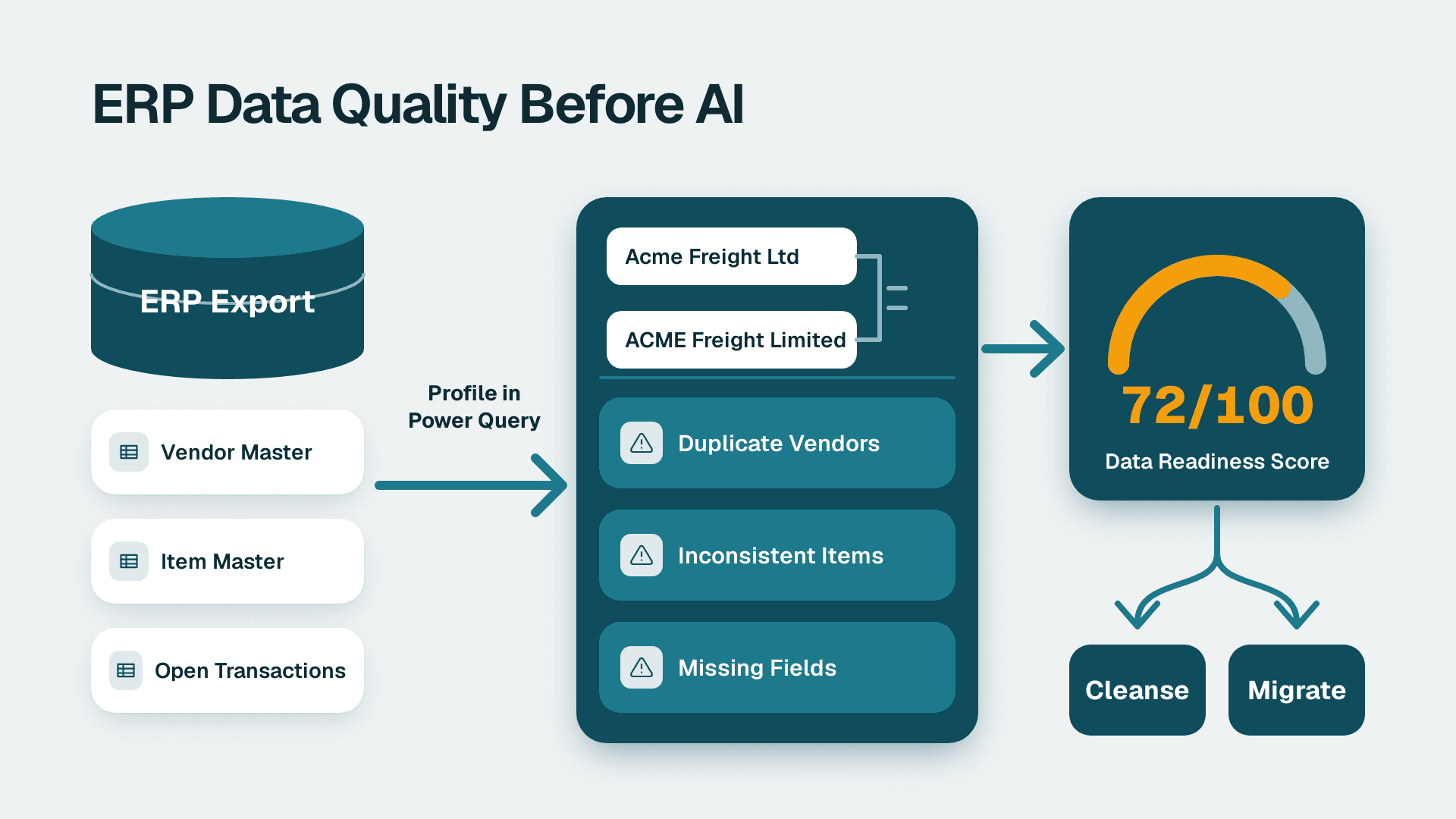
Health systems that will lead on AI outcomes over the next five years are those investing in data foundations today. A practical starting point is a current-state data audit: what clinical and operational data exists, where it lives, how complete it is, and what the known quality issues are. Most organisations find that data preparation - normalising records, resolving duplicates, and joining data from systems that were never designed to interoperate - represents 60-70% of the actual work in any AI project.
From that foundation, prioritise use cases by a combination of clinical impact and data feasibility. Readmission reduction, capacity optimisation, and clinical coding accuracy are well-proven entry points with clear return on investment and achievable data requirements. Ambient AI documentation - where large language models listen to clinician-patient encounters and auto-generate structured clinical notes - has emerged in 2026 as one of the fastest-adoption use cases in the sector, with early deployments at US health systems reporting 40-60 minutes of administrative time saved per clinician per day and measurable improvements in EHR data completeness. This makes it both an immediate productivity win and a data quality accelerator for the predictive modelling programmes that follow. More advanced applications - genomics analytics, real-time clinical decision support, and AI-assisted imaging review - follow once the data infrastructure is sufficiently robust and the organisation has demonstrated it can operationalise model outputs effectively.
Digital transformation leaders should also plan explicitly for the organisational changes that effective AI adoption requires: new analytical roles including data stewards and clinical informaticists, updated governance structures covering model validation and ongoing monitoring, and explicit frameworks for integrating data-driven insights into clinical and operational decision-making processes at every level of the organisation. An AI programme without this organisational alignment produces dashboards. One with it produces measurable change in outcomes, costs, and compliance standing.
---
Lets Viz works with healthcare organisations, clinical operations teams, and finance leaders to design and deliver AI-powered analytics programmes that produce measurable operational results. From data platform architecture and predictive model development to managed dashboards and ongoing analytics support, our consultants cover the full implementation lifecycle. If you are ready to assess your AI readiness or accelerate an existing programme, explore our Managed Power BI services or review our full analytics services portfolio.
---
About Lets Viz: Lets Viz is an analytics consulting firm with over a decade of experience delivering AI, analytics, and data solutions for healthcare organisations, financial services firms, and growth businesses across the UK, US, and India. Our consultants have designed and implemented analytics programmes spanning clinical operations, revenue cycle management, payer contracting, and regulatory compliance, working across Power BI, Google Analytics 4, and Sanity CMS. We combine deep technical capability with genuine sector expertise to deliver AI solutions that clinical and operational teams actually adopt and use.