ServiceNow GRC: What It Covers and Who It Fits
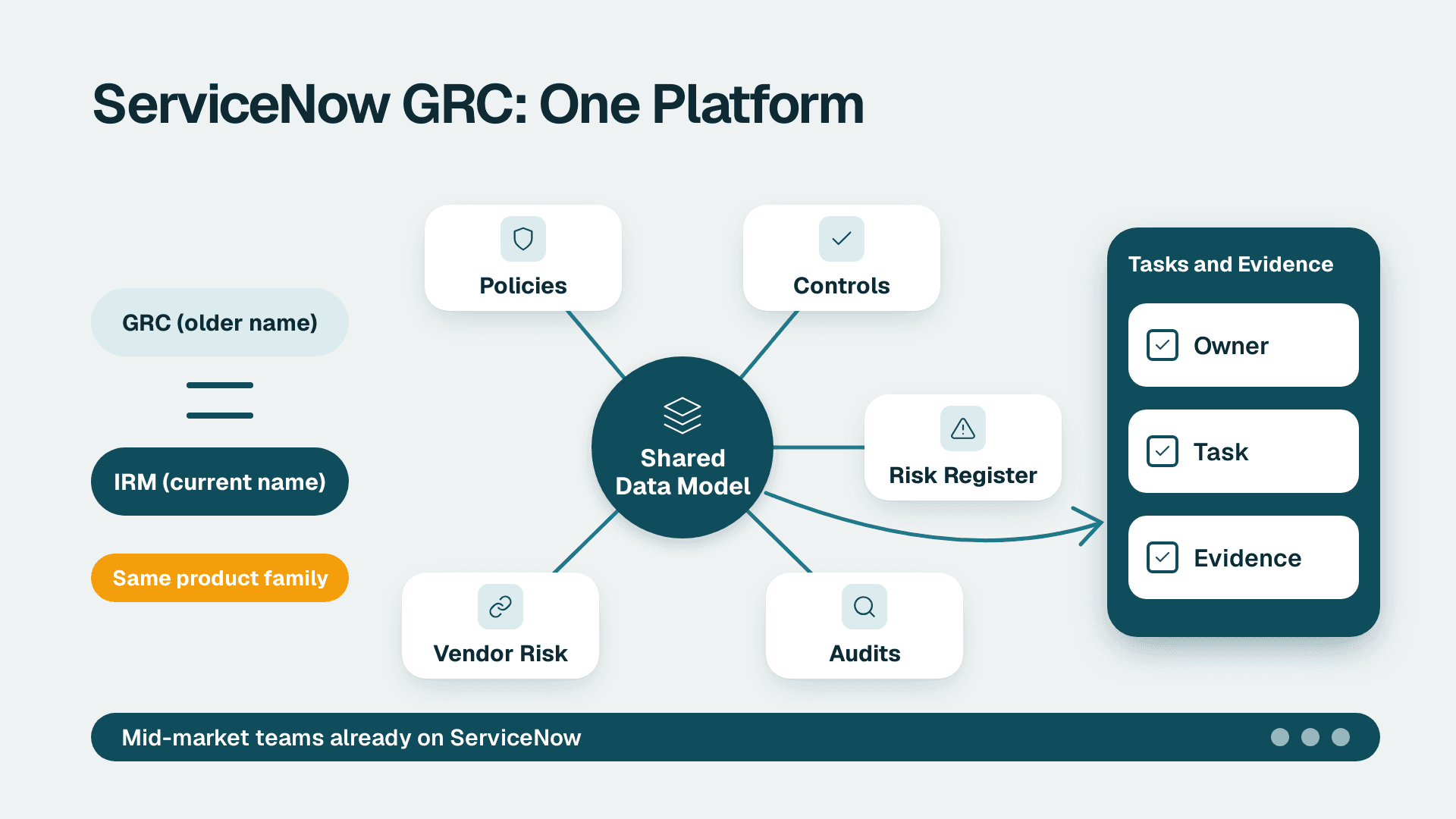
ServiceNow GRC is the set of ServiceNow applications that manage governance, risk and compliance on the same platform as IT and business workflows. It covers policies, controls, risk registers, audits and vendor risk in one data model. ServiceNow now sells it under the name Integrated Risk Management (IRM). It suits mid-market teams that already run ServiceNow and want evidence, owners and tasks in one place.
Key Takeaways
- ServiceNow GRC and IRM are largely the same thing: GRC is the older name, IRM is the current product family.
- The platform's main strength is connecting controls and risks to the workflows and records you already run in ServiceNow.
- It fits mid-market teams with an existing ServiceNow footprint and a real compliance burden, not teams starting from nothing.
- Most implementation effort goes into the control library, ownership and evidence design, not into configuration.
- Treat the tool as an enabler: OCEG notes that integrated GRC does not require one software system.
What is GRC in ServiceNow?
GRC in ServiceNow means using the platform to run governance, risk management and compliance activities as connected workflows instead of separate spreadsheets and email threads. Policies, controls, risks, issues and audit tasks sit in one database and link to each other.
To understand why that matters, start with what GRC itself means. AWS defines Governance, Risk, and Compliance as a structured way to align IT with business goals while managing risks and meeting industry and government regulations. It also notes that GRC combines the three disciplines in one coordinated model, whereas most businesses have practiced them separately in the past.
IBM adds a useful distinction: the term can refer to an organizational strategy, or to an integrated suite of software capabilities for implementing that strategy. When someone searches "servicenow governance risk and compliance", they usually mean the second sense. They want to know what the software does.
In ServiceNow, the software side typically includes these building blocks, as described on the ServiceNow governance, risk and compliance product page:
- Policy and compliance management: authoring policies, mapping them to regulations and internal controls, and tracking attestations.
- Risk management: a risk register with assessments, scoring and treatment tasks.
- Audit management: planning engagements, collecting evidence and tracking findings through to closure.
- Vendor risk management: assessing third parties against questionnaires and tracking remediation.
- Continuous monitoring: indicators that test control health from platform data and update control status.
If your team is still deciding whether the platform itself is the right investment, the complete ServiceNow platform guide for CIOs covers the wider picture. Teams that need help scoping GRC alongside other modules often work with ServiceNow consulting services to sequence the rollout.
Is ServiceNow GRC and IRM the same?
Mostly yes. ServiceNow GRC is the long-standing name, and Integrated Risk Management is the label ServiceNow uses for the broader product family that grew out of it. Search results and community forums use both, so buyers should confirm the exact applications in a quote rather than rely on the name.
The practical difference is scope. "GRC" tends to be heard as policy, compliance and risk. "IRM" signals a wider reach that also includes areas such as audit, vendor risk and operational resilience. If a vendor, analyst or colleague says "servicenow irm", ask which applications they mean and which they assume are included.
| Term | What people usually mean | Where it shows up |
|---|---|---|
| GRC | Policy, compliance and risk applications | Community forums, older documentation, job posts |
| IRM | The wider integrated risk product family | Current product marketing, analyst reports |
| GRC (generic) | The discipline, independent of any tool | Frameworks from OCEG and cloud providers |
The naming also has an origin story. IBM says the "GRC" name was first suggested by OCEG, the Open Compliance and Ethics Group, though OCEG itself dates the concept earlier. The sources disagree on the year, which is a good reminder that GRC is a framework before it is a product category.
Can ServiceNow be used as a GRC tool?
Yes. ServiceNow can serve as the system of record for controls, risks, audits and third-party assessments. Its advantage over standalone GRC tools is that the same platform often already holds your assets, incidents, changes and approvals, so a control can point at live evidence instead of a screenshot.
That advantage is easy to overstate. A GRC tool is only as useful as the content inside it. ServiceNow gives you the structure and the workflows, but someone still has to decide which regulations apply, which controls satisfy them and who owns each one.
Where the platform is strong
- Shared data. Configuration items, change records and incident data already exist, so a control such as "all production changes are approved" can be tested against real records.
- Workflow. Attestations, exceptions, remediation tasks and audit requests flow to named owners with due dates and reminders.
- Single audit trail. Auditors can see who did what and when without piecing it together from email.
- Reuse across frameworks. One control can map to several requirements, which reduces duplicate testing when you face multiple standards.
Where it needs care
- Content is not included by magic. Regulatory content, control libraries and risk taxonomies need design time, and some content may require separate subscriptions. Confirm what is in scope before you sign.
- Indicators can break quietly. A recurring complaint on the ServiceNow community GRC forum is indicators that stop working so that a positive result no longer updates control status. Build monitoring for the monitors.
- Over-customization. Heavy changes to the data model make upgrades harder and slow adoption.
One point from OCEG deserves repeating. It says integrating GRC does not require a single GRC mega-department, the end of decentralized management, or using only one GRC software system. ServiceNow can be the hub without being the only tool.
What problems does GRC in ServiceNow actually solve?
It removes the silos between risk, compliance and IT operations. OCEG lists the drawbacks of siloed GRC activities as high costs, lack of visibility into risks, inability to address third-party risks, difficulty measuring risk-adjusted performance, and too many negative surprises. A connected platform targets each of those.
AWS names a similar set of pressures from the modern environment: cyber risks from internet connectivity, new or updated regulatory requirements, data privacy and protection needs, more uncertainty, rising risk management costs, and complex third-party relationships. Those pressures are why mid-market teams look at tooling at all.
Here is how typical pain points map to platform capabilities:
| Pain point | Typical symptom | ServiceNow capability |
|---|---|---|
| Spreadsheet controls | Stale owners, version confusion | Central control library with ownership and attestations |
| Audit scramble | Weeks spent gathering evidence | Evidence requests and linked records |
| Invisible third-party risk | Vendor questionnaires in email | Vendor assessments with tracked remediation |
| Reactive compliance | Gaps found at audit time | Continuous control monitoring and issue workflows |
| Disconnected risk views | Risk register not tied to operations | Risks linked to assets, services and incidents |
GRC stakeholders reach well beyond IT. AWS lists senior executives, legal teams, finance managers, HR executives and IT departments. That breadth is why adjacent modules matter. For example, an HR team handling employee policy attestations may also be exploring ServiceNow HRSD for HR leaders, and the two should share a policy and case foundation rather than duplicate it.
Who is ServiceNow GRC a good fit for in the mid-market?
It fits mid-market organizations that already use ServiceNow for IT service or operations and now face audits, customer security reviews or regulator questions they cannot answer from spreadsheets. It is a weaker fit for teams with no platform footprint, no named risk owner and no appetite for process change.
A few hypothetical scenarios show where the fit is strongest. These are illustrations of typical situations, not client results.
- A US healthcare services company that must demonstrate HIPAA safeguards and also answers SOC 2 requests from enterprise customers. A shared control library lets one test serve both.
- A UK or EU fintech subject to GDPR that needs a defensible record of data protection controls, vendor assessments and incident handling. Linking vendor risk to the data processing relationship keeps the register honest.
- A Canadian manufacturer handling employee and customer data under PIPEDA while managing supplier risk across a multi-tier supply chain. Vendor assessments and issue tracking give the compliance lead one view.
AWS cites HIPAA and GDPR as examples of regulations a GRC program helps an organization comply with, and the same logic extends to PIPEDA and SOC 2. The tool does not make you compliant. It makes your compliance activity repeatable and visible.
Signals that you are ready
1. You have an existing ServiceNow instance with reasonably clean asset and change data.
2. A named executive owns risk or compliance and has budget authority.
3. You face at least two overlapping frameworks or recurring customer audits.
4. You can dedicate people to control design, not just to platform configuration.
Signals that you should wait
1. Your CMDB and change records are unreliable, so continuous monitoring would test bad data.
2. Nobody has agreed who owns which risks.
3. You want the tool to define your compliance program for you.
If you are unsure about data foundations, a data quality pass pays off before any monitoring goes live. The principles in running an ERP data quality check before AI implementation apply equally to the records your controls will test.
What does implementing GRC in ServiceNow involve?
Implementation is mostly a design and ownership exercise, followed by configuration and rollout in phases. Expect the heaviest effort in defining the control framework, mapping it to requirements and cleaning the data your indicators will read.
IBM says an integrated compliance program should be based on creating, updating, distributing and tracking compliance policies and on training employees on those policies. That is a good checklist for your first phase, because the software should support those activities rather than replace them.
| Phase | Main activities | Key output |
|---|---|---|
| 1. Scope | Pick frameworks, business units and use cases | Agreed scope and success measures |
| 2. Design | Build control library, risk taxonomy, roles | Mapped controls with named owners |
| 3. Configure | Set up applications, workflows, integrations | Working policy, risk and audit flows |
| 4. Monitor | Build indicators against clean data | Control health reporting |
| 5. Adopt | Train owners, run first attestation cycle | Live program with real evidence |
| 6. Improve | Review gaps, retire unused customization | Roadmap for added use cases |
Start small and prove one use case
Pick one framework and one business unit first. A first cycle of attestations and one audit gives you real feedback, and you can add frameworks after the model proves itself. Before committing, many teams prototype in a personal developer instance, a free sandbox that lets them test data model ideas without touching production.
Plan the budget honestly
Licensing is only part of the cost. Design time, integrations, data cleanup, training and ongoing administration all count. The ServiceNow implementation cost breakdown for mid-market teams explains how those pieces typically add up. Pricing and tiers change, so get a written quote that lists exactly which GRC applications and content are included.
Keep an exit path
Any system of record can become a lock-in risk. Document how controls, risks, evidence and audit history could be exported, and confirm export formats during contracting. An exit strategy for migration paths is not pessimism. It is the same third-party risk thinking your GRC program will ask of vendors.
How do you measure maturity once GRC is live?
Measure integration, not just activity counts. AWS defines GRC maturity as the level of integration of governance, risk assessment and compliance within an organization. A mature program shows connected data, clear ownership and decisions informed by risk, not simply a full control library.
OCEG publishes the GRC Capability Model 3.5, known as the Red Book, which helps GRC professionals plan, assess and improve their capabilities. It is a useful reference for setting targets that do not depend on any one tool.
Practical measures to track:
- Control ownership coverage: share of controls with a current, named owner.
- Evidence freshness: how recent the evidence behind each control is.
- Open issue ageing: how long findings sit before remediation.
- Indicator reliability: how many automated tests are running and returning valid results.
- Audit effort: hours and people needed to answer a standard audit request.
If you also use AI features in reporting or review, add them to the program's scope. The 8-step AI audit guide shows how to bring AI systems under the same control discipline.
What are the top GRC tools, and how should you compare them?
Compare GRC tools on fit with your existing systems, content coverage, ownership model and total cost, not on feature counts. Lists of the top five tools change often, and the right answer depends on whether you already run a platform that holds your operational data.
Use these criteria to build your own shortlist:
| Criterion | Question to ask |
|---|---|
| Data integration | Can controls test live records in systems we already run? |
| Content | Which regulations and control libraries are included, and which cost extra? |
| Workflow | Can owners attest and remediate without training marathons? |
| Reporting | Can leadership and auditors get views without exports? |
| Cost | What are licensing, implementation and admin costs over several years? |
| Exit | How do we extract our data if we leave? |
For teams that already depend on ServiceNow, the integration question usually decides the shortlist. For teams that do not, a lighter point solution may be more sensible than adopting a large platform just for compliance.
What mistakes slow down ServiceNow GRC projects?
The most common mistakes are starting with configuration before design, treating the tool as the program and underestimating data quality. Each is avoidable with early decisions.
1. Buying before scoping. Teams license a bundle, then discover half of it matches no real use case.
2. No control owners. Without named owners, attestations stall and evidence goes stale.
3. Importing every framework at once. Breadth without depth produces a large library nobody trusts.
4. Ignoring vendor diligence. Third-party risk is a named GRC challenge, so apply structure to it. The AI vendor due diligence checklist offers a template you can adapt for any supplier.
5. Skipping the reporting layer. Executives need clear views of risk posture, and a BI layer on top of ServiceNow data can help. Our guide to managed Power BI services shows what that reporting layer can look like.
If you want a quick view of how ready your data and reporting are before a GRC rollout, the free BI readiness self-assessment is a reasonable first step.
Final checklist before you start
Before approving a ServiceNow GRC project, confirm that you can answer yes to each of these:
- We know which frameworks and regulations are in scope for the first phase.
- Every first-phase control has a named owner.
- Our asset, change and incident data is clean enough to test against.
- We have a written quote listing the exact applications and content included.
- We have documented how data could be exported if we change platforms.
- We have a plan to measure maturity, not just activity.
A team that can tick these boxes is positioned to get real value from the platform. A team that cannot should fix those gaps first, because the software will expose them rather than hide them.
If you would like help scoping and sequencing a GRC rollout, see our ServiceNow consulting services.
---
About Lets Viz: Lets Viz has delivered analytics and platform consulting since 2020 for clients across US healthcare, UK fintech, Canadian manufacturing and global SaaS, and holds a 5.0 Clutch rating. Our team works with risk, compliance and IT leaders on the data foundations and reporting that make governance programs measurable.
Sources
- What is GRC (Governance, Risk, and Compliance)? - AWS
- What is GRC (Governance, Risk and Compliance)? - IBM
- What is GRC (Governance, Risk, and Compliance)? - OCEG
- Governance, Risk and Compliance - ServiceNow
- GRC forum - ServiceNow Community
Facts and prices checked October 2026.