AI Vendor Due Diligence Checklist for Small Business: A 6-Step Process
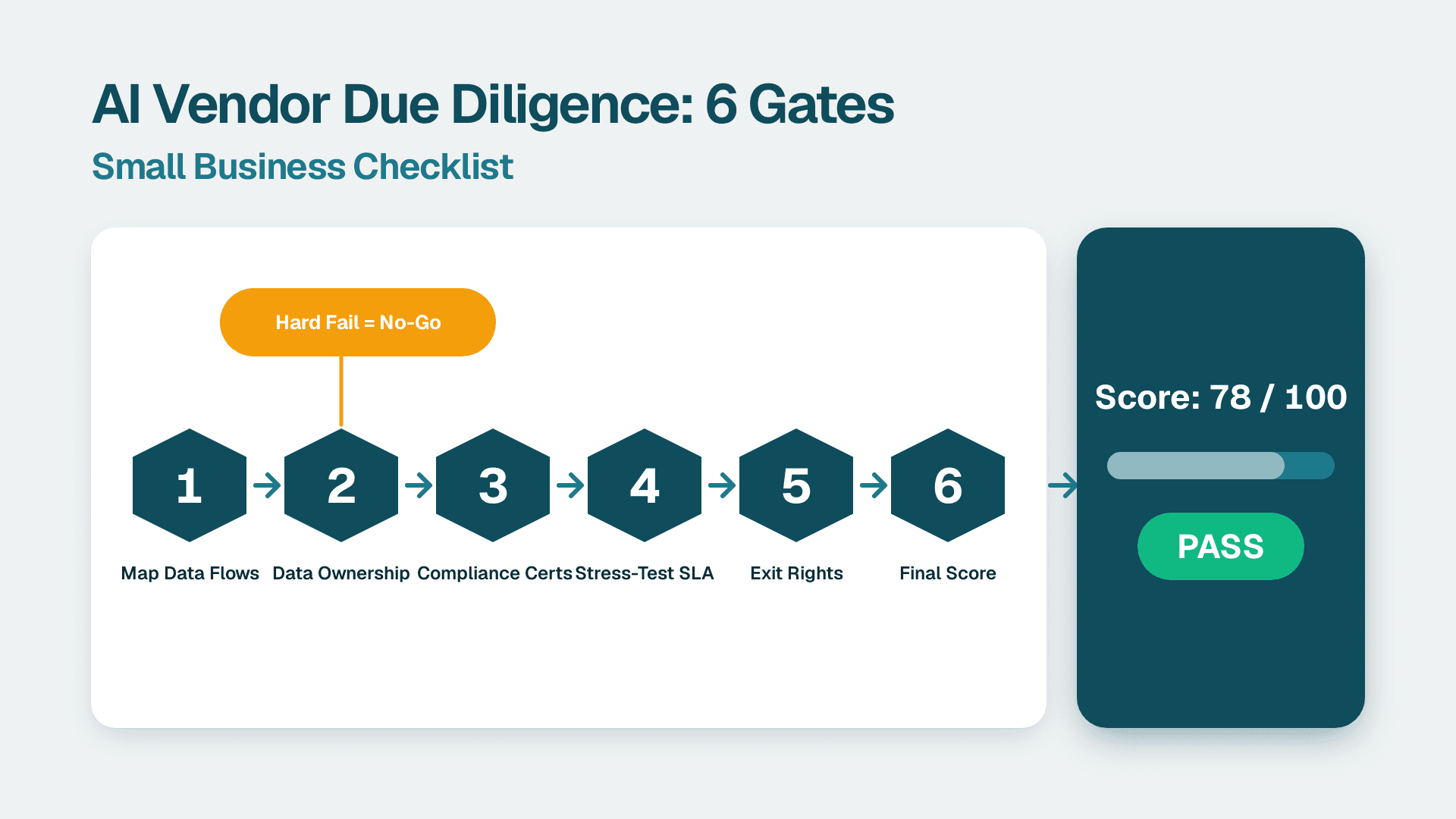
Running an AI vendor due diligence checklist for small business takes two to three working days and produces a scored, defensible record you can show legal, your board, or a future auditor. Work through six sequential gates: data flow mapping, contract clause review, compliance check, SLA stress-test, exit rights, and final scoring. By the end, you sign with clear eyes or walk away with a documented reason.
Key Takeaways
Request the MSA and DPA before the first sales call, not after.
Any hard Fail on data ownership, DPA, or data return is a no-go regardless of total score.
Treat anonymization clauses without a named technical standard (k-anonymity, differential privacy) as unenforceable.
Run a self-service export test before go-live to validate exit rights while you still have negotiating leverage.
Compliance pages are marketing collateral. Request the actual SOC 2 PDF with the audit period and scope section visible.
What You'll Need
The vendor's MSA and DPA draft: request these before the first sales call, not after
Your company's data classification list: what personal data types you process and from which jurisdictions
A copy of your existing vendor contracts for SLA benchmarks
Two to three hours from a senior operations person (COO, VP Ops, or equivalent)
A spreadsheet to track scores, one row per checklist item
Jurisdiction clarity: which of GDPR, PIPEDA, or CCPA applies to your customers' and partners' data
The AI Vendor Due Diligence Checklist for Small Business: Six Gates
Before you open a contract, establish scope. The six gates run in order because each one narrows what you need from the next. When teams search for the best AI audit tools for small business in 2026, most find that a structured review process like this one delivers more defensible results than any standalone audit software: your specific data exposure and regulatory context cannot be templated. A formal AI readiness assessment for small business surfaces the same questions before vendor talks begin: which regulations touch your data, which certifications matter, and which exit terms you cannot afford to skip.
Step 1: Map Your Data Flows Before Reading a Single Contract
List every data type you will send to or generate inside the AI tool. Open a spreadsheet and add four columns: Data Type, Volume (records/month), Sensitivity (Public / Internal / Confidential / Restricted), and Jurisdiction.
Row by row, add: customer names and emails (PII), order and invoice records, inventory and routing data, and any data you hold on behalf of clients.
For each row, mark whether it crosses a regulatory boundary: GDPR applies if any EU residents are in your dataset; PIPEDA applies if Canadian residents are; CCPA applies to California residents even if your company is not based in California.
Flag any row where a downstream client is in a regulated vertical. If you handle logistics data for a hospital distribution network, their compliance obligations can flow to you contractually, even if your firm is not in healthcare.
What you should see after this step: a single table that defines your due diligence scope. Every claim you make or concession you accept in the vendor contract should trace back to a row in this table.
Step 2: Review Data Ownership and Processing Clauses
Request the MSA and DPA before the first sales call. A vendor who will not share contract drafts pre-signature is giving you information about how they handle the relationship.
Open the MSA and navigate to the section titled "Intellectual Property" or "Data," typically sections 7-10 in a standard SaaS contract.
Data ownership: The contract must state that you own all data you upload or generate. Look for language like: *"Customer retains all right, title, and interest in Customer Data."* Reject any clause granting the vendor a license to use your data to train models, including language like "aggregated or anonymized data to improve services." Aggregation is not anonymization and can be reversed with sufficient auxiliary data.
Subprocessors: The DPA must list all third-party subprocessors (cloud hosts, LLM API providers, analytics tools) or link to a publicly maintained and dated list. Under GDPR Article 28 (2016/679), the vendor must notify you before adding new subprocessors and you must have the right to object.
Data residency: If any rows in your Step 1 table are GDPR-scoped, confirm the contract specifies EU or UK data residency, or identifies the legal transfer mechanism: Standard Contractual Clauses or an adequacy decision. For Canadian data under PIPEDA, confirm storage in Canada or a jurisdiction with equivalent protection.
What to confirm: a clause stating you own your data, no training use is permitted, and subprocessors are disclosed and up to date.
If the AI tool you are evaluating will produce operational or financial outputs, the AI-generated reports audit questions for finance teams covers the complementary question of what those outputs actually show: worth running in parallel with the contract review.
Step 3: Verify Compliance Certifications Are Current and In-Scope
A vendor can claim "SOC 2 compliant" in a pitch deck with an expired or narrow-scope report. Here is how to verify each certification without legal help.
SOC 2 Type II: Request the actual report, not a one-page summary. The cover page shows the audit period. A report older than 12 months is stale. The scope section lists which Trust Service Categories were covered: Security is standard; Confidentiality should be in scope if you are transmitting business-sensitive data. If it is not, ask why.
ISO 27001: Request the certificate and the scope statement. The scope statement defines which products and systems are covered. If the specific AI product you are buying is not named in the scope, the certification does not apply to it.
GDPR: If any of your data is EU-scoped, the vendor must sign a DPA meeting Article 28 requirements. If they refuse to sign a DPA at all, they cannot legally process EU personal data on your behalf.
HIPAA: If your data ever includes Protected Health Information (PHI), even incidentally, the vendor must sign a Business Associate Agreement (BAA). No BAA, no deal. There is no workaround.
PIPEDA: There is no standalone certification, but your DPA should require security safeguards appropriate to data sensitivity and breach notification within 72 hours, aligned with GDPR Article 33's notification window.
What to confirm: PDFs of each relevant certification with current issue dates, and a signed or agreed-to DPA before any data is shared.
Step 4: Stress-Test the SLA Terms
AI vendor SLAs tend to be weaker than equivalent SaaS contracts because inference has genuine variability. Know what to push on before accepting standard terms.
Uptime commitment: 99.9% uptime allows 8.7 hours of downtime per year. For a tool embedded in your order processing workflow, that may not be acceptable. For a reporting assistant used periodically, it may be fine. Match the SLA requirement to your actual operational dependency on the tool.
Latency: For AI tools in customer-facing workflows, such as an AI handling inbound logistics inquiries, get a written P95 response time commitment. "Best effort" is not an SLA.
Remedies: Most vendor SLAs offer service credits, not refunds. A credit of 10% of one month's fees for an outage that costs you a client relationship is a formality. Negotiate a right to terminate for cause if the vendor misses its SLA in two consecutive months.
Maintenance windows: The contract should specify when planned maintenance occurs and require advance notice. Unscheduled outages exceeding four hours during business hours should escalate to a named support contact, not just a status page update.
Support tier: Community-forum or email-only support is not appropriate for a tool in a production workflow. Confirm the contract includes a defined P1 response time (four hours or less is standard for business-critical tools).
If you are building the total cost model for this AI tool, the order entry automation ROI methodology shows how to factor downtime risk into the payback calculation: the same formula applies to any AI-integrated operational workflow.
Step 5: Negotiate Exit Rights and Data Return Provisions
This is the step most SMBs skip and later regret. Once your data is inside a vendor's platform, you have a migration problem by default. Define exit terms before you are inside the lock-in.
Export format: The contract must specify that your data can be exported in a standard, machine-readable format: CSV, JSON, or Parquet, not a vendor-proprietary format that requires their own tool to read. Confirm this is self-service, not a paid professional services engagement.
Return timeline: After termination, how long does the vendor retain your data? Best practice (and GDPR expectation) is 30 days for export availability and 90 days for confirmed deletion with written notice.
Deletion certificate: Get a contractual commitment to a written deletion certificate within 30 days of contract end. "We will delete your data" is not the same as a signed, dated certificate.
Migration window: Some vendors offer a 30-60 day read-only access period post-termination. This is rarely in the standard contract but is frequently granted when requested in writing during negotiation.
Model outputs: If the AI tool generates trained outputs using your data (embeddings, fine-tuned model weights, custom classifiers), confirm who owns those outputs. If the vendor owns the weights, you start from zero with any replacement vendor.
Return to your data flow table from Step 1. Check that every Confidential or Restricted row maps to a format the vendor can export in self-service. If it does not, treat that as a hard blocker before signing.
Step 6: Score the Vendor and Record Your Decision
Pull every finding into a single scoring sheet. This turns the checklist into a defensible record rather than a set of memory notes.
Score each item: Pass = 2, Partial = 1, Fail = 0, N/A = skip. A vendor scoring below 16 of 24 warrants a legal review before proceeding. Any hard Fail on data ownership, DPA, or data return is a no-go regardless of the total score.
| Checklist Item | Gate | Weight | Pass (2) / Partial (1) / Fail (0) |
|---|---|---|---|
| Data ownership clause present | Contract | High | |
| No training use permitted on customer data | Contract | High | |
| Subprocessor list disclosed | Contract | High | |
| Data residency confirmed | Contract | Medium | |
| SOC 2 Type II current (within 12 months) | Compliance | High | |
| ISO 27001 in scope for this product | Compliance | Medium | |
| DPA signed or agreed to | Compliance | High | |
| SLA uptime meets your operational requirement | SLA | Medium | |
| Remedies extend beyond service credits | SLA | Medium | |
| Export format is standard and self-service | Exit Rights | High | |
| Deletion certificate committed in writing | Exit Rights | High | |
| Migration window confirmed | Exit Rights | Medium |
If you are applying the 70-20-10 rule for AI investment (70% of your AI budget on core operational tools, 20% on adjacent experimentation, 10% on frontier bets), run this full checklist on every vendor in the 70% tier, where failure has real operational consequences. A shorter version covering only the data ownership and SLA gates is sufficient for the 20% tier.
For logistics and distribution teams running analytics alongside AI tools, the Power BI consulting for logistics guide covers how to keep your reporting layer independent of vendor-specific AI outputs: an important architectural consideration when assessing lock-in risk across your stack.
What Are the Most Common AI Vendor Due Diligence Mistakes?
Small business operators consistently make the same five errors when vetting AI vendors. Knowing them in advance lets you skip the expensive lesson.
Accepting a vendor's compliance landing page instead of the actual SOC 2 report. Compliance pages are marketing collateral. Request the PDF with the audit period and scope section visible. If the vendor refuses to share the report, document that refusal in your scoring sheet.
Not checking the subprocessor list before signing. Vendors add subprocessors continuously. If the DPA does not require advance notice and a right to object, a subprocessor added post-signature could put you in breach of your own client contracts without your knowledge.
Treating "anonymized data" training clauses as acceptable without a named technical standard. Anonymization is a technical claim. Without a specific method cited in the contract (k-anonymity, differential privacy, or a recognized standard such as NIST SP 800-188), the clause is unenforceable as written.
Skipping the migration test before go-live. Before you commit operational workflows, export a sample of your data using the vendor's self-service export tool. If the export fails, is incomplete, or requires a support ticket, you have found your lock-in risk while you still have negotiating leverage.
Relying on verbal SLA commitments from the sales team. If a sales rep says the company will "make it right" after an outage, that has no legal standing. Any commitment beyond the written contract terms belongs in a signed addendum.
What Should You Do When a Vendor Won't Share Their DPA or SOC 2 Report?
Both situations are negotiating positions, not legal requirements. Here is how to handle each one.
The vendor says they cannot share the DPA until after you sign the MSA. Escalate to their legal or compliance team and request a redacted version. If they still refuse, mark DPA as a Partial on your scoring sheet and document what you could not review before signing.
The SOC 2 report scope does not include the product you are buying. Ask the vendor for a written statement confirming the product is included in their next audit cycle and when that cycle closes. If the next audit is more than six months out, request a penetration test summary as an interim substitute and confirm the test covered the specific product you are purchasing.
The self-service export tool requires a support ticket and takes five to seven business days. This is a migration risk, not an inconvenience. Before signing, negotiate a contractual SLA on export processing time (five business days maximum) with a defined credit or termination right if it is missed.
If you are evaluating AI vendors for the first time and are unsure which certifications your data types actually require, our fixed-price AI readiness assessment maps your compliance exposure, evaluates vendor selection criteria, and delivers a scored vendor shortlist in five days.
---
About Lets Viz: Written by Rohit Singhal, Founder of Lets Viz, who works with SMB operations clients across distribution, logistics, and professional services on analytics implementation and AI readiness. Lets Viz holds a 5.0 rating on Clutch across analytics implementation and AI readiness engagements.