What Is ServiceNow HRSD? A Complete Guide for HR Leaders
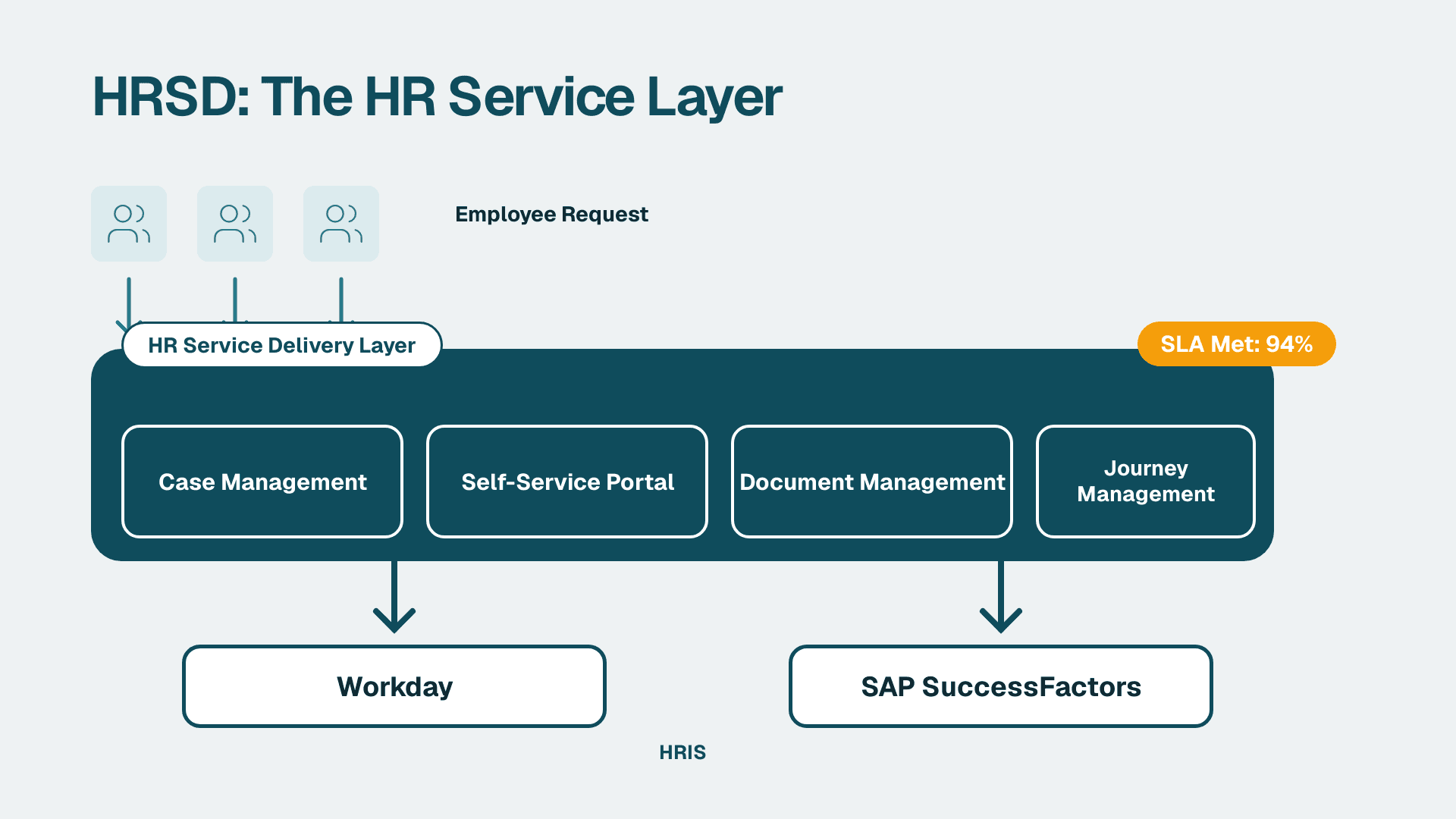
ServiceNow HR Service Delivery (HRSD) is a purpose-built module within the Now Platform that consolidates HR case management, employee self-service, document management, and lifecycle journey automation into a unified service layer. Rather than replacing an HRIS like Workday or SAP SuccessFactors, HRSD sits above it - the structured interface through which employees request HR services and HR teams manage workloads, track SLAs, and maintain audit-ready records.
Key Takeaways
HRSD is a ServiceNow module, not a standalone HRIS - it adds a structured service layer on top of existing HR record systems
The four core capability areas are HR case management, employee self-service (Employee Center), document management, and journey management
HRSD shares the Now Platform with ITSM, Legal Service Delivery, and Workplace Service Delivery, enabling natively integrated cross-functional workflows
US healthcare employers can use HRSD's confidential case controls for HIPAA-aligned HR data handling; UK and EU teams rely on its audit trails for GDPR compliance; Canadian organizations should review its data residency options against PIPEDA
A phased implementation approach is recommended - complexity scales with the number of HR service centers, geographies, and HRIS integrations in scope
What Is ServiceNow HRSD and What Problems Does It Solve?
ServiceNow HRSD is the platform's answer to a near-universal HR operations challenge: requests arrive through every channel - email, chat, phone, walk-up - routing is inconsistent, resolution times are invisible, and documentation is rarely sufficient for an audit. HRSD replaces that fragmented model with a system of engagement: structured cases, searchable knowledge, automated workflows, and real-time operational dashboards.
The practical impact is visible across company sizes and geographies. The following scenarios are illustrative examples, not client case studies. A new hire at a US technology company might otherwise receive onboarding instructions across five emails from five different HR staff members, with no single view showing what is complete. A UK fintech employee submitting a flexible working request might wait several days just to learn who owns it. A Canadian manufacturing company processing 40 offboardings per quarter might rely on a shared spreadsheet that one person maintains - a single point of failure for a compliance-sensitive process.
HRSD addresses all three scenarios through the same underlying architecture: cases with routing rules, workflows with relative due dates, and a knowledge base surfaced through a unified employee portal.
For organizations already running ServiceNow for IT service management, adding HRSD requires no additional infrastructure - the HR and IT service layers run on the same Now Platform instance. For teams evaluating a new deployment or extending an existing one, engaging a specialist in ServiceNow consulting services early defines the right module sequence and avoids costly re-scoping mid-project.
How Does HR Case Management Work in ServiceNow HRSD?
HR case management is the operational core of HRSD. Every employee request or HR-initiated action becomes a tracked case with a category, assigned owner, SLA clock, and full interaction history. Cases can be created by employees through the self-service portal, by HR staff on behalf of an employee, by a manager, or automatically by integration triggers - for example, a Workday termination event that auto-opens an offboarding case.
Center of Excellence routing
HRSD organizes HR teams into Centers of Excellence (COEs) - Benefits, Payroll, Employee Relations, Learning and Development, and others. When a case arrives, routing rules assign it to the correct COE based on case type, employee location, employment category, or custom logic. A UK fintech firm with a shared services center covering London and Dublin can maintain separate routing for UK and Irish employment law queries without duplicating the entire case schema.
Confidential cases and access controls
Sensitive HR matters - employee relations investigations, performance improvement plans, medical accommodation requests - can be flagged confidential, restricting visibility to a named list of HR agents. For US employers in healthcare, this supports HIPAA-aligned handling of medically relevant employee information. For UK and EU employers, the same controls support GDPR's data minimisation and purpose limitation requirements. Canadian HR teams subject to PIPEDA can use the same controls to demonstrate that personal employee data is accessed only on a documented need-to-know basis.
SLA tracking and operational visibility
Each case type carries a configurable SLA. HR operations directors can monitor mean time to resolution, first contact resolution, and case volume by COE in real time. For teams already visualizing ServiceNow data in external analytics tools, the ServiceNow ITSM KPIs to Track in Power BI guide provides a measurement framework that extends naturally to HRSD operational metrics.
What Is Employee Self-Service in ServiceNow HRSD?
Employee self-service in HRSD is delivered through Employee Center - the employee-facing portal where workers search the HR knowledge base, submit service requests, track case status, and complete assigned tasks. According to ServiceNow's 2025 product documentation, Employee Center is built on the Now Platform's unified portal framework and can surface content from HR, IT, Facilities, and Legal in a single destination, eliminating the need for separate department portals.
The operational argument for investing in self-service quality is direct: every Tier 1 HR inquiry resolved by a knowledge article is a case that was never opened. Common high-volume, self-resolvable queries include direct deposit updates, pay stub access, PTO balance requests, relocation policy questions, and standard benefits inquiries. HR teams that build and test the knowledge base before go-live - rather than after - consistently see higher deflection rates from the start.
ESS configuration priorities worth addressing before launch:
Topic pages: Knowledge articles, service catalog items, and HR announcements grouped by theme - Benefits, Payroll, Onboarding, Offboarding - so employees navigate by context rather than by search term alone
Now Mobile: The mobile companion app for Employee Center, critical for deskless workers in manufacturing, healthcare, and field services who do not have desktop access during shifts
Proactive notifications: Status update emails or push notifications when a case advances, reducing the volume of follow-up inquiries that re-enter the HR queue
For detailed guidance on portal taxonomy, search relevance tuning, and deflection measurement, the ServiceNow self-service portal best practices guide covers the configuration decisions that most influence self-service adoption rates.
What Is HR Journey Management in ServiceNow HRSD?
Journey management is HRSD's orchestration engine for multi-step employee lifecycle events. It replaces manual coordination - shared checklists, reminder emails, calendar flags between HR, IT, Facilities, and Payroll - with automated, cross-functional task sequences that execute relative to a trigger date and adapt to the employee's workforce segment, location, and employment type.
A journey in ServiceNow terminology is a configurable template of activities associated with a lifecycle event: new hire onboarding, promotion, relocation, parental leave, return from leave, or offboarding. Each activity carries an owner (an HR team, the employee's manager, the employee themselves, or a specific department), a relative due date, and automated routing to the responsible team or system.
Onboarding journeys in practice
As an illustrative scenario, a Canadian manufacturing company onboarding 60 seasonal workers each spring can configure a single HRSD journey template - localized for PIPEDA-compliant data collection - that simultaneously triggers IT provisioning requests, mandatory safety training assignments in the LMS, payroll enrollment in the HRIS, and benefits elections in Employee Center. Without journey management, each of those steps requires a separate manual coordination effort. With it, the HR coordinator monitors completion status across all 60 new hires on a single dashboard.
Offboarding journeys and compliance
Offboarding is where gaps in manual coordination create the most acute compliance risk. In an illustrative example, a US financial services firm processing an involuntary termination needs IT access revoked promptly, payroll finalized for the final period, company hardware returned, and severance documentation generated. HRSD's offboarding journey template sequences and SLA-enforces each task, producing an audit trail that directly supports SOC 2 control documentation.
Cross-functional orchestration via the Now Platform
Because HRSD shares the Now Platform with ITSM, a journey task assigned to IT automatically creates an ITSM request ticket and marks the HRSD journey task complete when IT closes it. There is no manual handoff and no status reconciliation between separate systems. This native integration is HRSD's most operationally significant advantage over standalone HR workflow tools that treat IT provisioning as an external dependency requiring a custom connector.
For teams running or implementing ITSM alongside HRSD, the ServiceNow ITSM implementation checklist covers the ITSM configuration decisions that directly affect cross-module journey workflows.
How Does HRSD Sit Within the Broader ServiceNow Platform?
HRSD is one of four Service Delivery products on the Now Platform. Understanding how they relate helps IT directors set clear scope boundaries during implementation planning.
| ServiceNow Module | Primary Owner | Core Function |
|---|---|---|
| IT Service Management (ITSM) | IT Operations | Incidents, requests, changes, and problem management |
| HR Service Delivery (HRSD) | HR Operations | Employee HR requests and lifecycle orchestration |
| Legal Service Delivery (LSD) | Legal and Compliance | Legal service requests and matter tracking |
| Workplace Service Delivery (WSD) | Facilities Management | Office and facilities service requests |
| Employee Center | Cross-functional | Unified employee portal for all four modules |
All four modules can surface through the same Employee Center portal - the core argument for consolidating on a single platform rather than running separate tools per department. A mid-market UK fintech that already owns a ServiceNow ITSM license can add HRSD without additional user directory management, integration middleware, or separate reporting infrastructure.
The shared data model also simplifies cross-functional reporting. A weekly employee experience dashboard can combine HR case resolution rates, IT request volumes, and facilities booking trends in a single view. Achieving the same result with separate systems requires custom data pipelines that introduce synchronization lag and ongoing maintenance overhead.
For a platform-level comparison with a common alternative, the ServiceNow vs Jira Service Management full comparison covers the ecosystem considerations that affect HRSD availability and cross-module workflow capability.
When Should an Organization Implement ServiceNow HRSD?
HRSD is the right investment in a defined set of organizational conditions. The decision is less about platform capability and more about organizational readiness and fit.
Strong indicators that HRSD is the appropriate next step:
An existing ServiceNow ITSM instance is already in production. The incremental cost and complexity of adding HRSD to an existing Now Platform instance is substantially lower than deploying a separate HR workflow platform, since infrastructure, identity management, and integration frameworks are already in place.
HR case volume exceeds shared-inbox capacity. At organizations above roughly 500 employees, the volume of HR requests typically makes unstructured email management inefficient. COE routing and SLA tracking become operationally justified at this scale.
Lifecycle events regularly miss steps. If onboarding or offboarding checklists are executed inconsistently - missed IT provisioning, late benefits enrollment, overdue equipment returns - journey management addresses the coordination breakdown at its source.
Compliance obligations require documented HR interactions. SOC 2 (US), GDPR (UK and EU), and PIPEDA (Canada) all require demonstrable controls over who accessed employee data and when. HRSD's case audit trail and role-based access controls are purpose-built to support those requirements.
What HRSD is not: It is not a system of record for headcount, compensation, or payroll calculations. Organizations that lack an established HRIS should build that foundation first. HRSD integrates with major HRIS platforms through the ServiceNow Integration Hub - it amplifies the value of an existing HRIS rather than replacing one.
Implementation timelines vary considerably by scope. As a rough, illustrative guide rather than a sourced benchmark, a single-country deployment using standard out-of-the-box configuration typically takes six to ten weeks from kickoff to go-live. A multi-country deployment covering several languages, custom journey templates, and HRIS integrations is realistically a multi-quarter program. The key driver of timeline variance is the number of HR service centers, geographies, and integration points in scope - defining those boundaries clearly in discovery, before configuration begins, is where experienced guidance pays the most.
---
About Lets Viz: Lets Viz is a data and technology consulting firm serving US healthcare, UK fintech, Canadian manufacturing, and global SaaS clients since 2020, with a 5.0 Clutch rating. Our ServiceNow practice spans ITSM, HRSD, and cross-platform analytics, helping mid-market teams implement, configure, and extend their ServiceNow investment to measurable operational outcomes.
Ready to scope an HRSD deployment or optimize an existing implementation? Our ServiceNow consulting services cover discovery, configuration, integration, and go-live support for HR Service Delivery projects at every stage.