What Is ServiceNow? A CIO's Complete Platform Guide
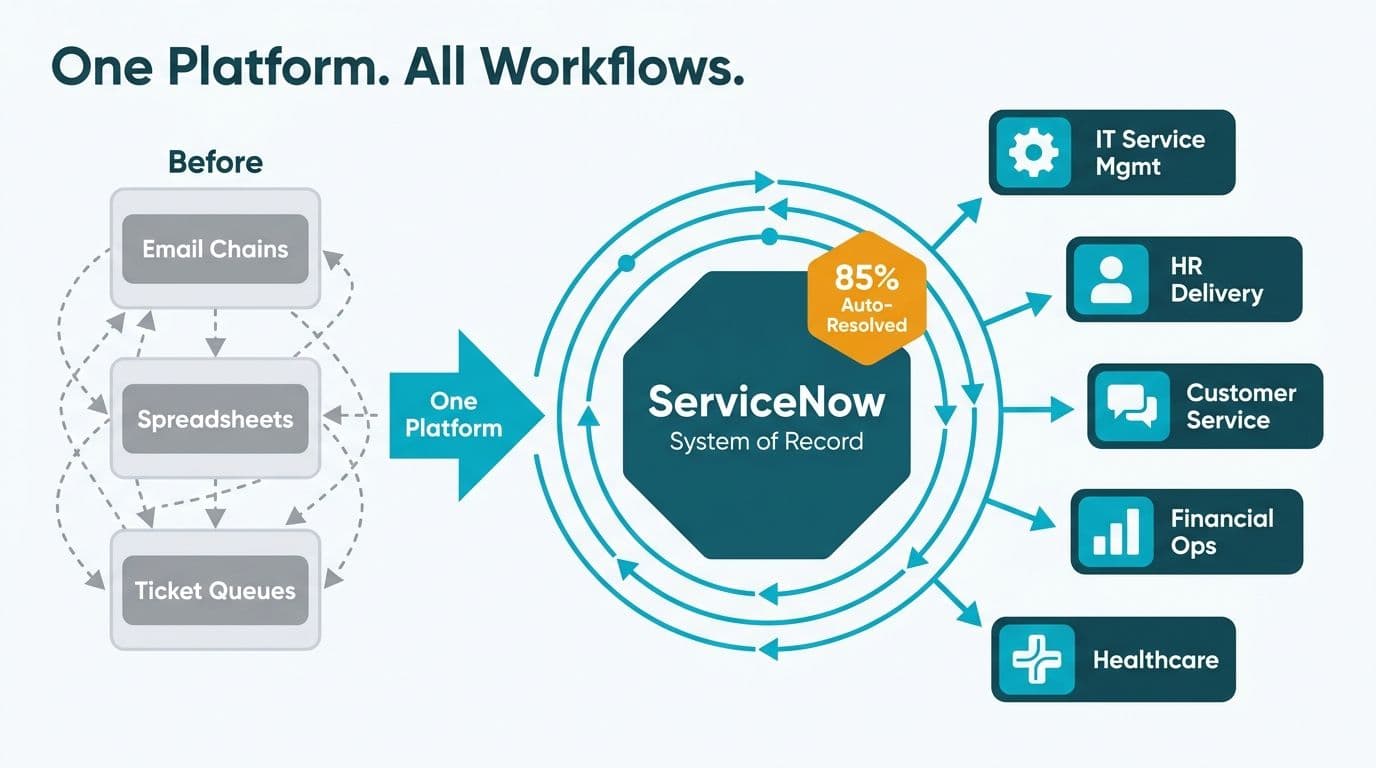
ServiceNow is a cloud-based enterprise platform that centralizes IT service management, business workflows, and operational data in a single system of record. Originally built for IT help desks, it has expanded into HR service delivery, financial operations, customer service, and healthcare workflows. Mid-market organizations use it to replace fragmented email chains and spreadsheets with auditable, automated processes that connect people, data, and systems.
Key Takeaways
- ServiceNow is a workflow automation and ITSM platform built on a unified data model, not a CRM or ERP replacement
- Its Now Platform connects IT, HR, finance, and customer service in a single low-code environment
- Healthcare and financial services teams use it to enforce HIPAA, GDPR, and PIPEDA controls at the workflow level
- Mid-market organizations typically start with ITSM and expand into adjacent modules as adoption matures
- Integration with BI platforms enables operational P&L variance visibility and real-time service cost dashboards
What Is ServiceNow and How Did It Evolve?
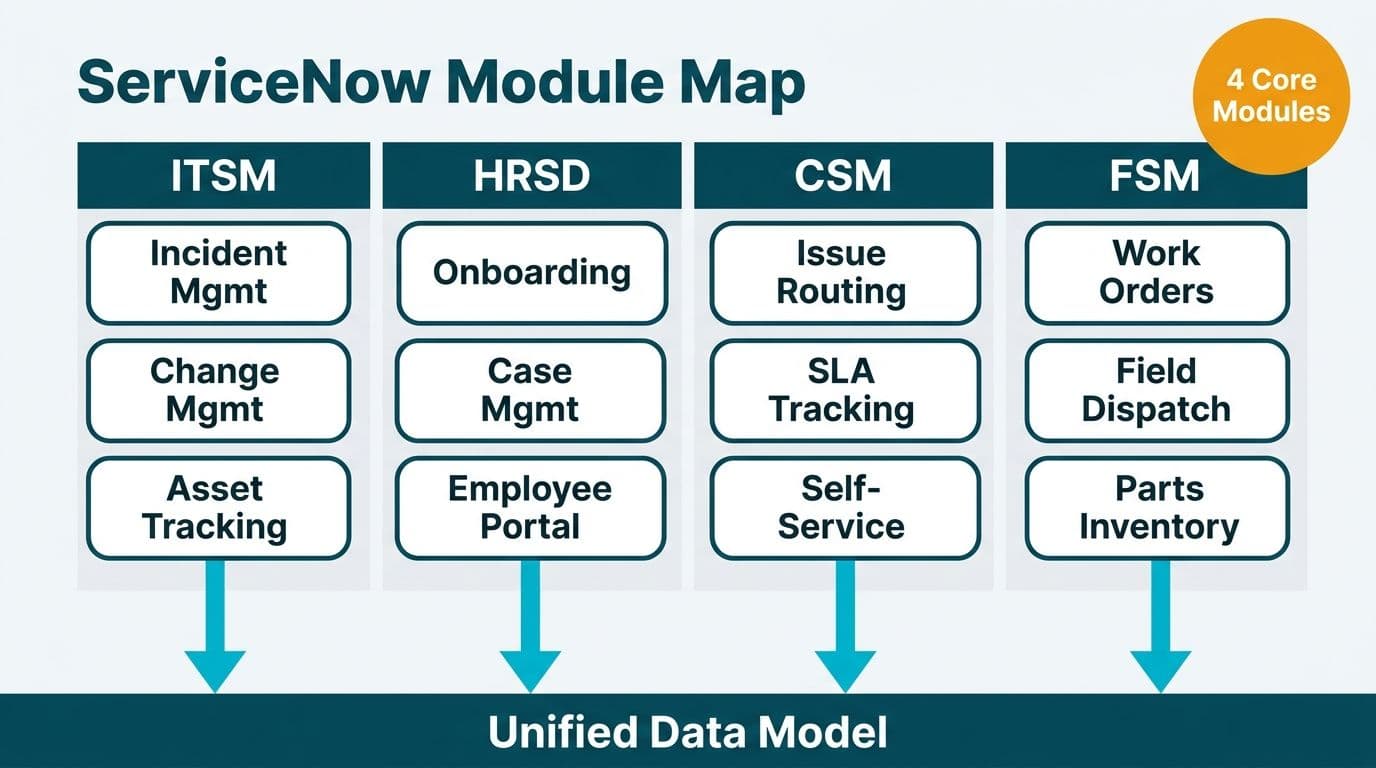
ServiceNow is a platform-as-a-service (PaaS) solution built on the Now Platform, a proprietary application environment that hosts all ServiceNow products and customer-built applications. Founded in 2004 by Fred Luddy and reaching general availability in 2005, ServiceNow went public in 2012 (NYSE: NOW). What started as an IT ticketing tool is now one of the most widely deployed enterprise workflow platforms globally.
The platform's defining architectural choice is its single data model. Unlike point solutions that handle one function and rely on API bridges to communicate with other systems, the Now Platform stores all workflow data in a shared repository. A change request in IT can automatically generate a compliance task in Governance, Risk, and Compliance (GRC) and a notification in HR, without custom code. That architecture - one record, one audit trail, one reporting layer - is the primary reason regulated industries have adopted ServiceNow at scale.
ServiceNow has also expanded into AI. The Now Assist suite, documented and expanded through 2025-2026 in ServiceNow release notes, adds generative AI capabilities including AI-assisted incident summarization, resolution recommendations, and conversational interfaces for end users and agents. CIOs evaluating enterprise AI readiness should factor this into the platform assessment alongside core workflow capabilities.
For organizations evaluating ServiceNow for the first time, partnering with experienced ServiceNow consulting services shortens the evaluation cycle and prevents misconfiguration errors that inflate first-year total cost of ownership.
What Are the Core Modules and Workloads of the Now Platform?
The Now Platform is modular. Organizations license the product lines they need and activate them on a shared infrastructure layer. The major modules, as documented by ServiceNow (2026), are:
| Product Line | Primary Function | Typical First Buyer |
|---|---|---|
| IT Service Management (ITSM) | Incident, problem, change, and asset management | CIO or IT Director |
| IT Operations Management (ITOM) | Infrastructure visibility, AIOps, event management | IT Ops or Platform Engineering |
| Customer Service Management (CSM) | External case handling and customer portals | VP Customer Success |
| HR Service Delivery (HRSD) | Employee requests, onboarding, lifecycle management | CHRO or HR Director |
| Financial Services Operations (FSO) | Case management for banking, insurance, wealth management | COO or Chief Compliance Officer |
| Healthcare and Life Sciences (HCLS) | Care team workflows, referral and equipment management | Hospital CIO or Clinical Operations |
| Governance, Risk, and Compliance (GRC) | Risk registers, audit workflows, policy management | Chief Risk Officer or Legal |
| App Engine | Low-code custom application development | Enterprise architects and IT |
All product lines share the same authentication, role-based access control, and audit logging infrastructure. A financial services firm that activates FSO and GRC on the same instance maintains one access review for both modules, a meaningful simplification when preparing for SOC 2 or ISO 27001 audits.
A key differentiator from standalone tools is that data from every module is queryable through a single reporting layer. ServiceNow's built-in Performance Analytics application lets operations leaders build dashboards spanning ITSM incident volume, GRC risk scores, and HR onboarding cycle times in one view, without exporting to a separate BI tool first. For organizations that do need a dedicated analytics layer on top - for P&L variance reporting or cross-system financial dashboards - ServiceNow exposes data via REST APIs and OData connectors that feed directly into BI platforms.
How Does ServiceNow Support Healthcare and Finance Workflows?
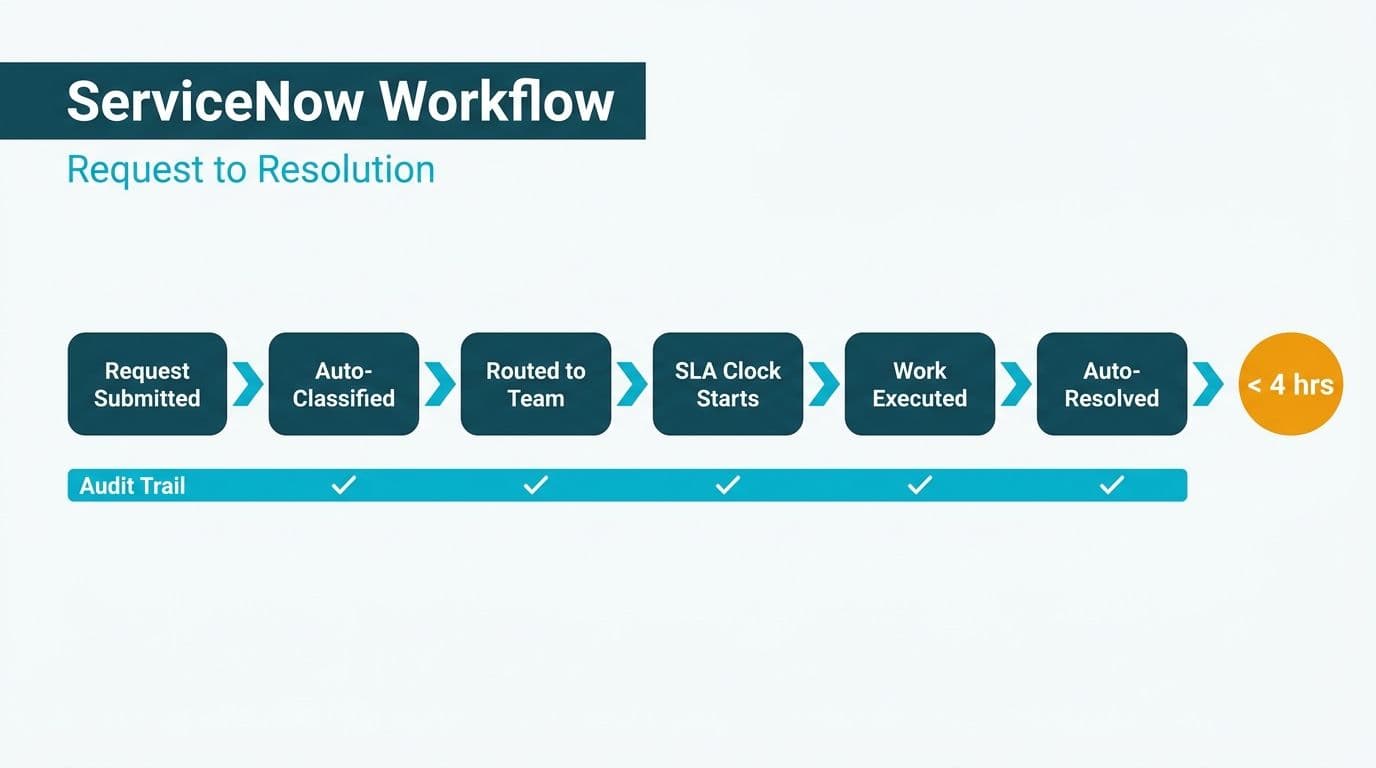
ServiceNow addresses two distinct needs in regulated industries: operational efficiency and compliance traceability.
Healthcare: The Healthcare and Life Sciences suite handles referral management, care team coordination, and medical equipment service requests. Because every action is time-stamped and stored in an immutable audit log, health systems operating under HIPAA can respond to auditor requests without reconstructing event histories from email threads. A US hospital system might use ServiceNow to route biomedical equipment repair requests, track mean-time-to-repair against internal SLA targets, and surface those metrics in a live operations dashboard. Teams that also need to visualize clinical data in BI tools - and ensure those tools meet HIPAA standards as well - should review our guide to HIPAA compliant BI tools for hospital data visualization.
Financial services: ServiceNow's Financial Services Operations module handles the case workflows that banks, insurers, and investment managers use for client onboarding, dispute resolution, and regulatory change management. A UK fintech firm subject to UK GDPR might configure ServiceNow to automate data subject access request (SAR) workflows, which are legally required to be fulfilled within 30 calendar days. The platform's built-in SLA engine flags impending breaches before they occur, and the audit trail provides the Article 30 record of processing activities that regulators may request.
Canadian financial institutions operating under PIPEDA can embed consent-capture checkpoints inside onboarding workflows, ensuring no customer record is processed without a logged consent event - directly addressing PIPEDA's accountability and consent principles. ServiceNow's Canadian data center option, available as of 2025 per ServiceNow product documentation, also supports personal information residency obligations under Quebec's Law 25.
For the broader 2026 regulatory picture across North American and UK markets, our AI compliance requirements for financial services regulatory map covers HIPAA, GDPR, PIPEDA, and SOX obligations in detail.
What Does a ServiceNow Implementation Actually Involve?
A mid-market ServiceNow rollout follows three broad phases.
Phase 1 - Foundation (weeks 1-8): Instance provisioning, Active Directory or SAML identity integration, data model scoping, and ITSM go-live. Most organizations start here because IT has a visible backlog and clear SLA pressure. This phase ends with a working incident management workflow, a self-service portal for end users, and a live dashboard for the IT director.
Phase 2 - Expansion (months 3-6): A second module is activated - typically HR Service Delivery or GRC depending on the organization's most pressing need. ERP integrations are built to feed financial data into service cost reporting. A manufacturing company in Ontario, for example, might connect ServiceNow ITSM to a procurement ERP so that a repair work order automatically generates a purchase requisition when parts are needed, eliminating the manual handoff between IT and the purchasing team.
Phase 3 - Intelligence (months 6-18): AI-assisted incident classification, predictive analytics, and cross-functional executive dashboards are layered on. Finance teams that integrate ServiceNow with a BI platform can build dashboards showing P&L variance data and IT service delivery costs side by side, giving CFOs a direct connection between operational disruptions and their financial impact.
The critical success factor at every phase is data quality. Teams that migrate records from legacy ITSM tools without first cleaning and deduplicating upstream data consistently see implementation timelines double. ServiceNow's import sets and data transform maps handle the mechanical migration, but they cannot compensate for poor-quality source data. A dedicated internal project owner - someone with authority over process decisions and access to source system owners - is equally important and frequently underestimated in initial scoping.
ServiceNow vs Other Enterprise Platforms: Where It Fits
ServiceNow is frequently compared to ERP systems and BI platforms during procurement evaluations. The comparison is worth addressing directly because the platforms serve fundamentally different architectural roles.
| Dimension | ServiceNow | ERP (SAP, Oracle, Dynamics) | BI Platform (Power BI, Microsoft Fabric) |
|---|---|---|---|
| Primary purpose | Workflow orchestration and service delivery | Financial ledger, HR, supply chain | Analytics, reporting, visualization |
| Primary data type | Service requests, incidents, tasks | Transactions, GL entries, master data | Metrics, dimensions, aggregated data sets |
| Compliance controls | Audit trails, SLA enforcement, access review | Financial controls, SOX, segregation of duties | Row-level security, data access policy |
| Integration role | Orchestrates work across systems | Source of financial and operational truth | Reads and aggregates from multiple sources |
| Typical first buyer | CIO or IT leadership | CFO or ERP project team | Data team or BI program lead |
The practical implication: ServiceNow is the workflow and engagement layer that sits above operational systems. It generates the activity data that ERP systems use for cost allocation and that BI platforms visualize for decision-makers. Enterprise data platforms such as Microsoft Fabric address the analytics, data modeling, and lakehouse layer; ServiceNow handles workflow and case management. These are complementary investments. Mid-market organizations evaluating both should plan for integration from the outset rather than treating them as competing platforms.
How Does ServiceNow Meet HIPAA, GDPR, and PIPEDA Requirements?
Compliance in regulated industries is a shared responsibility between the platform vendor and the customer organization. ServiceNow provides the technical controls; the customer configures and enforces them.
HIPAA: ServiceNow offers a Business Associate Agreement (BAA) to covered entities and business associates, as documented on the ServiceNow Trust site (2026). The platform's access logging, minimum-necessary data configuration, and AES-256 encryption at rest and in transit support HIPAA Security Rule requirements. Workflow audit logs capture who accessed or modified a record, when, and from which IP address - the chain of custody an OCR audit expects to see.
GDPR and UK GDPR: ServiceNow supports EU and UK data residency options and includes controls for Article 17 (right to erasure) and Article 20 (data portability) workflows. Organizations must configure retention schedules, consent fields, and data classification at implementation time. The platform provides the mechanism; the data controller sets the policy.
PIPEDA: The GRC module can embed consent-capture checkpoints in onboarding and case management workflows. Combined with the Canadian data center option, Canadian organizations can meet personal information residency obligations and consent documentation requirements in a single platform deployment.
For teams evaluating complementary workflow tooling that pairs with ServiceNow for specific departmental use cases, our guide to n8n HIPAA compliant workflow automation covers how to build HIPAA-safe automations for narrower needs without replacing a ServiceNow implementation.
When Should a Mid-Market Company Consider ServiceNow?
Four indicators consistently signal that an organization is ready for the investment.
- Volume threshold: more than 200 service requests per month across IT, HR, or facilities, where manual triage is creating visible delays and SLA misses
- Audit pressure: regulatory requirements - HIPAA, GDPR, PIPEDA, SOC 2, or ISO 27001 - that demand traceable, time-stamped workflows and exportable audit logs
- Cross-departmental friction: requests that routinely require coordination across multiple teams each working in separate tools or email threads
- Reporting gaps: inability to measure SLA performance, attribute service delivery costs, or produce audit-ready incident histories without manual data extraction
Cost is a legitimate evaluation factor. ServiceNow licenses on a per-fulfiller-user or consumption basis, as documented on ServiceNow pricing pages (2026), and implementation costs vary significantly by scope and integration complexity. Before committing, running a structured readiness check - such as our free BI readiness assessment - clarifies whether underlying data and process maturity can support a successful rollout.
Consider a hypothetical: a 200-seat US healthcare technology company manages IT incidents through a shared inbox and a spreadsheet. Outage response is slow, SLA tracking is absent, and the compliance team cannot produce a complete audit trail for its annual SOC 2 Type II assessment. ServiceNow ITSM with GRC activation resolves all three gaps in a single implementation phase, with native report export for the auditor. The same deployment provides a foundation for HIPAA workflow controls if the company later handles protected health information directly.
A mid-size UK fintech firm faces a structurally identical problem. Customer data processed across five departments in email and shared drives leaves no single audit trail when the ICO requests evidence of processing activities under Article 30. ServiceNow's case management and audit log capabilities address that gap without requiring a full data governance overhaul first.
---
About Lets Viz: Lets Viz has partnered with data and operations teams since 2020, delivering analytics and workflow implementations for US healthcare providers, UK fintech firms, Canadian manufacturers, and global SaaS organizations. Rated 5.0 on Clutch, our consultants bring platform expertise and regulatory fluency across HIPAA, GDPR, and PIPEDA environments.
If you are evaluating ServiceNow for your organization, explore our ServiceNow consulting services to get a scoped implementation roadmap.