ServiceNow Implementation Cost 2026: A Mid-Market Breakdown
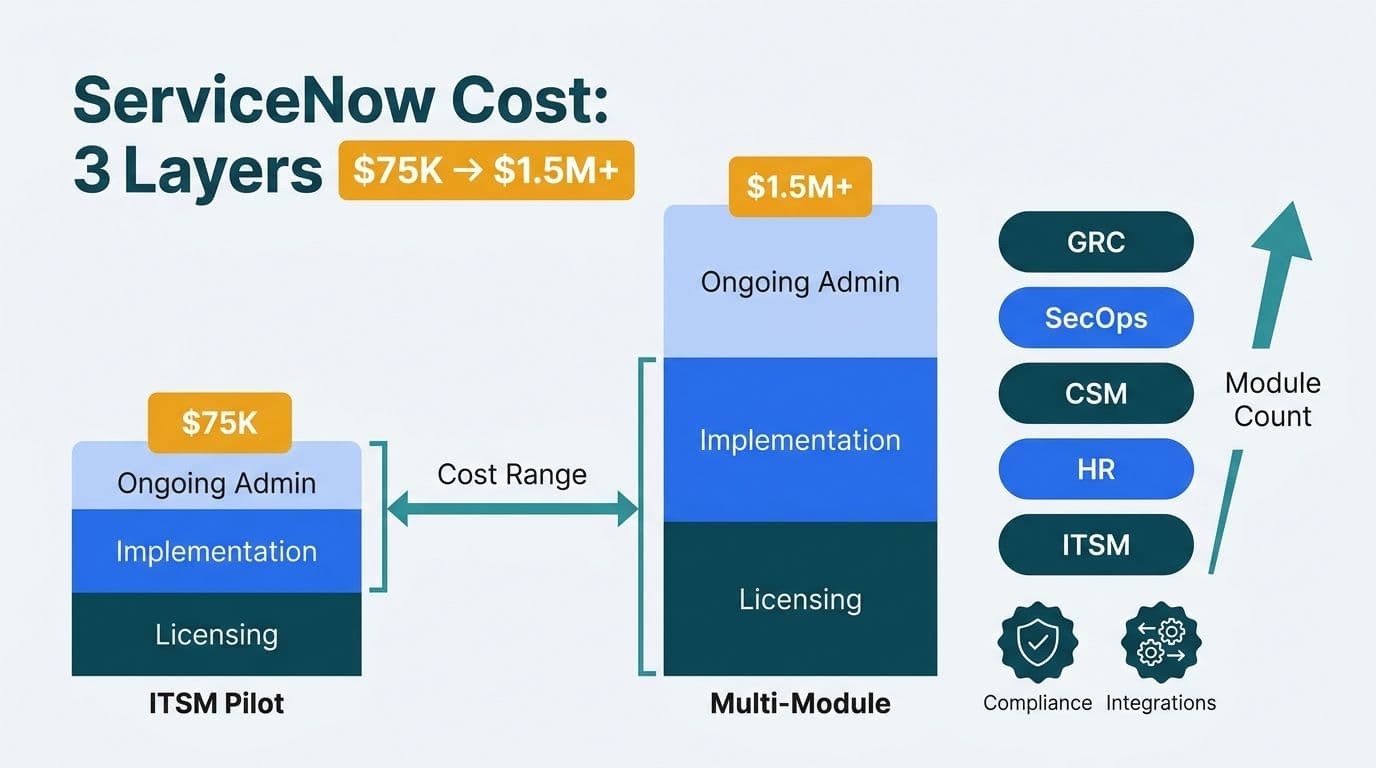
ServiceNow implementation cost in 2026 ranges from approximately $75,000 for a scoped ITSM pilot at a mid-size firm to over $1.5 million for a multi-module enterprise rollout. Three cost layers drive the number: platform licensing, implementation services, and ongoing administration. Module selection, integration complexity, and compliance requirements - particularly for healthcare and financial services organizations in the US, UK, and Canada - are the primary variables that push that range up or down.
Key Takeaways
- ServiceNow licensing is negotiated, not listed; per-fulfiller-seat pricing determines most of your annual license cost
- Implementation services typically run 1x to 3x the first-year license cost for mid-market projects
- Healthcare and finance teams should add 15-25% to the services baseline for compliance configuration (HIPAA, SOC 2, GDPR, PIPEDA)
- A phased rollout starting with ITSM reduces initial outlay and builds internal capability before more complex modules are activated
- Engaging a certified ServiceNow partner before the contract is signed surfaces scope risk and protects the budget
What Does ServiceNow Implementation Cost in 2026?
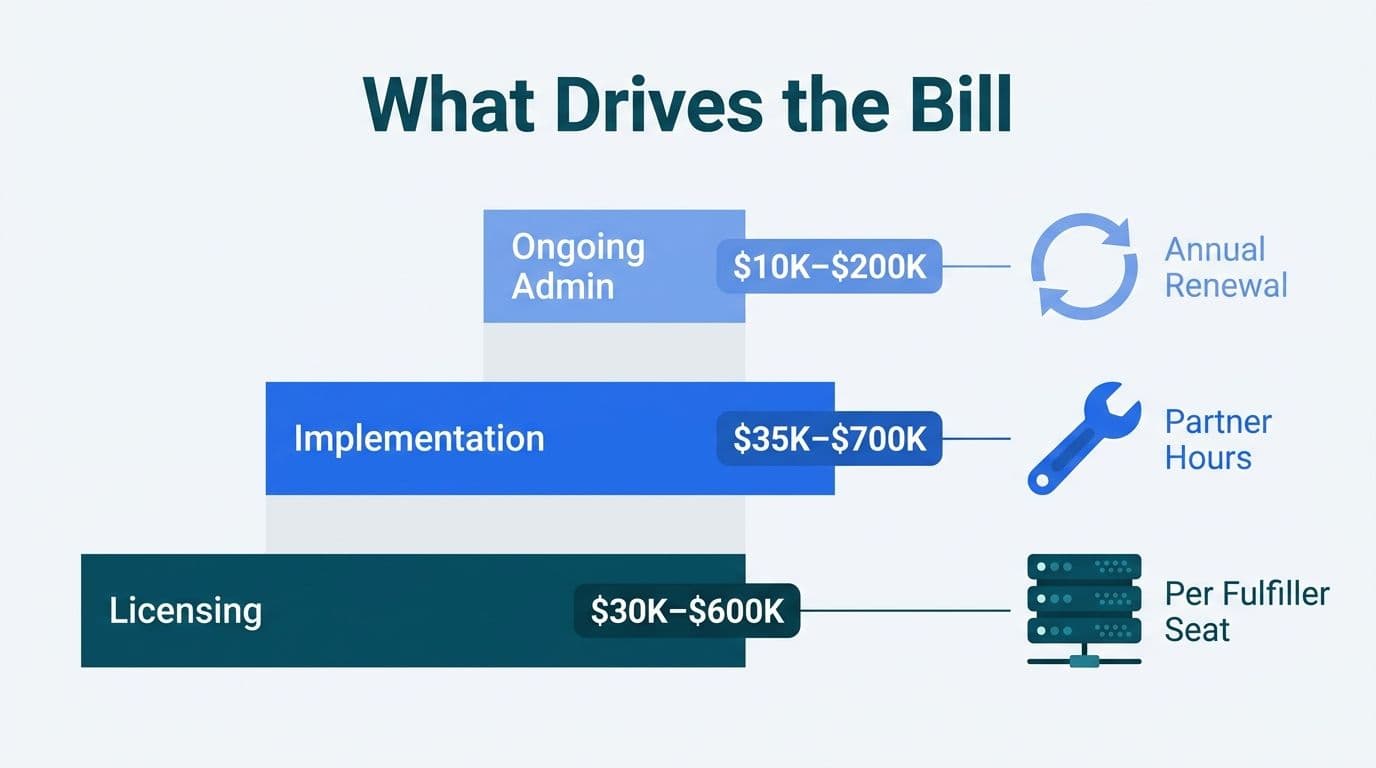
The total cost of a ServiceNow implementation in 2026 is best understood across three distinct budget lines: licensing, implementation services, and ongoing managed support. Mid-market organizations that plan for only the first two are frequently surprised by year-two costs.
Here is a representative budget framework for a mid-market company (500-2,500 employees) implementing one to two ServiceNow modules in 2026:
| Cost Component | Typical Range (USD) | Key Variables |
|---|---|---|
| ITSM licensing (annual) | $40,000 - $150,000 | Fulfiller seat count, instance tier |
| Additional module licensing | $20,000 - $80,000 per module | GRC, HRSD, CSM each carry separate fees |
| Implementation services | $75,000 - $400,000 | Discovery, configuration, testing, go-live |
| Custom development | $20,000 - $150,000 | Integrations, bespoke workflows |
| Training and change management | $10,000 - $50,000 | Admin training, end-user enablement |
| Year-1 total (one to two modules) | $165,000 - $830,000 | Pre-negotiation planning estimate |
| Ongoing annual (Year 2+) | $60,000 - $200,000 | License renewal, managed support |
These figures represent realistic planning ranges drawn from publicly available ServiceNow partner frameworks and project scoping patterns in 2026 - not guaranteed quotes. All ServiceNow licensing is negotiated directly with ServiceNow sales and will vary by contract.
For organizations entering the procurement process, engaging ServiceNow consulting services partners before issuing an RFP typically surfaces scope-reduction and cost-optimization opportunities before any contract is signed.
What Drives ServiceNow Implementation Cost Up or Down?
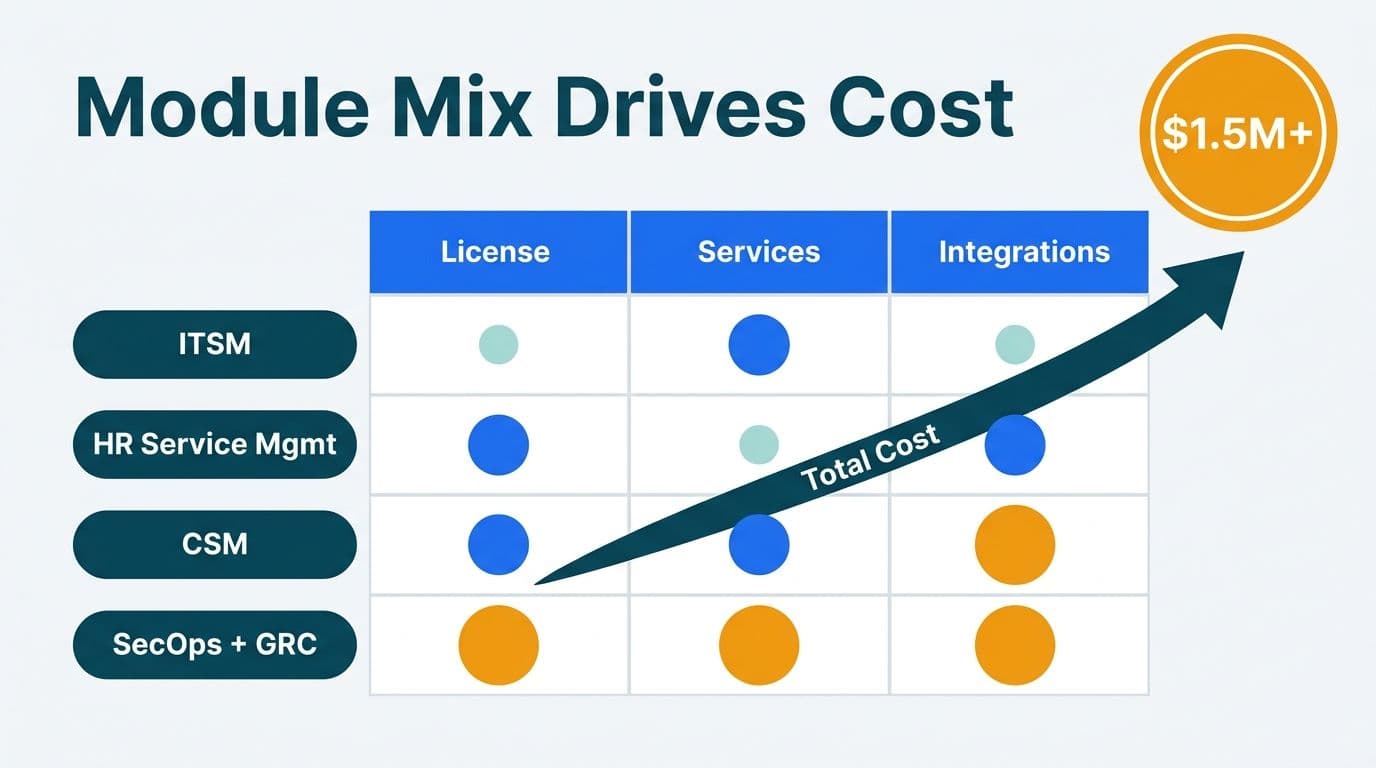
The single biggest cost lever is module scope. ServiceNow's Now Platform spans IT Service Management (ITSM), IT Operations Management (ITOM), HR Service Delivery (HRSD), Customer Service Management (CSM), Governance, Risk and Compliance (GRC), and Security Operations (SecOps). Each module carries separate licensing fees and distinct configuration complexity.
Module sprawl is where most mid-market projects overspend. A phased approach - beginning with ITSM, then expanding to GRC or HRSD after the team has built platform fluency - reliably delivers better outcomes than a multi-module big-bang launch. Organizations that attempt to go live on three or more modules simultaneously routinely encounter scope creep, extended timelines, and user adoption fatigue that inflate both cost and calendar.
Integration depth is the second primary cost driver. ServiceNow connects to identity providers, CMDBs, ERPs, monitoring stacks, and HRIS platforms. Each integration requires data mapping, transformation logic, error handling, testing, and documentation. A US healthcare organization connecting ServiceNow to a major EHR platform must build a discovery-to-population pipeline that respects HIPAA data handling requirements - a workstream that can add $30,000-$60,000 to the integration budget alone, before any module-level configuration begins.
Custom development versus out-of-the-box adoption is the third variable. The Now Platform ships with robust default workflows for ITSM, and most mid-market organizations can go live on standard flows with only minor configuration adjustments. Every custom table, custom field, and bespoke workflow added beyond the standard model increases both implementation cost and long-term upgrade risk. Organizations that adopt platform defaults wherever possible consistently finish faster and within budget compared to those that attempt to replicate legacy process logic line by line.
Organizational readiness affects cost less visibly but just as significantly. Projects where stakeholders cannot make workflow design decisions promptly, where legacy CMDB data is incomplete, or where IT and HR teams have conflicting governance models routinely run 30-50% over the original services estimate. A pre-implementation assessment identifies these blockers before they become costly project-stage problems. Organizations can use the free BI readiness assessment as a model for the kind of structured diagnostic that should precede any major platform investment.
How Do ServiceNow Licensing Tiers Affect Your Total Investment?
ServiceNow does not publish standard list prices; all contracts are negotiated. However, ServiceNow's official product documentation identifies the core licensing models that apply to most mid-market deployments.
User-based licensing charges per named user, typically separating requesters (employees who submit tickets) from fulfillers (IT staff who action and resolve them). Fulfiller seats carry a significantly higher per-seat cost. For a 1,000-person company with a 20-person IT support team, the fulfiller seat count drives most of the annual license bill - not the total company headcount. This distinction matters enormously when modeling first-year cost, and is one reason early headcount and role-mapping conversations with a certified partner are valuable before signing anything.
Capacity-based licensing applies to certain platform capabilities - particularly in ITOM and cloud management - where pricing is tied to the volume of infrastructure nodes or cloud resources being managed rather than user count.
Key negotiation considerations for mid-market buyers:
- Multi-year prepayment: Three-year contracts typically yield 5-15% discounts versus annual renewals. Finance directors modeling TCO should evaluate both scenarios and stress-test projected user growth against the savings.
- Sub-production instances: Standard contracts include one production and one or two sub-production environments. Additional sandbox capacity for development teams costs extra and should be negotiated upfront rather than added mid-project.
- Module expansion pricing: Locking in pricing for modules planned for year two or three - even if not activating them immediately - is significantly easier at initial contract stage than at renewal.
- Support tier inclusions: ServiceNow's standard, premium, and elite support tiers vary in response SLAs and access to technical account managers. Choosing the right tier at contract time avoids paying premium add-on rates later.
Understanding which features are included in your negotiated platform tier versus which require add-ons is essential. Discovering that a required capability is an add-on mid-implementation typically results in a change order that disrupts both project budget and timeline.
What Should Healthcare and Finance Teams Budget for ServiceNow in 2026?
Healthcare and financial services organizations consistently pay a premium over the mid-market baseline because their regulatory environments require platform configuration that standard deployments do not include.
US healthcare organizations: A hospital system or regional health plan implementing ServiceNow ITSM and GRC must configure HIPAA-compliant audit trails, role-based access controls, minimum-necessary access policies, and breach notification workflows. ServiceNow publishes HIPAA readiness documentation for its cloud infrastructure (ServiceNow Trust Center, 2026), but configuration compliance remains the customer's responsibility. Budget an additional $30,000-$80,000 in services for compliance configuration depending on module scope and data sensitivity. Organizations already running HIPAA-aligned analytics tooling - see the guidance on HIPAA compliant BI tools for hospital data visualization - will have faster data governance conversations during scoping, though the ServiceNow compliance configuration workstream is a separate engagement.
US financial services firms: A US bank, credit union, or insurance carrier implementing ServiceNow GRC for vendor risk management or internal audit faces SOC 2 Type II and FFIEC IT examination alignment requirements. SecOps module deployments often need to reference NIST CSF controls and CISA directives. Plan for $25,000-$60,000 in compliance-oriented configuration services, plus independent controls testing if the organization's external auditors require evidence of platform control mapping.
UK and EU organizations: A UK fintech or EU-based financial institution deploying ServiceNow for vendor risk or customer service management must configure GDPR Article 30 processing records, data subject access request (DSAR) automation, and 72-hour incident notification workflows aligned to UK and EU GDPR regimes. FCA operational resilience rules introduce additional requirements for UK-regulated entities around important business services mapping. London-based partner day rates typically run 20-30% higher than equivalent US rates, which affects total services cost when UK-based delivery resources are required.
Canadian organizations: A Canadian bank, insurer, or provincial health authority implementing ServiceNow must align with PIPEDA federal privacy requirements. Organizations with Quebec operations face additional obligations under Quebec's Act 25 (Law 25), which mandates privacy impact assessments, explicit consent mechanisms, and data residency documentation - all requiring ServiceNow configuration work. Federally regulated Canadian financial institutions also face OSFI guidelines governing how risk and audit data is managed on third-party platforms.
For organizations navigating the intersection of these regulatory frameworks, the AI Compliance Requirements for Financial Services 2026 Regulatory Map provides useful context on the regulatory stack that affects platform deployments across all three jurisdictions.
How Long Does a ServiceNow Implementation Take - and Why Does Timeline Affect Budget?
Timeline and budget are directly linked: longer projects consume more consulting hours, demand more internal resource time, and delay value realization.
Typical implementation timelines for mid-market ServiceNow projects in 2026:
- ITSM only, standard configuration: 8-14 weeks
- ITSM plus one additional module: 14-24 weeks
- Three or more modules in a phased program: 6-12 months per phase
- Enterprise-wide program (ITSM, HRSD, GRC, ITOM): 12-24 months total
Projects stall most frequently at two points. The first is CMDB population: automated discovery tools identify infrastructure assets, but data quality validation, ownership assignment, and relationship mapping require significant manual effort that is routinely underestimated at scoping stage. The second is workflow design sign-off: securing approvals from IT, HR, legal, and operations stakeholders simultaneously requires governance structures that many mid-market organizations have not established before the project kicks off.
A phased delivery model - ITSM live in quarter one, GRC or HRSD activated in quarter three after the organization has built platform fluency - reduces initial cash outlay, lowers go-live risk, and creates a track record of success that builds executive confidence for subsequent phases. ServiceNow releases two major platform upgrades per year; a phased rollout also allows the team to absorb those cycles without disrupting an active multi-module implementation.
How to Control ServiceNow Implementation Costs Without Sacrificing Quality
Invest in discovery before the contract. A focused 3-5 day scoping engagement with a certified partner surfaces integration complexity, compliance gaps, and data quality issues before the Statement of Work is signed. Scoping engagements typically cost $15,000-$25,000 and regularly prevent mid-project change orders that cost multiples of that amount.
Adopt platform defaults wherever possible. Establish a governance rule that every customization request must carry a written business case approved by a steering committee. The discipline of accepting the platform's standard workflow before requesting a deviation is the single highest-leverage cost control available. Each custom element adds implementation time and creates a long-term upgrade maintenance burden.
Use train-the-trainer for end-user enablement. Engaging the implementation partner to train 5-8 internal power users - who then own business unit enablement - cuts training spend by 40-60% compared to partner-led all-hands sessions. Internal champions remain after the partner engagement ends and provide more durable adoption support than external trainers cycling through the organization.
Negotiate total contract value, not just seat price. Module expansion pricing, sub-production instance counts, support tier inclusions, and upgrade services are all negotiable at initial contract stage. Finance directors should model the full 3-year TCO - including anticipated module additions and headcount growth - before entering vendor negotiations.
Budget for managed services from day one. ServiceNow requires ongoing platform administration, quarterly upgrade testing, and periodic workflow optimization. A managed support arrangement with a certified partner typically costs $5,000-$20,000 per month depending on scope. It eliminates the need to hire a dedicated full-time platform administrator and keeps the instance current with ServiceNow's release cycle. Use the project cost calculator to model managed services as part of your year-two and year-three budget planning.
---
About Lets Viz: Lets Viz is a data analytics and enterprise platform consultancy serving US healthcare systems, UK fintech firms, Canadian manufacturing organizations, and global SaaS businesses since 2020. The practice holds a 5.0 Clutch rating and specializes in platform implementations, compliance-aligned data architecture, and analytics modernization across regulated industries.
Ready to build a defensible ServiceNow budget before going to market? The ServiceNow consulting services team at Lets Viz offers a fixed-scope discovery engagement that sizes your implementation accurately - module by module, compliance requirement by compliance requirement - before any vendor contract is signed.