Power BI Healthcare Reporting: Implementation Cost Guide
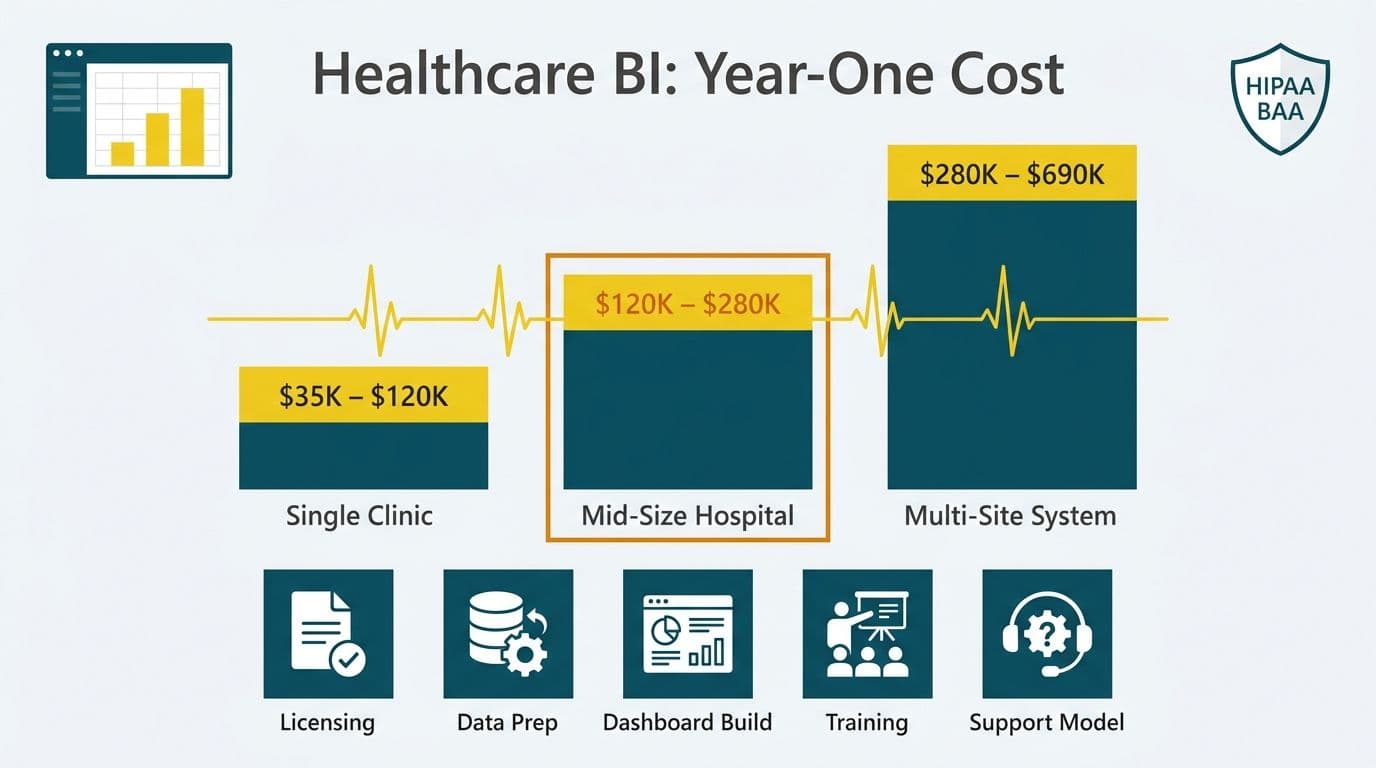
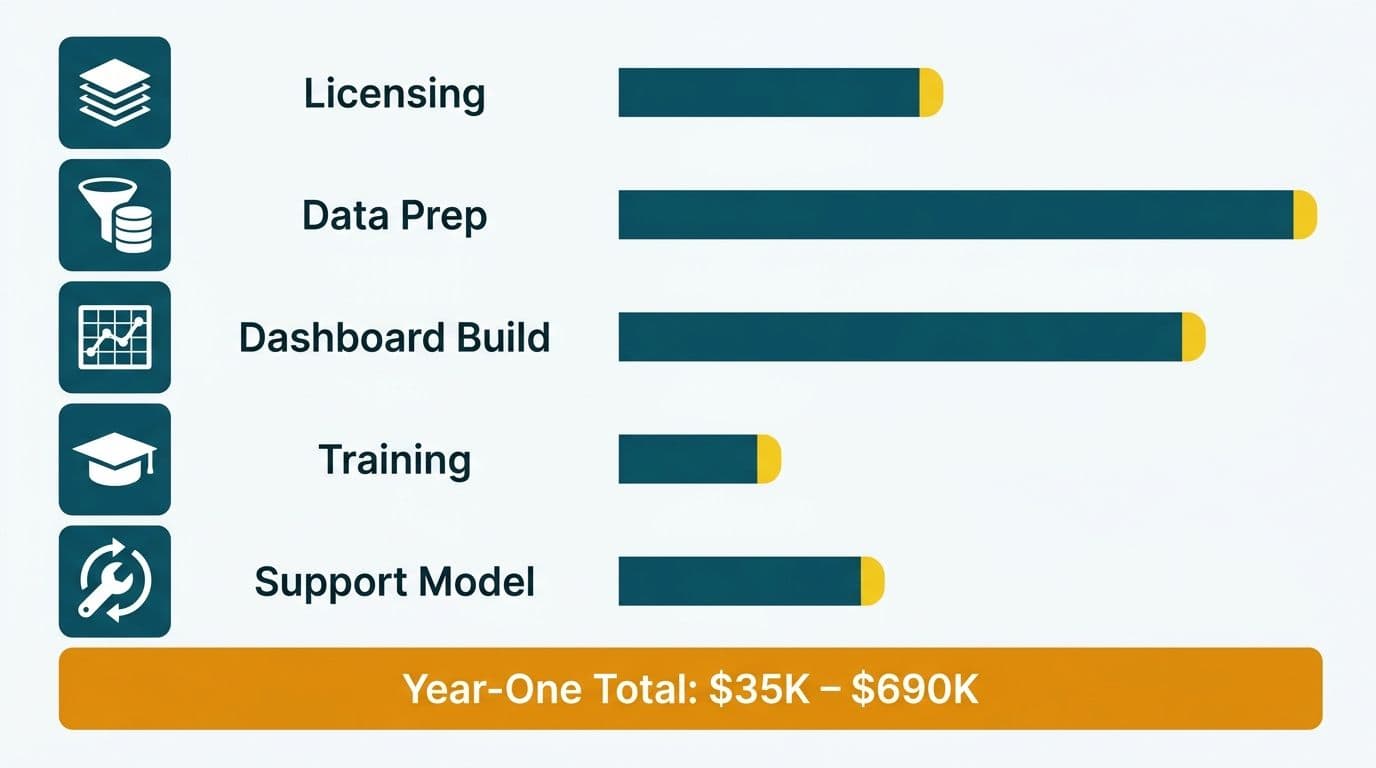
Implementing Power BI for healthcare reporting costs $35,000-$690,000 in year one, scaling from a single clinic to a multi-site health system. Five drivers determine the total: licensing tier, data preparation complexity, dashboard build scope, training investment, and ongoing support model. For a mid-size hospital with 100-150 seats, a realistic year-one budget falls between $120,000 and $280,000.
Key Takeaways
- Microsoft licenses Power BI at $10/user/month (Pro) or $20/user/month (Premium Per User); Premium capacity starts at approximately $4,995/month - always obtain a HIPAA BAA before processing PHI
- Data preparation - integrating EHR, claims, and ADT systems - typically consumes 35-50% of total year-one project spend
- Dashboard build costs range from $8,000 for a single-department clinic report to $200,000+ for a multi-site health system rollout
- ROI for healthcare BI typically surfaces first in revenue cycle and readmission tracking, usually within 12-18 months of go-live
- A managed service model consistently beats in-house staffing economics for organizations under 300 seats
What Does Power BI Healthcare Reporting Implementation Cost by Size?
Power BI healthcare reporting implementation cost varies most by organizational scale. A 20-seat rural clinic can be live for under $40,000 in year one; a 500-seat integrated health system can easily reach $600,000.
The table below shows realistic year-one cost bands across three tiers. All figures assume a BAA-covered Microsoft 365 environment, integration with at least one EHR, and a managed support arrangement.
| Cost Category | Small Clinic (<50 seats) | Mid-Size Hospital (50-300 seats) | Health System (300+ seats) |
|---|---|---|---|
| Licensing (annual) | $2,400-$14,400 | $36,000-$72,000 | Premium from ~$60,000/yr |
| Data Preparation (year 1) | $10,000-$30,000 | $40,000-$120,000 | $100,000-$250,000 |
| Dashboard Build | $8,000-$25,000 | $30,000-$100,000 | $80,000-$200,000 |
| Training | $3,000-$8,000 | $8,000-$25,000 | $25,000-$60,000 |
| Ongoing Support (annual) | $12,000-$24,000 | $24,000-$72,000 | $60,000-$120,000 |
| **Total Year 1** | **$35,400-$101,400** | **$138,000-$389,000** | **$325,000-$690,000** |
These are implementation budgets, not pure software costs. The software itself is a minority of year-one spend for most organizations; the heavy lifting is integration and data governance.
For teams evaluating whether Power BI is the right fit before committing a budget, Managed Power BI for healthcare teams outlines the readiness criteria and engagement models in detail.
How Do Healthcare Licensing Costs Break Down?
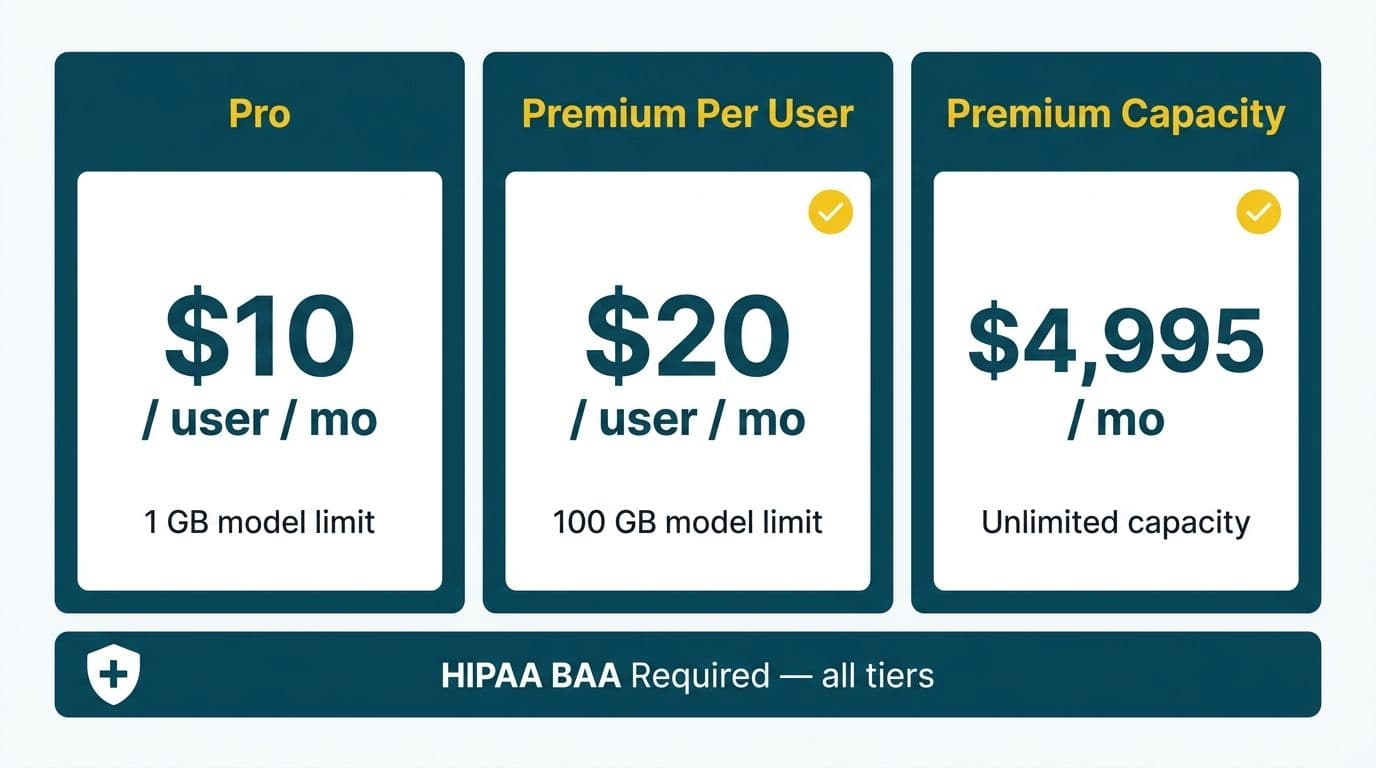
Licensing is the most predictable cost category because Microsoft publishes its pricing openly. As of 2026, the three tiers relevant to healthcare are:
- Power BI Pro - $10/user/month. Suitable for teams sharing reports internally. Every report consumer needs a Pro license unless the workspace owner holds a Premium license.
- Power BI Premium Per User (PPU) - $20/user/month. Adds paginated reports (critical for regulated clinical documentation), deployment pipelines, and higher refresh rates - features most healthcare BI programs require.
- Power BI Premium Per Capacity (P1 and above) - approximately $4,995/month for a P1 node (Microsoft 2026 pricing). Cost-effective for large health systems distributing reports to hundreds of unlicensed internal consumers.
HIPAA requirement: any Power BI environment processing or displaying Protected Health Information (PHI) requires a signed Business Associate Agreement (BAA) with Microsoft. Microsoft provides a BAA under the Microsoft Online Services Data Protection Addendum, but it must be explicitly activated - it does not apply automatically. Organizations that skip this step face significant compliance exposure regardless of technical security controls in place.
UK NHS Trusts face an analogous requirement under UK GDPR: a Data Processing Agreement (DPA) must be in place with Microsoft before any patient-identifiable data enters the cloud environment. Canadian health authorities operating under PIPEDA - or provincial legislation such as Ontario's PHIPA or Alberta's PHIA - need equivalent data processing assurances documented before go-live.
For a structured comparison of Power BI against purpose-built healthcare analytics platforms, the Power BI vs healthcare analytics software decision framework covers the build-vs-buy trade-offs across compliance, cost, and capability dimensions.
Why Is Data Preparation the Largest Variable Cost?
Data preparation is where healthcare BI projects most commonly exceed budget. Unlike a retail or SaaS dataset, hospital data lives across incompatible systems - an EHR (Epic, Oracle Health, Meditech), a separate claims adjudication platform, an ADT (admission-discharge-transfer) feed, a scheduling system, and often a legacy data warehouse that nobody fully understands.
The preparation work includes:
- Source system connectors: building or licensing connectors to EHR APIs, HL7 FHIR endpoints, or ODBC exports
- PHI masking and row-level security: mapping Power BI row-level security (RLS) correctly to clinical role hierarchies so a ward nurse sees their unit's data while the CFO sees the financial aggregate
- Data quality remediation: deduplicating patient records, resolving ICD-10 coding inconsistencies, normalizing date formats across systems
- Incremental refresh configuration: large hospitals generate millions of encounter rows per year; without incremental refresh and query folding, reports time out or return stale data
A mid-size US hospital integrating an EHR with a claims warehouse typically spends $40,000-$80,000 on data preparation alone in year one. A health system integrating five or more source systems can spend $150,000-$250,000 before a single dashboard is built.
HIPAA adds compliance overhead that pure-BI projects avoid: every data movement between source systems and Power BI must be logged, audited, and mapped to the organization's data flow inventory. This is not a one-time task - it recurs whenever a new data source is added or an existing source schema changes.
For teams already operating on Microsoft's data platform, the Microsoft Fabric architecture components guide covers how Fabric's lakehouse model can simplify EHR data ingestion compared to traditional ETL pipelines, and in some cases reduces year-one data preparation cost meaningfully.
How Much Does the Dashboard Build Phase Cost?
Build cost is driven by dashboard count, DAX model complexity, and the number of clinical or operational domains being addressed.
A single-department report - say, an ED throughput dashboard for one facility - is an $8,000-$20,000 engagement. A revenue cycle management suite covering AR aging, denial rates, and payer mix across three facilities costs $30,000-$80,000. A full enterprise rollout covering clinical quality, workforce, revenue cycle, and population health can exceed $150,000 in build cost alone.
Where DAX complexity inflates cost: clinical calculations are rarely simple sums. A readmission rate dashboard requires time-intelligence logic across discharge and readmission events. Measures using `CALCULATE` with filter context overrides and `SUMX` iterating encounter-level cost tables are common - and they require practitioners with healthcare domain knowledge, not just DAX syntax familiarity. Misbuilt measures produce numbers that look plausible but are clinically incorrect, which is a serious problem in a HIPAA-regulated environment.
Hospitals with IT service management data from platforms such as ServiceNow often find that pulling operational metrics - helpdesk SLA adherence, system downtime affecting clinical applications - into a combined ServiceNow and Power BI integration dashboard adds $5,000-$15,000 to a standard BI build, but gives the CIO a unified view of clinical and IT operations in a single workspace.
For a worked example of clinical KPIs and the data model logic behind them, the hospital readmission rate analytics dashboard in Power BI walkthrough shows the model structure and DAX patterns in detail.
What Should Healthcare Organizations Budget for Training?
Training is routinely underbudgeted and is the most common reason Power BI projects fail to deliver ROI. A technically sound dashboard that clinicians do not trust or cannot navigate produces no value.
A realistic training budget has three layers:
1. End-user adoption ($3,000-$15,000): role-based sessions for clinical leads, department heads, and finance staff. Healthcare workers are time-constrained; sessions must be short (60-90 minutes), scenario-based, and repeated across shifts.
2. Power BI author training ($5,000-$12,000): for internal analysts or data engineers who will maintain and extend reports. This covers DAX, data model design, and Power BI Service administration.
3. Change management ($5,000-$20,000 for mid-size hospitals): governance documentation, a data dictionary, and a defined workflow for requesting new reports or flagging data quality issues.
An NHS Trust rolling out a workforce analytics dashboard to ward managers across five sites will have substantially higher change management costs than a 30-physician clinic deploying a single revenue cycle report. The hospital workforce analytics dashboard guide for NHS, Canada, and US teams addresses the NHS Data Security and Protection Toolkit governance considerations that affect how training materials and data dictionaries must be structured.
When Does a Managed Support Model Beat In-House Staffing?
Ongoing support is the cost that persists beyond year one and most directly determines total cost of ownership. Organizations face a binary choice: hire internally or engage a managed service provider.
Suppose a 150-seat regional hospital in Ontario weighs both options. A dedicated Power BI data engineer with healthcare domain knowledge represents a significant fixed overhead - salary, benefits, recruiting cost, and the operational risk when that person departs. A managed service covering the same environment typically runs $2,000-$6,000/month, including monitoring, refresh management, model optimization, and new report development within a defined capacity.
Under PIPEDA and Ontario's PHIPA, any managed service provider accessing PHI must be bound by a data processing agreement and must not store PHI outside Canada without explicit authorization. A locally-contracted managed Power BI provider satisfies this requirement cleanly; an offshore team introduces data residency complexity requiring legal review before any access is granted.
An equivalent US community hospital under HIPAA needs its managed service provider to sign a BAA - the same obligation that applies to Microsoft. Engaging a third-party analytics firm without a signed BAA is a HIPAA violation regardless of what the underlying data looks like in the dashboards.
The economic crossover point - where managed consistently beats in-house - is typically at or below 200 seats. Above 300 seats, the breadth of work often justifies a dedicated internal analyst, supplemented by an external retainer for specialist development tasks.
What ROI Benchmarks Can Healthcare Organizations Expect?
ROI in healthcare BI depends on which clinical or operational domain gets addressed first. Three illustrative scenarios show what is achievable across geographies:
US hospital group - revenue cycle focus: Suppose a 300-bed acute-care hospital deploys Power BI across its billing and coding team. Common outcomes in this scenario include reduced denial rates (driven by identifying payer-specific rejection patterns), faster AR resolution through aging-bucket dashboards, and a measurable reduction in days in AR. Revenue cycle is the fastest-ROI domain because every improvement directly affects cash flow. Organizations in this scenario typically expect year-one gains to exceed implementation cost by month 18-24.
NHS Trust - operational efficiency focus: An NHS Trust deploying a bed management and discharge planning dashboard faces a different ROI calculus - the gain is capacity, not direct revenue. Reducing delayed discharges by even a small margin across a 500-bed trust recovers substantial bed-days annually. The relevant compliance layer is UK GDPR and the NHS Data Security and Protection Toolkit, both of which govern how patient flow data can be stored and displayed in the BI environment.
Canadian health authority - population health focus: A provincial health authority in British Columbia, operating under FOIPPA, might deploy a population health management dashboard tracking chronic disease prevalence, vaccination uptake, and ED utilization by geographic region. The ROI here is resource allocation efficiency - directing public health resources where they achieve the highest per-dollar impact. The population health management dashboard guide for payers and ACOs covers the data model requirements for this use case.
Across all three contexts, the pattern is consistent: ROI accrues fastest when Power BI addresses a process with measurable, recurring inefficiency - not when it is deployed as a generic reporting replacement.
What Hidden Compliance Costs Should Healthcare Budgets Include?
No Power BI healthcare cost breakdown is complete without accounting for compliance overhead that does not appear on a Microsoft invoice.
The major compliance costs organizations routinely underestimate:
- BAA documentation and legal review: $2,000-$8,000 one-time, depending on legal team hourly rates and vendor stack complexity
- Audit logging and monitoring: enabling and reviewing Power BI audit logs in the Microsoft 365 compliance center is technically free, but the process requires consistent ownership - in practice, 4-8 hours per month of analyst or security team time
- Annual security review: HIPAA Security Rule obligations require periodic review of technical safeguards; Power BI configuration must be included in that cycle
- Data classification: tagging PHI fields across the data model so row-level security applies correctly - a one-time setup cost that scales with data model complexity
For organizations evaluating HIPAA-compliant BI tooling more broadly, the HIPAA compliant BI tools for hospital data visualization comparison covers the compliance posture of the main platforms side-by-side, including how each handles audit logging and BAA coverage.
Ready to scope your Power BI healthcare reporting budget? Managed Power BI for healthcare teams outlines engagement models from project-based builds to full managed support, with HIPAA BAA coverage included as standard.
---
About Lets Viz: Lets Viz has delivered data analytics and BI implementations for US healthcare providers, UK fintech firms, Canadian manufacturing companies, and global SaaS organizations since 2020. Our Power BI and Microsoft Fabric practice holds a 5.0 Clutch rating, with engagements spanning HIPAA-regulated hospital systems, GDPR-compliant NHS data environments, and PIPEDA-governed Canadian health authorities.