n8n Self-Hosted vs Cloud: Compliance Decision Framework
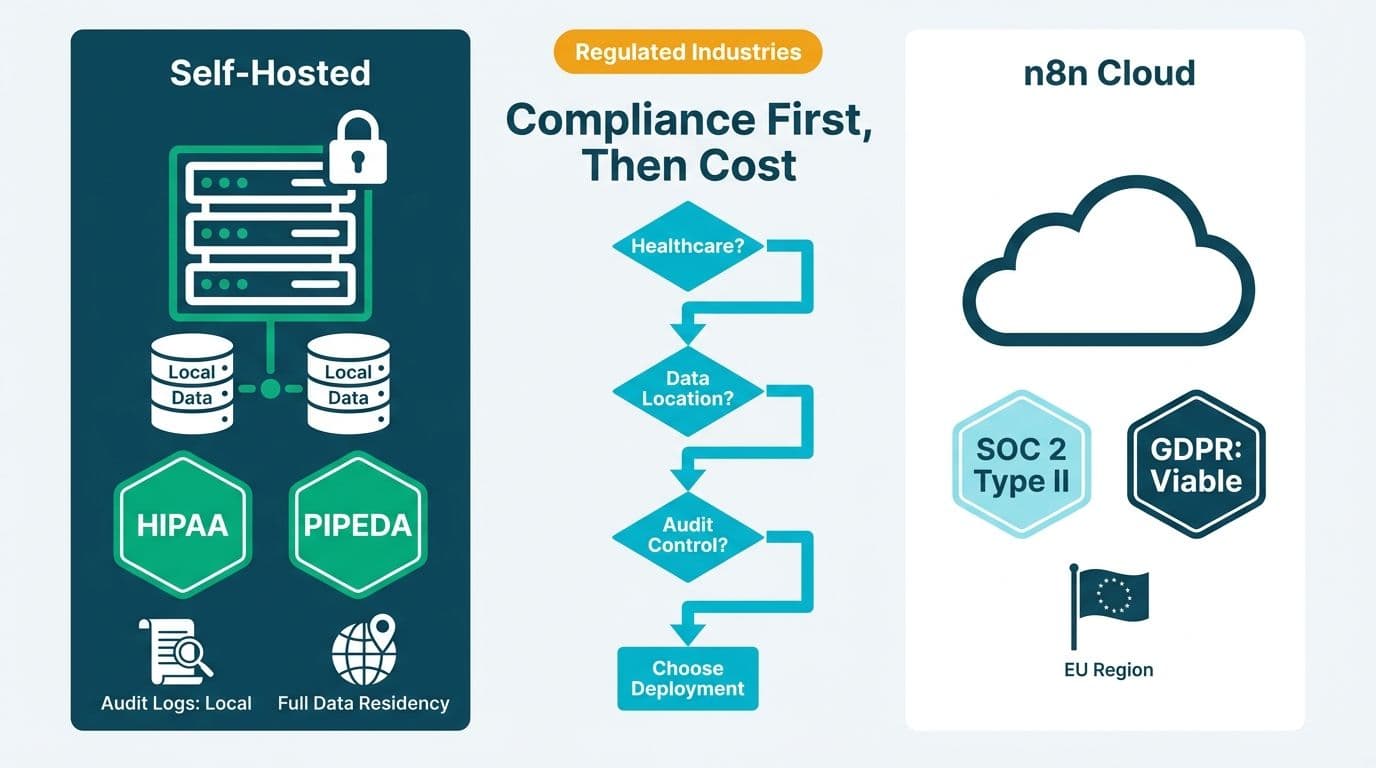
For regulated industries, the choice between n8n self-hosted and n8n Cloud is a compliance question before it is a cost question. Self-hosted n8n gives full control over data residency and audit infrastructure, making it the default choice for US healthcare entities under HIPAA and Canadian organizations under PIPEDA. n8n Cloud's SOC 2 Type II certification and EU-region hosting make it viable for many GDPR use cases, but healthcare workloads require additional contractual controls regardless of deployment model.
Key Takeaways
Self-hosted n8n keeps all workflow data, credentials, and execution logs inside your own infrastructure - essential for HIPAA compliance and most PIPEDA interpretations.
n8n Cloud holds SOC 2 Type II certification and offers EU-hosted infrastructure, meeting baseline GDPR data residency requirements for many organizations.
A Business Associate Agreement (BAA) with n8n GmbH is required before any Protected Health Information touches the platform; currently available on enterprise plans only.
Audit trail depth differs materially: self-hosted lets you route execution logs to your SIEM; n8n Cloud logs are vendor-managed with defined retention windows.
Neither deployment model is inherently "compliant" - regulatory fitness depends on how you configure the tool, not solely on where it runs.
What Is the Core Difference Between n8n Self-Hosted and n8n Cloud?
n8n is an open-source, fair-code workflow automation platform used by engineering and operations teams to connect APIs, databases, and internal tools without vendor lock-in. The self-hosted edition runs entirely on your own servers or cloud tenant - AWS, Azure, GCP, or on-premise bare metal - while n8n Cloud is a fully managed SaaS service operated by n8n GmbH on AWS infrastructure.
The architectural gap matters for compliance in three specific ways.
Data residency: Self-hosted instances process and store all workflow data - including credentials, execution payloads, and error logs - inside your own environment. n8n Cloud stores this data in n8n's AWS tenancy. For US healthcare organizations and Canadian financial services firms, that distinction frequently determines which deployment model is legally permissible.
Operational responsibility: On self-hosted, your team handles patching, uptime, and security hardening. On n8n Cloud, n8n manages the infrastructure layer. That shifts certain security controls to the vendor, which means your compliance posture depends in part on their security certifications rather than your own.
Extensibility and network boundaries: Self-hosted n8n supports custom nodes and unrestricted outbound HTTP integrations. n8n Cloud restricts custom node installs on lower tiers and manages outbound connections. In regulated environments where workflow data cannot leave a trusted network boundary - such as a healthcare system's internal cloud tenant or a financial firm's private infrastructure - self-hosted is the only model that enforces this boundary architecturally.
n8n's AI agent nodes — which, as of 2026, connect directly to Claude 4, GPT-4o, Gemini 2.0 Flash, and other frontier models through n8n's built-in LLM integrations — add a further dimension to this decision. When an AI agent node routes a prompt to an external model provider, that prompt may carry sensitive context drawn from internal systems. In HIPAA or GDPR environments, AI agent architecture must be reviewed at the data flow level, not just the infrastructure level; each external LLM call is effectively a cross-boundary data transfer that must be mapped and authorized.
For CIOs evaluating AI automation consulting projects in healthcare or finance, self-hosted n8n is the starting point for compliance conversations, not the fallback.
n8n Self-Hosted vs Cloud Compliance: How Do the Two Models Stack Up?
The table below maps each deployment model against the three regulatory frameworks most relevant to mid-market US, UK/EU, and Canadian organizations.
| Compliance Dimension | n8n Self-Hosted | n8n Cloud |
|---|---|---|
| **Data residency control** | Full - data never leaves your infrastructure | Partial - EU-region available; US-East default for other regions |
| **HIPAA (US healthcare)** | Viable with BAA, encryption, and SIEM integration | Viable on enterprise plans with BAA; requires explicit PHI data flow mapping |
| **GDPR (UK/EU)** | Strong - full control over DPA and transfer mechanisms | Viable - EU hosting, DPA, and SCCs available for cloud customers |
| **PIPEDA (Canada)** | Strong - data stays in Canadian infrastructure when self-hosted there | Requires DPA and Transfer Impact Assessment; no dedicated Canada region confirmed |
| **SOC 2 Type II** | Your team's responsibility to achieve | n8n Cloud holds SOC 2 Type II certification (n8n vendor documentation) |
| **Audit trail access** | Full SIEM integration; custom log retention | Vendor-managed logs; enterprise tier offers extended retention |
| **BAA availability** | Available on enterprise plans from n8n GmbH | Available on enterprise cloud plans |
| **Uptime SLA** | Your infrastructure team's responsibility | 99.9% SLA on paid cloud plans |
| **Patch management** | Your team manages the release cadence | Vendor-managed rolling updates |
Self-hosted wins on control and auditability. n8n Cloud wins on managed certification and lower operational overhead. The right choice turns on which dimension your regulator - or your internal security team - weighs more heavily.
How Does n8n Self-Hosted Meet HIPAA Requirements for US Healthcare?
HIPAA compliance is not granted by a software platform - it is earned through the combination of technical safeguards, administrative policies, and signed agreements. For n8n to process Protected Health Information, three baseline conditions must be met regardless of deployment model.
A signed Business Associate Agreement must exist. n8n GmbH must countersign a BAA with your covered entity before PHI enters any n8n workflow. This applies to both self-hosted and cloud. Without a BAA, any PHI-processing workflow exposes your organization to HIPAA's civil and criminal penalty tiers, regardless of how securely the platform is otherwise configured.
Encryption must be enforced end-to-end. Self-hosted n8n should run behind a TLS-terminating reverse proxy - NGINX or Caddy are common choices - with encryption at rest enabled on the underlying PostgreSQL database. Workflow credentials in n8n's internal vault must use the platform's built-in encryption key, and that key should be stored in a dedicated secrets service: AWS Secrets Manager, Azure Key Vault, or HashiCorp Vault, not alongside application code or environment files.
Audit logs must be immutable and retained for the required period. HIPAA's Security Rule requires controls that record and examine access to systems containing electronic PHI. Self-hosted n8n lets you stream execution logs - which workflows ran, which credentials were accessed, and what data payloads were processed - directly to your SIEM in real time. On n8n Cloud, log access is constrained by vendor policy and retention windows that may not align with HIPAA's six-year record retention standard.
Consider a hypothetical US regional health network automating referral routing workflows that pull patient identifiers from an EHR API. Running this on n8n Cloud without a signed BAA and without explicit PHI data-flow documentation creates significant regulatory exposure. Self-hosted n8n, deployed inside the health network's HIPAA-eligible cloud environment, inherits existing technical controls and reduces the compliance gap to a single step: the BAA negotiation with n8n GmbH.
For a broader view of how automation tools fit into clinical and administrative operations, see AI Workflow Automation for Healthcare Operations (2026).
How Does n8n Cloud Handle GDPR and UK Data Residency Requirements?
For UK and EU organizations, GDPR compliance centers on three questions: where is data processed, who has access, and what is the contractual basis for any cross-border transfer?
n8n Cloud addresses these directly. The platform offers EU-region hosting within the European Economic Area, keeping personal data within EEA borders during processing. n8n publishes a Data Processing Agreement for cloud customers, satisfying the GDPR Article 28 processor requirements. For UK customers, n8n's DPA covers International Data Transfer Agreements as the applicable post-Brexit transfer mechanism.
Where n8n Cloud introduces complexity is in its sub-processor chain. n8n uses AWS and other infrastructure sub-processors to operate its service. Each must be covered by appropriate transfer safeguards - Standard Contractual Clauses or equivalent. Enterprise customers should review n8n's published sub-processor list and confirm it aligns with their own GDPR Article 30 records of processing activities before any personal data enters production workflows.
Self-hosted n8n offers a structurally cleaner answer for EU and UK teams. If you deploy on your own EU-region cloud tenant or on-premise data center, personal data never leaves your environment. Your DPA obligation is with your existing cloud provider - whose GDPR certifications you have likely already reviewed and documented - rather than with a new SaaS vendor.
A hypothetical UK fintech firm processing customer data through automated Know Your Customer workflows illustrates the trade-off. On self-hosted n8n inside their existing UK Azure tenant, personal data stays within the UK border and GDPR Article 44 transfer questions are moot. On n8n Cloud with EU-region hosting, the arrangement is viable but requires active sub-processor management and periodic DPA review as the vendor updates its infrastructure.
For GDPR requirements across SaaS financial reporting pipelines, see GDPR Compliant SaaS Financial Reporting: The BI Checklist.
How Should Canadian Organizations Evaluate n8n Against PIPEDA?
Canada's Personal Information Protection and Electronic Documents Act (PIPEDA) does not mandate domestic data residency at the federal level - a key distinction from GDPR - but it requires organizations to protect personal information with equivalent safeguards when data crosses borders, under the statute's accountability principle.
For n8n deployments, this creates a two-part compliance evaluation.
Accountability under PIPEDA Principle 4.1.3: Your organization remains responsible for personal information transferred to a third-party processor, including n8n GmbH. If personal data leaves Canada to n8n Cloud's infrastructure, you must demonstrate that contractual protections equivalent to PIPEDA's safeguards are in place - a DPA specifying security obligations, data handling restrictions, breach notification timelines, and the right to audit.
Quebec's Law 25 applies additional cross-border pressure. Quebec's Act Respecting the Protection of Personal Information in the Private Sector, commonly known as Law 25 (Bill 64), which came fully into force in 2023 and entered active enforcement in 2025, requires a Privacy Impact Assessment and notification to the Commission d'accès à l'information before personal information is sent outside Quebec. Administrative penalties under Law 25 reach up to 4% of worldwide revenues or C$25 million, whichever is greater — a penalty ceiling that aligns Law 25 more closely with GDPR in severity than with federal PIPEDA — making cross-border transfer decisions materially higher-stakes for Quebec-based organizations. For Quebec-based financial institutions and insurers, self-hosted n8n deployed on Canadian infrastructure is typically the lower-friction compliance path.
A hypothetical Canadian financial services firm in Ontario automating vendor payment workflows has more flexibility under federal PIPEDA than a Quebec insurer handling policyholder data would. Both organizations benefit from the clear data lineage and audit trail that self-hosted provides, because demonstrating accountability under PIPEDA is most straightforward when you can document exactly where data traveled and who accessed it at every stage.
What Are the Operational and Cost Trade-offs of Each Deployment Model?
Compliance is not only a legal question - it is an operational one. The true cost of self-hosted n8n in a regulated environment includes infrastructure, staffing, and process overhead that cloud customers do not carry.
For a mid-market organization running self-hosted n8n compliantly, the operational requirements typically include:
A DevOps resource or managed infrastructure contract - often 0.25 to 0.5 FTE equivalent at mid-market scale, translating to roughly $25,000–$60,000 in annual labor cost at prevailing North American rates
PostgreSQL management with encryption at rest, automated backups, and point-in-time recovery
A TLS-terminating reverse proxy for all inbound traffic
A log pipeline connecting n8n execution logs to a SIEM
A patching cadence aligned to n8n's release schedule, including security-priority releases
n8n Cloud eliminates all of the above but introduces a vendor dependency and requires active contract management for HIPAA and PIPEDA use cases.
For organizations without dedicated DevOps infrastructure, n8n Cloud on an enterprise plan can lower total compliance burden compared to self-hosted. For organizations with existing HIPAA-eligible or ISO 27001-certified cloud infrastructure, self-hosted n8n typically carries lower risk because it inherits established controls rather than adding a new vendor to compliance scope and audit surface.
For a comparative view of where n8n sits among automation platforms by use case and operational profile, see Best AI Automation Tools for Business 2026: Ranked by Use Case.
How to Build an n8n Compliance Decision Framework: Four Questions
Rather than defaulting to a deployment model based on cost, CIOs and data team leads should work through four structured questions before committing.
Question 1: Does any workflow touch regulated data?
If yes - PHI under HIPAA, personal data under GDPR or PIPEDA, card data under PCI DSS, financial records under SOX - the compliance path must be mapped before selecting a deployment model. If no regulated data is involved, cost and operational preference can drive the decision without restriction.
Question 2: Can you execute a BAA or DPA with n8n GmbH?
Both self-hosted and cloud require this before regulated data enters the platform. Enterprise plans enable BAA execution. If your legal or procurement team cannot close this agreement in the required timeframe, n8n may not be the right near-term choice for regulated workflows, regardless of deployment model.
Question 3: Does your existing infrastructure already carry the required certifications?
A US healthcare organization running workloads inside a HIPAA-eligible AWS environment gains more from deploying n8n within that environment than from adding n8n Cloud as a separate BAA holder. Inheriting existing controls reduces compliance scope and audit burden materially.
Question 4: Do you have the operational capacity to run self-hosted reliably?
If your team lacks DevOps capacity to manage infrastructure, patching, and log pipelines, n8n Cloud on an enterprise plan can achieve compliance at lower operational cost - provided the BAA is executed and PHI data flows are explicitly bounded and documented.
For practical examples of how organizations across industries have structured compliant workflow automation programs, AI Workflow Automation Examples for Business: 2026 Guide is a useful pre-decision reference. For the most common configuration errors that create compliance gaps in production n8n environments, AI Workflow Automation Mistakes: Pre-Launch Checklist covers the pitfalls most frequently encountered during implementation.
---
About Lets Viz: Lets Viz has designed and audited AI automation workflows for clients in US healthcare, UK fintech, Canadian manufacturing, and global SaaS since 2020, and holds a 5.0 rating on Clutch. Our work spans compliance-sensitive automation architecture, data pipeline design, and analytics delivery across regulated mid-market organizations in North America and Europe.
If you are working through the n8n deployment decision for a regulated environment, our AI automation consulting team has structured compliant workflow automation programs across HIPAA, GDPR, and PIPEDA contexts and can help you select and configure the architecture that fits both your compliance obligations and your operational capacity.