AI Workflow Automation Examples for Business: 2026 Guide
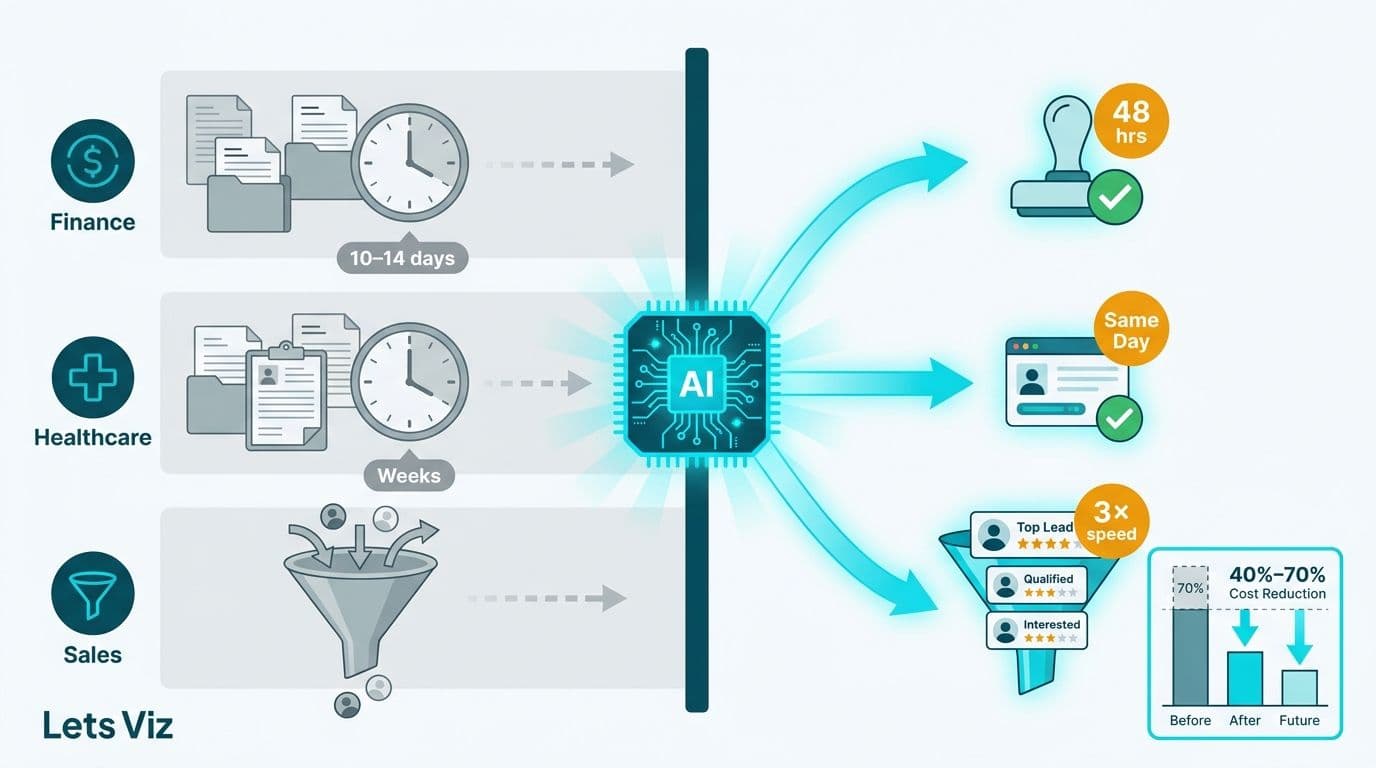
AI workflow automation examples for business span every major industry: finance teams eliminate 90% of manual invoice touches, healthcare payers cut prior authorization delays from weeks to hours, and sales organizations route leads with machine-speed precision. Across mid-market companies in the US, UK, and Canada, automated workflows consistently deliver 40-70% reductions in processing costs within the first year of deployment.
Key Takeaways
Finance invoice approval automation cuts average cycle time from 10-14 days to under 48 hours, freeing AP staff for exception handling and strategic work.
Healthcare prior authorization workflows reduce payer approval delays from 8+ days to 1-3 days, directly improving patient access to care.
Sales lead routing automation increases qualified-response rates by up to 78%, shortening pipeline timelines without adding headcount.
Mid-market organizations typically reach full ROI within 6-18 months, with timeline heavily influenced by data readiness.
A rigorous AI data maturity assessment should precede any automation investment - data quality gaps add months to deployment and reduce model accuracy.
What Are AI Workflow Automation Examples for Business, and Why Do They Matter Now?
AI workflow automation replaces rule-based, human-executed process steps with intelligent agents that read data, apply reasoning, route decisions, and trigger downstream actions - autonomously and at scale. According to Future Market Insights (2026), the AI consulting services market reached approximately USD 14 billion in 2026 - up from USD 11.07 billion in 2025 - and is projected to expand to USD 90.99 billion by 2035 at a 26.2% compound annual growth rate, reflecting how rapidly enterprise adoption has accelerated beyond isolated pilot programs.
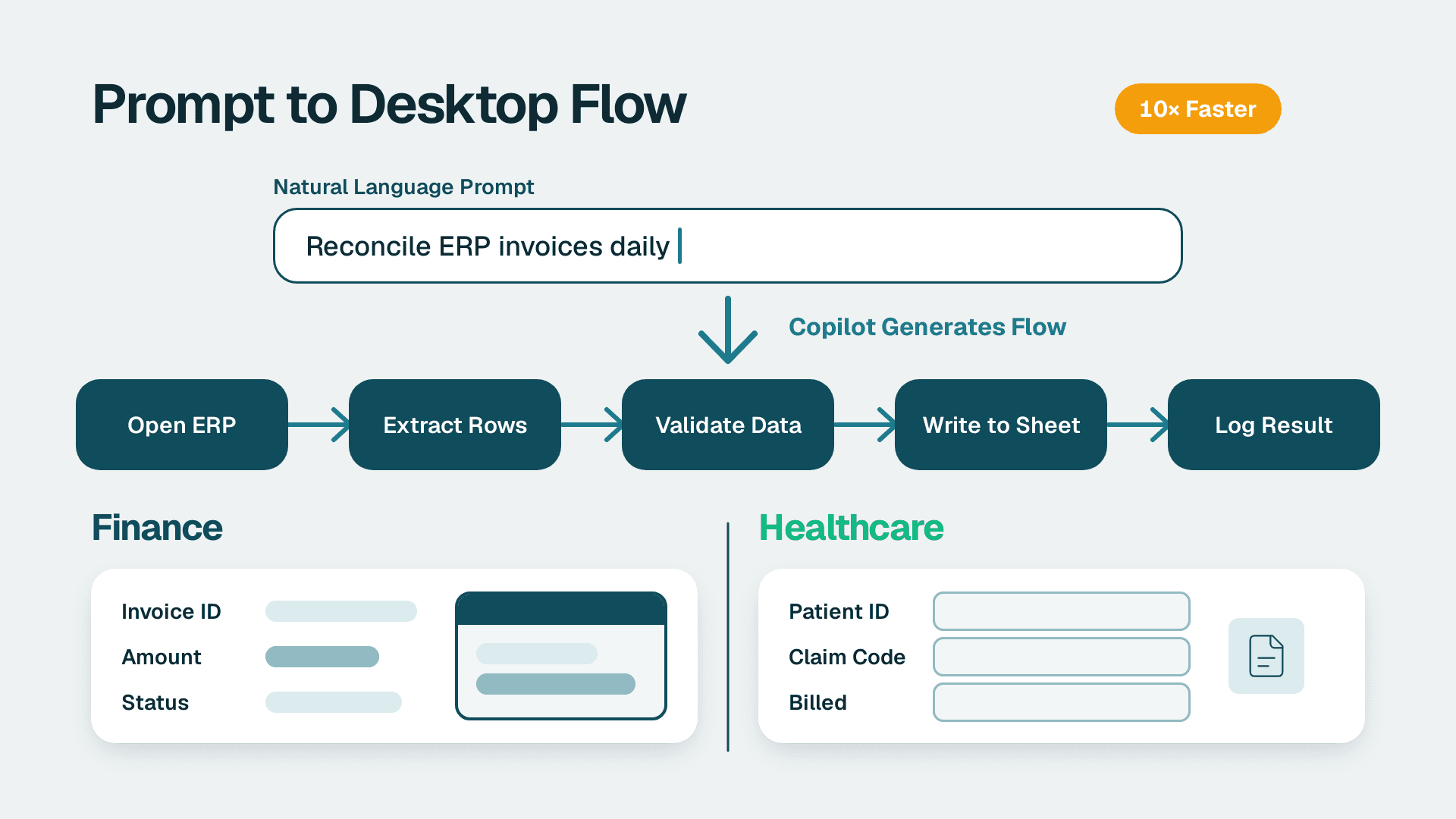
What separates modern AI workflow automation from first-generation robotic process automation (RPA) is contextual reasoning. A legacy invoice bot matched field patterns by rigid template. A modern AI model validates tax IDs against live government registries, flags duplicate vendor entries using fuzzy name matching, assigns GL codes using natural language context from invoice descriptions, and escalates anomalies to the correct approver - all within a single workflow pass and without human intervention for clean invoices.
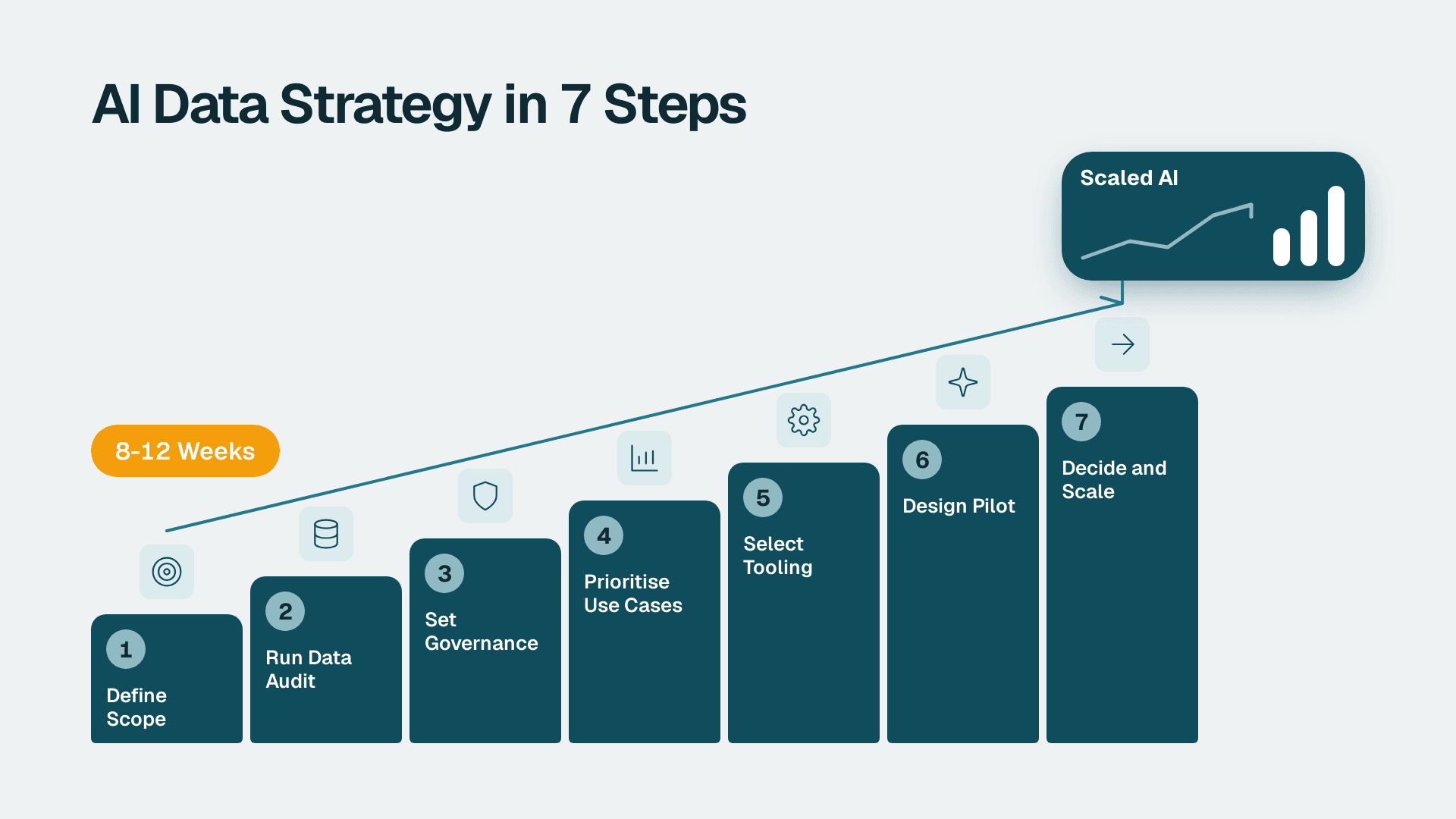
For CIOs and finance directors deciding where to start, the clearest ROI typically clusters in four process categories: accounts payable, clinical prior authorization, revenue team lead routing, and procurement intake. Selecting the right entry point requires mapping current cycle times, error rates, and staff hours against automation complexity - precisely the analysis that AI automation consulting teams conduct before recommending a deployment architecture.
Before any automation begins, organizations should define their AI data governance framework: the policies that determine who owns AI decisions, how outputs are logged, and under what conditions a human must review. Governance is not an afterthought - it is the structural layer that makes enterprise AI auditable, defensible, and compliant with HIPAA, GDPR, PIPEDA, and SOC 2 requirements across North American and European markets.
How Does Finance Invoice Approval Automation Work in Practice?
Finance invoice approval is the most commonly automated back-office workflow in mid-market companies. A typical AP team processes hundreds of invoices weekly, each requiring data entry, three-way matching against purchase orders and receipts, GL coding, and multi-tier manager approval. Manually, that cycle averages 10-14 business days and carries a per-invoice processing cost of roughly $12-15 at most mid-market organizations.
With AI automation, the workflow compresses dramatically:
1. Intelligent capture - OCR and document intelligence extract line items, amounts, vendor IDs, and payment terms from any format: PDF, scanned paper, EDI message, or email attachment.
2. Automated matching and coding - An AI model performs three-way matching, validates against contract terms, and assigns GL codes using context drawn from invoice descriptions and vendor history.
3. Exception routing - Mismatches, duplicates, or invoices above the approval threshold route automatically to the right manager via Slack, Teams, or email notification.
4. Straight-through processing - Clean invoices post directly to ERP with a full audit log and no human touch.
A US manufacturing company processing 1,200 monthly invoices reduced its average approval cycle from 12 days to 22 hours after deploying an AI-native AP workflow. Cost per invoice fell from $14.20 to $3.10, and the AP team shifted 70% of its time from data entry to exception resolution and vendor relationship management.
For US finance teams, SOC 2 compliance requirements mandate tamper-evident audit trails and role-based access controls on any automated financial process. Both are achievable within standard automation platforms but must be designed into the workflow architecture from day one - not retrofitted after deployment. Finance directors tracking SaaS metrics for board reporting will find AP automation a material EBITDA lever worth surfacing at the next board review cycle.
For teams wanting to avoid the most common implementation failures before going live, our AI workflow automation pre-launch checklist covers the failure modes most frequently seen in AP automation projects.
How Does AI Handle Healthcare Prior Authorization at Scale?
Healthcare prior authorization is one of the most damaging manual workflows in the US and Canadian health systems. Physicians and their staff spend significant administrative time each week preparing and following up on authorization requests, and approval delays directly postpone care for patients who need it. Under HIPAA in the United States and PIPEDA in Canada, any automated system handling member or patient data must enforce strict data minimization, purpose limitation, and access controls.
According to Market Research Future (2026), the Healthcare Financial Analytics Market is projected to grow at an 8.58% CAGR through 2035, driven in part by payer organizations investing in AI to reduce administrative overhead and meet the CMS Interoperability and Prior Authorization Rule, which took effect in January 2026 and now requires Medicare Advantage, Medicaid, and CHIP plans to implement electronic prior auth APIs - creating a compliance-driven forcing function for automation adoption across US payers. MedInsight (2026) separately identified AI-driven analytics and payer analytics innovation as two of the three dominant themes shaping healthcare operations strategy this year - trends that prior authorization automation directly addresses.
AI changes the economics of prior auth in three distinct phases:
Phase 1: Intelligent intake. AI reads unstructured clinical notes, discharge summaries, and referral letters - extracting ICD-10 diagnosis codes, CPT procedure codes, and supporting documentation - then pre-populates the payer's authorization form. This eliminates the 30-50 minute manual intake step that currently consumes most of the cycle time in each request.
Phase 2: Criteria matching. The AI cross-references the proposed procedure against the payer's clinical guidelines (such as InterQual or MCG criteria) and generates a preliminary recommendation - approve, pend for additional information, or recommend peer-to-peer review - with evidence citations drawn directly from the patient record.
Phase 3: Exception escalation. When a case is likely to require peer-to-peer review, the workflow automatically schedules the call, surfaces the strongest supporting clinical literature, and prepares a briefing document for the attending physician. Human clinicians stay in the loop for complex cases; the AI handles volume, triage, and routing.
A Canadian regional health authority piloting AI prior auth automation reduced average approval time from 9 days to 1.8 days across 3,200 monthly requests. The implementation included PIPEDA-compliant data residency controls ensuring all member records remained within Canadian borders, along with a consent-management layer for any data sharing with third-party clinical decision tools.
For US healthcare organizations building compliant analytics infrastructure to support these workflows, our healthcare AI analytics and data privacy audit guide details the HIPAA technical safeguards required at each layer.
What AI Workflow Automation Examples Apply to Sales and Revenue Teams?
Manual lead routing is a deceptively expensive problem. When a high-intent buyer submits a demo request on a B2B website, every hour of delayed response meaningfully reduces conversion probability. Sales operations teams at mid-market companies often rely on round-robin assignment rules that ignore lead quality, territory alignment, or rep capacity - resulting in slow follow-up, poor fit, and wasted pipeline.
AI-driven lead routing applies predictive scoring before assignment and delivers personalized outreach before a human representative enters the picture:
1. Enrichment - The AI appends firmographic data to the raw form submission: company size, industry, technology stack, revenue range, and buying signals drawn from public sources.
2. Scoring and classification - A model trained on historical closed-won data assigns a lead score and buying-stage classification (awareness, evaluation, decision-ready).
3. Intelligent routing - High-score enterprise leads route to senior account executives; SMB leads go to SDRs; leads from specific verticals or regions route to subject-matter specialists. Routing logic reflects actual win rates, not arbitrary round-robin rules.
4. Automated first touch - A personalized email or LinkedIn message fires within 90 seconds of form submission, referenced to the prospect's industry and apparent pain point.
A UK fintech firm running this pattern on inbound demo requests saw qualified-response time fall from 4.2 hours to under 3 minutes, with a 78% improvement in initial meeting set rates. GDPR compliance was addressed through explicit consent capture at form submission and data processing agreements with each enrichment vendor - a requirement for any UK or EU organization using third-party data to enrich prospect records.
What Time and Cost Benchmarks Can You Expect from AI Workflow Automation?
The table below summarizes benchmark ranges across the four most commonly automated business workflows. Actual results vary with data quality, integration complexity, and the implementation partner's experience with comparable deployments.
| Workflow | Manual Cycle Time | AI-Automated Time | Cost Reduction | Payback Period | Compliance Scope |
|---|---|---|---|---|---|
| Finance Invoice Approval | 10-14 days | 18-48 hours | 60-78% | 8-12 months | SOC 2 (US); GDPR (EU/UK) |
| Healthcare Prior Authorization | 6-9 days | 1-3 days | 40-55% | 12-18 months | HIPAA (US); PIPEDA (Canada) |
| Sales Lead Routing | 2-6 hours | Under 5 minutes | 35-50% (CAC) | 6-9 months | GDPR consent (UK/EU) |
| Procurement Intake and Approval | 8-12 days | 24-36 hours | 45-65% | 9-14 months | SOC 2; GDPR; PIPEDA |
These benchmarks apply to mid-market organizations with 100-1,000 employees and reasonably structured source data. Organizations that have not yet conducted an AI data maturity assessment frequently discover that data quality remediation extends the deployment timeline by 3-6 months. Clean, accessible data is the single largest predictor of automation success - more so than platform selection or budget size.
For a CFO-level view on quantifying returns from analytics and automation investments, our AI analytics ROI framework for finance leaders provides a practical model built specifically for mid-market finance teams.
How Much Does AI Workflow Automation Implementation Actually Cost in the US, UK, and Canada?
Most AI workflow automation implementation cost guides stop at platform licensing and miss the two budget lines that dominate first-year spend: integration development and ongoing maintenance. A complete total cost of ownership (TCO) analysis covers all three layers - and the numbers shift meaningfully depending on which country your team is operating in.
Platform Licensing: Per-Tool Pricing Tiers (Mid-2026)
The platform layer typically runs $200-$2,500 per month for mid-market deployments, depending on workflow volume and whether enterprise compliance features are required. Published pricing tiers for the most commonly deployed tools in 2026:
| Platform | Entry Tier | Mid Tier | Enterprise |
|---|---|---|---|
| Make (formerly Integromat) | Free (1,000 ops/mo) | $16/mo (10,000 ops) | Custom |
| Zapier | Free (100 tasks/mo) | $69/mo (2,000 tasks) | Custom |
| Microsoft Power Automate | $15/user/mo | $100/flow/mo | Custom |
| UiPath | Community (free) | ~$420/mo (Pro) | Custom |
| n8n | Free (self-hosted) | $20/mo (Cloud Starter) | Custom |
| Automation Anywhere | Community (free) | Price on quote | $50k-$200k+/yr |
For AI-layer processing - document intelligence, LLM-backed decision routing, or clinical criteria matching - add-on costs apply separately. Microsoft Azure AI Document Intelligence runs approximately $1.50 per 1,000 pages processed. OpenAI API usage for decision-layer calls typically adds $50-$300 per month at mid-market workflow volumes, depending on model selection and call frequency.
Integration Development: What Professional Services Actually Cost
Platform licensing is rarely the dominant cost item. Integration development - mapping your ERP, CRM, or clinical system to the automation platform, building exception-handling logic, and configuring compliance controls - typically represents 60-75% of total first-year spend. Benchmark hourly rates for senior automation engineers in mid-2026:
United States: $150-$250/hour (boutique firm blended rate or senior contractor)
United Kingdom: £110-£185/hour
Canada: CAD $130-$210/hour
Scoped project ranges by complexity:
| Project Complexity | Typical Scope | Cost Range (USD) |
|---|---|---|
| Simple (1-2 integrations, no AI layer) | Webhook setup, Zapier/Make config | $5,000-$15,000 |
| Mid-complexity (3-5 integrations, AI decision layer) | ERP + CRM + AI routing, SOC 2 logging | $25,000-$65,000 |
| Compliance-grade (HIPAA/GDPR/PIPEDA) | Healthcare prior auth, cross-border finance | $60,000-$150,000 |
| Enterprise (multi-system, multi-region) | Full AP + procurement + analytics stack | $120,000-$300,000+ |
UK and Canadian projects at the compliance-grade tier often run 10-20% below US equivalents due to lower local contractor rates, partially offset by GDPR and PIPEDA legal review requirements that add $5,000-$15,000 in compliance scoping fees per engagement.
Ongoing Maintenance: The Budget Line Teams Consistently Underestimate
Production AI workflows require active maintenance as upstream systems change, LLM APIs update, and exception volumes shift. Budget 15-25% of initial implementation cost annually for API version management and connector updates, model retraining or prompt tuning when accuracy degrades, exception pattern review and routing rule adjustments, and compliance log audits and access control reviews. For a $50,000 initial implementation, plan for $7,500-$12,500 per year in maintenance, or negotiate a managed services retainer with your implementation partner at deployment close.
Quick Cost Estimation Framework
Use these inputs to estimate your first-year total cost of ownership:
| Cost Component | How to Calculate |
|---|---|
| Platform licensing | Monthly platform cost x 12 |
| Integration development | Hourly rate x hours (simple: 40-80 hrs; mid: 200-400 hrs; enterprise: 600-1,200 hrs) |
| Compliance scoping (if HIPAA/GDPR/PIPEDA applies) | Add $5,000-$15,000 |
| Year-1 maintenance | 20% of integration development cost |
| **Total Year-1 TCO** | Sum of all rows above |
Applied example: a mid-market US company implementing AI invoice approval with SOC 2 controls. Platform ($600/yr) + integration development at $200/hr x 250 hours ($50,000) + SOC 2 scoping ($8,000) + year-1 maintenance ($10,000) = approximately $68,600 total first-year cost. Against AP processing savings of $130,000+ annually at 1,000 invoices per month (at $14.20 pre-automation vs. $3.10 post-automation), payback lands comfortably inside 7 months.
Should You Build or Buy Your AI Workflow Automation Capability?
The build vs buy AI data capability question is one of the most consequential decisions a technology leader will face when evaluating workflow automation. For most mid-market organizations, the answer is clear: buy proven platforms, configure workflows to your specific data model, and customize only at the integration edges.
Most mid-market companies lack the ML engineering capacity to build and maintain production-grade document intelligence models, clinical criteria-matching engines, or real-time lead scoring infrastructure from scratch. Building internally typically requires 12-24 months to reach a reliable production state. By contrast, the maturation of agentic AI platforms in 2026 - including pre-built workflow connectors, native document intelligence, and LLM-backed decision layers - has compressed scoped platform implementations to 4-8 weeks for standard patterns, down from the 6-12 week timelines common in 2024.
However, buying a platform does not mean deploying it out of the box unchanged. Each workflow described in this article requires meaningful configuration:
Finance AI must map to your specific chart of accounts, approval thresholds, and ERP data model.
Healthcare AI must reference your payer's clinical criteria sets, formulary data, and member record schema.
Sales AI must be trained on your historical closed-won data - not generic industry benchmarks - to score leads accurately for your specific buyer profile.
When evaluating whether to engage a boutique AI consulting firm vs large consultancy, the key differentiators are speed and proximity to decision-makers. Boutique firms typically embed directly in your team, configure to your existing data model, and iterate in 2-week sprints with senior practitioners available throughout the engagement. Large consultancies tend to run longer discovery phases, involve greater coordination overhead, and are better suited to enterprise-scale transformations with multi-year horizons and global deployment requirements.
If your organization is still establishing its AI data governance framework - defining ownership of AI decisions, error-logging protocols, and model retraining cadences - that groundwork should precede any production deployment. Automating into an ungoverned data environment is the fastest route to a compliance incident, particularly under HIPAA, GDPR, or PIPEDA.
For a detailed breakdown of open-source tooling options and when building individual components makes economic sense, our build vs buy guide for AI workflow automation tools walks through the full platform landscape with a total cost of ownership analysis.
Which Supply Chain and Operations Workflows Benefit from AI Automation?
An AI data strategy for supply chain typically focuses on three process layers: demand forecasting signal aggregation, supplier risk scoring, and customs or compliance document handling. Each is a strong candidate for automation in mid-market organizations managing cross-border procurement. AI workflow automation for logistics and supply chain teams - including 3PLs, e-commerce operations teams, and warehouse managers across the US, UK, and Canada - also delivers some of its fastest returns in four fulfillment-adjacent areas: order management, inventory threshold alerting, carrier tracking reconciliation, and exception handling.
A US-based 3PL managing 15,000+ daily shipments across multiple retail clients automated its carrier tracking and exception workflow using an AI agent that polls carrier APIs every 30 minutes, classifies exceptions (delays, failed deliveries, customs holds) by root cause, and routes each exception to the correct client account manager with a pre-drafted resolution note. Manual exception review time dropped from 3.2 hours per day per account manager to under 25 minutes, while customer SLA breach notifications shifted from reactive to proactive - flagged 18-36 hours before expiry rather than after the breach occurred.
E-commerce operations teams see equally strong returns from automated inventory alerting. Rather than static reorder-point rules, AI models ingest rolling sales velocity, seasonality signals, supplier lead times, and inbound shipment status to generate dynamic replenishment triggers. A UK e-commerce retailer processing 4,000+ daily orders eliminated 90% of its manual stock-level review cycles using this pattern, reducing stockout incidents by 43% over a 6-month period - a result that static rule-based systems consistently failed to replicate during demand spikes.
A Canadian manufacturing company processing over 800 cross-border shipments monthly automated its customs documentation workflow using AI document extraction and a classification rules engine connected to Canada Border Services Agency (CBSA) tariff schedules. Under PIPEDA, supplier contact data required a separate data processing agreement and explicit handling disclosures for each automated touchpoint. Results: a 67% reduction in customs hold frequency and a 4.2-day improvement in average clearance time - gains that directly improved working capital performance.
For UK and EU manufacturers, GDPR compliance adds a requirement to document the lawful basis for processing supplier personal data within automated workflows - a step that often surfaces undocumented data flows and results in a cleaner overall data architecture as a secondary benefit.
Supply chain automation also creates a natural foundation for improved board-level visibility. As organizations automate manual data collection across procurement, fulfillment, and logistics, the same structured data feeds BI dashboards that surface SaaS metrics for board reporting and operational KPIs - turning an efficiency project into an ongoing visibility program at no additional data collection cost.
---
About Lets Viz: Lets Viz is a data analytics and AI automation consultancy serving US healthcare organizations, UK fintech firms, Canadian manufacturers, and global SaaS companies since 2020. With a 5.0 Clutch rating, our practitioners design and deploy AI workflows that are auditable, compliant, and built to deliver measurable results at mid-market scale - without the overhead of a large consultancy engagement.
---
Ready to identify your highest-value automation opportunity? Our AI automation consulting team benchmarks, designs, and deploys production-ready AI workflows for mid-market organizations across healthcare, finance, and operations.