Best AI Automation Tools for Business 2026: Ranked by Use Case
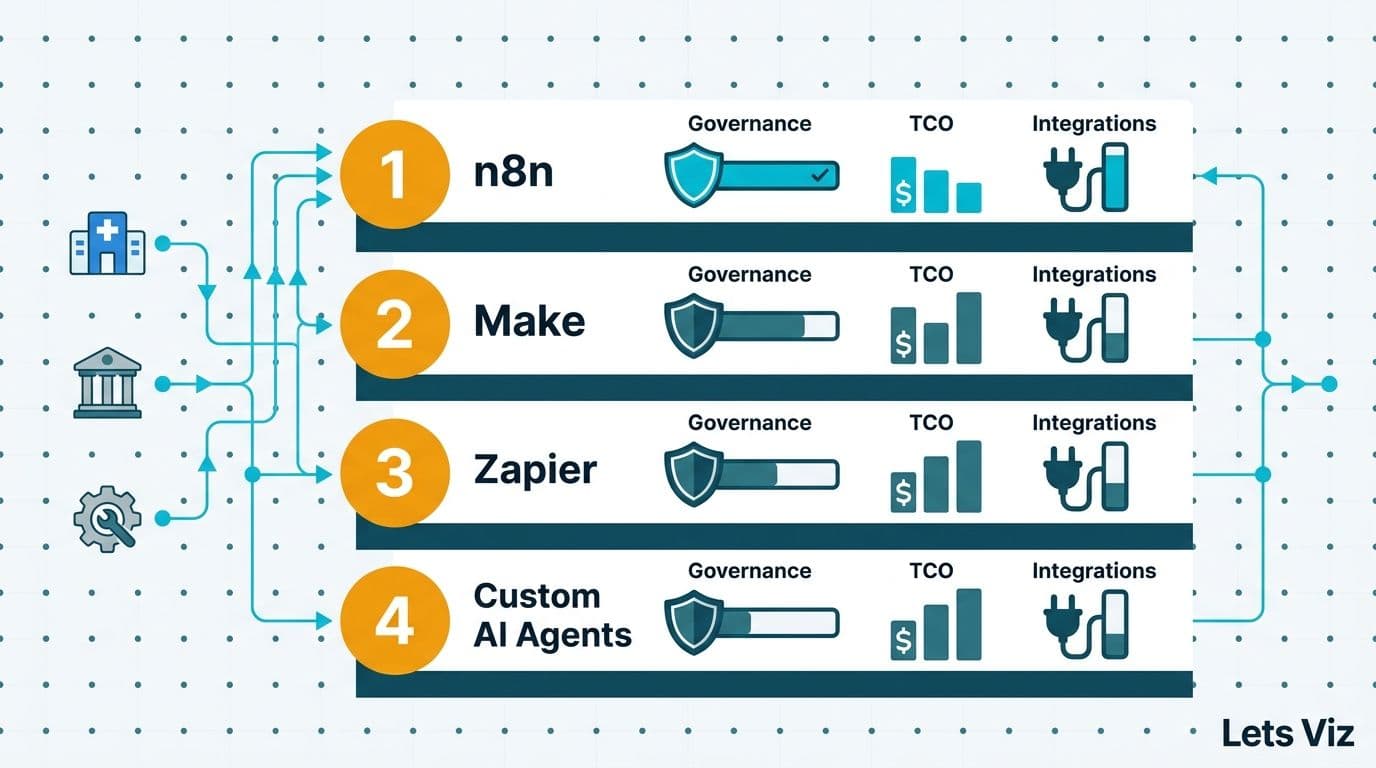
The best AI automation tools for business in 2026 are n8n, Make, Zapier, and custom AI agents - each optimized for a distinct combination of scale, budget, and compliance requirement. Mid-market healthcare and finance teams should evaluate platforms across three dimensions: data governance controls, total cost of ownership at projected task volume, and integration depth with existing ERP and analytics systems.
Key Takeaways
n8n offers the deepest customization and optional self-hosted deployment - the strongest fit for HIPAA and GDPR-regulated workflows
Make delivers the best cost-to-feature ratio for visual, multi-step workflows at 50-200 seat mid-market companies
Zapier deploys fastest but carries the highest per-task cost at scale, limiting its viability for high-volume finance or operations teams
Custom AI agents outperform SaaS orchestrators for workflows requiring reasoning rather than rule-following - but require a full build vs buy AI data capability analysis before committing
An AI data maturity assessment is the essential first step: teams with immature data pipelines will amplify errors, not efficiency, regardless of which platform they select
What Are the Best AI Automation Tools for Business in 2026?
The AI automation tool landscape has matured into three distinct tiers in 2026. Low-code orchestrators like Zapier and Make serve teams that need fast deployment and broad app connectivity. Developer-first workflow engines like n8n offer deeper logic, self-hosting, and more granular access controls. Custom AI agent frameworks - built on orchestration libraries and large language models - handle workflows that require reasoning, judgment, or proprietary business logic that cannot be expressed as a simple trigger-action rule.
The complexity of choosing and implementing the right automation stack has driven sustained growth in AI automation consulting through 2025 and into 2026: most mid-market companies lack the internal expertise to evaluate platforms rigorously, configure governance controls, and manage ongoing maintenance without external support.
The AI automation consulting discipline exists precisely to bridge that gap. A structured platform selection process - anchored in a formal AI data maturity assessment - prevents the most costly mistake in automation: deploying the right tool on the wrong data foundation.
| Platform | Best For | Pricing Model | Self-Hosted? | HIPAA/GDPR Ready? | Scalability |
|---|---|---|---|---|---|
| Zapier | Fast deployment, broad connectivity | Per-task | No | Limited (BAA on Enterprise) | Medium |
| Make | Visual workflows, mid-market ops | Per-operation | No | Yes (Enterprise plan) | Medium-High |
| n8n | Complex logic, regulated industries | Per-execution or self-hosted flat fee | Yes | Yes (self-host for full control) | High |
| Custom Agents | Proprietary reasoning, unique workflows | Build + maintenance investment | Yes | Fully configurable | Very High |
n8n vs Make vs Zapier: How Do They Compare on Cost and Scalability?
Zapier is the most widely deployed automation platform among mid-market US companies, largely because its no-code interface reduces time-to-first-workflow to hours. A US SaaS finance team automating contract-to-invoice processing can be operational within a single day. The critical limitation is economics: Zapier's per-task pricing model becomes expensive above roughly 50,000 tasks per month, and finance directors tracking rule of 40 SaaS benchmark metrics will find the unit economics difficult to defend at scale.
Make (formerly Integromat) is the price-competitive alternative for teams that need conditional logic and multi-step branching without developer involvement. A UK fintech firm reconciling payment exceptions across its payment processor, accounting platform, and risk engine can build and maintain that workflow without an engineering hire. Make's per-operation pricing runs consistently 60-75% lower than Zapier for equivalent workflows, and its GDPR-compliant data handling controls - including data region selection and automated processing records - make it the more defensible choice for organizations operating under UK and EU obligations.
n8n has seen the strongest adoption growth among regulated industries since 2024. Its core differentiator is the ability to run entirely within a customer's own infrastructure - a private cloud instance, an on-premises server, or a containerized deployment in a region of the customer's choosing. For a Canadian manufacturing company under PIPEDA, running n8n inside a Canadian-region cloud instance eliminates the cross-border data transfer question entirely. For US healthcare organizations under HIPAA, self-hosted n8n means protected health information (PHI) never passes through a third-party processor, removing a significant category of Business Associate Agreement exposure.
For teams evaluating the full open-source automation spectrum alongside these platforms, the open source AI workflow automation tools build vs buy guide covers decision criteria that distinguish platforms worth building on from those that create expensive migration debt.
What Are the Best Free AI Workflow Automation Tools for SMEs in 2026?
For small and mid-sized businesses in the US, UK, and Canada evaluating AI automation without a committed budget, genuine free plans exist on every major platform - but the limits differ enough to matter at typical SME task volumes.
| Platform | Free Tier Allowance | AI Features on Free? | Self-Host Option? | Key Constraint |
|---|---|---|---|---|
| Zapier | 100 tasks/month, 5 Zaps, single-step only | No | No | Single-step restriction blocks real workflows |
| Make | 1,000 operations/month, 2 active scenarios | Limited | No | Premium connectors (Salesforce, HubSpot) require paid plan |
| n8n | Unlimited (self-hosted community edition) | Yes | Yes - community edition | Requires infrastructure to run and maintain |
| Activepieces | Unlimited (self-hosted community edition) | Yes | Yes - open source | Smaller connector library than n8n |
Zapier's free plan allows 100 tasks per month across a maximum of 5 single-step Zaps. The single-step restriction is significant: multi-step workflows - the kind required for any real business process - require a paid tier. AI features including Copilot suggestions and AI-powered field mapping are not available on the free plan. For US-based SMEs exploring automation for the first time, Zapier free is adequate for simple notification triggers but not for production workflows.
Make's free tier provides 1,000 operations per month across two active scenarios. Because Make counts operations rather than tasks, a multi-step scenario that runs three modules per trigger consumes three operations per execution. At 1,000 operations per month, a typical SME running a five-step order management scenario could process roughly 200 orders before hitting the cap. For UK businesses, Make stores data on EU servers even at the free tier, which supports GDPR Record of Processing Activities documentation from day one.
n8n's community edition is the standout option for technical teams. Self-hosting n8n is genuinely free with no task caps, no workflow limits, and no AI feature restrictions - the self-hosted instance runs any node including LLM integration nodes without a subscription. For a Canadian SME with PIPEDA obligations, a self-hosted n8n instance in a Canadian cloud region provides unlimited automation capacity and confirmed data residency at zero platform cost. The trade-off is infrastructure: the team needs the capability to maintain a containerized deployment, handle updates, and monitor uptime.
Activepieces, an open-source alternative increasingly cited in evaluations of the best free AI workflow automation tools, also offers an unlimited self-hosted community edition with a simpler UI than n8n - a reasonable starting point for developer-led SMEs that want the economics of self-hosting without n8n's full configuration depth.
The practical guidance for SMEs across these three markets: use Zapier or Make free tiers for early-stage validation and proof-of-concept testing. Once a workflow is validated as business-critical and running above roughly 1,000 executions per month, per-operation costs on paid tiers grow quickly. At that inflection point, the economics of self-hosted n8n or a structured evaluation of paid plans deserves serious analysis. Teams with data residency obligations under GDPR (UK/EU), PIPEDA (Canada), or HIPAA (US healthcare) should note that self-hosting is the only free path that fully resolves cross-border data transfer questions from day one.
When Should You Build a Custom AI Agent Instead of a SaaS Platform?
Custom AI agents are not a replacement for SaaS orchestrators - they serve a fundamentally different class of problem. SaaS platforms handle deterministic workflows: when X happens in system A, execute Y in system B. Custom agents add value when the workflow requires judgment - parsing an unstructured referral document, classifying an ambiguous insurance claim, generating first-draft FP&A commentary, or routing a prior authorization based on clinical criteria that resist reduction to a rule set.
The build vs buy AI data capability analysis for a custom agent project should address four questions: Does the workflow require reasoning that cannot be expressed as conditional logic? Is the task volume sufficient to amortize the build investment within 18 months? Do compliance requirements make third-party cloud processors legally or operationally problematic? Does the team have engineering capacity to maintain the agent in production?
A prior authorization routing workflow illustrates where the threshold lies: the agent must interpret unstructured clinical notes, cross-reference formulary exceptions, and generate a justification summary for the reviewing clinician. No SaaS trigger-action rule set can express that logic reliably, and errors carry direct patient and liability consequences that make a bespoke, auditable agent the defensible choice over a general-purpose orchestrator.
When the first three answers are yes but the fourth is no, a hybrid architecture works well: n8n or an equivalent workflow engine handles orchestration, with a custom AI reasoning component embedded at specific decision points. This approach preserves auditability and structured logging while adding LLM-powered judgment where rule-based logic falls short.
Before moving any custom agent into production, the AI workflow automation mistakes pre-launch checklist provides a structured review of the error-handling gaps, fallback logic failures, and missing human-in-the-loop gates that most commonly delay ROI on agent deployments.
Which AI Automation Tools Are Best for Healthcare Organizations?
Healthcare presents the most constrained automation environment of any North American industry - and one of the highest-potential ones. Value-based care, AI-driven analytics, and payer analytics innovation have defined healthcare technology investment priorities through 2025 and into 2026. All three depend on reliable, governed automation pipelines that connect clinical systems, administrative platforms, and reporting layers without exposing sensitive data.
The central constraint is HIPAA compliance. Every automation tool that touches protected health information must operate under a signed Business Associate Agreement. Zapier and Make both offer BAAs on Enterprise-tier plans. n8n, when self-hosted, avoids the third-party processor question entirely because PHI never leaves the customer's own infrastructure - making it the default recommendation for US hospital systems, payer analytics teams, and mid-market healthcare SaaS companies. Canadian health networks operating under PIPEDA benefit from the same architecture: a private cloud deployment ensures personal health data remains within the country's borders and under the organization's direct control.
High-impact healthcare automation use cases include prior authorization routing, revenue cycle exception handling, patient scheduling optimization, clinical document summarization, and quality measure reporting for HEDIS and STAR ratings. An AI data strategy for supply chain in healthcare - covering implant tracking, inventory management, and pharmacy replenishment - has also delivered strong ROI at mid-sized health systems, reducing manual touchpoints without the capital outlay of a full ERP replacement.
For healthcare organizations building a governed analytics layer alongside their automation stack, the AI analytics data privacy risks healthcare audit guide provides a structured framework for ensuring both layers meet HIPAA documentation and access-control requirements.
How Should Finance Teams Evaluate AI Automation Platforms in 2026?
Finance is the second major vertical where AI automation is advancing rapidly from pilot to production. Demand for real-time financial reporting and tightening regulatory requirements across North America and Europe have made finance one of the fastest-growing segments for automation adoption through 2026. For finance directors and controllers, the platform evaluation criteria look substantially different from those applied by IT or operations teams.
The priorities are:
Audit trail completeness: Every automated action touching a financial record must produce a timestamped, tamper-evident log. This is a SOC 2 requirement in the US and an equivalent requirement under UK Financial Reporting Council standards and EU regulatory frameworks.
ERP integration depth: Native, certified connectors to SAP, Oracle, NetSuite, or Dynamics matter more than breadth of app coverage. A platform with thousands of connectors but a fragile custom ERP webhook is less reliable than one with fewer but maintained integrations.
SaaS metrics for board reporting: Finance teams tracking ARR, net revenue retention, customer acquisition cost, and rule of 40 calculations need automation pipelines that feed clean, reconciled data into reporting layers without manual intervention between system and dashboard.
Data residency controls: UK and EU finance teams must confirm that transaction data processed by any cloud automation platform stays within approved jurisdictions. GDPR Article 46 restricts cross-border transfers to countries with an adequacy decision or equivalent safeguards.
When Power BI serves as the reporting layer, automation data feeds into the semantic model where DAX cross-filtering functions determine how measures respond to slicer selections across report pages. Clean, well-typed automation outputs are a prerequisite for consistent cross-filter behavior - a point of failure that often surfaces only after board reporting goes live. The AI-powered Power BI consulting for finance teams guide addresses how to align the automation and reporting layers for end-to-end data consistency.
What Does AI Automation Actually Cost at Mid-Market Scale?
Cost modeling for AI automation is consistently underestimated. Platform licensing is the visible line item; integration maintenance, error handling, compliance documentation, and AI data governance framework overhead are the hidden costs that determine whether a project delivers positive ROI within its first year.
A realistic 12-month total cost of ownership for a 100-seat mid-market organization processing 100,000 automated tasks per month:
| Cost Category | Zapier (Business) | Make (Business) | n8n (Cloud) | Custom Agent |
|---|---|---|---|---|
| Annual platform license | ~$9,600 | ~$2,400 | ~$3,600 | $0 |
| Implementation cost | $8,000-18,000 | $6,000-14,000 | $10,000-22,000 | $35,000-90,000 |
| Ongoing maintenance | Low | Low-Medium | Medium | High |
| Compliance overhead | Medium | Medium | Low (self-host) | Configurable |
| **Estimated 12-month TCO** | **$18,000-28,000** | **$9,000-17,000** | **$14,000-26,000** | **$40,000-100,000+** |
*Estimates based on 100,000 tasks/month. Custom agent costs assume a boutique AI consulting firm engagement; large consultancy fees typically run 2-4x higher for equivalent scope.*
The boutique AI consulting firm vs large consultancy question matters at this scale. For mid-market automation projects under $150,000 in total scope, boutique firms consistently deliver faster time-to-value: experienced practitioners engage directly rather than staffing large teams. Large consultancies add value on enterprise-scale governance programs, change management across thousands of users, and vendor negotiation leverage - scenarios uncommon at the mid-market level.
How Do You Build an AI Data Governance Framework Around Your Automation Stack?
Automation without governance is both an operational and a compliance liability. An AI data governance framework for automation tools must address four layers: data classification (what types of data flow through each workflow?), access controls (who can read, write, and modify automated workflows?), audit logging (is every automated action recorded in a tamper-evident log?), and model explainability (for AI-enhanced workflows, can you reconstruct and explain a specific automated decision for an auditor or regulator?).
The practical starting point for any organization is a formal AI data maturity assessment - a structured evaluation of current data quality, schema consistency, lineage documentation, and access control posture. Organizations that skip this step regularly discover mid-project that source systems are inconsistent or insufficiently governed to produce reliable automated outputs. Deploying automation on top of low-quality data accelerates error propagation at machine speed rather than eliminating manual effort.
For US healthcare organizations, this means mapping every PHI data element before configuring the first workflow node. For UK and EU companies, GDPR Article 30 requires a Record of Processing Activities that covers any automated processing of personal data - including the legal basis for that processing. For Canadian organizations under PIPEDA, each automated data use must be documented with its purpose, and individuals retain the right to know their information is being processed automatically.
The governance layer is not a one-time configuration. As workflows multiply and data volumes grow, governance requirements scale with them. Organizations that build the framework before their first workflow are the ones that avoid the costly remediation projects that follow a failed compliance audit.
Ready to evaluate your automation options with confidence? The AI automation consulting practice at Lets Viz helps CIOs, data team leads, and finance directors in healthcare and financial services select, implement, and govern the right platform - from initial maturity assessment through production deployment and ongoing compliance review.
---
About Lets Viz: Lets Viz is a data analytics and AI automation consultancy serving US healthcare providers, UK fintech firms, Canadian manufacturing companies, and global SaaS businesses since 2020. The team holds a 5.0 Clutch rating and delivers governed, scalable automation implementations that meet HIPAA, GDPR, and PIPEDA requirements across North America and Europe.