How Much Does an AI Audit Cost? 2026 Price Guide
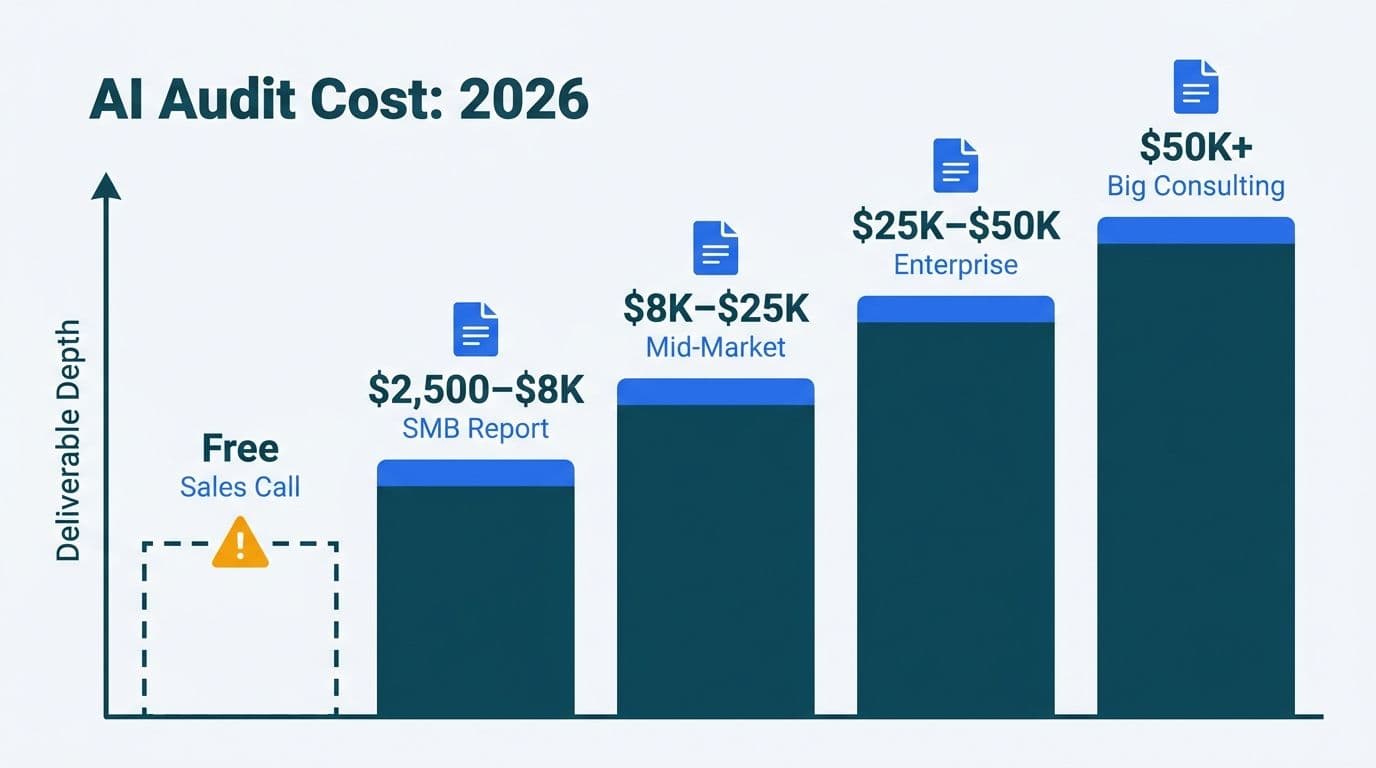
An AI audit costs anywhere from nothing (a free sales call dressed as a strategy session) to six figures at a major consulting firm. For most 20-200 person businesses across the US, UK, and Canada, the realistic range is $2,500 to $50,000. What separates the bands is deliverable depth - and whether the findings are actionable without a follow-on retainer.
Key Takeaways
Free "AI audits" are structured sales calls with no independent deliverable - useful for early discovery, not for analysis.
The SMB tier ($2,500-$8,000) covers one to three processes and delivers a written report with tool recommendations.
Mid-market audits ($5,000-$15,000) span a full department and include a phased roadmap and vendor-neutral comparison.
Enterprise audits ($15,000-$50,000) cross departments, cover integration architecture, and produce board-ready output.
Big 4 and tier-one strategy firms charge $75,000 and above; their value is regulatory standing and stakeholder authority, not analytical depth per dollar.
How Much Does an AI Audit Cost? The Five Real Price Bands
The AI audit market has no standard pricing, no regulated scope, and no credentialing body. Any firm - from a one-person freelancer to a global consultancy - can call a slide deck an "AI audit." That absence of standardisation makes price transparency unusually valuable for buyers.
The table below maps what buyers actually receive at each tier.
| Tier | Typical fee | Who sells it | What you receive |
|---|---|---|---|
| Free / complimentary | $0 | Vendors, SaaS platforms, generalist consultants | 30-60 min discovery call; output is a proposal, not a report |
| SMB boutique | $2,500-$8,000 | Specialist firms, freelancers | 1-3 process reviews, written findings, tool shortlist |
| Mid-market boutique | $5,000-$15,000 | Specialist firms, regional consultants | Department-wide process map, vendor comparison, phased roadmap |
| Enterprise specialist | $15,000-$50,000 | Specialist firms, mid-tier consultancies | Multi-department scope, integration analysis, change-management plan |
| Big 4 / top-tier strategy | $75,000-$250,000+ | Global consulting firms | Full enterprise scope, regulatory sign-off, C-suite presentation layer |
Consider a wholesale distributor in the US Midwest reviewing its order management and purchasing workflows. A mid-market audit at $8,000-$12,000 covers both processes in depth - enough to determine whether a document-AI tool would recover sufficient manual hours to pay back within 12 months. A UK logistics firm managing GDPR-classified customer data faces an additional layer: a competent auditor must map data-residency constraints before recommending any cloud-based extraction tool. A Canadian 3PL operating under PIPEDA encounters the same question around supplier data handling. Geography shapes scope, and scope shapes price.
Our AI readiness assessment (fixed price, 5 days) sits in the mid-market boutique band. The fixed price removes the scope-creep risk common to time-and-materials engagements - you know the cost before the work begins.
What Do Free AI Audits Actually Deliver?
A free AI audit delivers a qualified lead for the firm running it. That is a structural reality, not a criticism.
A vendor-run assessment collects your technology stack, headcount, and stated pain points, then scores you against a readiness framework designed to show that its product closes the gap. Independent findings would undermine the commercial purpose of the exercise. The output is a proposal dressed as a report.
That said, free audits are not worthless if you approach them correctly. Running two or three vendor assessments in parallel surfaces the questions worth asking before you pay a boutique for independent analysis. Treat them as structured discovery, not as findings.
The red flags to watch for:
No written report delivered after the call
All recommended tools belong to the same vendor's portfolio
The findings require a follow-on paid engagement to be actionable
The "roadmap" is a feature list for the vendor's own product
If the output of a free audit would be useful regardless of whether you buy from that vendor, it was probably an honest engagement. If removing the vendor's solution from the picture makes the entire analysis pointless, it was not.
What Does an SMB AI Audit Include at $2,500-$8,000?
At this tier the work is scoped, not broad. A quality SMB audit covers one to three specific processes - typically the ones the buyer identifies as the highest source of manual friction: purchase order processing, customer onboarding, invoice matching, or outbound quoting.
What a quality SMB audit delivers:
A written process map of the current state for each in-scope workflow, including hand-off points and manual steps
Identification of the steps that carry the highest error rate or time cost
A shortlist of two to four tools that address those steps, with a build-vs-buy recommendation
A rough return-on-investment frame - hours saved per month, not a five-year NPV model
A clear statement of what would need to be true before implementation makes sense
What it does not deliver:
Coverage across multiple departments
Change-management planning at the team or leadership level
Integration architecture for complex ERP, WMS, or CRM environments
A defensible board-level business case
For an ops leader at a 30-person ecommerce brand wanting to know whether AI document processing would remove three hours per day from the receiving team, a $5,000 audit answers that question precisely. Pair the findings with an AI automation business case framework for finance leaders to structure the internal approval process.
What Does a Mid-Market AI Audit Cover at $5,000-$15,000?
This is the band where the depth-to-cost ratio is strongest for 20-200 person companies. The scope expands from a single process to a full department - logistics operations, finance, sales operations, or customer service - and the deliverable shifts from a point-in-time snapshot to a sequenced roadmap.
Mid-market audits add the following over the SMB tier:
Full process inventory: every repeatable workflow in the department catalogued, not just the two the client nominated at the start
Data readiness review: an assessment of whether existing data is structured and accessible enough to support AI tooling, or whether a data preparation phase is a prerequisite
Vendor-neutral scorecard: three to five platforms evaluated against the client's specific stack, budget, and implementation capacity - not a generic feature comparison
Phased roadmap: a sequenced plan separating quick wins (four to six weeks) from deeper build-outs (three to six months), with dependencies mapped clearly
Risk register: regulatory, integration, and change-management risks specific to the client's geography and sector
For a UK logistics firm operating under GDPR, a proper mid-market audit maps data flows and identifies where personal data intersects with any proposed AI tool - a step that prevents expensive remediation downstream. For a Canadian manufacturing business subject to PIPEDA, the same data-residency analysis applies to any cloud model-serving environment used in production. Professional services firms that bill by the hour find this tier particularly useful for auditing quoting, scheduling, and document generation before committing to a workflow platform.
What Do Enterprise AI Audits Deliver at $15,000-$50,000?
Enterprise-scope audits cross departmental boundaries. A 150-person non-defense manufacturer might commission an engagement spanning procurement, production scheduling, quality inspection, and finance - four functions with interdependent data flows and separate technology owners who rarely align on priorities.
The additional scope at this tier covers:
Cross-department integration mapping: where data moves between systems, which hand-offs are manual, and where AI automation would require a middleware or integration layer
Change management analysis: a realistic assessment of which teams need retraining, how long adoption cycles take, and what governance structures must exist before deployment
Architecture recommendations: whether to extend an existing ERP or WMS, procure a standalone AI tool, or invest in a middleware layer connecting existing systems
Vendor evaluation support: a shortlist of qualified vendors with evaluation criteria a procurement team can deploy directly in a request-for-proposal process
Board-ready executive output: a prioritised initiative list with estimated investment ranges, realistic payback timelines, and a governance framework
Ecommerce operators who have scaled to 100-200 employees often reach a point where every function has adopted a different SaaS tool and no one has mapped the data flows between them. An enterprise audit at this tier produces the integration picture a COO or CIO needs to make a platform decision with confidence rather than guesswork. If the underlying data infrastructure is a concern, a BI readiness self-assessment provides a useful baseline before the full engagement begins.
When Does a Big 4 Six-Figure AI Audit Make Sense?
At $75,000 and above, the primary product is not analysis - it is authority. A top-tier firm's name on a report carries weight in board rooms, with regulators, and in mergers and acquisitions due diligence. That standing is real, and for some buyers it is worth the premium.
For most 20-200 person companies in distribution, logistics, manufacturing, professional services, or ecommerce, it is not. Several structural reasons explain why.
First, large-firm engagements are typically staffed with junior analysts supervised by a partner whose direct involvement is limited to kickoff and final presentation. The analytical depth at $150,000 is not proportionally greater than at $30,000 - the overhead, stakeholder management layer, and brand premium account for the difference.
Second, the frameworks are built for Fortune 500 complexity. They carry compliance and regulatory overlays - SOX, HIPAA, financial services capital requirements - that a wholesale distributor or 3PL has no use for. Paying for irrelevant scope is not a minor inefficiency; it shapes how the findings are framed and can obscure the decisions that actually matter for a mid-size operation.
Third, the timeline - typically ten to sixteen weeks - is calibrated to multi-stakeholder management in large organisations, not speed-to-decision in a 50-person firm.
When a six-figure audit is justified:
You are raising private equity capital and investors require a named firm's sign-off as part of due diligence
You operate in a regulated sector where a credentialed audit is contractually required by a client or regulator
The audit output will be used in investor materials, regulatory submissions, or public disclosures
Outside those scenarios, the same budget applied to a focused boutique engagement plus early implementation will produce more measurable value in less time.
What Our Fixed-Price AI Audit Costs and What It Includes
The AI readiness assessment (fixed price, 5 days) from Lets Viz sits in the mid-market boutique band. The fixed-price, five-day structure directly addresses the most common problem in this market: scope creep and findings that require a follow-on retainer before they become useful.
The five-day engagement covers:
Days 1-2 - Process discovery: structured interviews with operations, finance, and technology stakeholders; a full inventory of repeatable workflows and the manual steps within each, ranked by time cost and error rate
Day 3 - Data audit: a review of data sources, quality, and connectivity - identifying whether AI tooling can work with current data or whether a preparatory phase is needed first
Day 4 - Tooling and build analysis: a vendor-neutral evaluation of two to four platforms matched to the client's stack, budget, and implementation capacity, with a build-vs-buy recommendation
Day 5 - Roadmap and handoff: a written report with a prioritised action plan, a risk register, and a clear statement of implementation effort for each initiative
The output is a standalone document. It does not require a follow-on retainer to be useful. It does not recommend tools we have a commercial relationship with. The cost is fixed before the engagement begins.
The entire cost SERP for "how much does an AI audit cost" is populated by boutiques at roughly our size. What most of them do not publish is what the work actually covers at each price point. We do, because a buyer who understands what they are purchasing makes a better client and a clearer brief.
For an indicative figure before any conversation, the instant project cost calculator gives a range based on your company size and scope.
---
About Lets Viz: Lets Viz is an analytics and automation consultancy working with operations and finance teams since 2020, with clients spanning US healthcare, UK fintech, Canadian manufacturing, and global SaaS. The firm holds a 5.0 rating on Clutch across multiple service lines and applies a human-review standard to all analytical work - every finding is verified before it reaches a client.
If you want a fixed-price, five-day answer to where AI creates measurable value in your operations, the AI readiness assessment (fixed price, 5 days) is where to start.