Microsoft Fabric Real-Time Analytics vs Stream Analytics
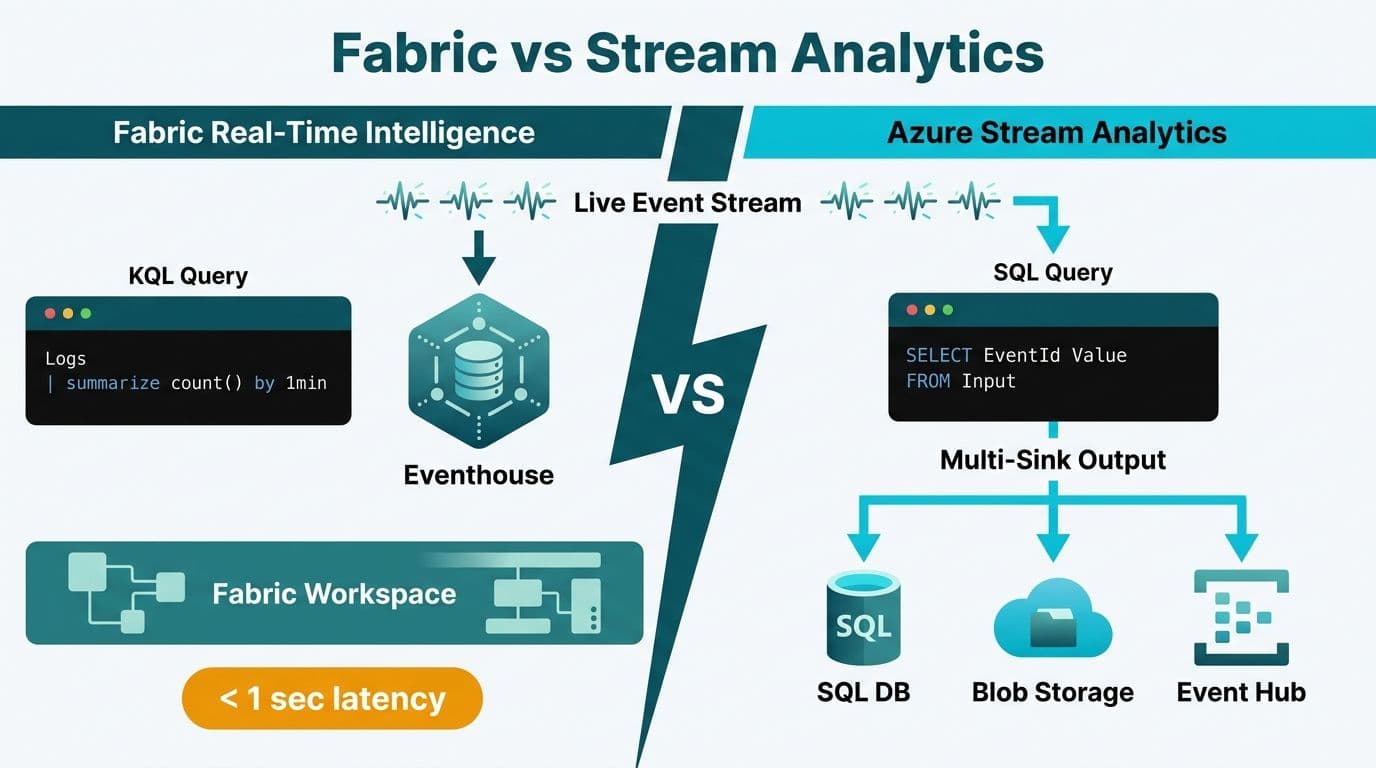
When choosing between Microsoft Fabric real-time analytics and Azure Stream Analytics, the right tool depends on where your processed data needs to land and how your team queries it. Fabric Real-Time Intelligence - powered by KQL and Eventhouse - suits organizations building on a unified Fabric platform. Stream Analytics suits teams that need SQL-based, purpose-built stream processing with output routing to heterogeneous Azure sinks.
Key Takeaways
Fabric Real-Time Intelligence uses KQL and Eventhouse for sub-second analytics natively inside the Fabric workspace - no separate storage tier needed.
Azure Stream Analytics uses SQL-like query logic with mature windowing functions and native IoT Hub integration.
For trading tick data and operational dashboards, Fabric's built-in Power BI integration removes a major pipeline step.
For IoT sensor feeds with multi-sink output requirements, Stream Analytics offers cleaner job-level throughput controls.
Both services carry HIPAA BAA, SOC 2, and GDPR certifications; the governance architecture differs and affects how compliance teams document data flows.
What Is Microsoft Fabric Real-Time Intelligence?
Microsoft Fabric Real-Time Intelligence is the streaming and time-series analytics layer built natively into the Microsoft Fabric unified platform. It centers on Eventhouse, a managed columnar KQL database optimized for high-velocity, time-stamped data. Within the same Fabric workspace, data engineers can ingest through Eventstream - a managed pipeline connecting to Azure Event Hubs, IoT Hub, Apache Kafka, and custom sources - query with KQL, and surface results in Power BI Real-Time Dashboards, all without leaving the Fabric environment.
Teams already invested in Power BI and Fabric consulting workflows will recognize Real-Time Intelligence as a natural extension of the platform: the same OneLake storage layer, the same identity model, and the same capacity-based billing apply across real-time and batch workloads alike.
Key capabilities per Microsoft Fabric documentation (2026):
Eventhouse: columnar KQL store with sub-second query response on time-series data
Eventstream: no-code pipeline for ingesting and transforming live streaming data
Real-Time Dashboards: auto-refresh Power BI visuals at intervals as short as 1 second
KQL Querysets: reusable, workspace-stored query assets for operational teams
Activator: event-driven alert and action engine that fires Power Automate flows, Teams notifications, or custom webhooks when KQL conditions are met on live Eventhouse data - enabling self-contained operational monitoring without a separate alerting service
Eventhouse is architecturally descended from Azure Data Explorer (ADX). Engineers with ADX or Azure Monitor experience transfer their KQL skills directly - a practical advantage for organizations already running Microsoft observability tooling.
What Is Azure Stream Analytics?
Azure Stream Analytics (ASA) is Microsoft's dedicated cloud-native stream processing service, continuously updated for enterprise production workloads. It uses a SQL-like query language - the Stream Analytics Query Language (SAQL) - that most data engineers with a SQL background can learn quickly.
ASA connects natively to Azure Event Hubs, Azure IoT Hub, and Azure Blob/ADLS Gen2, and outputs to a wide range of sinks: Azure SQL Database, Cosmos DB, Power BI streaming datasets, Azure Functions, and Azure Data Lake. This multi-sink capability is central to its value proposition.
ASA runs on a streaming unit (SU) model: capacity is provisioned explicitly per job, and SLA guarantees apply at the job level. For production IoT pipelines where throughput and availability must be controlled independently of other workloads, this job-level isolation is operationally valuable.
ASA's windowing functions are particularly relevant for IoT sensor feeds and trading tick data:
Tumbling windows aggregate over non-overlapping fixed intervals (such as a 1-minute sensor average)
Hopping windows allow overlapping intervals (a 5-minute window advancing every 1 minute)
Sliding windows produce output only when events occur at window boundaries
Session windows group events by activity gaps rather than fixed time intervals
All four types support configurable late-arrival event tolerance - a practical requirement for real-world feeds where sensor clocks drift or network delays are common.
Microsoft Fabric Real-Time Analytics vs Stream Analytics: Core Differences
The most useful frame for evaluating Microsoft Fabric real-time analytics vs Stream Analytics is not which is better but which fits your architecture. Both handle high-velocity data; they differ on integration depth, query model, storage behavior, and operational overhead.
| Dimension | Fabric Real-Time Intelligence | Azure Stream Analytics |
|---|---|---|
| Query language | KQL (Kusto) | SQL-like (SAQL) |
| Data storage | Eventhouse (persistent, columnar) | Output sinks only (SQL, Cosmos, Blob) |
| Ingestion pipeline | Eventstream (managed, no-code) | Event Hubs / IoT Hub (standalone) |
| Power BI integration | Native (same workspace, 1-second refresh) | Via streaming dataset connector |
| Capacity model | Fabric F-SKU (shared with all workloads) | Streaming Units (per-job SU allocation) |
| Windowing functions | KQL time-series operators (`bin()`, `make-series`, `series_decompose`) | Tumbling, Hopping, Sliding, Session |
| Multi-sink output | Limited (connectors required for external) | Native multi-output jobs |
| Compliance governance | Microsoft Purview (workspace-level) | Azure Policy and Monitor (job-level) |
| Skill prerequisite | KQL (or willingness to learn) | SQL proficiency |
| Best for | Unified Fabric platform, operational dashboards | Standalone IoT pipelines, SQL-native teams |
The structural difference that matters most in practice: Fabric Real-Time Intelligence stores data inside the platform in Eventhouse, making it queryable long after the stream closes. Stream Analytics is primarily a processing engine - it transforms data in flight and routes it to output sinks; persistence is the sink's responsibility.
When Should You Choose Fabric Real-Time Intelligence?
Fabric Real-Time Intelligence is the stronger choice when your team is already on the Fabric platform, or when the business requires live dashboards tightly coupled to historical batch data.
Trading tick data and finance dashboards: A US capital markets operations team monitoring intraday position exposures benefits from Eventhouse's ability to blend live stream data with historical price series in a single KQL query. Power BI Real-Time Dashboards refresh at 1-second intervals (Microsoft Fabric documentation, 2026), and the same Fabric workspace hosts the historical fact tables - enabling cross-temporal queries that would require multiple services in a Stream Analytics architecture.
Healthcare operational monitoring: A US health system tracking ICU patient vitals can ingest device sensor feeds through Eventstream and render live charge-nurse dashboards while the same Eventhouse serves as the compliance data lake for HIPAA audit queries. Because all data stays within OneLake under Microsoft Purview governance - explained in the Microsoft Fabric OneLake Explained guide - HIPAA BAA coverage applies uniformly across real-time and historical data, simplifying Business Associate Agreement scope.
Teams without dedicated DevOps capacity: Eventstream's managed connectors - including native change data capture (CDC) sources for Azure SQL Database, PostgreSQL, and MySQL - mean no streaming units to size and no ASA jobs to version and deploy independently. Operational database changes and event-hub feeds can be unified in one Eventstream topology without standing up a separate Debezium cluster. Capacity scales with the Fabric F-SKU already paying for Power BI and Data Factory workloads.
KQL-native organizations: Teams running Azure Monitor, Application Insights, or Azure Data Explorer already have KQL fluency. Fabric Real-Time Intelligence is the ADX successor surface inside Fabric; the language, syntax, and time-series mental model transfer directly.
When Should You Choose Azure Stream Analytics?
Stream Analytics earns its place when the streaming pipeline stands alone - because downstream systems are outside Fabric, or because the team needs explicit, job-level throughput guarantees.
Industrial IoT sensor feeds: A Canadian manufacturing company running thousands of sensors across multiple plants typically routes telemetry through Azure IoT Hub. Stream Analytics processes that feed at the IoT Hub level, applies windowed aggregations, and writes anomaly alerts to Azure SQL where the SCADA team's existing toolchain reads them. For PIPEDA compliance, the job-level regional deployment makes it straightforward to demonstrate that personal operational data remains within Canada Central or Canada East.
SQL-native data engineering teams: A UK fintech firm whose data engineers live in T-SQL and have built CI/CD pipelines around Azure DevOps can deploy and version ASA jobs using ARM templates or Bicep - mature infrastructure-as-code patterns the team already operates. For GDPR-regulated data flows, ASA's job-level regional boundaries make it easier to document in a Data Protection Impact Assessment that specific streams are processed within EU regions under GDPR Article 44 transfer rules. The GDPR Compliant SaaS Financial Reporting checklist covers complementary BI-layer controls that work alongside either streaming architecture.
Multi-sink output requirements: When a single stream must simultaneously write to Azure SQL, Cosmos DB, and a Power BI streaming dataset, ASA handles all three outputs from one job definition. Routing to heterogeneous external sinks from Fabric Real-Time Intelligence requires additional pipeline steps.
Existing ASA investment: Organizations with production ASA jobs that have tuned SU allocations and Azure Monitor alert rules should weigh migration cost carefully. The Fabric vs Synapse vs Databricks TCO breakdown covers analogous migration economics for batch workloads - the cost-benefit logic applies equally here.
How Do Compliance Requirements Shape the Architecture Choice?
Both services carry the certifications mid-market organizations in the US, UK, and Canada require: HIPAA BAA, SOC 2 Type II, ISO 27001, and GDPR-ready data processing agreements. The distinction is governance architecture, not certification status.
US healthcare (HIPAA): Covered entities need documented data flows and access controls over protected health information. Fabric Real-Time Intelligence's advantage is that Eventhouse sits inside the same Fabric workspace as the rest of the data estate, governed by Microsoft Purview policies, row-level security, and workspace-level audit logs. A US hospital system can demonstrate a single governance perimeter for both streaming and historical data. With Stream Analytics, protected data flows through an additional service boundary - manageable, but a larger audit surface.
UK and EU (GDPR): GDPR Article 44 requires appropriate safeguards for personal data transferred outside the EEA. ASA's job-level regional deployment makes it straightforward to assert that a specific job runs in West Europe and data does not leave that region. Fabric's regional deployment operates at the capacity level, so all workloads on that capacity inherit the same region. Either approach satisfies GDPR; ASA's granularity makes Data Protection Impact Assessment documentation more explicit for data protection officers.
Canada (PIPEDA and Law 25): Both services can be deployed in Canada Central or Canada East. Fabric's Purview integration provides a data catalog and lineage view that simplifies PIPEDA accountability requirements - mapping where personal data flows, who processes it, and how long it is retained, which directly addresses Quebec's Law 25 accountability obligations.
Decision Framework: Which Tool Should Your Team Choose?
Three questions point to a clear recommendation for most mid-market teams.
1. Where does your data land after streaming? If the answer is Power BI dashboards and a unified data lake, Fabric Real-Time Intelligence eliminates pipeline hops. If the answer is Azure SQL, Cosmos DB, or a third-party system, Stream Analytics routes there natively.
2. What is your team's query language baseline? SQL fluency maps to Stream Analytics. KQL fluency (or an ADX background) maps to Fabric Real-Time Intelligence. For a team shipping within six weeks, language familiarity is the practical tiebreaker.
3. Do you need real-time processing in isolation or as part of a unified analytics platform? Stream Analytics excels as a purpose-built processing layer. Fabric Real-Time Intelligence excels as one layer in a Fabric-native architecture that also covers data pipeline orchestration and copy activities, semantic models, and Power BI reporting.
Use Case Matrix
| Use Case | Recommended Tool | Primary Reason |
|---|---|---|
| IoT sensor feed to Azure SQL | Azure Stream Analytics | Native IoT Hub connector; SQL sink |
| Trading tick data with Power BI dashboards | Fabric Real-Time Intelligence | 1-second refresh; KQL time-series |
| Healthcare operational monitoring (HIPAA) | Fabric Real-Time Intelligence | Unified Purview governance |
| GDPR-scoped stream per data category | Azure Stream Analytics | Job-level EU-region isolation |
| Multi-sink output (SQL + Cosmos + blob) | Azure Stream Analytics | Native multi-output job definitions |
| Fabric-native unified data platform | Fabric Real-Time Intelligence | Single capacity; single workspace |
| PIPEDA compliance audit trail | Fabric Real-Time Intelligence | Purview catalog and lineage |
Suppose a 30-person data team at a mid-market US insurance company processes claims adjudication events in real time and surfaces results in Power BI dashboards for operations leads. If Fabric is already the data platform, Fabric Real-Time Intelligence reduces service count and governance overhead. If the team runs Azure-native microservices with Event Hubs as the backbone and needs outputs to three downstream systems, Stream Analytics is the cleaner fit.
Neither tool makes the other obsolete. Many organizations run Stream Analytics for edge-facing IoT pipelines and Fabric Real-Time Intelligence for the analytics and dashboard layer that consumes the processed output - a layered architecture that plays to each service's strengths.
---
About Lets Viz: Lets Viz is a data analytics and BI consulting firm serving US healthcare systems, UK fintech companies, Canadian manufacturing organizations, and global SaaS businesses since 2020. The firm holds a 5.0 Clutch rating and specializes in Microsoft Fabric, Power BI, and modern data stack architecture - helping mid-market teams deliver production analytics without enterprise-scale headcount.
If your organization is evaluating Microsoft Fabric Real-Time Intelligence or Azure Stream Analytics as part of a broader data platform strategy, the Power BI and Fabric consulting team at Lets Viz can assess your architecture, query patterns, and compliance requirements to recommend the right path forward.