AI Use Cases for Wholesale Distribution: What Works
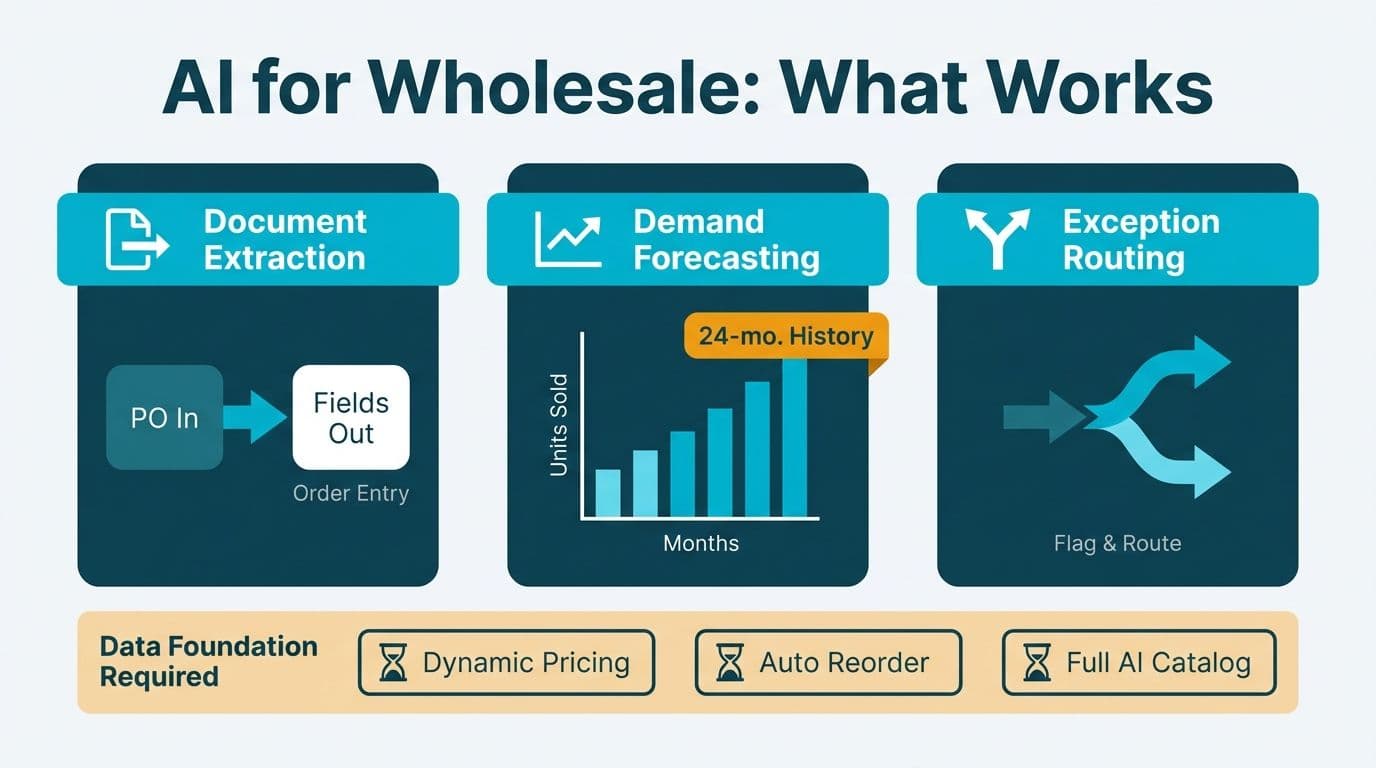
The AI use cases that deliver real results in wholesale distribution are narrower than vendor decks suggest: document extraction, demand forecasting from clean transactional history, and exception routing. Everything else depends on data infrastructure most mid-market distributors do not yet have. The honest starting point is knowing which category you fall into before you buy anything.
Key Takeaways
AI document extraction cuts order-entry re-keying today with minimal data preparation required.
Demand forecasting requires at least 18-24 months of clean, item-level sales history with consistent SKU identifiers.
Invoice matching is the highest-ROI back-office use case for distributors billing on variable terms.
"Autonomous" procurement and carrier-selection tools require structured supplier data most mid-market operations cannot yet provide.
A structured readiness assessment identifies which use cases your actual data supports - before you purchase a platform.
What AI Use Cases for Wholesale Distribution Actually Deliver Results?
The working use cases share one trait: input documents are structured enough that a model can extract fields reliably. Purchase orders arrive as PDFs or EDI files with consistent field positions. Invoices follow vendor-specific templates. Delivery confirmations carry BOL numbers that map to existing shipment records. These structured inputs are where AI earns its keep.
Document extraction - sometimes marketed as intelligent document processing - uses optical character recognition combined with large language model parsing to pull vendor name, PO number, line items, quantities, and prices from inbound documents and write them directly into the ERP or TMS. A distributor handling 400 inbound vendor invoices per week can redirect the staff who previously re-keyed those invoices toward exception handling and vendor dispute resolution instead.
Demand forecasting works when the underlying data is clean. A US food-service distributor with two years of item-level sales history, consistent product identifiers, and promotional calendars tagged in the system can run a statistical or ML-based forecast that outperforms the spreadsheet projections most mid-market operations still rely on. The same tool fed fragmented SKU histories and untagged promotions produces confident-sounding wrong answers.
Exception routing - flagging orders outside normal parameters (credit hold, out-of-stock substitution, unusual quantity, new ship-to address) and queuing them for human review - is one of the least glamorous but most reliable AI applications in distribution. Rules-based exception engines have done this for years; LLM-based classification now handles the ambiguous middle cases that rigid rules miss.
Before evaluating any platform for these use cases, an AI readiness assessment (fixed price, 5 days) is the fastest way to find out whether your transactional data is clean enough to feed a model - or whether a data-cleanup sprint needs to come first.
What Data Prerequisites Does Each AI Use Case Actually Need?
This is the section vendor decks leave out. Each working use case has a minimum data condition; below it, the tool either fails silently or produces confident-sounding wrong answers.
| AI Use Case | Minimum Data Prerequisite | Common Gap in Mid-Market Distributors |
|---|---|---|
| Document extraction (invoices, POs) | Consistent PDF or EDI format per vendor; ERP fields mapped | Vendor sends Excel attachments; no ERP field mapping |
| Demand forecasting | 18-24 months item-level history, consistent SKU IDs | SKUs remapped at ERP migration; history fragmented |
| Exception routing | Business rules defined in structured, queryable form | Rules exist in people's heads, not in the system |
| Freight audit automation | Carrier invoices in standard format (EDI 210 or PDF) | Carrier sends scanned paper invoices |
| Automated PO matching | Structured 3-way match: PO, goods receipt, invoice | Goods receipts not recorded in ERP; done on paper |
| Supplier lead-time prediction | Historical PO-to-receipt timestamps per supplier | Receipts logged inconsistently or not at all |
The table above reflects what we see in actual distributor back offices, not what a vendor demo environment is pre-loaded with.
How Does AI Invoice Matching Work for Distributors and 3PLs?
AI invoice matching compares inbound supplier invoices against purchase orders and goods receipts to flag discrepancies before payment. For distributors billing on variable terms - weight-based pricing, quantity brackets, freight surcharges, fuel adjustments - this is the highest-ROI back-office application available today.
The process works as follows. An extraction layer reads the inbound invoice (PDF, EDI 810, or scanned document). A matching layer compares extracted fields against the corresponding PO in the ERP. A classification layer categorizes discrepancies: price variance, quantity variance, duplicate invoice, missing PO reference, or within-tolerance. Exceptions above tolerance route to the payables team; clean matches auto-post.
The prerequisite is a 3-way match framework already defined in your ERP - purchase order, goods receipt, and invoice. If goods receipts are not recorded in the system (a common gap at distributors where receiving is done on paper or in a separate WMS with no ERP integration), the matching layer has nothing to compare against and the tool adds no value beyond basic document capture.
For UK and EU distributors, GDPR considerations apply to any supplier invoice data flowing through a cloud-based extraction service. Standard data processing agreements cover most cases, but verify that invoice data containing personal names or bank details is handled under an adequate transfer mechanism if processing occurs outside the EEA. Canadian distributors operating under PIPEDA should apply the same scrutiny to any cross-border data transfers involving supplier records.
A detailed process walkthrough of accounts-payable automation is covered in our AI Automation for Accounts Payable guide.
Which AI Use Cases for Order Entry Actually Reduce Re-Keying?
Automated order capture addresses the most common back-office complaint in wholesale distribution: customer orders arrive by email, fax, or customer portal in formats the ERP cannot ingest directly, so someone re-keys them.
An LLM-based order capture layer reads the inbound email or PDF, extracts customer account, ship-to address, requested items (by customer part number, distributor SKU, or description), quantities, and requested delivery date, then creates a draft order in the ERP for review - or routes it directly if confidence is high. The system flags orders where it cannot match the customer's part number to a distributor SKU, because that ambiguity exists in the data, not just in the training set.
The critical prerequisite is a clean customer-SKU cross-reference table. If the same product has been sold under three different SKUs across two ERP migrations, the AI will confidently pick one and be wrong a significant fraction of the time. Cleaning the cross-reference table is the actual prerequisite; the AI tool is the second step.
Suppose a 60-seat Canadian distributor handles 200 emailed orders per day, each taking four minutes to re-key. An order capture tool that handles 70 percent of those automatically - the clean, repeat-customer orders with known SKUs - frees over nine staff-hours per day for exception handling, customer service, and vendor management. The 30 percent requiring human review are the genuinely complex cases that needed human judgment anyway.
For a framework on building the business case for this kind of automation, see our AI automation ROI guide for finance leaders.
What AI Vendor Promises Don't Survive Contact with Real Distributor Data?
Several AI use cases dominate vendor marketing but consistently underdeliver in mid-market wholesale distribution because the required data infrastructure does not exist in most operations.
"Autonomous" procurement optimization - tools that claim to automatically reorder, negotiate spot buys, and optimize supplier allocation - requires structured supplier scorecards, consistent lead-time data, and clean on-hand inventory records. Most distributors have inventory data; they rarely have supplier performance data in structured, queryable form.
Predictive customer churn requires a consistent customer master, clean transactional history linked to named contacts, and enough volume per customer to build a reliable signal. A distributor with 200 active accounts and average customer tenure of eight years does not have a churn-prediction problem; they have a relationship-management problem that CRM handles better than ML.
Real-time dynamic pricing is sold as an AI use case but is actually a pricing-strategy change that requires pricing governance, ERP integration, and customer contract management before the AI layer adds any value. Distributors with complex contract pricing - different tiers per customer, contract-locked prices, promotional calendars - need to rationalize the pricing master first.
Autonomous carrier selection in 3PLs and freight brokerages requires lane-level rate history, structured carrier scorecards, and shipper requirements in a format the tool can ingest. Many freight brokerages still manage carrier relationships in spreadsheets and email threads. The AI cannot optimize what is not yet structured.
The pattern is consistent: the vendor demo works because the demo data is clean. Knowing whether your data is demo-clean or production-messy is exactly what a structured readiness assessment surfaces - and our AI readiness assessment (fixed price, 5 days) returns that answer in five business days.
What to Evaluate in an AI Platform Before You Buy
Once you have confirmed the data prerequisites are met for a specific use case, platform evaluation follows. For back-office wholesale distribution, four criteria matter more than feature count.
ERP connectivity - does the platform have a native connector to your ERP (NetSuite, SAP Business One, Microsoft Dynamics 365, SYSPRO, Acumatica) or does integration require custom API development? Custom API work is not a disqualifier but it adds cost and timeline. Ask the vendor for a live demo against a system identical to yours, not a pre-loaded sandbox.
Confidence scoring and human-in-the-loop design - every extraction and matching tool should expose a confidence score per extracted field and route low-confidence records to human review. A tool that silently auto-posts low-confidence invoice matches is more dangerous than no automation at all, because errors compound quietly and accumulate before anyone notices.
Audit trail - for US companies under Sarbanes-Oxley controls, UK companies under FRC reporting standards, or Canadian companies under ASPE, every automated ERP posting needs a complete, exportable audit trail: what the AI extracted, what it matched against, and what threshold triggered the auto-post. Verify this capability before signing a contract.
Vendor stability and reference customers - the AI platform market at the back-office layer is consolidating. Prefer platforms with established ERP partnership programs and active customer references in wholesale distribution specifically. A vendor whose reference customers are all in professional services has not solved the same data problems your operation faces.
For a structured approach to evaluating automation platforms, our guide to choosing an AI workflow automation platform covers the full decision framework.
When Should a Distributor or 3PL Commission an AI Readiness Assessment?
The right time is before purchasing any AI platform - not after a six-month implementation that surfaces data problems the vendor's sales engineer never asked about.
Specific triggers that indicate a readiness assessment is the next step:
You are evaluating an AI platform and the vendor has not asked to see a data sample before scoping the project.
You have had a failed or stalled automation project where the tool worked in the demo but could not be trained on your actual order or invoice data.
You are post-ERP migration and unsure whether the migrated data is reliable enough to use as a training set.
Your leadership is asking for AI ROI projections but no one in the organization can describe what the input data actually looks like.
A UK freight brokerage automating carrier invoice reconciliation under GDPR-compliant data handling, and a US distributor benchmarking against SOC 2 audit requirements, face the same first question: is the underlying data structured and consistent enough to feed a model? That question has a definite answer - and finding it before the platform purchase saves the cost of the platform itself.
A Real Data Quality Warning From the Back Office
A silent join failure, an inconsistent field, or a date range that excludes edge cases affects wholesale distribution reporting constantly. AI tools layered on top of flawed data do not fix the flaw; they automate it at scale. The data audit comes before the AI purchase, not after.
For organizations earlier in the analytics maturity curve, our guide on connecting AI workflow automation to Power BI covers how automation outputs feed into your existing reporting stack.
---
About Lets Viz: Lets Viz has delivered analytics and AI automation implementations for clients in US wholesale distribution, UK fintech, Canadian manufacturing, and global SaaS since 2020. Our team holds a 5.0 rating on Clutch across data engineering, business intelligence, and back-office automation engagements. We help operations and finance leaders identify which AI use cases their data infrastructure actually supports - and which ones require a cleanup sprint first.
If your operations or finance team is evaluating AI for back-office workflows, the AI readiness assessment (fixed price, 5 days) delivers a prioritized use-case roadmap in five business days, based on your actual data - not a vendor's demo environment.