AI Automation Business Case for Finance Leaders: ROI Framework
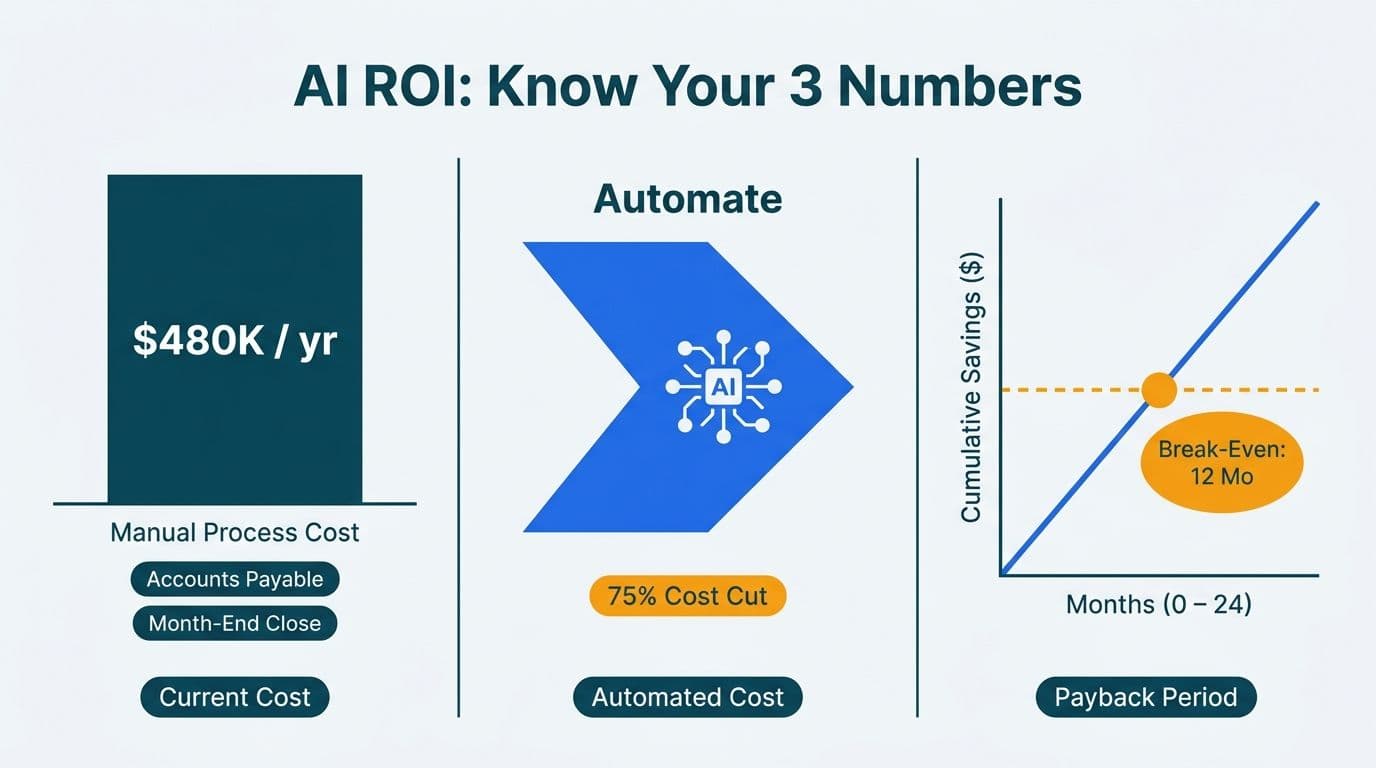
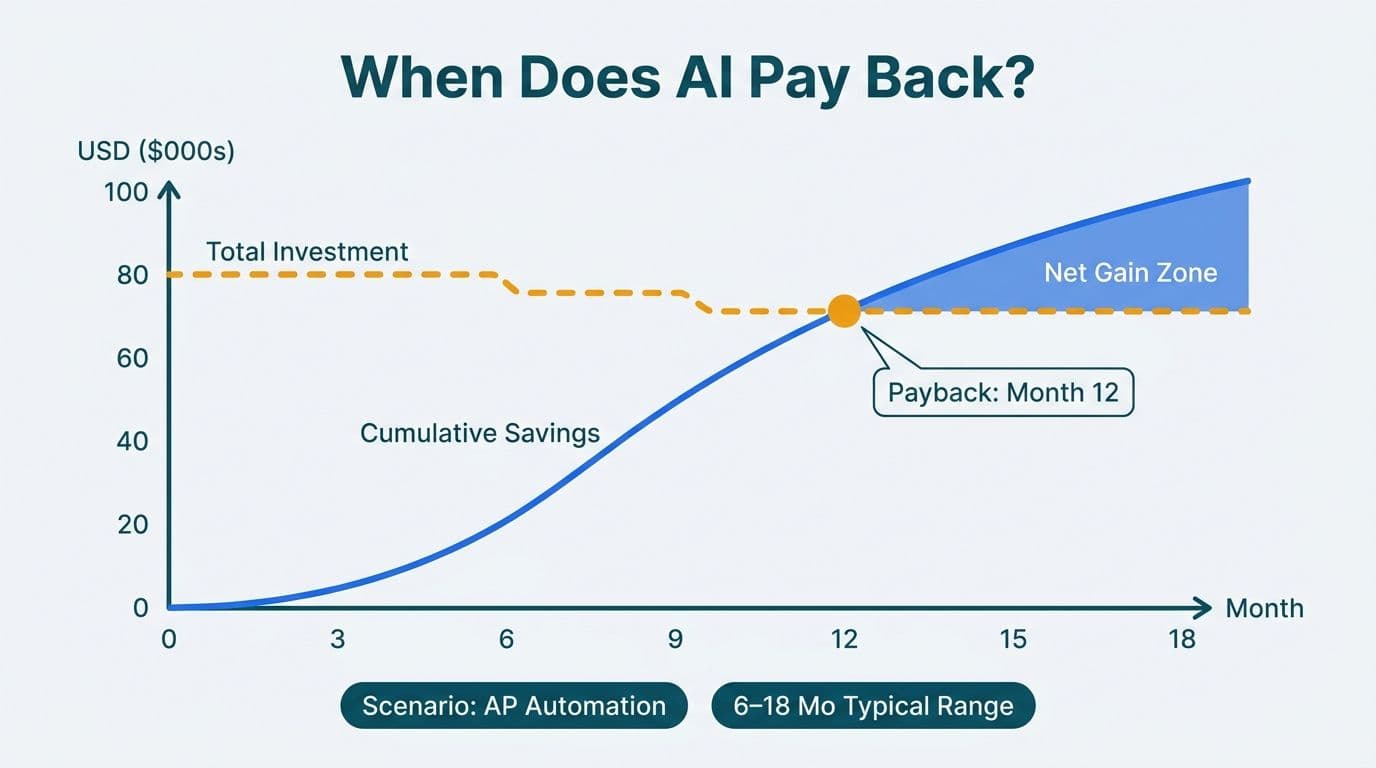
An AI automation business case for finance leaders rests on three numbers: what the manual process costs today, what it will cost after automation, and how long before the investment pays back. For mid-market finance teams in the US, UK, and Canada, payback periods for high-volume processes like accounts payable and month-end close typically fall between six and eighteen months, depending on transaction volume and integration complexity. The most credible board presentations anchor ROI to process-level benchmarks, not aggregate technology promises.
Key Takeaways
- Start with the highest-volume, rules-adjacent processes: accounts payable, invoice extraction, and expense management automation typically deliver the shortest payback periods
- AI automation and RPA are not the same - RPA automates fixed rule-based steps; AI handles unstructured data, exceptions, and variable document formats
- A credible payback model must include implementation cost, licensing, and change management - not just headcount reduction
- Compliance framing matters for board approval: HIPAA and SOC 2 for US healthcare and finance, GDPR for UK and EU operations, PIPEDA for Canadian organizations
- Verify outcomes against source systems - a task marked complete in a workflow log is not the same as a verified business result
What Finance Workflows Should Teams Automate with AI First?
Sequencing is the most important decision in any AI automation program. The wrong first project - one that is technically ambitious but operationally marginal - erodes board confidence before the technology proves itself.
Finance teams typically get the fastest payback from processes that are high-volume, document-heavy, and currently dependent on repetitive human review. The strongest candidates are accounts payable processing, invoice data extraction, expense report validation, and bank statement reconciliation. These four processes share a structural trait: they involve extracting structured data from semi-structured or unstructured inputs - PDFs, scanned documents, email attachments - matching it against existing records, and routing exceptions. That is precisely where AI models outperform rule-based tools.
The general principle from our AI automation consulting practice: prioritize the workflow where the exception rate is already lowest. A process that is 90% rules-based with 10% human judgment is a better first project than one that is 50-50. This limits the blast radius of early model errors and produces a clean ROI story that supports the business case for the next phase.
Geographic context shifts the prioritization. For a US healthcare finance team managing high claim volumes under HIPAA, accounts payable automation often produces the fastest compliant win because vendor invoices are generally outside protected health information scope. For a UK fintech firm operating under GDPR, ai expense management automation with a documented data retention policy is often the cleanest entry point. A Canadian manufacturing company with cross-border procurement under PIPEDA may prioritize invoice extraction first to manage the complexity of multi-jurisdiction supplier documents.
How Do You Build an AI Automation Business Case for Finance Leaders?
A credible AI automation business case for finance leaders follows a structured cost-benefit model that a CFO or audit committee can challenge and stress-test. The framework has four steps.
Step 1 - Baseline the current process cost. Calculate the fully loaded cost of the manual process: staff hours per transaction, error rate and rework cost, cycle time delay cost, and compliance risk exposure. Suppose a 10-person accounts payable team processes 5,000 invoices per month at a fully loaded cost of $80,000 per FTE annually. If each invoice takes 12 minutes of human review, the baseline cost is approximately $2.00 per invoice in direct labor - before error correction or exception handling.
Step 2 - Estimate post-automation cost. AI-assisted processing shifts most of the 12 minutes to machine time. Human review becomes exception-only. The cost model converts from per-invoice labor to a platform licensing fee plus a fraction of FTE time for oversight. The cost-per-invoice falls materially even when the automation handles only 70% of invoices fully automatically.
Step 3 - Calculate the payback period. Payback period = Total implementation cost divided by monthly net savings. Implementation cost must include software licensing, integration build, data mapping, user acceptance testing, and change management. Omitting change management - the time and cost of retraining staff and redesigning roles - is one of the most common errors in finance automation business cases and routinely causes payback estimates to miss by 30-50%.
Step 4 - Present three scenarios. Give the board a conservative case (50% of target automation rate achieved in Year 1), a base case (75%), and an optimistic case (90%+). This demonstrates that you have stress-tested the assumptions and gives the board a defensible range within which to approve the investment.
For a broader view of when to bring in external expertise versus building in-house, see When to Outsource Finance Analytics Consulting: A CFO Guide.
RPA vs AI Automation for Finance Teams: Which Delivers Better ROI?
Presenting RPA vs AI automation for finance teams as interchangeable technologies is one of the most common errors in technology business cases. It leads to scope mismatches, missed savings, and cost overruns when the selected tool cannot handle actual input complexity.
| Dimension | RPA | AI Automation |
|---|---|---|
| What it handles | Fixed, rule-based steps with structured inputs | Variable, unstructured inputs: PDFs, emails, scanned documents |
| Exception handling | Breaks or routes to human | Classifies, interprets, and handles exceptions autonomously |
| Maintenance burden | High - brittle to UI and format changes | Lower - model-based, not screen-scrape dependent |
| Best finance use case | Fixed-format data entry, structured report generation | Invoice extraction, expense categorization, anomaly detection |
| Typical implementation | 4-8 weeks per process | 8-16 weeks including model training and testing |
| ROI profile | Faster initial deployment | Higher ceiling on savings at scale |
The practical guidance: RPA is right for what is already structured; AI is right for what requires interpretation. Most mid-market finance teams deploy both. RPA moves data between systems; AI determines what the data means before it moves. A typical AP automation pipeline uses AI to extract and classify invoice fields, then RPA to post validated entries into the ERP - each tool doing what it does best.
How AI Extracts Data from Invoices and Automates Accounts Payable
Understanding how AI extracts data from invoices and financial documents is essential for any finance leader presenting this technology to a board, because it clarifies both the capability ceiling and the risk profile.
Modern AI-based document processing combines optical character recognition, named entity recognition, and large language model inference to extract structured fields - vendor name, invoice number, line items, amounts, due dates, and tax codes - from any document format. Unlike template-based extraction tools that require a separate configuration per supplier, AI models generalize across layouts after training on a representative document set. A new supplier's invoice format does not require a new template; the model infers the structure.
In practice, how to automate accounts payable with AI means the finance team handles exceptions rather than routine extraction. Ambiguous fields, amounts that do not match a purchase order, or invoices in unsupported formats are routed to a reviewer with extracted fields pre-populated - reducing review time even for cases that require human judgment.
Compliance considerations are non-optional at the board level. For a US healthcare organization subject to HIPAA, vendor invoices adjacent to protected health information must be processed within SOC 2 certified infrastructure or a cloud environment satisfying Business Associate Agreement terms. For UK and EU organizations under GDPR, the automation pipeline requires a documented data retention schedule - AI systems must not retain personally identifiable information from invoices beyond the period required by policy. For Canadian organizations under PIPEDA, similar consent and retention obligations apply to any supplier data that includes personal information.
A one-page compliance matrix covering data elements, processing location, and retention governance belongs in every board presentation. The AI Automation Compliance Checklist for Finance Teams provides a structured starting framework.
How to Automate Month-End Financial Close and Account Reconciliation
AI automation for month-end financial close targets the most time-compressed part of the finance calendar. A five-to-ten-day close cycle at a mid-market company carries real costs: overtime, external consultant fees, and the elevated error risk that comes with deadline pressure.
The automation opportunity in month-end close sits at three points. First, data aggregation - pulling trial balances, sub-ledger feeds, and intercompany eliminations from multiple systems into a consolidated view. Second, AI automation for account reconciliation - matching general ledger balances against bank statements, AR aging reports, and AP subledgers to identify open items and timing differences. Third, variance analysis - flagging material variances across periods and drafting explanatory commentary for management review.
Account reconciliation is particularly well-suited to AI because it is fundamentally a matching problem with exceptions. AI models can match transactions across datasets, learn which mismatches are systematic - currency translation differences, cut-off timing - versus genuinely anomalous, and prioritize the reviewer's attention on the exceptions that carry financial risk.
A realistic first-year expectation: the automation will handle 60-80% of reconciliation matches without human intervention. The match rate improves as the model accumulates transaction history and the finance team builds trust in its outputs - typically reaching 85-90% in the second year of a well-implemented program.
For a UK fintech with multi-currency books and IFRS reporting obligations, AI-assisted variance explanation across dozens of accounts reduces the manual commentary drafting burden considerably. A Canadian manufacturing company managing intercompany eliminations across provincial entities can use AI to flag elimination mismatches before they reach the consolidation stage - catching errors earlier when they are less costly to correct.
See Generative AI Use Cases in Finance: 10 Real Applications for additional close-cycle automation patterns.
What Payback Period Should Finance Leaders Expect by Process?
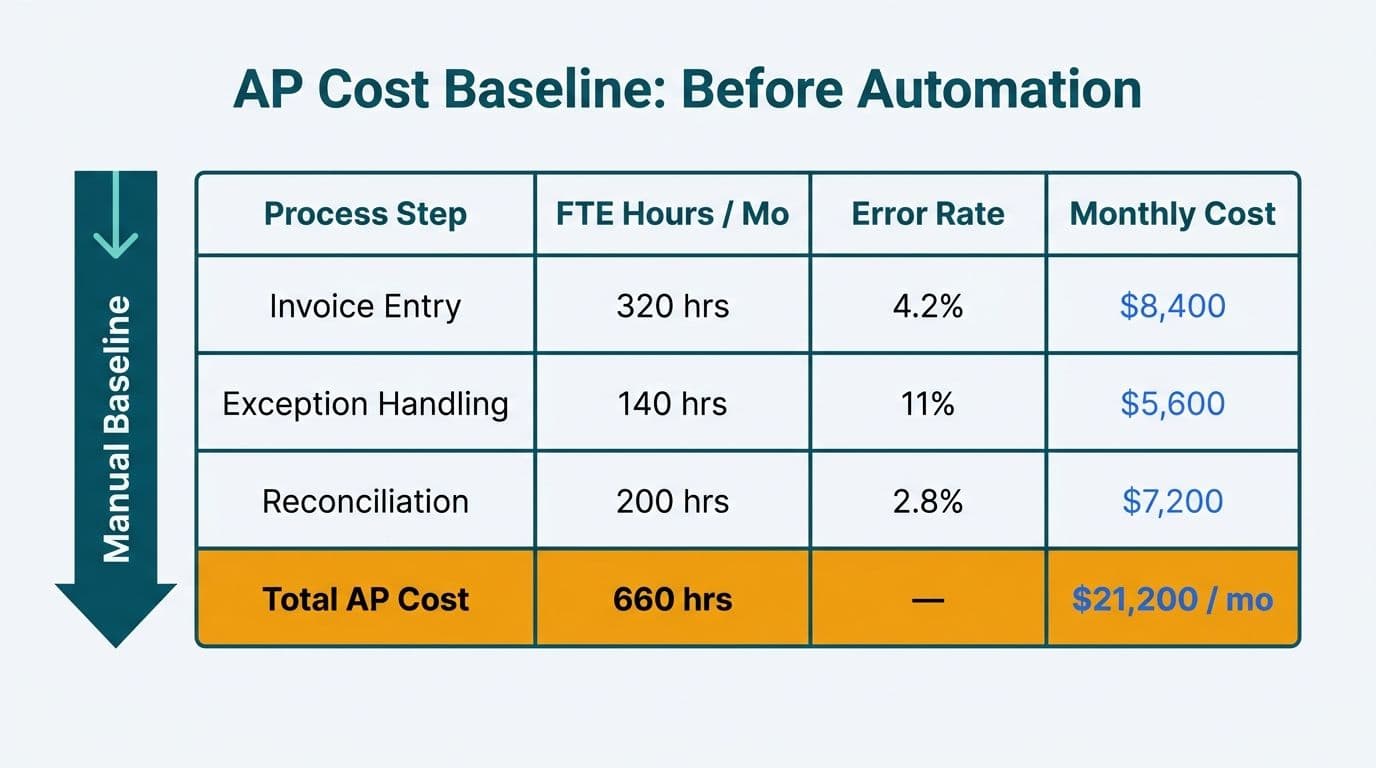
The table below provides illustrative payback ranges for common finance process automations at mid-market scale (organizations with 50-500 employees). Actual payback depends on transaction volume, existing system integrations, and the fully loaded cost of the current manual process.
| Process | Typical Implementation Cost (USD) | Estimated Monthly Net Savings | Illustrative Payback Period |
|---|---|---|---|
| Invoice data extraction (AP) | $30,000 - $60,000 | $8,000 - $18,000 | 4 - 8 months |
| Expense report automation | $20,000 - $45,000 | $5,000 - $12,000 | 4 - 9 months |
| Bank reconciliation | $25,000 - $50,000 | $6,000 - $14,000 | 4 - 9 months |
| Month-end close acceleration | $50,000 - $120,000 | $10,000 - $25,000 | 5 - 12 months |
| Financial reporting automation | $60,000 - $150,000 | $12,000 - $30,000 | 5 - 12 months |
| Full AP process end-to-end | $80,000 - $180,000 | $15,000 - $40,000 | 5 - 12 months |
*These are illustrative ranges, not guaranteed outcomes. Costs in USD. UK and EU implementations may carry GDPR compliance overhead of 10-20% on implementation cost. Canadian implementations under PIPEDA may require additional data mapping work where supplier data includes personal information.*
Three variables move payback periods most significantly. Transaction volume is the strongest lever - higher volume compresses payback because savings scale with transactions while implementation cost does not. Integration complexity is the most consistently underestimated cost - legacy ERP environments require significantly more integration work than modern cloud-native platforms. Exception rate is the most commonly overestimated saving - processes with high exception rates require more human-in-the-loop design, reducing automation-driven savings particularly in early phases.
How Should CFOs and Boards Frame AI Automation Risk?
Risk framing is where most finance automation business cases lose board approval - not because the ROI case is weak, but because the risk section is absent or too vague to inspire confidence.
A credible risk framework covers four categories.
Operational risk addresses what happens when automation produces incorrect outputs at scale. The answer must include a defined exception-handling process, a reconciliation check against source systems, and a clear escalation path. Our own experience with AI-assisted workflows makes this concrete: we once had 26+ auto-generated site-performance fix tasks marked resolved in the system while Google's Core Web Vitals report stayed flat at 405 flagged URLs. Resolved, it turned out, meant a human had read the recommendation - not that any code had shipped. The lesson applies directly to finance automation: agents must verify outcomes against source systems, not just confirm that a task moved through the workflow.
Model risk covers the tendency of AI models to produce confident-sounding errors on edge cases - unusual document formats, transactions outside the training distribution, or ambiguous supplier data. Finance leaders should require a documented accuracy baseline tested on real historical data before production deployment, a defined retraining schedule, and a process for flagging systematic errors when they surface in reconciliation outputs.
Compliance and data risk maps directly to jurisdiction. HIPAA and SOC 2 apply to US healthcare and finance contexts. GDPR governs UK and EU operations. PIPEDA applies to Canadian organizations. The board presentation should include a one-paragraph compliance summary per applicable jurisdiction, reviewed by legal counsel or a qualified compliance officer before it goes to the board.
Change management risk is consistently underweighted. Automation that functions technically but faces resistance from the finance team produces zero ROI until adoption is resolved. Budget for role redesign, training, and a parallel-run period where humans and automation operate simultaneously. That parallel-run period also provides the most valuable opportunity to validate accuracy against a known baseline before fully removing the manual process.
For a detailed regulatory map across jurisdictions, the AI Compliance Requirements for Financial Services: 2026 Regulatory Map covers the current enforcement landscape.
---
About Lets Viz: Lets Viz has designed and delivered data analytics and AI automation engagements for US healthcare systems, UK fintech firms, Canadian manufacturing companies, and global SaaS organizations since 2020. The firm holds a 5.0 rating on Clutch, built on engagements that tie automation recommendations to measurable financial outcomes. The frameworks in this article reflect the business case structures we use when preparing AI automation proposals for CFO and board review.
If you are building an AI automation business case and need process-specific cost benchmarks, a payback model calibrated to your transaction volumes, or a compliance matrix for your jurisdiction, AI automation consulting is where we start - with a process audit and a board-ready framework.