How to Choose an AI Workflow Automation Platform (2026)
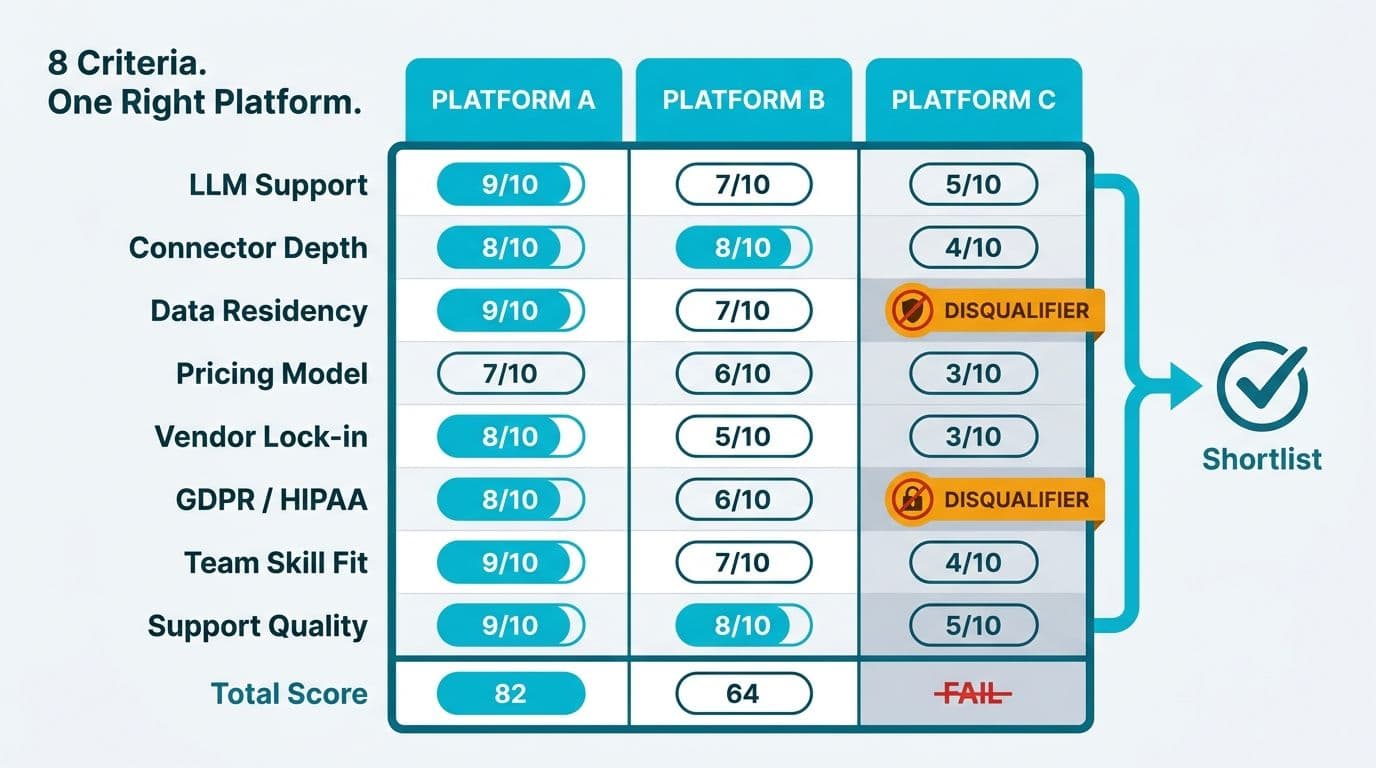
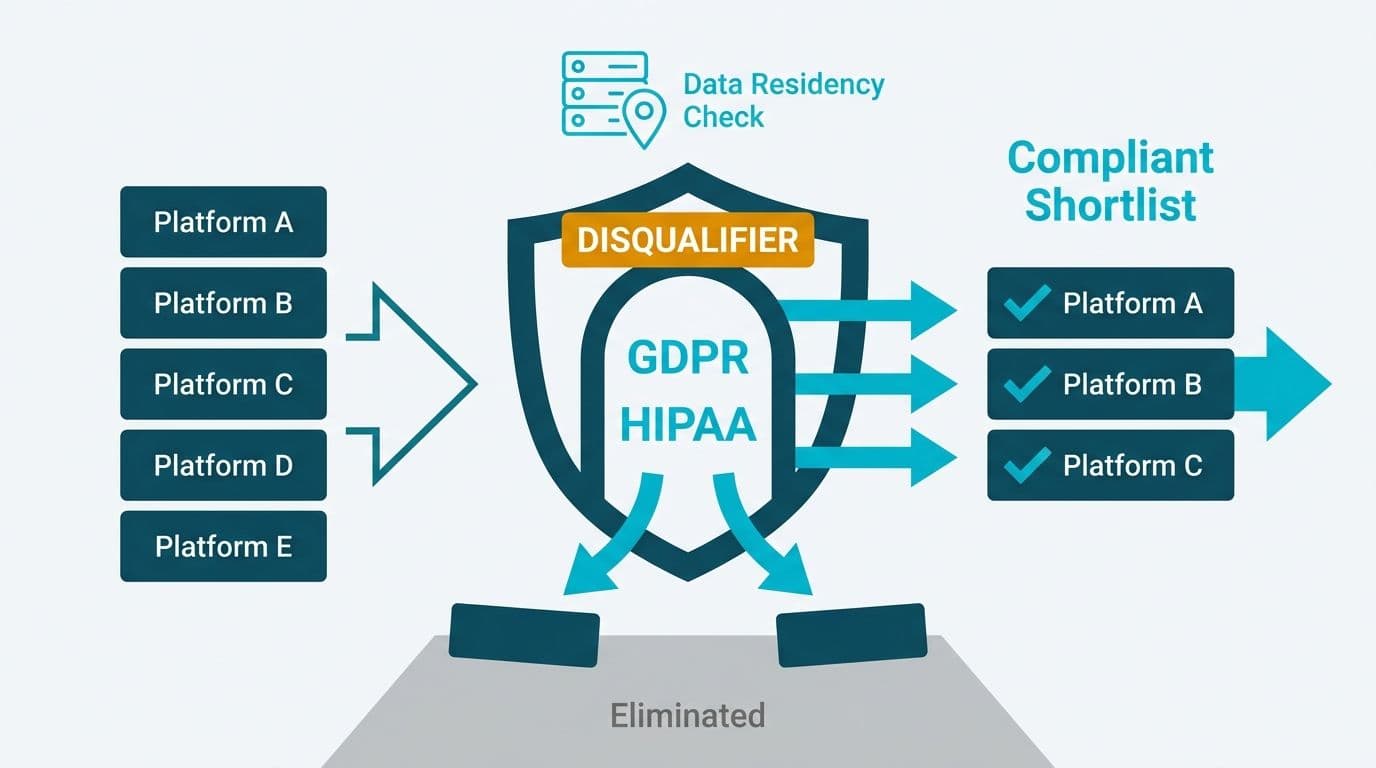
Choosing an AI workflow automation platform comes down to scoring eight criteria against your team's real constraints: native LLM support, connector depth, data residency controls, pricing model, vendor lock-in risk, GDPR/HIPAA posture, team skill fit, and support quality. Mid-market healthcare and finance teams should weight compliance posture and data residency highest - a platform that fails either criterion disqualifies itself regardless of feature count.
Key Takeaways
- Score all eight criteria before shortlisting: skipping any one creates procurement regret at renewal
- Data residency and HIPAA/GDPR posture are knock-out criteria for US healthcare and finance teams
- Native LLM support determines how much custom code you write two years from now - evaluate it as infrastructure, not a feature
- Total cost of ownership depends on pricing model structure - per-task pricing scales badly at volume
- Vendor lock-in risk and team skill fit are chronically underweighted; both drive long-term migration cost
Why Your Platform Choice Is a Compliance Decision, Not Just a Tech Decision
The appeal of AI workflow automation is significant for mid-market teams. Organizations exploring an AI automation consulting engagement frequently discover that platform selection is where projects derail - not implementation. Finance teams want to automate accounts payable, month-end close, and invoice extraction without adding headcount. Healthcare administrators want to route prior authorizations, sync EHR data, and flag claims anomalies without carelessly exposing PHI.
The wrong platform choice compounds both problems: it creates a compliance liability and a migration headache simultaneously.
For US companies, the regulatory baseline is HIPAA for healthcare and SOC 2 for financial services. UK and EU teams add GDPR to every workflow that touches personal data. Canadian organizations fall under PIPEDA, with stricter provincial equivalents in British Columbia and Quebec. A platform that stores workflow execution logs in a US-only data center is non-compliant for a Canadian team processing patient records, regardless of its LLM capabilities.
Start with compliance posture and data residency. If a vendor cannot satisfy those two criteria, the rest of the scorecard does not matter.
What Are the Eight Criteria for an AI Workflow Automation Platform Evaluation?
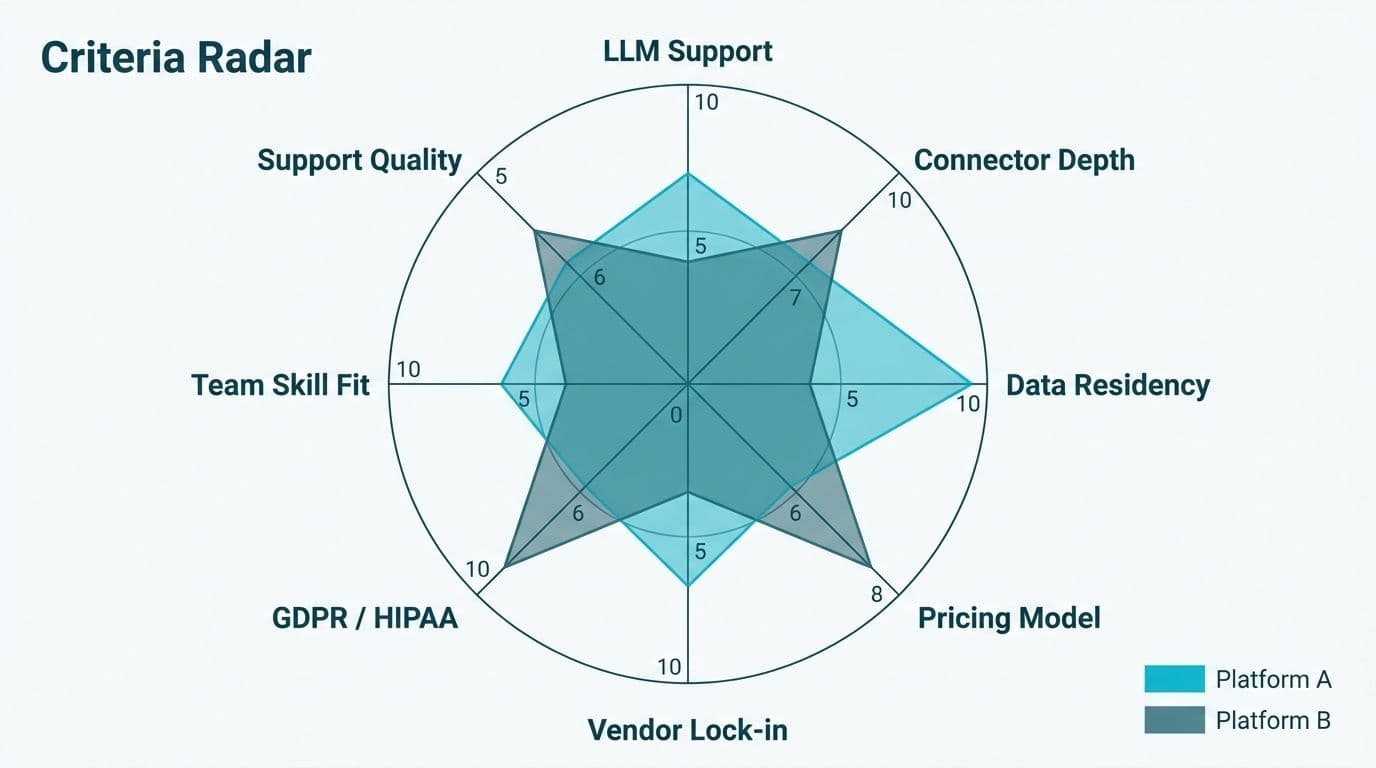
The framework below assigns each criterion a maximum of 10 points. Score each vendor independently, then apply weighting by your risk profile. Healthcare and finance teams should apply a 1.5x multiplier to Criterion 3 (data residency) and Criterion 6 (GDPR/HIPAA posture) before summing totals.
| # | Criterion | What "10/10" Looks Like | Healthcare/Finance Weight |
|---|---|---|---|
| 1 | Native LLM support | First-class Claude, GPT-4o, and Gemini nodes; no wrapper hacks | Standard |
| 2 | Connector library | 500+ certified connectors; EHR and accounting system coverage | Standard |
| 3 | Data residency controls | Region-pinned execution; EU, Canada, US zones selectable per workflow | 1.5x |
| 4 | Pricing model | Flat monthly or per-seat; no per-task overage surprise at volume | Standard |
| 5 | Vendor lock-in risk | Open standards (BPMN, JSON); self-hostable option; exportable definitions | Standard |
| 6 | GDPR/HIPAA posture | BAA available; documented DPA; audit logs with field-level redaction | 1.5x |
| 7 | Team skill fit | Low-code builder with code escape hatch; matches your existing stack | Standard |
| 8 | Support tier quality | Named CSM at mid-market tier; SLA-backed escalation path | Standard |
Score each vendor 1-10 per criterion, apply the multipliers to criteria 3 and 6, and total. The vendor with the highest weighted score earns the deepest pilot.
How Do Native LLM Support and Connector Library Affect Long-Term Build Cost?
Native LLM support is infrastructure, not a feature. A platform with a mature LLM node lets you swap foundation models without rewriting workflow logic - update a configuration parameter, not your entire automation. A platform that wraps LLMs through generic HTTP nodes forces custom engineering every time a model API updates its schema.
Evaluate this at the node level, not the marketing level. Ask each vendor: 'If we switch between foundation models tomorrow, how many workflows need modification?' The right answer is 'none - you update the model parameter in the LLM node.' A weak answer involves changes to HTTP call structures or custom connector code.
Connector library depth matters most in healthcare and finance because your critical systems are specialized. An EHR integration requiring a custom webhook rather than a certified connector adds weeks to implementation and shifts maintenance burden onto your team permanently. When evaluating, distinguish between certified connectors (vendor-maintained, tested against current production APIs) and community connectors (user-contributed, tested inconsistently).
For finance teams automating accounts payable or AI automation for month-end financial close, verify that connectors exist for your specific ERP and banking APIs before signing a license. Connector count on a pricing page is a marketing metric; the list of certified accounting system connectors is the real evaluation signal.
The generative AI use cases in finance guide covers what production integrations look like across AP, reconciliation, and reporting workflows for mid-market teams.
What Finance Workflows Should Teams Automate with AI First?
Most finance teams underestimate how much manual coordination happens upstream of the formal close process. The highest-value targets, roughly ordered by implementation ease and return:
1. Invoice data extraction and routing. AI extracts vendor name, line items, amounts, and PO numbers from unstructured PDFs and routes each document to the correct approval queue. This eliminates manual keying and creates an auditable log - directly solving how AI extracts data from invoices and financial documents at volume.
2. AI automation for account reconciliation. Matching bank transactions to GL entries is repetitive and rules-heavy - exactly the profile AI automation handles well. The platform pulls both data feeds, runs match logic, flags exceptions, and queues them for human review.
3. Month-end close coordination. Automating month-end close with AI replaces the shared email chain across 12 to 20 task owners with a structured workflow: tasks trigger in sequence, each owner receives a notification when their step is ready, and a live dashboard shows close status in real time. The human judgment calls remain with the team; the coordination overhead disappears.
4. AI expense management automation for finance teams. Receipt OCR, policy rule engines, and approval routing can compress reimbursement cycles from multi-week backlogs to same-week processing for compliant submissions.
5. Accounts payable automation. AI manages the full AP cycle - invoice intake, three-way match, exception handling, and payment scheduling - with human review reserved for high-value or anomalous items.
The principle underlying all five: automate coordination and data movement; keep humans on judgment calls. Vendors that advocate fully autonomous processing for high-value financial transactions before model accuracy is validated on your specific data are a yellow flag in any procurement conversation.
One engagement illustrates how scheduling and connector architecture transfers across business functions. A B2B client's team built marketing contact lists manually from their CRM. After implementing a scheduled automation, a job now runs every two hours inside Zoho, syncing 30 fields of sales context into four regional mailing lists and routing each contact by country. Manual list-building went to zero. The same architecture - scheduled sync, conditional routing, multi-field mapping - applies directly to finance data pipelines at larger scale.
The n8n finance workflow automation examples guide covers similar patterns applied to accounts payable and period-end reporting.
How Do Data Residency Controls Work in Healthcare and Finance Contexts?
Data residency means that workflow execution - including intermediate data states, logs, and LLM prompts - stays within a defined geographic boundary. It is distinct from encryption (which protects data in transit and at rest) and access control (which restricts who can view data). All three matter independently; data residency determines where data is physically processed.
For a US healthcare team under HIPAA, PHI must be processed within systems covered by a signed Business Associate Agreement. If an automation platform routes a patient intake form through a cloud LLM without a BAA covering that specific data path, the result is a HIPAA violation regardless of the platform's general encryption posture.
For a UK or EU-based fintech firm under GDPR, personal data processed by a workflow cannot route through servers outside the EEA without adequate safeguards - Standard Contractual Clauses or an applicable adequacy decision. A platform with EU-region execution eliminates this exposure; one without it creates legal review overhead on every workflow touching personal data.
For a Canadian organization under PIPEDA, comparable obligations apply, with stricter requirements under British Columbia's PIPA and Quebec's Law 25. A platform that cannot pin workflow execution to Canadian infrastructure creates measurable compliance risk for any workflow handling personal information of Canadian residents.
Ask vendors three specific questions: (1) Where are workflow execution logs stored, and can that location be configured per workflow? (2) Is a BAA available for healthcare customers, and does it explicitly cover LLM inference calls? (3) Does prompt data leave the selected region for model inference?
The AI compliance requirements for financial services regulatory map covers the 2026 framework across US, UK, and EU jurisdictions in detail. For HIPAA-specific workflow configuration, the n8n HIPAA compliant workflow automation guide walks through node-level implementation.
RPA vs AI Automation for Finance Teams: What Is the Real Difference?
RPA (robotic process automation) mimics human interaction with software interfaces - clicking buttons, copying text between screens, populating forms. It works when a system has no API and the process never changes. It breaks when a UI updates, a field moves, or an exception falls outside its scripted path.
AI automation uses machine learning, large language models, or trained models to handle variability. It can read an unstructured invoice in any vendor format, extract the relevant fields, and route the document without requiring a per-vendor template. It degrades gracefully on edge cases - flagging for human review rather than stalling the entire queue.
| RPA | AI Automation | |
|---|---|---|
| Handles unstructured data | No | Yes |
| Breaks on UI changes | Yes | No (API-driven) |
| Exception handling | Script-defined only | Model-defined, adaptive |
| Best fit | Legacy systems with no API and stable UI | Document extraction, NLP, variable formats |
| Setup complexity | Low to medium | Medium |
| Maintenance burden | High (UI changes break scripts) | Lower (model updates vs. code rewrites) |
For most mid-market finance teams in 2026: use AI automation for anything involving document understanding, language, or variable-format data. Reserve RPA for legacy systems with no API and a genuinely stable UI. For net-new workflows, AI automation is the right starting point.
How Do You Assess Vendor Lock-In Risk and Support Quality Before Signing?
Vendor lock-in risk is invisible in procurement and expensive at exit. Four signals to evaluate during shortlisting:
- Workflow portability: Are workflows stored in an open format (BPMN, JSON, YAML) importable elsewhere, or in a proprietary schema that requires vendor tooling to interpret?
- Self-hosting option: Does the vendor offer a self-hosted deployment tier? Self-hosted options preserve a migration path if the vendor is acquired or pricing changes substantially.
- API completeness: Can all workflow operations be managed through an API, or do critical actions require the vendor's GUI? API-complete platforms function as composable infrastructure; GUI-only platforms create a dependency.
- Data export: Can you export full workflow history, execution logs, and configuration without vendor involvement?
Suppose a US SaaS finance team faces a material pricing increase from their automation vendor at renewal. If their workflows are stored in a proprietary format, migration requires a full rewrite - months of engineering time - rather than a configuration export and import. Open-format workflow storage would have reduced that to a configuration migration. The hypothetical reflects a real structural risk that rarely surfaces in vendor sales conversations.
Support tier quality matters more for healthcare and finance teams than for general SaaS buyers because regulated workflows cannot tolerate extended downtime or ambiguous escalation paths. Key questions before signing:
- Does the mid-market support tier include a named Customer Success Manager, or only a shared ticket queue?
- Is there an SLA covering critical workflow failures, not just platform uptime metrics?
- Are HIPAA or GDPR compliance questions handled by a dedicated team?
The practical test before purchasing: open a support ticket with a HIPAA or GDPR-specific technical question and measure response time and answer quality. That interaction predicts post-sale support experience more accurately than any vendor reference call.
If your team is evaluating AI workflow automation platforms against these eight criteria and needs guidance tailored to your regulatory environment and connector requirements, AI automation consulting from Lets Viz includes structured vendor assessments for healthcare and finance organizations.
---
About Lets Viz: Lets Viz has delivered AI automation and analytics engagements for clients across US healthcare, UK fintech, Canadian manufacturing, and global SaaS since 2020, earning a 5.0 rating on Clutch. Our team works with CIOs, data leads, and finance directors at mid-market organizations to evaluate, implement, and govern AI workflow platforms against the compliance and operational standards their industries require.