AI Automation Compliance Checklist for Finance Teams
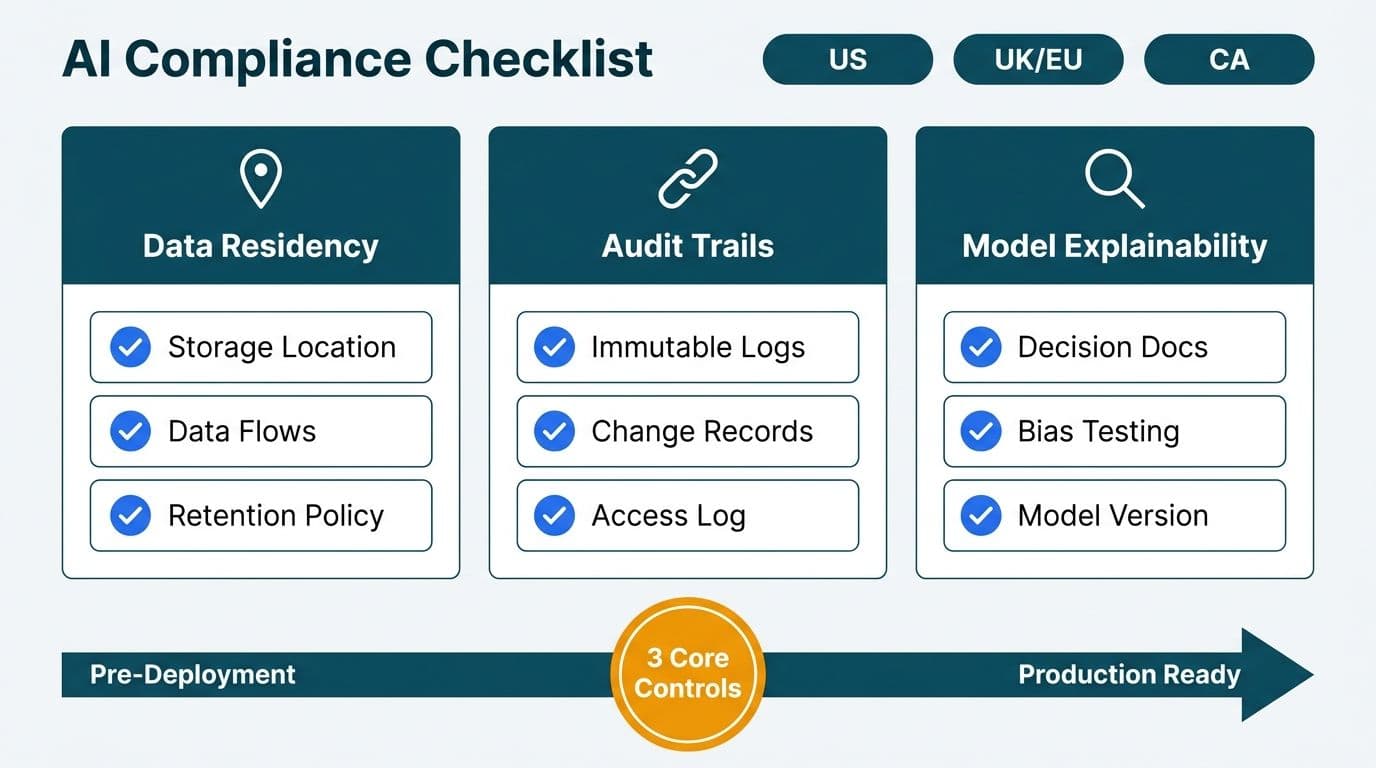
An AI automation compliance checklist for finance teams defines the regulatory controls that must be in place before any automated process handles financial data. The core requirements - data residency configuration, immutable audit trails, and model explainability documentation - apply across US, UK/EU, and Canadian jurisdictions, though the specific standards differ meaningfully by market. Getting these controls right before deployment prevents the remediation cost that follows an audit finding.
Key Takeaways
Data residency, audit trails, and model explainability form the non-negotiable core of any compliant AI finance workflow.
Applicable standards vary by market: SOC 2 and HIPAA in the US, GDPR and the EU AI Act in the UK and EU, PIPEDA and OSFI guidance in Canada.
Every automated financial decision - AP approvals, close entries, anomaly flags - requires a human-readable explanation trail.
Compliance is continuous: quarterly access reviews and annual model validations, not a one-time gate at launch.
Third-party automation vendors inherit the same data residency and explainability requirements as internal builds.
What Is AI Automation for Finance Teams - and Why Does Compliance Matter?
Understanding what is AI automation for finance teams is the foundation before any compliance work begins. AI automation in finance applies machine learning models, rule-based engines, and workflow orchestration to processes that previously required manual handling: invoice matching, account reconciliation, variance analysis, financial close journal entries, and management reporting pipelines.
The compliance stakes in finance are categorically higher than in other business functions. The data is regulated, material, and often contains personally identifiable information. A misclassified transaction in an automated accounts payable run can trigger a Sarbanes-Oxley control deficiency. An unexplained AI-generated forecast routed into an investor deck creates potential disclosure risk. A cloud deployment that routes personal financial data outside an approved jurisdiction can draw a GDPR enforcement action in the UK or EU, or a PIPEDA investigation in Canada.
That asymmetry - high productivity upside, high regulatory downside - makes the compliance checklist a prerequisite, not an afterthought. Engaging an AI automation consulting partner early means the first deliverable is a compliance scope document that maps every data flow to the applicable regulatory framework before any model is trained or tool is deployed. For US healthcare finance teams subject to both HIPAA and SOX, the overlap of patient financial records and public reporting obligations creates a dual compliance burden that demands this scoping step above all others.
What Does the AI Automation Compliance Checklist for Finance Teams Include?
The AI automation compliance checklist for finance teams organizes around six control domains. The table below maps each domain to its primary regulatory drivers across the three major markets.
| Control Domain | What It Covers | US | UK/EU | Canada |
|---|---|---|---|---|
| **Data Residency** | Approved storage and processing regions for financial data | SOC 2 CC6, state privacy laws | GDPR Art. 44-49 | PIPEDA Principle 7, OSFI B-10 |
| **Audit Trail Logging** | Immutable record of automated actions, inputs, and outputs | SOX Sec. 302/404 | FCA SYSC 10A | OSFI B-13 |
| **Model Explainability** | Human-readable justification for AI-driven financial decisions | Fed SR 11-7 | EU AI Act Title III | OSFI AIRB guidance |
| **Access Governance** | Role-based controls on automation triggers and overrides | SOC 2 CC6.1 | GDPR Art. 25 | PIPEDA Principle 7 |
| **Data Minimization** | Only required data is ingested by the model | HIPAA Minimum Necessary | GDPR Art. 5(1)(c) | PIPEDA Principle 4 |
| **Incident Response** | Documented process for automation failures and anomalous outputs | HIPAA Security Rule | NIS2 Directive | OSFI B-10 |
Vendor tools deserve the same scrutiny as internal builds. When a finance team subscribes to a cloud-based automation platform, the platform inherits the team's compliance obligations. If the platform stores invoice data containing personal financial information in a region outside GDPR adequacy coverage, the finance team - not the vendor - carries the regulatory exposure. Verify vendor compliance documentation before onboarding, not after the first audit finding.
How Do Data Residency Requirements Differ Across the US, UK/EU, and Canada?
Data residency is often the first compliance obstacle finance teams encounter when selecting an AI automation platform. It determines which cloud regions can legally store and process financial data - and the rules differ substantially by market.
In the US, data residency for financial data is governed primarily by the platform's SOC 2 audit scope and, for healthcare finance, HIPAA's requirements around where protected health information is processed. There is no blanket federal data-localization law for non-PHI financial data, but contracts with regulated entities routinely impose their own residency clauses. A US SaaS finance team running automated accounts payable on a major cloud platform should confirm that the vendor's SOC 2 Type II report covers the specific region where their data resides - not just the vendor's global footprint.
In the UK and EU, GDPR Articles 44 to 49 govern cross-border data transfers. Post-Brexit, UK organizations follow the UK GDPR and the UK Adequacy Framework, which currently recognizes the EU as adequate but requires ongoing monitoring for divergence. Any AI automation workflow that sends personal financial data - salary records, invoice data that can identify an individual, or payment history - outside the EEA requires either a transfer impact assessment, standard contractual clauses, or an adequacy decision. A UK fintech firm automating its month-end close through a US-hosted AI platform must ensure its data processing agreement explicitly covers the transfer mechanism.
In Canada, PIPEDA Principle 7 requires organizations to protect personal information even when transferred to a third-party processor. The Office of the Privacy Commissioner has consistently held that a Canadian organization cannot contract away accountability for data processed offshore. For Canadian financial institutions subject to OSFI B-10 (Third-Party Risk Management), the bar is higher: an incident at a cloud provider processing your financial data is treated as your incident, regardless of contractual indemnification.
The practical checklist item: obtain the vendor's data processing agreement, confirm the processing region, document the transfer mechanism, and schedule an annual review. Vendor infrastructure changes - a region migration by your automation provider can silently invalidate a previously compliant setup.
What Audit Trail Standards Apply to Automated Financial Workflows?
Every automated action in a financial workflow - an invoice approval, a journal entry, a reconciliation match, a variance flag - must generate an immutable audit trail that a regulator, auditor, or internal control function can reconstruct without ambiguity.
SOX Sections 302 and 404 (US public companies) require that any automated control in the financial reporting process be documented as an IT general control or automated application control. The documentation must cover what the control does, what data it touches, who configured it, and when it was last tested. An AI model that approves invoices below a dollar threshold is an automated application control under SOX - it needs a control owner, a change management log, and periodic testing evidence, not just a system-generated entry.
FCA SYSC 10A (UK regulated firms) requires an algorithmic decision log capturing every decision, the data used, and the outcome. While drafted primarily for trading contexts, the FCA has applied the same expectations to automated finance functions in supervised entities, particularly for decisions that affect client money or the accuracy of regulatory reporting.
OSFI B-13 (Canadian federally regulated financial institutions) explicitly requires that AI and machine learning models maintain version-controlled logs of model inputs, outputs, and parameter changes. These logs must be retained for the period required by the institution's record-retention policy - typically seven years for financial records in Canada.
The practical implication: do not accept a vendor's assurance that their platform keeps logs. Ask whether logs are append-only, whether they capture the full input payload rather than just the output, and whether retention matches your regulatory requirement. A common pre-deployment oversight covered in our AI workflow automation mistakes pre-launch checklist is discovering after go-live that a platform rotates logs on a 90-day window - far short of a seven-year retention expectation.
How Do You Satisfy Model Explainability Requirements for AI in Finance?
Model explainability - the ability to explain in plain language why an AI system produced a specific output - is moving from best practice to regulatory mandate across all three markets.
In the US, the Federal Reserve's SR 11-7 guidance on model risk management requires that models used in material financial decisions be validated by an independent function, with documentation of the model's assumptions, limitations, and performance metrics. SR 11-7 applies directly to banks, but its framework has become the de facto standard for any finance team subject to regulatory examination. Healthcare finance teams subject to HIPAA must additionally demonstrate that any AI model touching protected health information implements minimum necessary access - meaning the model should not ingest data fields it does not require to produce its output.
In the UK and EU, the EU AI Act (Annex III high-risk system obligations took effect August 2026) classifies AI systems used in credit scoring, insurance underwriting, and certain financial decisioning as high-risk. High-risk systems require a conformity assessment, technical documentation, and human oversight measures before deployment. UK finance teams should note that while the UK has not directly adopted the EU AI Act, the FCA's AI governance expectations for supervised firms increasingly mirror its requirements.
In Canada, OSFI's AIRB guidance and the Guideline on Artificial Intelligence require that models used in credit and financial risk decisions be explainable to the board risk committee - not just to the data science team. The expectation is a business-level summary of model logic accessible to non-technical governance bodies.
For every market, maintain a model card for each AI model in a financial workflow. The model card documents the training data scope, the decision logic at a summary level - SHAP (SHapley Additive exPlanations) feature-importance outputs work well for tree-based models common in AP anomaly detection, translating raw scores into ranked driver lists that internal audit can read without a data science background - the validation approach, the performance thresholds that trigger a review, and the last review date. Make this accessible to internal audit and external regulators on request.
How Does the Checklist Apply to Accounts Payable and Financial Close Automation?
The six control domains translate differently depending on which part of the financial close process or reporting pipeline you are automating.
AI automation for accounts payable: The highest-volume workflow and typically the first AI automation target. Compliance requirements focus on audit trail logging for every approval decision, vendor master data residency for supplier PII, and model explainability for anomaly detection or duplicate-payment models. For US healthcare finance teams, AP automation that processes invoices for clinical services may require HIPAA Business Associate Agreements with the automation platform. A hospital finance director automating invoice reconciliation for surgical supply vendors must confirm whether any invoice contains protected health information before deploying a tool without a BAA in place.
AI automation for the financial close process: Automated journal entries and account reconciliations are SOX application controls. Each auto-generated entry needs a documented preparer, a human approver, and a supporting rationale trail. Close automation built on platforms without granular role separation fails SOX testing. The AI workflow automation examples for business guide covers close automation architectures including the separation-of-duties patterns that satisfy control testing.
How to automate financial reporting with AI: When AI generates or supplements management reports, the explainability requirement extends to the data lineage of every figure. Teams using Power BI or similar platforms to surface AI-generated insights in financial reporting should ensure row-level security is correctly configured and AI-generated commentary is labeled appropriately. For platform-level data protection controls in reporting, the GDPR compliant SaaS financial reporting BI checklist covers the relevant configuration requirements for teams operating under UK and EU data protection rules. For output format and access control decisions in Power BI-based finance reporting, the Power BI Report Builder vs Desktop finance guide addresses the architectural trade-offs.
What Governance Controls Should Finance Teams Build Into AI Pipelines?
Compliance is not sustained by a one-time checklist - it requires ongoing governance controls embedded in the pipeline architecture itself.
The minimum governance framework for a compliant AI finance workflow includes four components:
1. Model inventory register. A living document listing every AI model and automation rule in production, its owner, its last validation date, the regulatory frameworks it touches, and its scheduled review date. Finance teams subject to OSFI B-13 or SR 11-7 will face requests for this register during regulatory examination.
2. Quarterly access reviews. Role-based access to automation configuration - who can modify a threshold, a routing rule, or a model parameter - must be reviewed and recertified at minimum quarterly. This is a SOC 2 CC6 requirement and reflects GDPR's accountability principle under Article 5(2).
3. Annual model validation. Every model in a material financial workflow should be re-validated annually against current data distributions. Model drift - where a model's performance degrades as real-world patterns diverge from training data - is a documented risk in financial AI. An AP anomaly detection model trained on pre-2024 transaction patterns may generate unacceptable false-positive rates on current data without revalidation.
4. Third-party risk reviews. Every vendor whose platform processes your financial data inherits your compliance obligations. Annual vendor reviews should include updated SOC 2 Type II reports, confirmation of data processing regions, and evidence of the vendor's own model governance practices. The best AI automation tools for business 2026 guide identifies which platforms include native governance tooling versus requiring custom controls.
Building the AI automation business case for finance leaders with compliance costs included from the outset - governance tooling licensing, annual model validation effort, quarterly access review cycles - produces a more accurate ROI projection and avoids the remediation costs that surface when a compliance gap is discovered during audit.
---
About Lets Viz: Lets Viz has delivered data analytics and AI automation engagements across US healthcare, UK fintech, Canadian manufacturing, and global SaaS since 2020, earning a 5.0 Clutch rating. The team works directly with CIOs, finance directors, and compliance officers to design automation workflows that satisfy the regulatory frameworks their auditors examine - across HIPAA, SOX, GDPR, and PIPEDA.
Ready to move from checklist to implementation? Our AI automation consulting practice helps finance teams design, validate, and deploy compliant automation workflows across accounts payable, financial close, and reporting pipelines.