Agentic BI: Definition, Meaning, and What It Actually Does
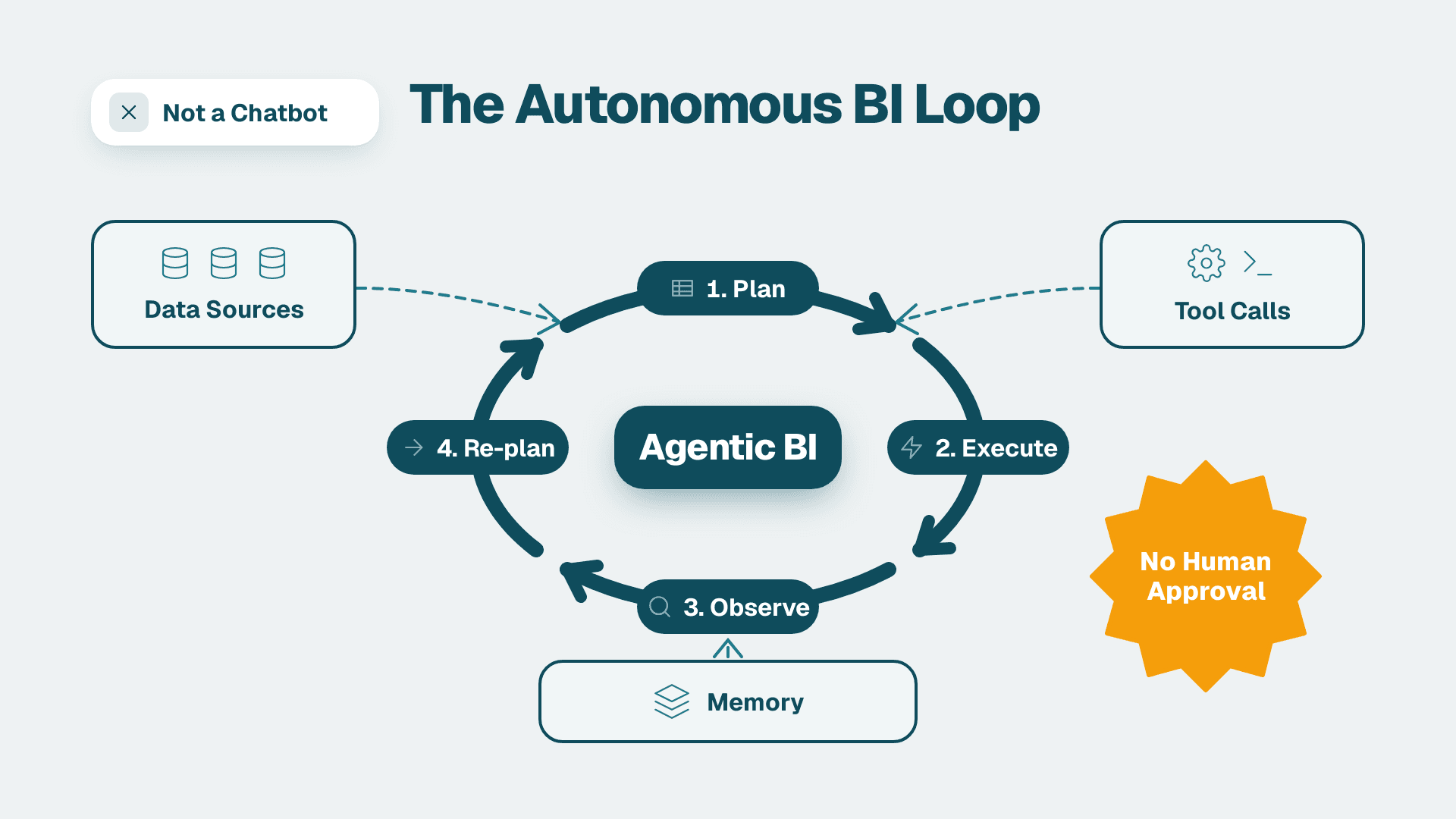
Agentic BI is a class of AI system that combines an autonomous decision loop, tool use, and persistent memory to execute multi-step analytical tasks without requiring a human to approve each individual step. It is not a chatbot layered on top of a dashboard. The defining characteristic is the loop: the system plans a course of action, executes the first step, observes the result, and re-plans - repeating until it reaches a conclusion or hits a defined boundary.
Key Takeaways
Agentic BI requires three components working together: an autonomous decision loop, the ability to call external tools and APIs, and memory that persists across steps.
Natural language query interfaces and AI-generated dashboard summaries are not agentic BI - they are stateless, one-shot interactions.
Three use cases have proven reliable in production at mid-market scale: anomaly investigation pipelines, report maintenance automation, and context-aware narrative generation.
Five commonly hyped applications carry risks that outweigh current agent reliability: autonomous pricing, fully autonomous financial close, complete pipeline self-healing, analyst replacement, and rebranded NLQ.
Evaluating Microsoft Copilot for Power BI requires mapping which components of the agentic BI tripod the platform delivers natively and which require deliberate architecture to unlock.
What Is the Agentic BI Definition? The Three Components That Matter
Agentic BI describes an AI system that can autonomously plan and execute a multi-step analytical workflow, call external tools mid-task, and retain context across those steps - without requiring a human to intervene between each action. Strip away any one of the three components below and you have a genuinely useful tool, but not an agent in the meaningful sense.
The autonomous decision loop is the foundational component. A traditional AI query produces one response and stops. An agent receives a goal - say, "investigate why gross margin declined in the UK division this week" - generates a plan, executes the first step, receives a partial result, updates the plan based on that result, and continues until it reaches a conclusion or hits a defined stopping condition. This iterative replanning is what separates an agent from a sophisticated autocomplete.
Tool use means the agent can reach outside its own reasoning and call external systems mid-loop: run a SQL query against a data warehouse, refresh a dataset via the Power BI REST API, look up an incident record in an ITSM platform, retrieve revenue data from an ERP system, post a result to a Teams channel, or trigger a downstream approval workflow. Without tool use, the agent reasons in isolation. Microsoft's Copilot Studio documentation (Microsoft, 2025) identifies the connector and plugin layer as the mechanism through which agents gain real-world reach in the Microsoft stack.
Memory closes the loop. Session memory allows the agent to reference earlier results within a single task - so if step three reveals the anomaly is concentrated in one product category, step five queries that category specifically. Persistent memory allows the agent to carry context across separate sessions: it can remember that last week's revenue spike was caused by a promotional event, so this week's similar pattern gets a different investigation path. Persistent memory is the component most often absent from early enterprise deployments, and its absence is why production agents frequently appear to "forget" context that an experienced analyst would carry naturally.
For BI leads beginning an evaluation, the most productive question is not "does this product use AI?" but "does it run a loop, call tools, and remember?" Before diving into specific platform capabilities, understanding where your current environment stands is foundational - the Power BI Copilot Readiness Checklist covers the infrastructure and governance conditions that must be in place before agentic features can run reliably in production.
For organizations that want to scope what a fully architected, Copilot-ready environment looks like before any implementation commitment, Power BI consulting (Copilot-ready) starts with exactly that assessment.
What Agentic BI Is Not: Where the Hype Misleads BI Leads
The most pervasive confusion in vendor marketing is equating natural language query (NLQ) with agentic BI. When a user types "show me gross margin by product line for the last six months" and the BI tool renders a chart, that is NLQ. The interaction is stateless, single-step, and involves no loop, no external tool calls, and no memory between sessions. It is useful. It is not an agent.
A closely related misconception is the AI-generated dashboard summary. Several leading BI platforms now generate a paragraph describing what a report shows. This is generative text applied to a pre-loaded data snapshot - there is no planning loop, no mid-task tool calls, and no memory of previous summaries. It functions as a sophisticated caption generator: useful for executive reporting and accessibility, but architecturally distinct from agentic BI.
Automated threshold alerts are a third false flag. A monitoring system that detects a KPI breach and sends an email notification is a rule-based automation. It has one trigger, one action, and no mechanism for adjusting behavior based on prior outcomes. The distinction between rule-based automation and genuine agents is examined in AI Agents vs Rule-Based Automation: When to Use Each - rules execute a fixed action; agents decide what action to take based on what they observe.
The practical field test: give the system a goal, not a query. "Investigate why customer acquisition cost increased in the US market this quarter and identify the top two contributing factors" is a goal. "Show me customer acquisition cost by channel this quarter" is a query. An agent handles goals. A query interface handles queries. Most mid-market BI deployments today are primarily query-and-visualization platforms with agent-adjacent features being layered on incrementally - and that is fine, as long as evaluation budgets and timeline expectations are calibrated accordingly.
The 3 Realistic Agentic BI Use Cases for Mid-Market Organizations
These three patterns have demonstrated reliable value at mid-market scale. They share a common characteristic: the cost of a wrong intermediate answer is manageable, the loop is bounded in scope, and a human reviews the output before any consequential action is taken.
1. Anomaly Investigation Pipelines
An anomaly investigation agent detects a metric deviation, queries the underlying data across multiple dimensions and time periods, checks whether the pattern appears in related metrics, and produces a structured root-cause hypothesis with supporting evidence - before a human has opened a single report. The analyst's job shifts from navigating five dashboards to validating one structured summary.
A US SaaS finance team might deploy this pattern to investigate monthly ARR movements automatically. The agent cross-references closed-won data from the CRM, churn records from the billing platform, and currency fluctuation data from a public exchange-rate API - producing a memo the revenue analyst reviews before the Monday stand-up. The agent does not make a decision; it compresses the investigation from hours to minutes.
2. Report Maintenance Automation
Stale calculated columns, failed credential refreshes, and broken dataset relationships accumulate as maintenance debt in any mid-market Power BI environment with more than a dozen datasets. An agentic approach assigns the agent the goal of monitoring report health, diagnosing failure causes, and applying fixes within a defined scope - logging every change for human review before anything reaches production.
3. Context-Aware Narrative Generation
A scheduled narrative agent that writes a weekly executive summary is only genuinely agentic if it remembers what it said last week, knows which trends it has already flagged, and adjusts accordingly - writing "operating margin compression continued for the third consecutive week" rather than restating the same observation as new information every cycle. Without persistent memory, automated narrative generation is a useful reporting feature, not an agent.
A Canadian manufacturing company subject to PIPEDA data-residency requirements can deploy this pattern within a sovereign cloud boundary, with the agent's memory store restricted to the same geographic region as the underlying data. The compliance consideration is an architecture decision, not a blocker - but it must be made before deployment rather than discovered in production.
The 5 Overhyped Agentic BI Claims to Scrutinize
1. Real-Time Autonomous Pricing Decisions
Agents that surface pricing insights and flag anomalies are reliable and valuable. Agents that autonomously set and publish prices without human sign-off carry risk that current reliability levels do not justify. A single miscalibrated loop run against a live pricing system can reprice an entire catalog before any human notices. For UK organizations under FCA conduct-of-business rules, US firms with SOX obligations, and EU companies under GDPR Article 22's automated-decision provisions, autonomous pricing raises audit and liability questions the technology alone cannot resolve.
2. Fully Autonomous Financial Close
The month-end close involves exception handling, judgment calls on accruals, and multi-party sign-offs that are precisely the conditions where current agents fail unpredictably. Agents handle the structured, repeatable portions of the close effectively - the practical patterns are described in Real-Time Financial Reporting Best Practices for FP&A. They produce confident, well-formatted outputs when they encounter novel exceptions, which is exactly when human judgment is most necessary. "Fully autonomous" financial close is a claim to pressure-test with specific exception scenarios before any procurement decision.
3. Self-Healing Data Pipelines - Complete Coverage
Agents can diagnose and resolve common pipeline failures reliably: expired credentials, timeout thresholds, known transformation errors with documented remediation steps. They struggle with schema drift they have not previously encountered, cascading failures across tightly coupled datasets, and ambiguous transformation logic left undocumented by the original pipeline author. Vendor marketing for pipeline automation products often describes the reliable portion of the problem space as though it covered the complete picture.
4. Agent as Full Analyst Replacement
This framing misunderstands where agents fail. An agent asked "what drove the decline in net revenue retention this quarter?" will produce a confident, well-structured answer. If the business logic embedded in the data model diverges from the CFO's working definition of NRR - a common situation in mid-market companies that have grown through acquisition or platform migration - the agent explains the wrong number with full confidence. The piece AI Explain NRR to Your SaaS Board: What to Validate First addresses this validation gap in detail. Agents augment the analyst who holds institutional knowledge of what the numbers actually mean; they do not replace that function.
5. NLQ Interfaces Described as Agentic AI
This is the most widespread mislabeling in current vendor marketing. A natural language interface that translates a user's question into a DAX query or SQL statement is a query generator, even a very capable one. It has no decision loop, no tool use beyond the semantic model already loaded, and no persistence between sessions. BI leads evaluating platforms should request a live demonstration of a multi-step goal that requires the system to change its approach based on an intermediate result. That test distinguishes real agentic capability from NLQ with a more polished interface.
Realistic vs. Overhyped: An Evaluation Framework
| Capability | Loop? | Tool Use? | Memory? | Verdict |
|---|---|---|---|---|
| Anomaly investigation pipeline | Yes | Yes (API, SQL) | Session | Realistic - human review required |
| Report maintenance automation | Yes | Yes (Admin API) | Persistent | Realistic - bounded scope |
| Context-aware narrative generation | Yes | Limited | Persistent | Realistic - human review required |
| Real-time autonomous pricing | Yes | Yes | Persistent | Overhyped - regulatory risk |
| Fully autonomous financial close | Partial | Yes | Partial | Overhyped - fails on novel exceptions |
| Self-healing pipelines (complete) | Partial | Yes | Limited | Overhyped - reliable for common failures only |
| Full analyst replacement | Yes | Yes | Varies | Overhyped - business logic gap |
| NLQ interface billed as agentic | No | No | No | Mislabeled - not agentic |
What the Agentic BI Definition Means for Your Copilot for Power BI Evaluation
Microsoft's documentation on Copilot for Power BI (Microsoft, 2025) describes features including natural language report creation, automated narrative summaries embedded in report pages, and DAX query suggestions within the development interface. These are genuinely useful and well-implemented. They are also primarily stateless - the autonomous decision loop, persistent cross-session memory, and cross-system tool use that define agentic BI are not delivered by Copilot for Power BI as a standalone out-of-the-box capability in its current form.
The path to agentic BI on the Microsoft stack runs through Copilot Studio and Azure AI Foundry. Microsoft's platform documentation (2025) describes these as the orchestration and extensibility layer where agents can be built with custom tool connectors, configurable memory, and multi-step logic. The distinction matters for evaluation timelines and budget: enabling Copilot in a Power BI Premium workspace is not equivalent to deploying an agentic BI system. The second requires architecture work that the first does not include.
For EU organizations, GDPR Article 22 provisions on automated individual decision-making apply when an agentic system takes actions - updating records, triggering workflows, posting outputs to downstream systems - rather than merely generating text for human review. A UK fintech firm and a German industrial company face the same regulation through different sector lenses; both need the memory layer reviewed as a data-processing component before production deployment.
For Canadian organizations, PIPEDA governs automated decision systems in commercial contexts. If an agentic BI deployment moves from generating insights to taking actions, the governance requirements shift accordingly. The architecture decision to keep agents in "output only" mode versus "action-taking" mode is, in part, a compliance decision that should be made early in the design process.
The three-component test - loop, tool use, memory - applied consistently across every vendor demonstration and internal pilot provides a durable evaluation framework as product capabilities evolve rapidly. For teams ready to translate that framework into a concrete readiness and scoping conversation, AI Automation for Finance Teams: Where to Start maps the sequencing most mid-market organizations find practical when moving from Copilot features to production agentic workflows.
---
About Lets Viz: Lets Viz has delivered Power BI, data engineering, and analytics solutions to mid-market and enterprise clients since 2020, including US healthcare systems, UK fintech firms, Canadian manufacturing companies, and global SaaS organizations. The firm holds a 5.0 Clutch rating. Guidance shared here reflects direct implementation experience, not vendor documentation alone.
If you are evaluating whether your Power BI environment is positioned for Copilot deployment or agentic capabilities, Power BI consulting (Copilot-ready) covers readiness assessment, scoping, and implementation.