Real-Time Financial Reporting Best Practices for FP&A
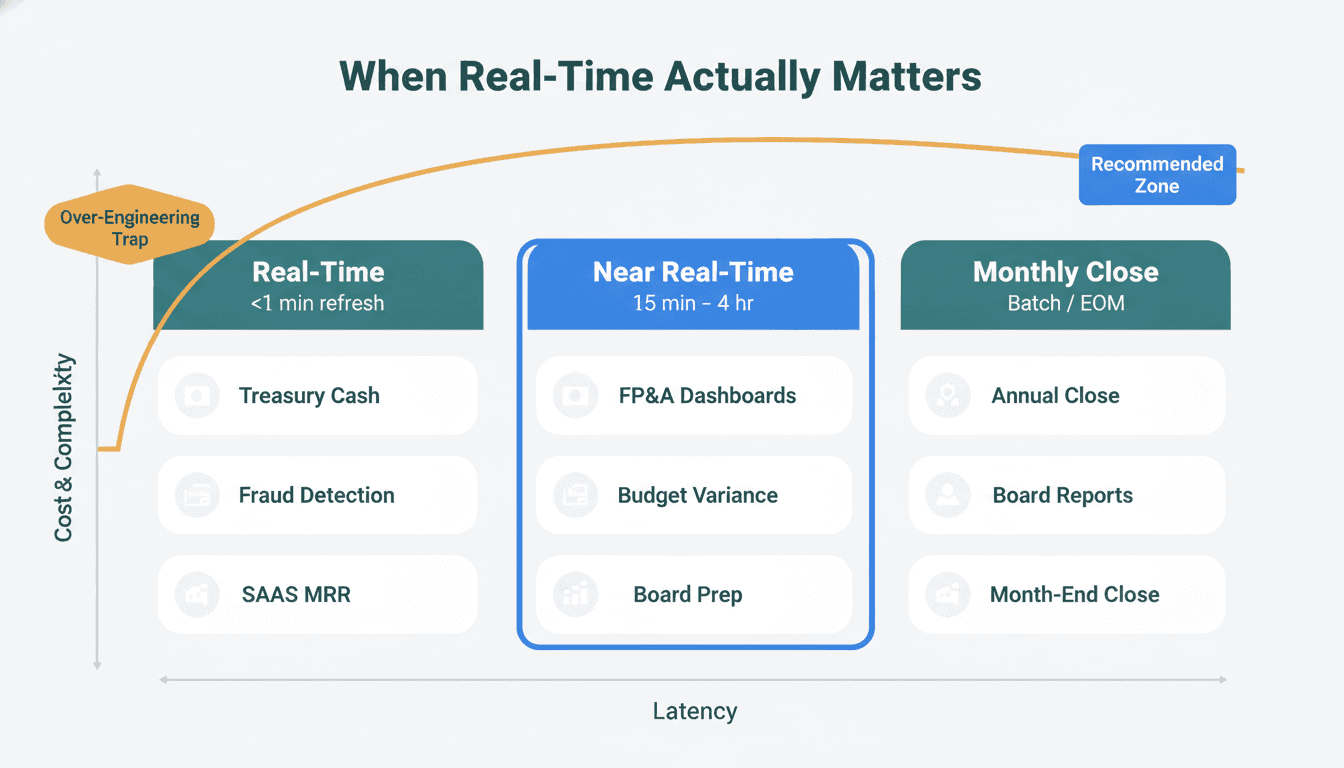
Real-time financial reporting delivers genuine value when the decision it supports requires same-day action - treasury cash management, intraday fraud exposure, or live SaaS MRR monitoring. For most FP&A cycles, monthly close, and board reporting, near-real-time refreshes of 15 minutes to 4 hours are architecturally simpler, significantly cheaper, and produce identical decisions. The real-time default is a costly over-engineering trap for most finance teams.
Key Takeaways
- Real-time pipelines are essential for treasury cash positioning, live SaaS MRR, and intraday fraud detection - they are overkill for monthly close, budget variance, and board packs.
- SAP, Oracle, NetSuite, and Dynamics 365 each carry distinct latency ceilings that must be understood before designing any finance pipeline.
- Streaming Power BI datasets update tiles via pushed JSON payloads but require a separate setup from the Import or DirectQuery models used for analytical FP&A work.
- Data-latency trade-offs centre on three axes: query cost, data freshness, and governance complexity.
- US, UK, and Canadian teams face different compliance drivers - SOX, GDPR, PIPEDA - that shape how real-time pipelines must be architected.
When Do Real-Time Financial Reporting Best Practices Matter - and When Don't They?
Real-time close matters when a delayed number changes a same-day decision. The clearest cases are treasury cash positioning, where a US multinational managing intraday liquidity needs live bank feed data to avoid overdraft fees; SaaS revenue recognition, where a platform billing thousands of micro-transactions per hour needs a continuously updated deferred revenue ledger; and fraud monitoring, where a UK fintech firm on batch feeds could miss a suspicious pattern until next morning.
Outside those cases, the argument collapses. A Canadian manufacturing company running a monthly variance report against a standard cost model gains nothing from 30-second refreshes. The close cycle itself - accruals, intercompany eliminations, FX revaluation - requires human sign-off steps that introduce hours of latency regardless of pipeline speed. Streaming the GL in real time while waiting three days for accruals to post produces a false sense of precision, not a better close.
The practical framework: map each reporting use case to the shortest interval at which a delayed number would cause a different financial decision. Days - use scheduled refresh. Hours - DirectQuery against a well-indexed warehouse. Minutes - streaming pipeline, with the governance overhead that entails.
The Power BI for SaaS finance teams practice at Lets Viz consistently finds that most SaaS finance teams need one streaming dataset for a live MRR/ARR monitor and three to five scheduled-refresh datasets for cohort analysis, churn, and pipeline coverage. A wholesale real-time architecture is rarely the right answer.
What Are the ERP Connector Options and Their Latency Profiles?
Choosing the wrong ERP connector is the most common source of unexpected latency in finance pipelines. The four dominant platforms carry meaningfully different data access architectures.
SAP exposes data through SAP BW (pre-aggregated OLAP cubes), SAP HANA Direct, and OData services. BW cubes update on a nightly process chain, making them unsuitable for intraday use without a separate HANA Direct or OData connection. Microsoft's SAP HANA connector supports DirectQuery against HANA, enabling sub-minute refresh on properly partitioned tables (Microsoft Power BI documentation, 2025).
Oracle Fusion / Oracle ERP Cloud uses rate-limited REST APIs per tenant. High-frequency polling hits throttle ceilings before reaching the intended refresh rate. Oracle's documented recommendation for near-real-time extraction is GoldenGate Change Data Capture (CDC), feeding a downstream warehouse rather than the transactional system (Oracle documentation, 2025).
NetSuite - used widely by SaaS companies and mid-market firms across the US, UK, and Canada - provides SuiteAnalytics Connect, an ODBC/JDBC interface querying a replicated analytics schema. NetSuite's documentation states this read replica carries up to a 20-minute lag from the live database by design (Oracle NetSuite documentation, 2025). A 15-minute Power BI refresh against this source achieves at best 20-minute freshness, not 15.
Microsoft Dynamics 365 Finance integrates through the Dataverse DirectQuery connector, useful in GDPR-regulated UK and EU environments where data residency matters. For high-volume transactional data, Synapse Link for Dataverse continuously replicates tables into Azure Synapse Analytics, eliminating per-query load on the production ERP (Microsoft documentation, 2025).
| ERP Platform | Native Connector | Min. Achievable Latency | Recommended Near-Real-Time Pattern |
|---|---|---|---|
| SAP HANA | Power BI DirectQuery | Sub-minute (with indexing) | HANA Direct or OData service |
| Oracle ERP Cloud | REST API / OAC | Minutes (rate-limited) | GoldenGate CDC to warehouse |
| NetSuite | SuiteAnalytics Connect | ~20 min (replica lag by design) | SuiteAnalytics + scheduled refresh |
| Dynamics 365 Finance | Dataverse DirectQuery | Sub-minute | Synapse Link for Dataverse |
How Do Streaming Power BI Datasets Work for Finance Teams?
Streaming Power BI datasets are architecturally distinct from Import or DirectQuery - and the distinction has direct consequences for finance teams.
A streaming dataset accepts JSON payloads pushed to a REST endpoint: tiles update in near real time, but the dataset does not retain queryable history unless the "Historic data analysis" setting is enabled at creation time (Microsoft Power BI documentation, 2025). Without it, you see live numbers but cannot slice by dimension or write DAX CALCULATE measures across historical rows.
Use streaming datasets for: live cash balance tiles, intraday payment counters, real-time SaaS signup triggers, and fraud alerts. Use Import or DirectQuery for: all analytical work - variance analysis, cohort tables, rolling forecasts, and multi-period calculations. The Import vs. DirectQuery choice for the analytical layer involves trade-offs in query performance and DAX capability covered in Power BI Import Mode vs DirectQuery for Copilot and Q&A. For most FP&A teams, Import mode on a 15- to 60-minute schedule is the right answer.
A well-designed finance dashboard combines both: a streaming tile at the top showing live MRR, sitting above Import-mode visuals for month-to-date actuals, pipeline coverage, and churn. The live tile creates operational confidence; the Import-mode visuals drive decisions.
What Are the Data-Latency Trade-offs Finance Teams Must Understand?
Data latency is not a single number - it is a chain. End-to-end latency from a transaction hitting your ERP to a CFO seeing it on a dashboard sums ERP write time, extraction lag, transformation time, Power BI refresh interval, and browser cache TTL. Each step compounds.
A Canadian manufacturing company using NetSuite (20-minute replica lag) feeding into an Azure Data Factory pipeline on a 30-minute trigger, loading into Power BI on a 15-minute refresh schedule, faces a minimum end-to-end latency of 65 minutes before any transformation logic runs. Investing in a real-time CDC tool at the extraction layer does nothing while that 30-minute ADF trigger remains.
The three axes of the trade-off:
Query cost. DirectQuery and streaming pipelines generate continuous load on source systems. Five finance users opening a DirectQuery report is negligible; hundreds of users simultaneously is a capacity and licensing problem. Import mode shifts load to predictable scheduled windows that are easier to govern and cost-model.
Data freshness. The treasury team needs intraday data. The FP&A team building a 12-month rolling forecast needs data accurate as of yesterday's close - a one-day lag is irrelevant to that decision. Forcing freshness on audiences that do not need it adds cost without improving outcomes.
Governance complexity. A streaming pipeline that bypasses the transformation layer - where data quality checks live - produces dashboards showing real-time numbers that are technically wrong. A UK fintech under GDPR cannot deploy a live transaction dashboard without confirming the streaming layer applies the same data masking and role-level access controls as the batch layer. A finance analytics data governance checklist covering every source, transformation, latency SLA, business owner, and downstream consumer must be complete before any streaming pipeline reaches production.
The finance analytics consulting cost of building and maintaining a streaming pipeline is materially higher than a well-governed scheduled-refresh architecture - in initial build, ongoing monitoring, and incident response. That total cost of ownership must factor into the investment decision.
When Should Finance Teams Avoid Real-Time Reporting?
Whenever the decision does not require it. Over-engineering for real-time is one of the most expensive mistakes in finance analytics, typically driven by infrastructure ambition rather than a clear reporting requirement.
A SaaS company that built a full streaming pipeline for its weekly board pack illustrates the trap. The board meets Fridays. Data is prepared Thursdays. A 15-minute Import refresh on Thursday morning produces identical outputs at a fraction of the infrastructure cost. Zero additional decision quality was gained.
Real-time also introduces accuracy risk at month-end. When accruals, intercompany eliminations, and manual journals are still in flight, a "real-time" dashboard is showing an incomplete picture. Finance leaders at US public companies under SOX, UK companies under Companies Act requirements, and Canadian companies reporting under ASPE or IFRS need confidence that what they see is complete, not just current. For automating the month-end close, batch automation with human-in-the-loop checkpoints consistently outperforms streaming architectures.
The finance analytics maturity model framing is useful here: real-time pipelines are a Stage 4 or Stage 5 capability, appropriate only after a team has mastered data governance, consistent metric definitions, and reliable scheduled refresh. Teams at Stage 2 - inconsistent definitions, no single source of truth - do not become more effective by adding streaming. They become more effectively confused, at higher cost.
This pattern appears often in practice. An events production company had two finance reports showing different revenue numbers for the same period and nobody knew which to trust. When reconciled, the grand totals matched exactly. The entire dispute traced to 34 filler rows from different date windows - not any real data difference. The problem was never latency. It was governance and metric definition alignment. Solving that first would have delivered more value than any streaming investment.
The question of whether AI will replace financial analysts is relevant here: AI anomaly detection in financial reporting can add genuine value, but only on top of a clean, trusted, well-governed foundation. AI that summarizes incorrect real-time data produces confident wrong answers at machine speed.
How Do Compliance Requirements Shape Real-Time Reporting in the US, UK, and Canada?
Compliance does not mandate real-time reporting - but it defines the governance architecture any real-time pipeline must satisfy.
United States: SOX Section 404 requires documented and tested internal controls over financial reporting. A streaming pipeline that bypasses transformation and audit trail logic creates control gaps auditors will flag. US SaaS finance teams must ensure every data movement step has a durable audit trail - CDC logs, pipeline run histories, transformation lineage - accessible to external auditors. SOC 2 Type II attestations from cloud infrastructure vendors are the baseline due diligence expectation.
United Kingdom and EU: GDPR creates data minimisation and purpose-limitation obligations. A live transaction dashboard must apply the same pseudonymisation, access controls, and retention rules as the batch layer. UK GDPR (ICO, post-Brexit) mirrors these requirements. FCA-regulated firms face additional data lineage obligations under the Senior Managers and Certification Regime (SM&CR).
Canada: PIPEDA and Quebec's Law 25 impose consent and breach notification requirements for pipelines touching personal financial data. Canadian companies using cloud streaming infrastructure should confirm data residency - transit through US-based data centres carries implications under PIPEDA requiring legal review before deployment.
Across all three markets the implication is the same: real-time pipelines require identical governance rigour to batch pipelines, applied proactively in the pipeline design rather than retrofitted after a compliance incident.
---
About Lets Viz: Lets Viz is a data analytics consultancy serving clients in US healthcare, UK fintech, Canadian manufacturing, and global SaaS since 2020. With a 5.0 Clutch rating and delivery expertise across Power BI, Microsoft Fabric, and cloud data platforms, Lets Viz helps finance and operations teams build reporting infrastructure that is accurate, governed, and matched to the decisions that actually matter.
If your team is evaluating a real-time reporting investment - or diagnosing why your current dashboards feel untrustworthy - explore the Power BI for SaaS finance teams service page for a practical starting point.