AI Agents vs Rule-Based Automation: When to Use Each
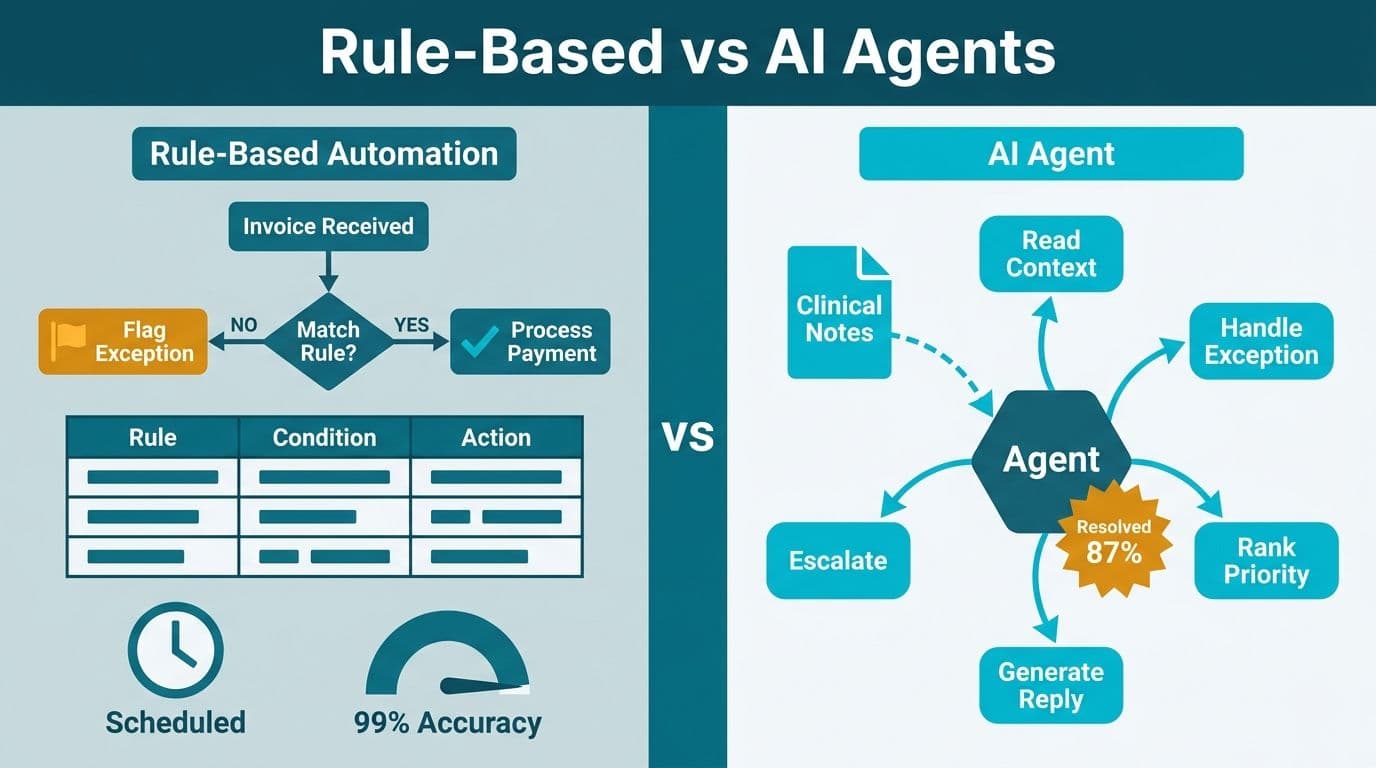
Choose rule-based automation when your process has fixed inputs, deterministic steps, and no ambiguity - think scheduled data transfers or invoice matching against predefined rules. Choose an LLM-driven AI agent when the task requires reading context, handling exceptions, or reasoning through ambiguity - think triage of unstructured clinical notes or dynamic contract review. Most mid-market organizations need both, running in the right sequence.
Key Takeaways
- Rule-based automation wins on cost, speed, and auditability for predictable, high-volume tasks.
- AI agents add value when inputs are unstructured, exceptions are frequent, or judgment is required.
- Finance and healthcare both use layered stacks: deterministic rules handle clean cases; agents handle edge cases and judgment calls.
- Compliance requirements (HIPAA, GDPR, PIPEDA) shape which automation layer handles sensitive data and how decisions must be logged.
- Verifying outcomes - not just marking tasks complete - is the discipline that separates automation that works from automation that only appears to work.
What Is the Difference Between AI Agents and Rule-Based Automation?
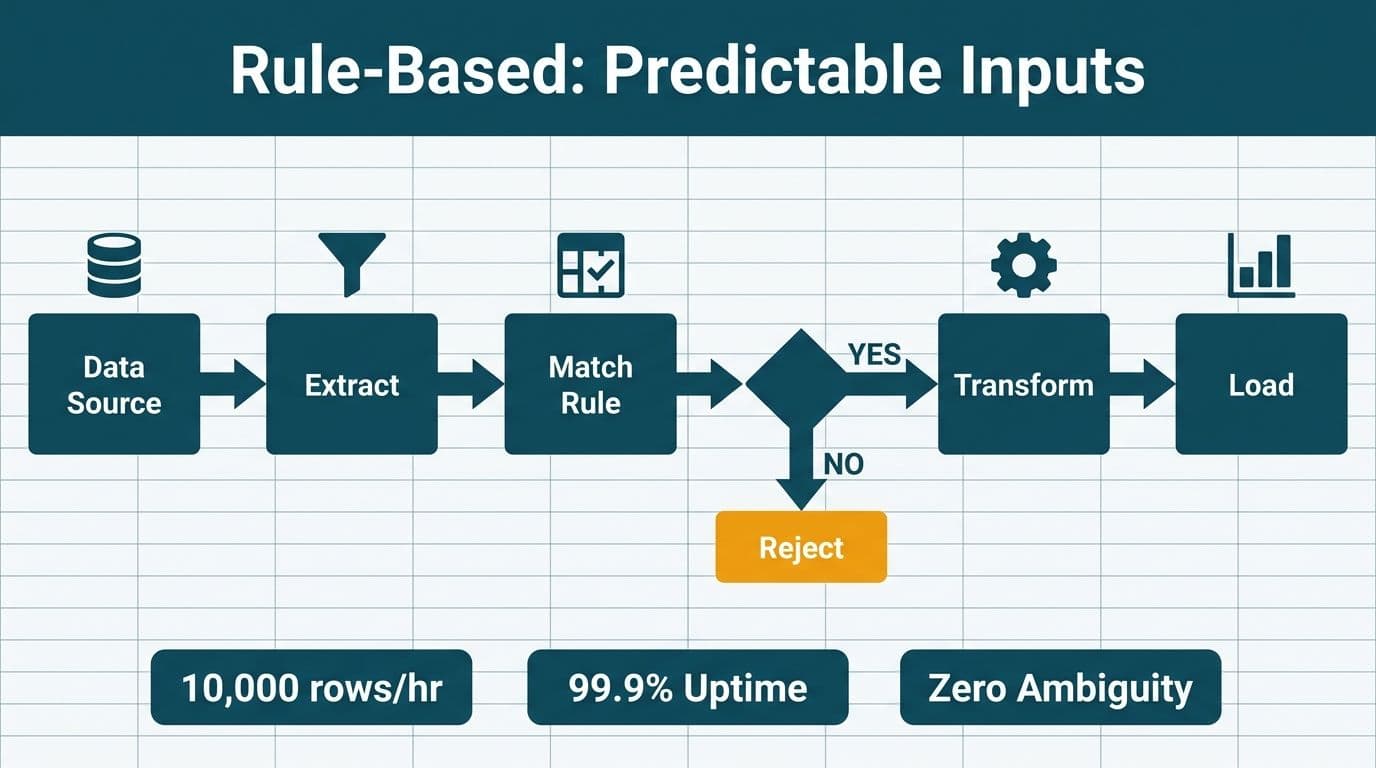
Rule-based automation executes a fixed sequence of instructions triggered by a defined event. No reasoning occurs - the system follows its script exactly. A scheduled job that extracts invoices from an ERP, matches them against purchase orders, and posts the resulting journal entries is rule-based: every step is predetermined, and every exception either triggers a pre-written fallback or escalates to a human queue.
An LLM-driven AI agent, by contrast, receives a goal and determines how to pursue it. It can read unstructured text, evaluate context, call external tools, and adjust its approach mid-task when intermediate results are unexpected. Anthropic's 2026 agent documentation defines agents by three capabilities: tool use, persistent state management, and multi-step autonomous action - distinguishing them from simple prompt-response interactions that respond once and stop.
The practical implication is that rule-based systems are predictable and auditable by design, while AI agents are flexible and require deliberate governance architecture. Neither is universally superior. For teams mapping out where each capability belongs in their stack, our AI automation consulting practice begins with a structured process inventory before recommending any specific tooling.
| Factor | Rule-Based Automation | LLM-Driven AI Agent |
|---|---|---|
| Input type | Structured, predictable fields | Unstructured or variable-format |
| Decision logic | Deterministic if/then rules | Reasoning and context evaluation |
| Exception handling | Fails or escalates to human queue | Adapts, retries, or resolves in-line |
| Auditability | Full trace by default | Requires explicit logging design |
| Per-run cost | Near-zero at volume | LLM inference cost per call |
| Compliance posture | Straightforward to certify | Requires explainability architecture |
| Typical use cases | ETL, scheduling, alerting, matching | Triage, drafting, review, extraction |
When Should You Use AI Agents vs Rule-Based Automation?
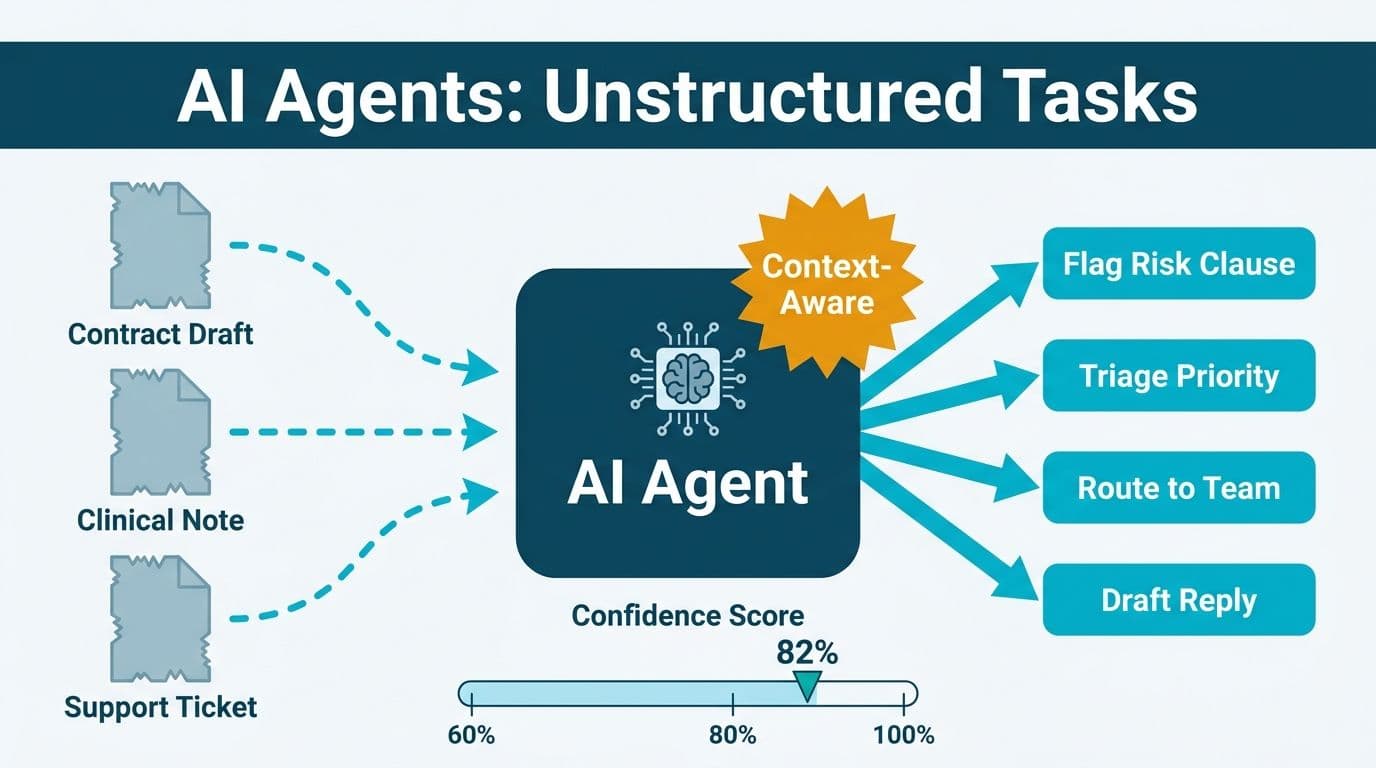
The choice between AI agents vs rule-based automation - and when to use each - comes down to three diagnostic questions: How structured is the input? How stable are the rules? And how frequently do exceptions occur?
If all three answers point toward "structured, stable, and rare exceptions," rule-based automation is the right tool. It is cheaper, faster to deploy, and easier to certify under compliance frameworks. A UK fintech firm processing trade confirmations under MiFID II benefits from deterministic automation because regulators expect a reproducible, inspectable audit trail - something a well-built rule-based pipeline provides by design.
If inputs vary, rules shift frequently, or exceptions represent a material share of volume, an AI agent earns its added cost. A Canadian insurance operation processing PIPEDA-governed claims notes - written differently by every adjuster across every regional office - cannot rely on keyword matching. An agent that reads each note, extracts structured fields, and flags ambiguous cases for human review handles the variability that no fixed rule set can accommodate.
A practical calibration test: take 100 representative examples from your process and walk them through your proposed rule set. If more than 10-15% require a human override to complete correctly, you have an agent use case. If the override rate stays below 5%, invest in a well-tested rule set and deploy agents on a harder problem.
Where Rule-Based Automation Still Wins
For high-volume, low-ambiguity operations, rule-based automation remains the benchmark. Scheduled database syncs, threshold alerts, API-to-API data handoffs, compliance-driven data masking, and reporting refreshes all benefit from the determinism and auditability of a rule engine. A US SaaS finance team running nightly GL extracts, bank reconciliation, and automated journal postings gains nothing by introducing LLM reasoning into a process that is already fully specified. Agents would add cost, latency, and behavioral surface area without solving any genuine problem.
Where AI Agents Earn Their Cost
AI agents justify their inference cost when the task genuinely cannot be reduced to a rule set. Document review, policy interpretation, extracting intent from free-text support tickets, and synthesizing research across multiple sources all require reading comprehension and contextual judgment. A US healthcare system reviewing prior authorization requests that cite clinical criteria across varied physician letters cannot automate that review with keyword matching without creating an unacceptable error rate. An agent that reads each letter against the payer's policy documents and produces a structured recommendation for a clinical reviewer to approve or override is the appropriate tool.
How Does AI Automation Help Finance Teams Automate the Month-End Close?
Finance offers the clearest worked examples of both automation types running in parallel. The goal to automate month-end financial close with AI tools is a common priority for finance directors and CFOs - but individual components of a close cycle require different automation strategies.
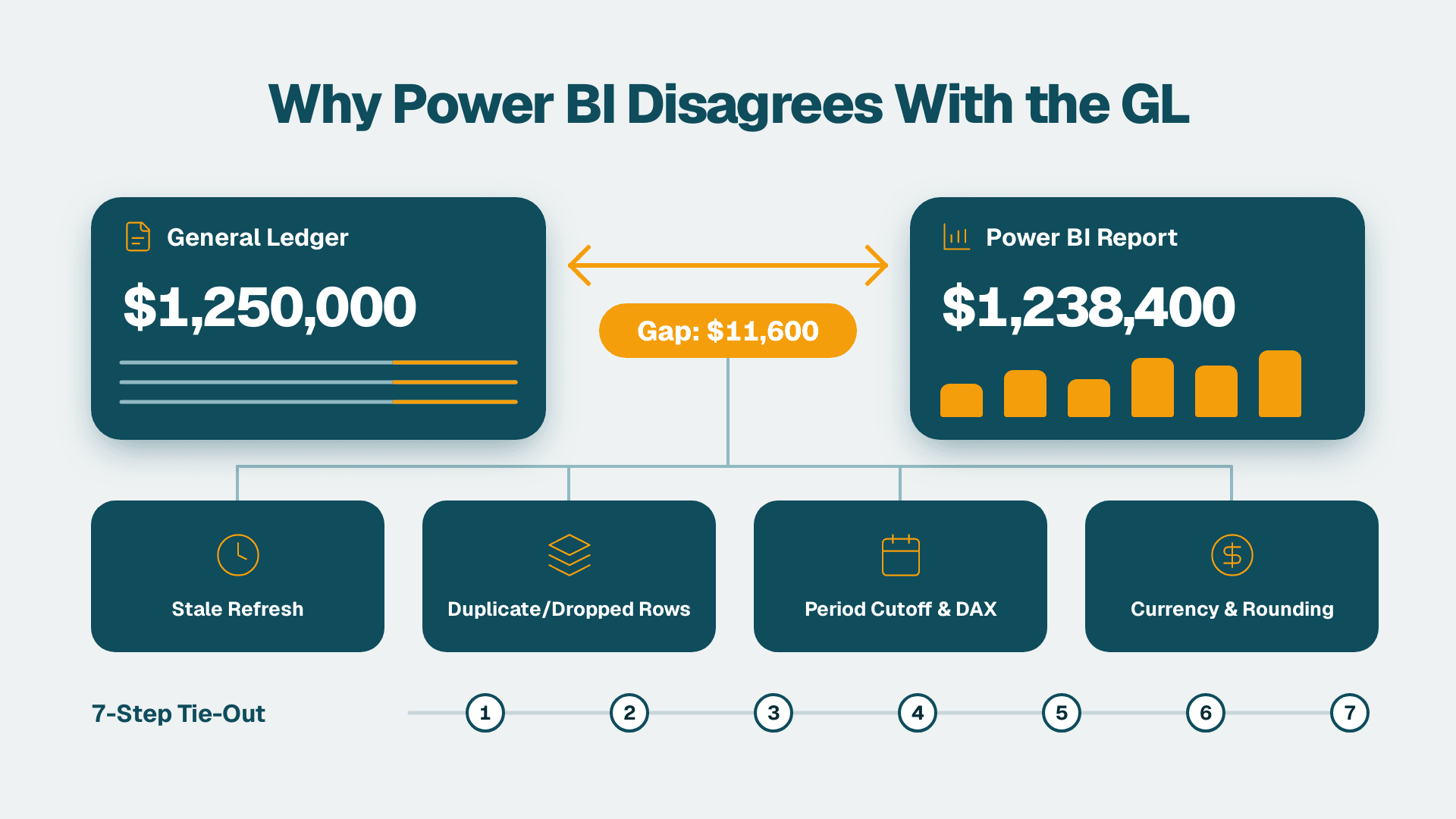
Where rules handle the backbone: Journal entry posting, balance sheet reconciliation against a fixed chart of accounts, automated variance alerts, and currency conversion at published exchange rates all follow deterministic logic. A mid-market US manufacturer might use a workflow orchestrator to schedule these tasks nightly, feeding results into a finance reporting layer. There is no ambiguity in "if GL balance differs from bank statement by more than $500, raise a variance alert" - rule-based automation handles it cleanly, with a full audit trail that satisfies SOC 2 requirements.
Where agents handle the exceptions: The same team's vendor master data typically contains years of accumulated inconsistencies - different legal entity spellings, merged supplier records, missing tax IDs. An AI agent can read unstructured vendor onboarding emails, cross-reference against existing records, and propose deduplication without requiring the finance director to write a bespoke rule for every naming variant. Contract review for early-payment discount eligibility is another clear agent task: clause language varies by supplier agreement in ways that resist standardization.
For teams asking where to start with AI automation for finance teams, the sequencing is consistent: automate the deterministic backbone first - reconciliation, scheduling, variance alerts - then layer agents on top for judgment-intensive exceptions. Our AI Automation for Accounts Payable: A Process Walkthrough maps this sequence for the AP function specifically.
When evaluating tooling for the deterministic pipeline layer - workflow orchestrators like n8n for connecting APIs and scheduling repeatable tasks versus LLM-native agent builders for finance automation that requires reasoning over content - the key distinction is structural: orchestrators handle the "when and what"; agents handle the "how and why." Mature finance automation stacks typically use both in sequence. For reporting visibility across the automated close process, a Looker Studio finance reporting dashboard gives finance directors live status without requiring direct engineering access to the underlying pipeline.
What Does AI Agent Automation Look Like in Healthcare?
Healthcare automation operates under tighter constraints than almost any other sector. In the US, HIPAA governs what data can be processed, where it can be stored, and who can access it. In Canada, PIPEDA and provincial privacy laws apply to personal health information. In the UK and EU, GDPR's special-category data rules govern clinical records and require data minimization by design.
These constraints favor rule-based automation for data movement - structured, certified transfers of appropriately authorized records between compliant systems - and AI agents for interpretation tasks that would otherwise demand clinical staff time.
A representative US scenario: a regional hospital network uses rule-based automation to pull admission records from its EHR on a fixed schedule, aggregate them into a structured data model, and refresh a healthcare Power BI reporting layer every four hours. HIPAA compliance is tractable because the automation touches only predefined fields through certified API endpoints, with no reasoning step that could deviate from the approved data flow.
The same network then deploys an AI agent for discharge summary triage. The agent reads free-text clinical notes, identifies patients who may meet criteria for a follow-up care protocol, and generates a structured referral recommendation for a care coordinator to review and confirm before any record is updated. Nothing is written to the EHR directly by the agent - it produces a draft; a human approves. This human-in-the-loop design reflects the standard governance posture for AI-assisted clinical workflows consistent with NHS Digital guidance on responsible AI deployment in clinical settings.
A Canadian hospital group facing similar workflows under PIPEDA applies the same layered approach: deterministic rules for certified data ingestion and movement, agents for interpretation tasks that output recommendations rather than direct writes. For the IT governance layer that sits above both automation types, ServiceNow ITSM for Healthcare IT Teams: HIPAA, GDPR & PIPEDA addresses how to manage the incident, change, and compliance workflows that enterprise healthcare automation requires.
How Do You Build a Decision Framework for IT and Ops Leaders?
A repeatable five-checkpoint framework for choosing between AI agents and rule-based automation covers the core decision in operational terms rather than theoretical ones:
1. Map the input surface. List every data type entering the process. Structured fields from a certified API support rule-based automation. Free text, variable-format documents, or images indicate an agent is likely required at that stage.
2. Count exception rates over three months. Pull process logs and count human interventions. A rate below 5% supports a rule set. A rate above 15% signals that judgment is required and an agent should be evaluated.
3. Identify compliance boundaries. HIPAA, GDPR, PIPEDA, and SOC 2 all carry expectations about automated decision-making. Deterministic systems are easier to audit and certify. If an agent makes a consequential decision - a credit approval, a care pathway selection, a fraud classification - you need explainability logging and a documented human-approval checkpoint before that decision takes effect.
4. Cost the inference budget. LLM calls are not free. For a 10,000-transaction-per-day process, even concise prompts accumulate material annual cost. Rule-based automation at equivalent volume costs near zero per run. Calculate the full inference cost before defaulting to an agent for a high-volume, low-complexity workflow.
5. Design for outcome verification, not just output verification. This is the step most teams miss.
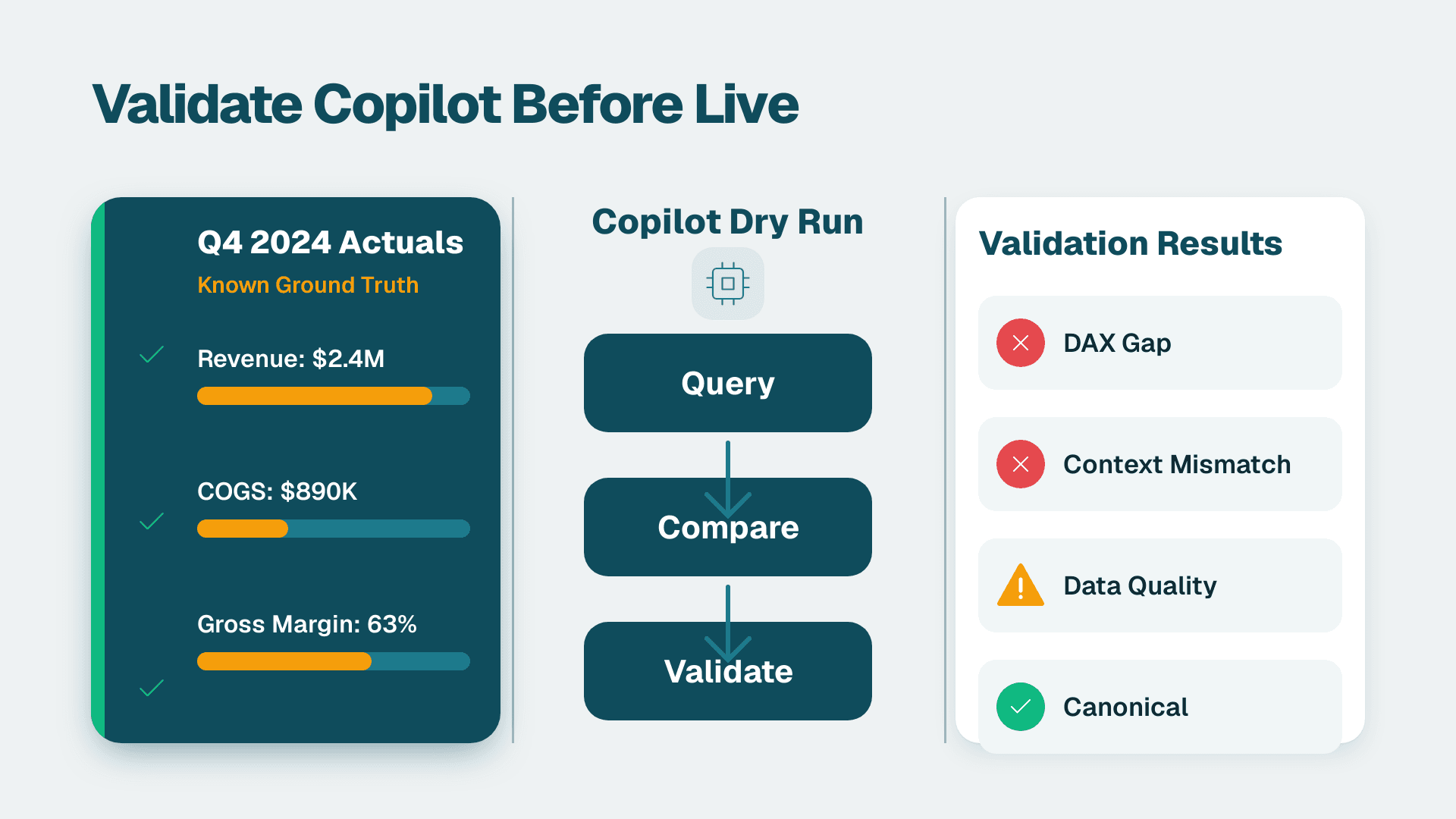
We encountered this failure mode directly in our own automation stack. Twenty-six auto-generated site-performance fix tasks accumulated in our system, all marked "resolved." Google's Core Web Vitals report held flat at 405 flagged URLs throughout. "Resolved" meant a human had read the recommendation - not that any code had shipped. The automation completed its output step perfectly and failed its outcome step entirely. Agents must verify outcomes, not outputs - which means the workflow must query the downstream system after taking action and confirm that the state actually changed.
What Are the Risks of Getting This Choice Wrong?
Deploying an AI agent where a rule set would do creates unnecessary cost, latency, and compliance exposure. Agents can produce unexpected outputs under edge conditions; deterministic systems cannot. For a US healthcare payer processing prior authorization requests under strict HIPAA timelines, an agent that misreads ambiguous policy language and approves an out-of-network claim creates liability that a rule - checking plan code against a certified network list - never would.
Deploying a rule set where an agent is needed creates brittle automation that breaks on the first exception it was not written to handle. A UK financial advisory firm that routes client complaint emails by keyword matching will inevitably mis-route a message that uses different phrasing, creating regulatory exposure under FCA conduct rules.
The riskiest pattern is automation that looks complete but is not: a pipeline where tasks transition to "done" without any verification against the downstream system the automation is meant to affect. Before deploying either type, define what success looks like in the EHR, the bank statement, the regulator's portal, or whatever authoritative external system sits downstream - and build a verification step against that system into the workflow itself.
For teams building the data foundation that makes outcome verification tractable, Fabric Lakehouse Finance Analytics: Power BI Reporting for FP&A covers how to construct the reporting layer that surfaces pipeline health alongside business outcomes.
If your organization is working through this decision - whether to invest in workflow automation, AI agents, or a layered combination - our AI automation consulting team can map your process inventory, score each workflow against this framework, and design the compliant, outcome-verified stack that fits your budget and regulatory environment.
---
About Lets Viz: Lets Viz has delivered analytics and AI automation engagements since 2020 across US healthcare systems, UK fintech firms, Canadian manufacturing operations, and global SaaS companies. The practice holds a 5.0 Clutch rating and specializes in helping mid-market CIOs and finance directors build automation stacks that are auditable, compliance-ready, and genuinely outcome-verified - not just output-complete.