10 AI-Generated Reports Audit Questions for Finance Teams 2026
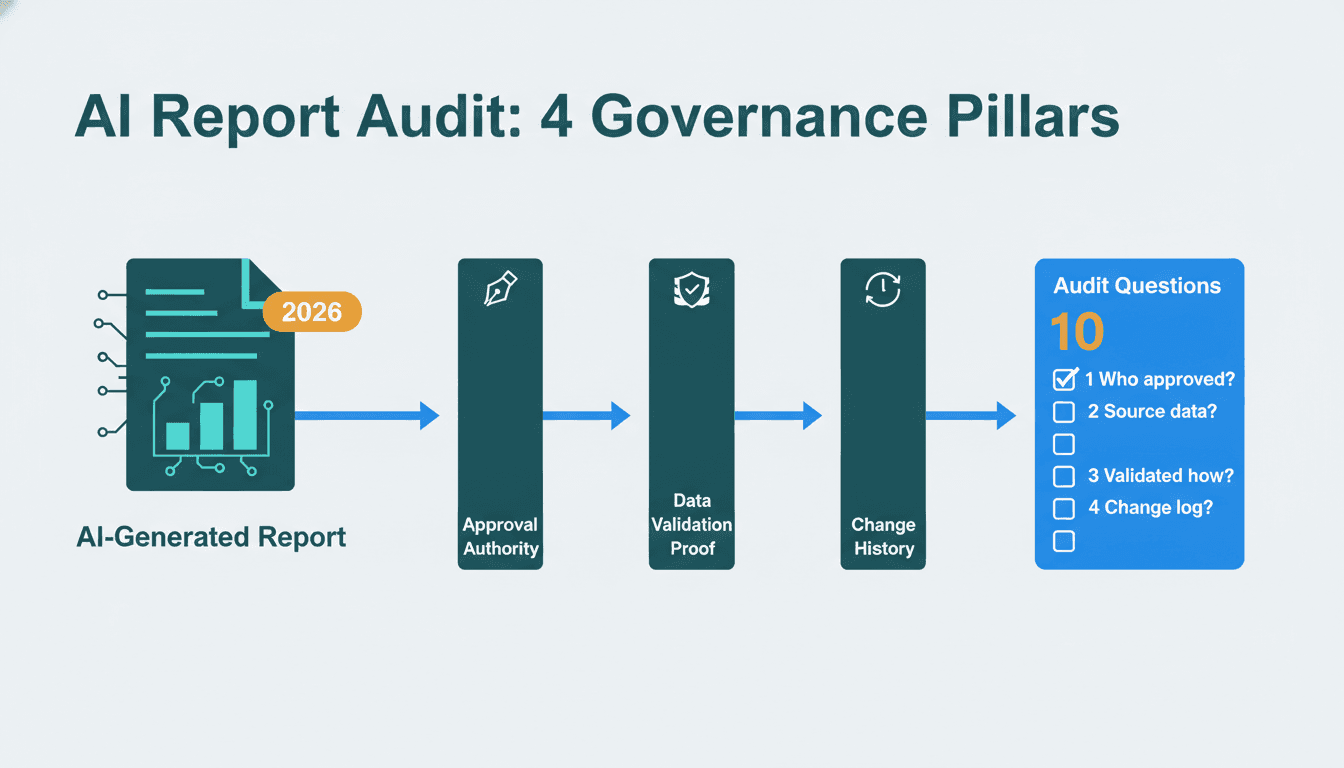
Finance and BI teams using AI tools - including Microsoft Copilot for Power BI - face a new category of audit scrutiny in 2026. Auditors now ask four core questions for every AI-generated output used in external reporting: who approved it, where did the underlying data come from, how was the output validated before it was used, and what is the documented change history? Mapping each question to a specific artifact closes the governance gap before an auditor opens the request.
Key Takeaways
- The four documentation pillars for AI-generated reports are: approval authority, data source lineage, validation method, and change log.
- Microsoft Copilot for Power BI (per 2025 Microsoft documentation) generates natural-language summaries and DAX suggestions that require human sign-off before entering any reportable figure.
- Finance teams should maintain an AI Report Register - a log of every Copilot-generated output used in board packs, regulatory filings, or external disclosures.
- GDPR (UK/EU), SOC 2 and HIPAA (US), and PIPEDA (Canada) each carry different retention obligations for AI-assisted financial outputs.
- Preparing the documentation pack before the auditor asks is faster than reconstructing audit trails under examination pressure.
What Are AI Generated Reports Auditor Questions and Why Do They Matter in 2026?
AI generated reports auditor questions are the structured inquiries an internal or external auditor directs at a finance or BI team to establish the reliability, traceability, and governance of any output produced or materially shaped by an AI system. In 2026, with tools like Microsoft Copilot embedded directly into Power BI service and Microsoft 365, auditors can no longer assume a human calculated every figure in a board pack or investor disclosure.
For teams evaluating Power BI consulting (Copilot-ready) engagements, understanding what an auditor will ask before deployment is the difference between a smooth AI adoption and a remediation project run under audit pressure.
Microsoft's documentation for Copilot in Power BI (2025) describes AI-generated insights as suggestions that require user review before publication. That framing carries a governance obligation: every Copilot output used in a reportable context needs a human reviewer, and that reviewer needs to be identifiable by name, role, and date.
The shift is structural. Traditional financial report audits focused on formula accuracy, data completeness, and accounting judgement. AI governance audits add a further layer: the method by which an automated system produced or influenced a figure is now subject to the same evidentiary standard as the figure itself.
What Documentation Do Auditors Require for AI-Generated Financial Reports?
Auditors in 2026 require evidence across four pillars: approval authority, data source, validation method, and change log. Each pillar maps to a specific document or system record that your team should maintain as a standard output of the reporting process.
| Audit Pillar | What Auditors Ask | Required Documentation |
|---|---|---|
| Approval Authority | Who approved this AI output for use? | Sign-off log with name, role, date, and report version |
| Data Source | Where did the underlying data originate? | Data lineage record with source system, dataset name, and refresh timestamp |
| Validation Method | How was the AI output checked before use? | Validation checklist: cross-check method, variance threshold, comparison baseline |
| Change Log | What changed between report versions? | Version history with rationale for each change, linked to approver |
A US SaaS finance team preparing for a SOC 2 Type II audit would need to demonstrate that every Copilot-generated revenue summary in their board pack was reviewed and approved by a named finance controller before distribution. A UK fintech firm subject to GDPR would additionally need to show that no personal data underpinned the AI output without a documented lawful basis - and that the output was not used in a decision triggering Article 22 explainability obligations without a human review record. A Canadian manufacturing company subject to PIPEDA would need a written retention schedule, typically aligning to the Canada Revenue Agency's seven-year standard for financial records.
The 10 AI Generated Reports Auditor Questions for 2026
These are the specific questions BI leads and finance directors are encountering in AI governance audits across mid-market organizations. Each question maps to a documentation artifact your team should have ready before the audit begins.
1. Who approved this AI-generated output before it entered the report?
Required documentation: A named approval log showing the reviewer's full name, role (Finance Controller, CFO, or equivalent), the scope of what was approved, and the date. Power BI workspaces support comments and activity logs that can be configured to anchor this record inside the platform.
2. What was the data source for this AI summary or projection?
Required documentation: A data lineage record showing the source system (ERP, CRM, data warehouse), the Power BI dataset name, and the confirmed last-refresh timestamp at the time the output was generated. Microsoft Fabric's delta table architecture and audit trail capabilities provide schema evolution history that satisfies this requirement natively when Fabric is part of the stack.
3. How was the AI output validated before being used in a reportable figure?
Required documentation: A validation record showing the specific method applied - comparison to the prior period, cross-check against the source system total, or a variance threshold rule that flagged the output for manual review if it exceeded a defined percentage change. The record should name the person who performed the validation, not just the method.
4. What is the change log for this report version?
Required documentation: A version history record capturing what changed between the current and prior versions of the report, who made the change, when, and why. Power BI deployment pipelines provide a technical record; finance teams should supplement this with a plain-language change rationale that non-technical auditors can follow without navigating the platform.
5. Was the AI model, prompt, or configuration modified between reporting periods?
Required documentation: A prompt or configuration change log. If your team uses Copilot with custom instructions or a saved prompt library, any modification to those instructions constitutes a material change to the output methodology and must be documented with the same rigour as a formula revision in a traditional financial model.
6. What human oversight was applied to this AI-generated forecast?
Required documentation: A review record showing the name and role of the person who assessed the AI forecast, the method used to evaluate reasonableness (management estimate comparison, sensitivity analysis, or peer review), and the outcome of that review including any adjustments made to the output before it was used.
7. Is the AI output reproducible from the documented data source?
Required documentation: Evidence that the same output can be reproduced by running the same prompt against the same dataset snapshot - or, where Copilot outputs are non-deterministic, a captured record of the specific output that was reviewed and approved. This matters especially for AI anomaly detection use cases in financial reporting, where the flagged exceptions form part of the audit trail and must be tied to a fixed output state.
8. How is access to the AI tool governed and restricted?
Required documentation: A role-based access control record showing who holds Copilot permissions in the context of financial reporting, when those permissions were last reviewed, and whether any access was revoked in the period under audit. Power BI workspace access controls and row-level security form part of this evidence pack.
9. What is the retention policy for AI-generated outputs used in financial reporting?
Required documentation: A written retention policy specifying how long AI-generated outputs, approval logs, validation records, and change logs are kept. US SOC 2 and HIPAA standards, GDPR's storage limitation principle in UK and EU, and PIPEDA's accountability obligations in Canada each impose distinct requirements. The policy should address the most stringent jurisdiction applicable to your reporting context.
10. Has the AI system ever produced output that materially differed from the source data?
Required documentation: A discrepancy log or exception register recording any instance where a Copilot summary, projection, or recommendation was found to be materially inconsistent with the underlying source data - together with the resolution, the correction applied, and the name of the person who identified and resolved the discrepancy.
How Do You Build an AI Report Register?
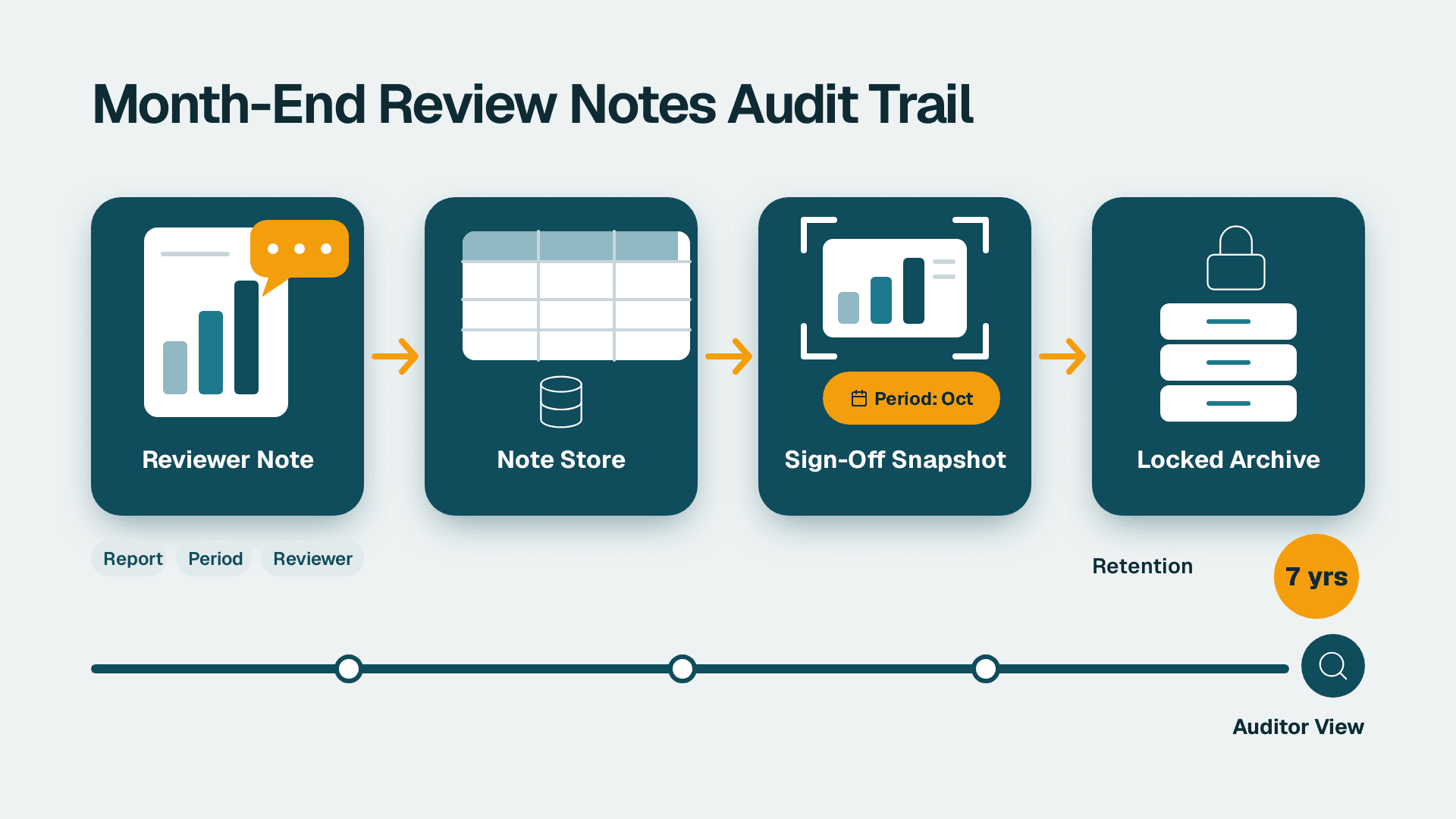
An AI Report Register is a structured log of every AI-generated output used in a reportable context. For most mid-market teams, a maintained spreadsheet or structured list in a project management tool is a sufficient starting point. Each entry should capture: report name, output type (summary, projection, anomaly flag, narrative), date generated, data source and refresh timestamp, validation method applied, approved by (name and role), and the version number linked to the report's version control record.
The governance principle is straightforward: if an auditor asks "show me every AI-generated figure that appeared in your Q3 board pack," your team should be able to answer within one business day - not two weeks of manual reconstruction.
Teams running automated month-end financial close pipelines should wire the register update directly into the pipeline so that every time a Copilot output is surfaced in a published report, the register entry is created or updated automatically. Automating the register itself eliminates the risk of it falling behind the reporting cadence.
How Do You Document AI Report Approvals to Satisfy an Auditor?
Documenting approval authority is the most common gap auditors find in first-time AI governance reviews. An audit-grade approval record needs three elements: identity (full name and role of the approver, not a shared account username), scope (the specific report version, dataset, and reporting period covered by the approval), and timing (a timestamp confirming the approval was made before the output entered the reportable figure, not reconstructed after the fact).
Power BI Service's workspace activity log records user actions at a technical level but does not constitute a formal approval record on its own. Finance teams need an explicit approval step - a structured workflow task, a formatted workspace comment, or a sign-off communication with a date record - that can be presented independently of the platform's native logs.
The pattern for structured approval workflows in low-code platforms applies directly here: define the approver role, route the output to them, capture the decision with a timestamp, and archive the record against the report version. Teams that have already built approval workflows for operational processes will recognize the same logic applied to BI governance.
What Compliance Frameworks Apply to AI-Generated Reports in the US, UK/EU, and Canada?
AI-generated financial reporting sits at the intersection of existing audit standards and emerging AI governance requirements. In 2026, no single jurisdiction has a dedicated AI report audit standard, but obligations cascade from frameworks already in force.
United States: SOC 2 Type II engagements increasingly include AI tool governance under the availability and processing integrity criteria. For US healthcare finance teams, HIPAA's minimum-necessary standard applies to any patient-linked financial data used as input to a Copilot prompt. Finance teams should review Power BI RLS and HIPAA data protection controls before enabling Copilot on datasets containing any protected health information.
United Kingdom and European Union: GDPR Articles 5, 13, and 22 apply where personal data is processed as part of the AI input or where AI outputs inform decisions about individuals. Article 22's restrictions on solely automated decision-making require a documented human review step for any Copilot output that directly drives a consequential financial decision. UK-listed companies should also track FRC guidance on digital reporting, which increasingly addresses AI-assisted disclosure.
Canada: PIPEDA's accountability principle requires organizations to name a responsible role for AI governance compliance - which in practice means designating who is accountable for approving and validating AI-generated financial outputs. Canadian finance teams should document that designation and review it annually as part of their governance programme.
How Should Finance Teams Prepare for an AI Governance Audit?
The core preparation principle is: document prospectively, not retrospectively. A documentation pack assembled under audit examination pressure will have gaps that a prospectively maintained pack will not. Here is a practical readiness checklist for BI leads heading into a 2026 AI governance review:
- [ ] Maintain an AI Report Register for all Copilot-generated outputs used in external or board reporting
- [ ] Implement a named approval workflow before any AI output enters a reportable figure
- [ ] Document the data source and last-refresh timestamp for every AI-assisted report at the time of generation
- [ ] Maintain a prompt and configuration change log versioned to match report versions
- [ ] Write a validation record for each AI output: what was checked, by whom, and how
- [ ] Draft a retention policy addressing SOC 2 and HIPAA, GDPR, and PIPEDA as applicable
- [ ] Run a tabletop exercise: given last quarter's board pack, can your team answer all 10 questions above within two business days?
A lesson from our own automation practice is directly relevant here. A set of 26-plus auto-generated fix recommendations sat marked "resolved" in a workflow system while the underlying performance metric remained entirely unchanged. "Resolved" meant a human had read the recommendation - not that any corrective action had shipped. The same failure mode applies to AI report governance: an approval field marked "reviewed" must represent a substantive check against the source data, not simply that the report was opened.
When evaluating how to deploy Copilot-ready analytics responsibly, working with a consultant who installs governance infrastructure from the first sprint - not as a retrofit - reduces audit remediation risk materially. Teams considering a Copilot deployment should include AI governance documentation standards as a scope requirement from day one.
---
About Lets Viz: Lets Viz has delivered Power BI, Fabric, and analytics governance engagements since 2020, working with finance and BI teams in US healthcare, UK fintech, Canadian manufacturing, and global SaaS organizations. The firm holds a 5.0 rating on Clutch based on verified client reviews and specializes in governance-first BI deployments that satisfy audit requirements before they are tested in the field.
If your team is preparing for an AI governance review or deploying Copilot in a regulated reporting environment, Power BI consulting (Copilot-ready) covers documentation frameworks, approval workflows, and audit-ready data lineage as standard engagement deliverables.