AI Anomaly Detection in Financial Reporting: 2026 Guide
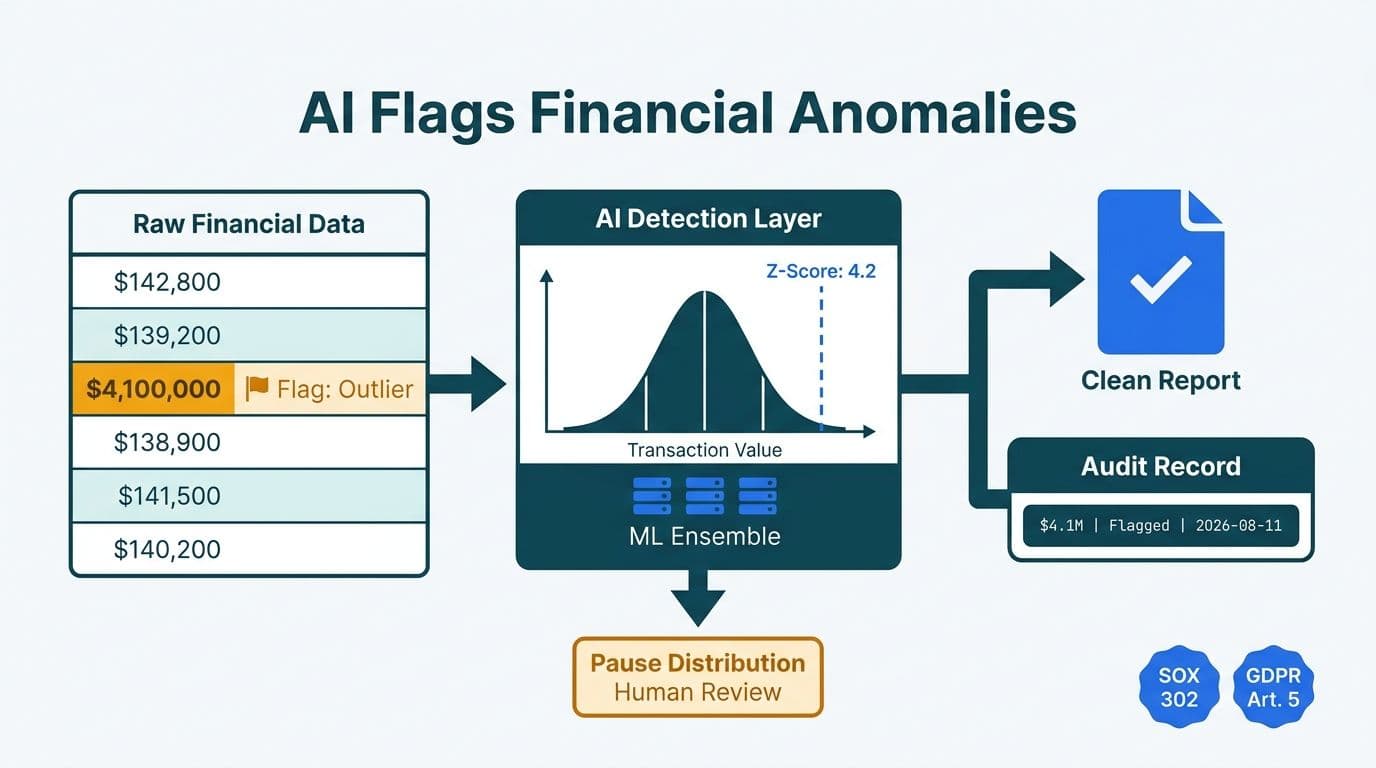
AI anomaly detection in financial reporting uses statistical baselines and machine learning to flag outliers, duplicates, and data-entry errors before reports reach executives or auditors. When a figure deviates beyond a learned tolerance, the system pauses distribution, routes the item to a human reviewer, and writes a timestamped audit record - a workflow that satisfies SOX Section 302, GDPR Article 5(1)(f), and PIPEDA Principle 7.
Key Takeaways
- AI detection methods range from simple z-score thresholds to ensemble machine learning models - match the method to your data volume and variance.
- Human-review checkpoints are not optional: regulators in the US, UK/EU, and Canada all require traceable human sign-off on flagged anomalies.
- SOX, GDPR, and PIPEDA each impose distinct audit trail immutability and retention requirements.
- Automated reporting tools for professional services firms can reduce pre-distribution review cycles from days to hours when detection is tuned correctly.
- Most mid-market teams benefit from engaging AI automation consulting before building detection pipelines in-house, because model selection mistakes compound over time.
What Is AI Anomaly Detection in Financial Reporting?
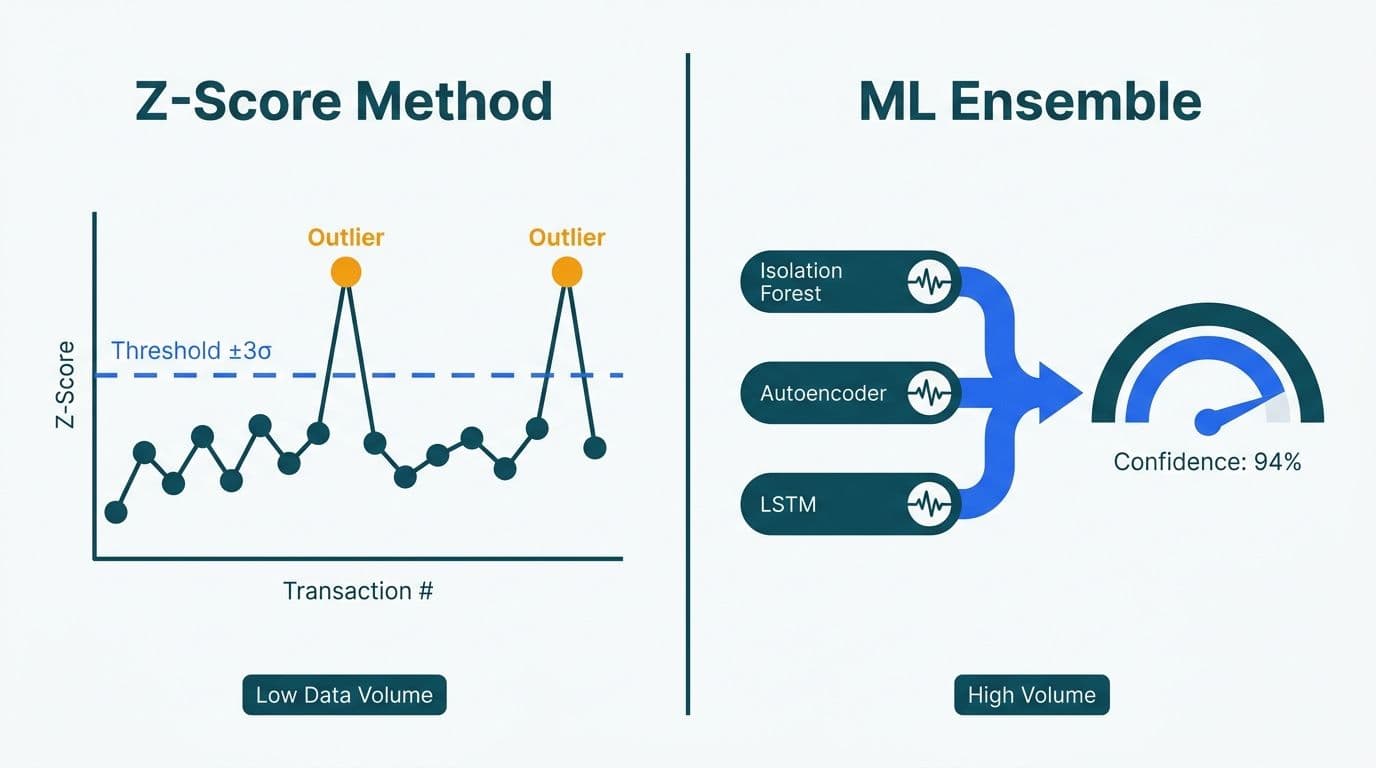
AI anomaly detection is the automated identification of data points that fall outside expected patterns in financial datasets - think a revenue figure that spikes 400% in a single day without a corresponding sales event, a duplicate journal entry posted twice in the same period, or a balance sheet field that returns a negative value where one cannot logically exist.
In financial reporting specifically, the term covers three categories of issues:
- Statistical outliers - values that exceed a learned or configured tolerance band (often expressed as standard deviations from a rolling mean).
- Structural errors - missing fields, broken foreign keys, mismatched period tags, or records dropped by a filter bug in the reporting pipeline.
- Semantic anomalies - figures that are individually plausible but contextually wrong (a Canada HST rate applied to a US invoice, or a GDPR data-subject category exposed in a field that should be anonymised).
Finance teams at US public companies, UK fintech firms, and Canadian manufacturing operations all share a common problem: reports compiled from dozens of source systems carry latent errors that manual spot-checking reliably misses. Automated detection layers address this gap before the report leaves the pipeline.
For organisations evaluating how detection fits into a broader data strategy, AI automation consulting provides the architecture review that prevents teams from solving the wrong problem - for instance, adding a detection layer on top of a broken ETL rather than fixing the root cause first.
How Does AI Flag Outliers and Data Errors Before Distribution?
The flagging process typically runs in four stages between data ingestion and report delivery:
1. Baseline computation. The system builds a rolling statistical profile for each metric - mean, standard deviation, and seasonal index - across a configurable lookback window (commonly 13 months to capture one full year plus the prior-year comparison period used in same-period-last-year analysis).
2. Threshold evaluation. Each incoming value is compared against its baseline. Simple z-score rules handle high-confidence bright-line violations (a negative accounts-receivable balance). Isolation Forest or LSTM models handle subtler deviations in time-series data where variance is expected but extremes are not.
3. Contextual enrichment. A flagged value is cross-referenced with upstream sources. If revenue is up 40% but no new deals are recorded in the CRM, the flag is elevated. If a shipment-volume anomaly coincides with a known port delay, the flag may be suppressed. This context layer is what separates production-grade detection from simple threshold alerting.
4. Distribution hold. The report scheduler pauses the send queue. A notification routes the flagged item to the assigned reviewer with supporting evidence: the current value, the historical baseline, the z-score, and a link to the source record.
The full cycle - from data landing to distribution hold - typically completes in under five minutes for report sets under 100,000 rows, which means a 06:00 report scheduled for an 08:00 board meeting still has a meaningful human review window.
What AI Detection Methods Work Best for Financial Data?
For most mid-market finance teams, a two-tier combination of rule-based engines and a statistical outlier model delivers the highest signal-to-noise ratio. No single method covers every financial reporting scenario. The table below maps common detection approaches to their practical use cases:
| Detection Method | Best For | Typical Financial Use Case | Key Limitation |
|---|---|---|---|
| Z-score / IQR thresholds | Simple outlier detection | Expense lines exceeding rolling average | Fails with heavy seasonal variance |
| Isolation Forest | High-dimensional datasets | Multi-ledger journal entry review | Requires sufficient historical volume |
| LSTM neural networks | Time-series prediction | Period-over-period revenue anomalies | Computationally expensive to retrain |
| Rule-based engines | Regulatory bright lines | Missing GL codes, negative balances | No adaptive learning |
| Ensemble models | Mixed data quality environments | Combined financial and operational data | Higher implementation complexity |
Healthcare finance teams in the US face an additional layer: anomaly detection rules must not inadvertently create audit trails that expose protected health information (PHI) in violation of HIPAA. Any flag record that references a patient-linked billing code requires the same de-identification controls as the underlying report. The AI Automation Compliance Checklist for Finance Teams covers this intersection in detail.
A concrete illustration of what happens without a structural detection layer: an air-quality remediation company we worked with had revenue reports that quietly dropped invoices each reporting cycle. Scanning all 9,500 invoices in their field-service management system uncovered 175 orphaned records that a date-filter bug had excluded from the reporting join. The fix was upstream - in the ingest logic - not in the report template. A detection layer watching for period-over-period revenue variance would have surfaced the discrepancy weeks before a manual audit found it.
How Do Human-Review Workflows Integrate with AI Detection?
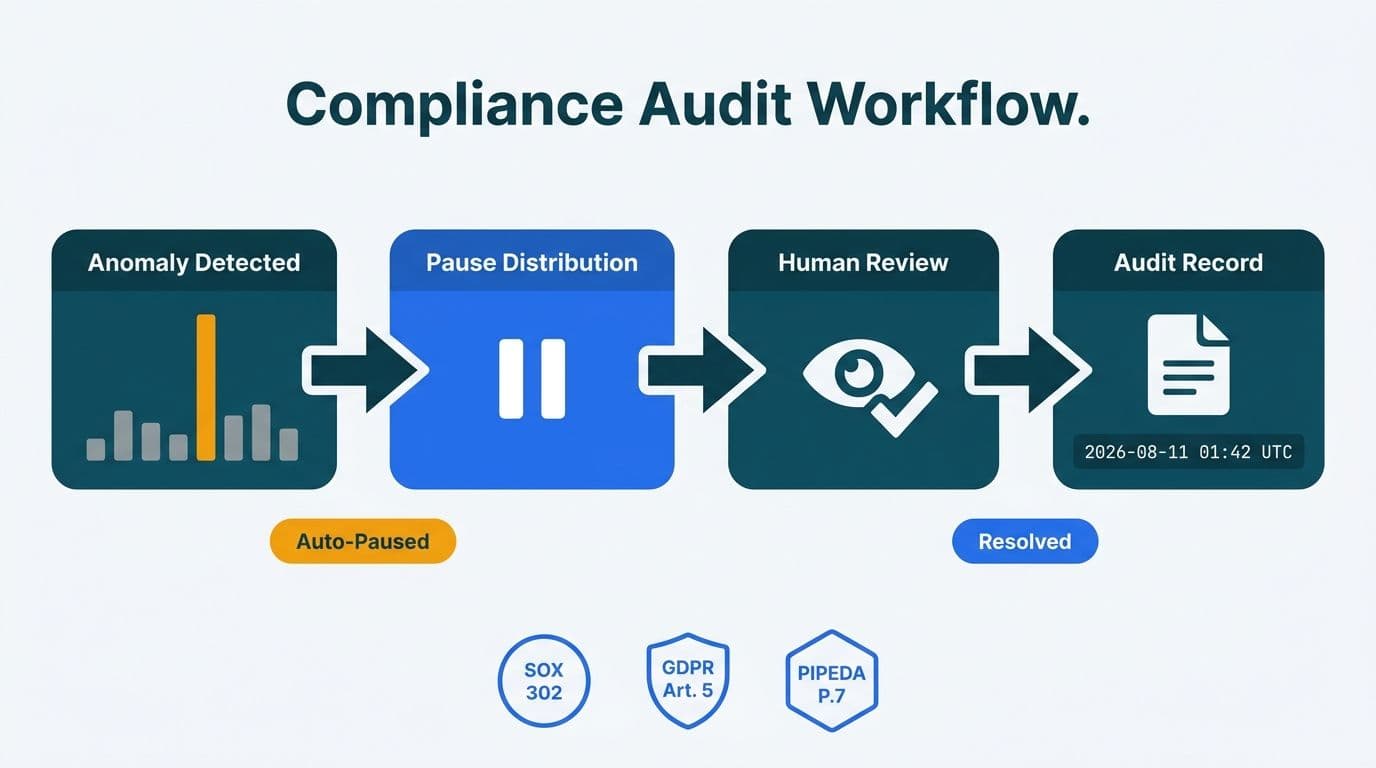
AI detection is not a replacement for human judgement - it is a triage mechanism that ensures reviewers spend time on items that actually need attention. A well-designed workflow has three gates:
Gate 1 - Automated resolution. A subset of flags resolves without human input: duplicate records that can be merged by rule, fields re-populated from a secondary source, or variance within a pre-approved tolerance band that finance leadership has signed off on. These are resolved, logged, and released automatically.
Gate 2 - Reviewer queue. Flags exceeding automatic resolution thresholds land in a prioritised queue. The reviewer sees the flagged value, the historical baseline, the z-score, and a recommended action (approve, reject, escalate). Crucially, the reviewer cannot modify the underlying flag record - only the report state. The immutable flag log is preserved regardless of what the reviewer decides.
Gate 3 - Escalation. If a reviewer approves a flagged item that a secondary model considers high-risk, a senior sign-off is required before distribution proceeds. This two-person rule mirrors the segregation-of-duties principle embedded in SOX Section 404 and satisfies the four-eyes principle increasingly referenced in UK Financial Conduct Authority (FCA) guidance on algorithmic decision-making in finance.
For a UK fintech firm operating under both UK GDPR and FCA oversight, the reviewer workflow must also log the data controller's name and the lawful basis under which any flagged personal data was accessed during review - a requirement that most out-of-the-box reporting tools do not handle natively.
For Canadian organisations subject to PIPEDA, the Accountability Principle (Principle 1) requires a named individual to be responsible for each processing step. Human-review workflows should map each gate to a named role, not just a team, so that accountability is unambiguous during a regulatory examination.
Automated reporting tools for professional services firms - legal, accounting, and consulting practices that file detailed financial disclosures - increasingly embed these gate structures in their pre-built approval workflows. When evaluating platforms, confirm that the gate log is write-once and that reviewer identity is authenticated, not self-declared.
What Audit Trail Requirements Apply Under SOX, GDPR, and PIPEDA?
SOX (US), GDPR (UK/EU), and PIPEDA (Canada) each impose distinct immutability, retention, and accountability obligations that AI anomaly detection systems must satisfy. Audit trail requirements differ in scope and emphasis. The table below summarises the key differences:
| Requirement | SOX (US public companies) | UK/EU GDPR | PIPEDA (Canada) |
|---|---|---|---|
| Immutability | Yes - no deletions after period close | Yes - Article 5(1)(f) integrity and confidentiality | Yes - reasonable security safeguards |
| Retention period | 7 years (Section 802) | Duration of processing plus limitation period | As long as reasonably required |
| Who is logged | All reviewers and approvers | Data controller and processors | Named accountable individual |
| Scope | Financial statement controls | Any processing touching personal data | Personal information in any form |
| Machine-generated logs | Acceptable as primary evidence | Acceptable with controller attestation | Acceptable with accountability mapping |
| Cross-border transfer rules | N/A for domestic records | Adequacy decision or SCCs required | PIPEDA Schedule 1, Principle 7 |
SOX Sections 302 and 404 require that executives certify the effectiveness of internal controls over financial reporting. An anomaly detection system must produce evidence - time-stamped, role-attributed, and tamper-evident - that each flag was reviewed before the report was distributed. Cloud object storage services that support WORM (Write Once, Read Many) locking satisfy the immutability requirement without proprietary archive infrastructure.
UK and EU GDPR applies wherever financial reports process personal data - common in payroll cost centres, healthcare billing, and any report that includes named individuals. Article 5(1)(f) requires protection against unauthorised access and accidental loss or destruction. An anomaly flag that references a personal data record must itself be stored with the same access controls as the underlying data.
PIPEDA in Canada is principles-based rather than prescriptive. Principle 7 (Safeguards) requires that personal information be protected by security safeguards appropriate to the sensitivity of the information. Anomaly detection logs containing financial data linked to individuals - common in healthcare revenue cycle or insurance claim reporting - need encryption at rest, access controls, and a documented retention schedule.
Organisations operating across all three jurisdictions - a scenario common in US-headquartered firms with Canadian subsidiaries and EU data subjects - should model their audit trail on the most restrictive common denominator, which in practice means GDPR-level controls applied globally.
For a deeper look at governance architecture supporting these requirements, the Power BI Governance Best Practices: 12-Point Checklist covers role-based access, row-level security, and retention policy configuration in a reporting stack context.
When Should You Build vs. Hire for AI Reporting Automation?
The AI reporting automation build-vs-hire decision turns on three variables: data volume, regulatory complexity, and internal ML capacity.
Build internally if:
- Your data engineering team already maintains the ETL pipeline and can extend it with detection rules without adding headcount.
- Your anomaly patterns are well-understood, stable, and expressible as deterministic rules rather than learned models.
- You have a compliance officer who can own the audit trail specification and validate it against applicable regulations before go-live.
Engage an AI reporting automation consultant if:
- You are operating under two or more regulatory frameworks (the SOX-GDPR-PIPEDA combination is the most common cross-border scenario).
- Your finance data arrives from multiple source systems with inconsistent schemas - a common situation in post-merger environments.
- Your internal team understands the business rules but lacks the time or expertise to translate them into detection thresholds and model training sets.
For most mid-market organisations, the first internal build surfaces a model selection problem: teams default to z-score thresholds for everything, miss seasonal anomalies that a simple LSTM would catch, and lose confidence in the system after a run of false positives. A consultant brings a working method-selection framework and accelerates time-to-confidence significantly.
The When to Outsource Finance Analytics Consulting: CFO Guide provides a structured framework for this decision, including a readiness checklist that maps internal capabilities against implementation complexity.
A typical mid-market engagement - covering detection model selection, reviewer workflow design, and audit trail specification for a single regulatory framework - runs six to twelve weeks. Cross-border compliance scoping (SOX plus GDPR plus PIPEDA) adds four to six weeks for the regulatory mapping exercise alone.
---
About Lets Viz: Lets Viz is a data analytics and AI automation consultancy serving US healthcare, UK fintech, Canadian manufacturing, and global SaaS clients since 2020. The practice holds a 5.0 Clutch rating across engagements covering anomaly detection, reporting governance, and compliance-aligned analytics architecture. Our team designs detection pipelines and human-review workflows that satisfy multi-jurisdiction audit trail requirements - and we validate every system against source data before it goes live.
Ready to build a financial reporting layer that catches errors before they reach your stakeholders? Explore AI automation consulting to see how Lets Viz designs anomaly detection and human-review workflows for finance teams across the US, UK, and Canada.