Dax Function: RRI
 Reviewed by Neetu Singla — Founder, Lets Viz Technologies — AI & Data Consultant. Last reviewed June 5, 2026.
Category: Financial Functions
The RRI function in Power BI calculates the equivalent constant interest rate needed to grow an investment from its present value to its future value over a given number of periods. It is primarily used for financial modeling and investment analysis.
Purpose
To determine the rate of return required for an investment to achieve a specific future value.
Useful for assessing the viability of investments or comparing investment opportunities.
Type of Calculations
Computes the geometric mean rate of return over a specified number of periods.
Provides insight into the annualized growth rate for investments.
Practical Use Cases
Investment Planning: Determine the annual return needed to reach a financial goal.
Performance Benchmarking: Compare the growth rate of different investments.
Scenario Analysis: Model various growth scenarios to evaluate potential outcomes.
RRI(nper, pv, fv)
| Parameter | Type | Description |
|---|---|---|
nper | Scalar | The number of periods over which the investment grows. |
pv | Scalar | The present value or starting amount of the investment. |
fv | Scalar | The future value or desired amount of the investment at the end of the periods. |
How Does RRI Dax Works
Mathematical Principle
The RRI function calculates the equivalent growth rate using the formula:
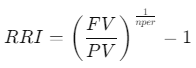
Where:
FV: Future Value
PV: Present Value
nper: Number of periods
Key Points
Assumes a constant growth rate over the entire investment period.
Can handle fractional periods for more accurate modeling.
What Does It Return?
Scalar Value: The constant growth rate (as a decimal) required to grow the investment from the present value to the future value over the given number of periods.
When Should We Use It?
Savings Goals: Determine the rate needed to achieve savings targets.
Retirement Planning: Calculate required return rates for retirement accounts.
Investment Comparisons: Compare growth rates across different investments or portfolios.
Examples
Basic Usage :
You want to grow $10,000 to $20,000 in 10 years. Calculate the required annual growth rate:
GrowthRate = RRI(Investments[Periods], Investments[StartValue], Investments[EndValue])
Result: Computes the growth rate for each investment.
Column Usage
For a table of investments:
| InvestmentID | Periods | StartValue | EndValue |
|---|---|---|---|
| 1 | 5 | 5000 | 7500 |
| 2 | 10 | 20000 | 40000 |
GrowthRate = RRI(Investments[Periods], Investments[StartValue], Investments[EndValue])
Result: Computes the growth rate for each investment.
Advanced Usage
Combine with other functions to calculate total portfolio return across different periods:
PortfolioGrowthRate =
RRI(SUM(Portfolio[Periods]), SUM(Portfolio[StartValue]), SUM(Portfolio[EndValue]))
Result: Provides the overall growth rate for a portfolio.
Tips and Tricks
Use consistent time units for
nper(e.g., years, months) to avoid incorrect results.Ensure that
pvandfvvalues are positive and logically consistent.A negative or zero
pvornperwill result in errors.Inconsistent time units can distort results.
Performance Impact of RRI DAX Function:
Optimized for individual calculations or small datasets.
For larger datasets, consider using aggregations or calculated columns to enhance performance.
Related Functions You Might Need
| Function | Description |
|---|---|
RATE | Calculates the interest rate per period for an investment or loan. |
FV | Computes the future value of an investment based on periodic payments and a constant interest rate. |
NPER | Determines the number of periods required to achieve a future value. |
XIRR | Calculates the internal rate of return for a series of cash flows. |
Want to Learn More?
For more information, check out the official Microsoft documentation for RRI You can also experiment with this function in your Power BI reports to explore its capabilities.
Unlock the full capabilities of Power BI and elevate your data insights with our specialized consulting services. Whether you need guidance on advanced DAX functions like those highlighted here, support in designing interactive dashboards, or expertise in optimizing data models for enhanced performance, our experienced Power BI consultants are equipped to deliver customized solutions for your business. Explore our Power BI Consulting Services page to discover how we can help your organization make smarter, data-driven decisions.
The RRI function computes the constant growth rate needed to grow an investment from a present value to a future value over a specific number of periods.
Yes, the RRI function can handle fractional periods, providing precise growth rates for non-integer durations.
The function will return an error, as these values are invalid for the calculation.
Yes, the RRI function calculates the equivalent constant growth rate, which aligns with the principles of compound interest.
Yes, the function can compute negative growth rates if the future value is less than the present value.
Need Power BI help in a real engagement?
Our team writes DAX like this every day for SaaS finance and ops teams. Refresh monitoring, change requests with a 2-business-day SLA, and a named analyst on retainer — or scoped hourly help if you just need a fix.
Named analyst2-day SLAFrom $5K/mo