Dax Function: DB
 Reviewed by Neetu Singla — Founder, Lets Viz Technologies — AI & Data Consultant. Last reviewed June 5, 2026.
Category: Financial Functions
The DB (Declining Balance) function in Power BI is used to calculate the depreciation of an asset for a specified period, based on the declining balance method. It allows for an accelerated depreciation schedule, meaning larger depreciation charges in the early years of an asset’s life.
Purpose
Provides a method to compute depreciation for assets in financial models.
Useful in creating asset amortization schedules and cost analyses.
Reflects real-world scenarios where assets lose value faster in their early years.
Type of Calculations
Computes accelerated depreciation for fixed assets.
Depreciation is calculated using a constant depreciation rate applied to the book value of the asset.
Practical Use Cases
Asset Depreciation: Calculate depreciation for machinery, vehicles, or equipment.
Financial Reporting: Create financial dashboards to monitor asset value over time.
Tax Calculations: Model tax liabilities using accelerated depreciation methods.
DB(cost, salvage, life, period, [month])
| Parameter | Type | Description |
|---|---|---|
cost | Scalar | The initial cost of the asset. |
salvage | Scalar | The salvage value of the asset (value at the end of its useful life). |
life | Scalar | The number of periods (useful life) the asset will be depreciated over. |
period | Scalar | The period for which depreciation is calculated. |
[month] | Scalar | (Optional) The number of months in the first year. Default is 12 months. |
How Does DB Dax Function Works
Declining Balance Formula:
Rate: The depreciation rate is calculated based on the formula:
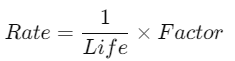
Where
Factoris a constant for accelerated depreciation.
Depreciation Schedule:
Depreciation in the early periods is higher as the book value is larger.
Depreciation gradually decreases as the book value reduces.
First-Year Adjustment (using the
[month]parameter):If the first year has fewer than 12 months, depreciation is prorated.
What Does It Return?
Returns a decimal value representing the depreciation expense for the specified period.
The value is negative, reflecting a reduction in the asset’s book value.
When Should We Use It?
When modeling asset depreciation in financial analyses.
For accelerated depreciation scenarios, such as vehicles or IT equipment.
When preparing financial statements that require accurate depreciation charges.
Examples
Basic Usage :
Calculate the depreciation for a machine costing $50,000, with a salvage value of $5,000, a useful life of 10 years, and a first-year period of 12 months:
DB(50000, 5000, 10, 1)
Returns: -9000.00 (Depreciation for the first period)
Column Usage:
Create a calculated column for a depreciation schedule:
Depreciation =
DB(
Assets[Cost],
Assets[Salvage],
Assets[Life],
Assets[Period],
12
)
This is useful for generating reports showing yearly depreciation for multiple assets.
Using the [month] Parameter
For the same machine, calculate depreciation for the first year with only 6 months:
DB(50000, 5000, 10, 1, 6)
Returns: -4500.00 (Prorated depreciation)
Tips and Tricks
Use consistent units (e.g., yearly or monthly) for
lifeandperiod.Apply the
monthparameter to account for partial years.Combine with cumulative functions to show total depreciation over time.
Ensure the
perioddoes not exceed the asset’slife; otherwise, depreciation may result in errors or zero.The function does not handle non-linear depreciation rates; use custom calculations if needed.
Performance Impact of DB DAX Function:
Efficient for small datasets but may require optimized queries for large-scale depreciation schedules.
Use aggregated calculations to reduce performance overhead.
Related Functions You Might Need
| Function | Description |
|---|---|
SLN | Calculates straight-line depreciation over the asset’s useful life. |
DDB | Calculates double-declining balance depreciation, an accelerated method. |
SYD | Calculates depreciation using the sum-of-years-digits method. |
PV | Computes the present value of future cash flows (e.g., asset value). |
Want to Learn More?
For more information, check out the official Microsoft documentation for DB You can also experiment with this function in your Power BI reports to explore its capabilities.
Unlock the full capabilities of Power BI and elevate your data insights with our specialized consulting services. Whether you need guidance on advanced DAX functions like those highlighted here, support in designing interactive dashboards, or expertise in optimizing data models for enhanced performance, our experienced Power BI consultants are equipped to deliver customized solutions for your business. Explore our Power BI Consulting Services page to discover how we can help your organization make smarter, data-driven decisions.
The DB function calculates depreciation for an asset using the declining balance method over a specified period.
The [month] parameter prorates the depreciation for the first year, allowing for partial periods.
DB: Uses a fixed declining balance rate.DDB: Applies a double-declining rate, leading to faster depreciation.
Yes, ensure the life and period parameters are adjusted to reflect monthly intervals.
Depreciation stops once the book value reaches the salvage value.
Need Power BI help in a real engagement?
Our team writes DAX like this every day for SaaS finance and ops teams. Refresh monitoring, change requests with a 2-business-day SLA, and a named analyst on retainer — or scoped hourly help if you just need a fix.
Named analyst2-day SLAFrom $5K/mo