Dax Function: LCM
 Reviewed by Neetu Singla — Founder, Lets Viz Technologies — AI & Data Consultant. Last reviewed June 5, 2026.
Category: Mathematical and Trigonometric Functions
The LCM function in Power BI is a mathematical DAX function used to calculate the Least Common Multiple (LCM) of two or more numbers. The LCM is the smallest positive integer that is evenly divisible by all the given numbers.
Purpose:
The purpose of the LCM function is to simplify operations involving multiples, especially in scenarios like scheduling, synchronization, and aligning periodic events.
Type of Calculations:
The LCM function performs integer-based calculations to determine the smallest common multiple of two or more numbers. It ensures accurate results even when handling large values.
Practical Use Cases:
- Scheduling tasks: To find a common time interval for recurring events or tasks.
- Inventory management: To determine order cycles for products with different restocking periods.
- Mathematical modeling: For calculations involving multiples in academic or engineering contexts.
LCM(<number1>, <number2>)</number2></number1>
| Parameter | Type | Description |
|---|
| number1 | Scalar | The first number for which the LCM is to be calculated. Must be an integer. |
| number2 | Scalar | The second number for which the LCM is to be calculated. Must be an integer. |
How Does LCM Dax Function Works?
The LCM function uses mathematical principles to compute the least common multiple by leveraging the formula:
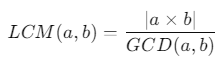
Where GCD is the greatest common divisor of the numbers. Power BI’s DAX engine computes the result efficiently, ensuring accuracy for large integers.
What Does It Return?
The LCM function returns a single scalar value representing the Least Common Multiple of the input numbers. The result is always a non-negative integer.
When Should We Use It?
- To synchronize time-based data: For example, aligning datasets with different refresh intervals.
- In project management: Finding the least common period to synchronize team tasks with varying durations.
- In resource planning: Calculating shared operational cycles.
Examples
Basic Usage
To find the LCM of 12 and 15:
LCM(12, 15)
Output:
60
Column Usage
To calculate the LCM of numbers in two columns:
LCM = LCM([Column1], [Column2])
Output: Using LCM with other DAX functions:
Advanced Usage
Using LCM with other DAX functions:
Adjusted Cycle = LCM(SUM('Sales'[Cycle1]), SUM('Sales'[Cycle2]))
Output:
This calculates the LCM of the sum of cycles from two columns.
Tips and Tricks
- Ensure all input values are integers; non-integer values will result in an error.
- Combine LCM with GCD for more advanced mathematical calculations.
- Use with aggregate functions like SUM or MAX to dynamically compute LCM for groups of data.
Performance Impact of LCM DAX Function:
The LCM function is optimized for scalar values and small datasets. For large datasets, ensure proper filtering to minimize performance overhead.
Related Functions You Might Need
- GCD: Finds the greatest common divisor of two numbers.
- MOD: Useful for remainder calculations when working with divisors.
- ROUND: Rounds numbers, often used in combination with LCM for adjustments.
Want to Learn More?
For more information, check out the official Microsoft documentation for LCM. You can also experiment with this function in your Power BI reports to explore its capabilities.
If you’re looking to unlock the full potential of Power BI and take your data insights to the next level, our expert Power BI consulting services are here to help. Whether you need assistance with implementing advanced DAX functions like the ones discussed here, creating interactive dashboards, or optimizing your data models for better performance, our team of seasoned Power BI consultants is ready to provide tailored solutions for your business. Visit our Power BI Consulting page to learn more about how we can empower your organization with data-driven decisions.
No, the LCM function only accepts non-negative integers.
If any number is zero, the LCM function will return 0 since the LCM of any number and zero is zero.
No, the LCM function in DAX is designed for two numbers. To find the LCM of more numbers, use iterative calculations.
No, it only works with integer values. Using decimals will result in an error.
The LCM function finds the smallest multiple, whereas the GCD function finds the greatest divisor.
Need Power BI help in a real engagement?
Our team writes DAX like this every day for SaaS finance and ops teams. Refresh monitoring, change requests with a 2-business-day SLA, and a named analyst on retainer — or scoped hourly help if you just need a fix.
Named analyst2-day SLAFrom $5K/mo