Dax Function: COTH
 Reviewed by Neetu Singla — Founder, Lets Viz Technologies — AI & Data Consultant. Last reviewed June 5, 2026.
Category: Mathematical and Trigonometric Functions
The COTH function in Power BI is a mathematical DAX function that calculates the hyperbolic cotangent of a specified number. It is a reciprocal hyperbolic function, providing the ratio of the hyperbolic cosine to the hyperbolic sine.
Purpose
The COTH function is used to compute the hyperbolic cotangent, often applied in areas such as engineering, physics, and complex mathematical modeling involving hyperbolic functions.
Type of Calculations
The function performs hyperbolic calculations and is defined mathematically as:
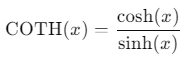
Where:
- cosh(x) is the hyperbolic cosine of x.
- sinh(x) is the hyperbolic sine of x.
The COTH function is valid for all real numbers except zero, where it is undefined.
Practical Use Cases
- Physics: Used in calculations involving heat transfer, wave propagation, and relativistic velocity.
- Engineering: Applied in structural analysis and cable dynamics.
- Finance: Rarely used, but may assist in certain mathematical models of growth or decay.
COTH(<number>)</number>
| Parameter | Type | Description |
|---|---|---|
<number> | Scalar | A numeric value for which the hyperbolic cotangent is to be calculated. |
How Does COTH Dax Function Works?
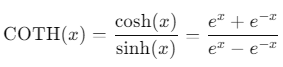
The COTH function computes the ratio of the hyperbolic cosine (cosh(x)) to the hyperbolic sine (sinh(x)) for a given numeric input x:
Important Notes
- Undefined at x=0: The function requires that x≠0x \neq 0, as division by zero is not defined.
- Exponential Nature: As x grows large in magnitude, COTH(x) approaches 11 for positive x and −1 for negative x.
What Does It Return?
The function returns a scalar decimal value representing the hyperbolic cotangent of the input number.
When Should We Use It?
- In mathematical models involving hyperbolic relationships.
- For scientific computations requiring precise hyperbolic cotangent values.
- When modeling natural phenomena with hyperbolic functions.
Examples
Basic Usage
Calculate the hyperbolic cotangent of 2:
COTH(2)
Output: 1.0373
Column Usage
If a column [Values] contains numeric data, calculate the hyperbolic cotangent for each row:
= COS([Values])
This creates a calculated column with COTH values.
Advanced Usage
Combine COTH with other DAX functions to handle special cases, such as ignoring undefined inputs:
= IF([Value] <> 0, COTH([Value]), BLANK())
This formula avoids errors by returning a blank value for undefined cases.
Tips and Tricks
- Undefined Input: Always handle x=0 explicitly to avoid runtime errors.
- Visualization: Use a graph to observe the behavior of the function as increases or decreases.
- Combine with Other Functions: Pair with related hyperbolic functions (e.g., COSH, SINH) for complex modeling.
Potential Pitfalls
- Zero Input: As x=0 is undefined, unhandled inputs may cause calculation errors.
- Input Range: Ensure the input values are meaningful for your specific application.
Performance Impact of COTH DAX Function:
- The function is efficient for small datasets.
- For large datasets, ensure proper error handling to avoid runtime issues with zero inputs.
Related Functions You Might Need
- COSH: Calculates the hyperbolic cosine.
- SINH: Calculates the hyperbolic sine.
- TANH: Calculates the hyperbolic tangent.
- COT: Calculates the cotangent for angles.
Want to Learn More?
For more information, check out the official Microsoft documentation for COTH. You can also experiment with this function in your Power BI reports to explore its capabilities.
The COTH function calculates the hyperbolic cotangent of a number, useful in mathematical and scientific computations.
The function is undefined for zero inputs, as division by zero occurs. Use conditional logic to handle this case.
Yes, it is often combined with other functions like IF, COSH, and SINH for complex calculations.
No, the COTH function operates directly on numeric values without requiring conversion to radians.
No, hyperbolic functions are not periodic. The COTH function is hyperbolic and asymptotically approaches 1 or −1.
Need Power BI help in a real engagement?
Our team writes DAX like this every day for SaaS finance and ops teams. Refresh monitoring, change requests with a 2-business-day SLA, and a named analyst on retainer — or scoped hourly help if you just need a fix.
Named analyst2-day SLAFrom $5K/mo