Zoho Zia AI Features for Sales Teams: What Actually Works
Zoho Zia is the AI layer embedded across Zoho CRM, offering predictive lead scoring, anomaly detection on pipeline data, and email sentiment analysis to sales teams. These features deliver real value in specific configurations, but each carries meaningful data prerequisites that vendor marketing materials tend to understate. Sales leaders who calibrate expectations before go-live avoid the most common AI-related implementation disappointments and unlock Zia's capabilities on a timeline grounded in actual data maturity rather than vendor timelines.
Key Takeaways
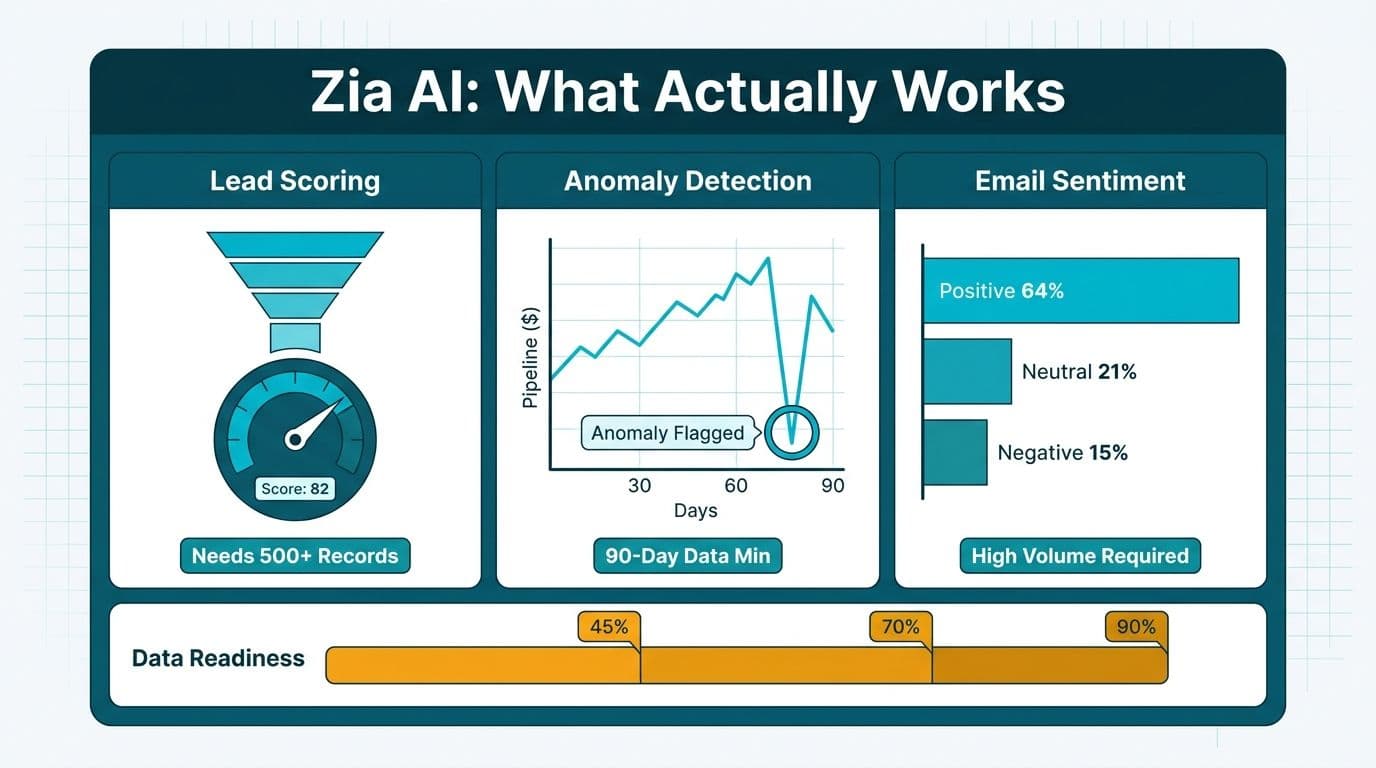
- Zia's predictive lead scoring requires three to six months of historical win/loss data before it produces statistically meaningful scores
- Anomaly detection surfaces genuine pipeline deviations but generates alert noise for the first 90 days while baselines are still calibrating
- Email sentiment analysis works exclusively on emails logged inside Zoho CRM - emails that never enter the CRM are invisible to Zia
- Healthcare organizations in the US and Canada, and financial services firms in the UK and EU, face specific compliance considerations before enabling AI features
- A phased enablement approach tied to measurable adoption milestones consistently produces better AI outcomes than activating all Zia features on day one
What Are the Zoho Zia AI Features for Sales Teams?
Zia is Zoho's embedded AI assistant, available from the Enterprise tier of Zoho CRM and above, as described in Zoho's official product documentation (2026). For sales teams, the three most operationally significant capabilities are predictive lead and deal scoring, anomaly detection across pipeline metrics, and email sentiment analysis on CRM-logged communications.
Beyond these three, Zia includes conversational AI for natural-language CRM queries, data enrichment suggestions for incomplete records, task and call recommendations, and voice-to-text note capture. These supplementary features add genuine productivity value but depend entirely on data that has already been structured inside Zoho CRM. The AI cannot draw on data that lives outside the platform.
Configuration choices made during initial Zoho CRM deployment directly determine which Zia capabilities activate meaningfully and on what timeline. Engaging a Zoho CRM consulting partner before those choices are finalized - particularly the field structure, activity logging standards, and email sync scope - gives AI features the best possible foundation. A data model designed for AI readiness from the start avoids the costly rework required when teams attempt to retrofit clean data practices at month six.
How Does Zia Lead Scoring Work - and When Does It Become Useful?
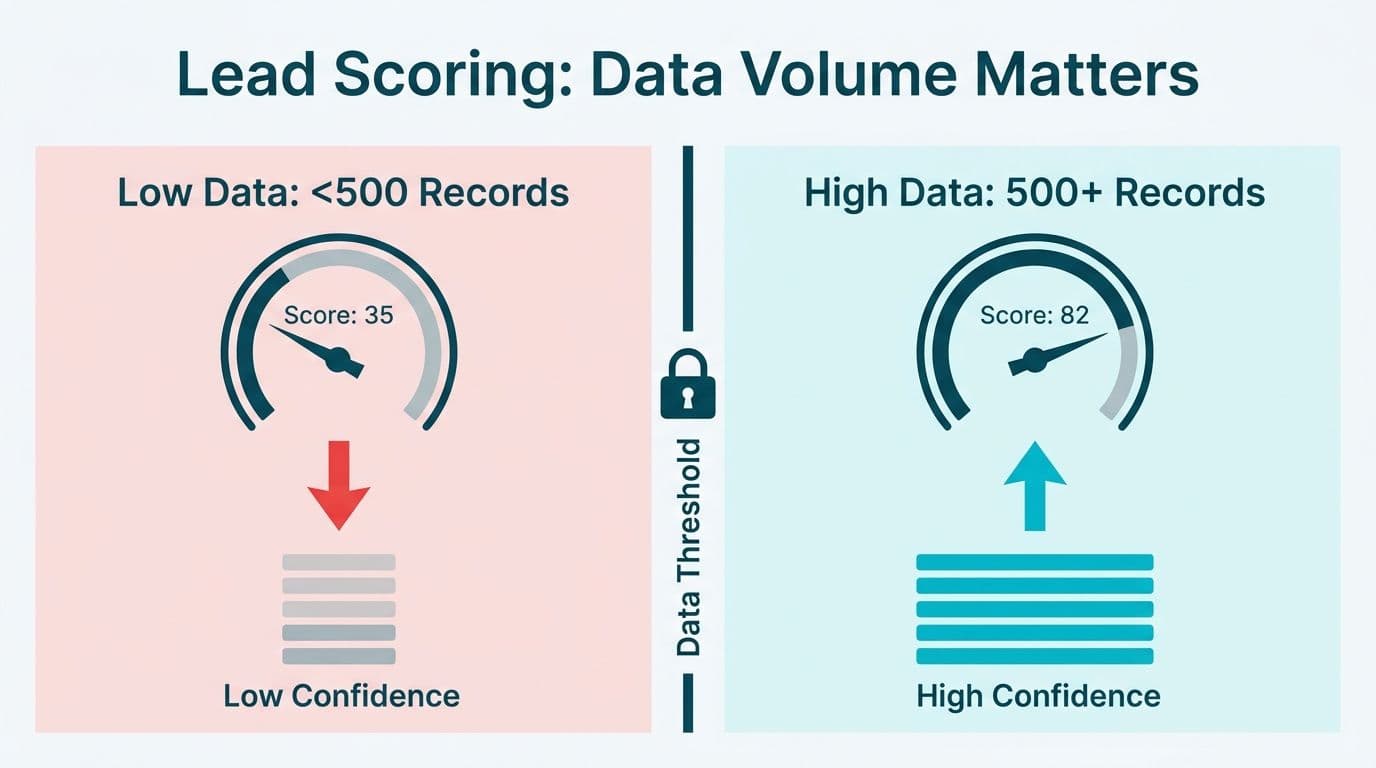
Zia's lead scoring generates a conversion likelihood score for each lead by training on your team's own historical CRM data - specifically, leads and deals marked as converted or lost over time. Zoho's official CRM documentation (2026) specifies that Zia requires a minimum threshold of closed records before the scoring model activates. For most mid-market teams, this threshold takes three to six months to reach after go-live.
Until the threshold is met, Zia displays an "insufficient data" status rather than generating scores. This is the correct behavior. A model trained on too few records produces misleading prioritization signals rather than useful ones. Sales leaders who expect Zia to score leads from the first week of go-live need to understand this limitation before implementation begins, not after.
What signals does Zia score? By default, Zia's model considers email open and response rates, call log volume, time since last contact, and demographic attributes such as industry, company size, and geography. If your team does not log calls inside Zoho CRM or does not sync email activity into contact records, those signal types are absent from the training data. Lead scoring accuracy is directly proportional to activity data completeness - sparse activity logging produces an underpowered model regardless of how many lead records exist in the system.
Scale and data volume matter significantly: A 25-seat US SaaS finance team closing 20 deals per month will hit Zia's training threshold in approximately four months. A six-seat team closing five deals per month may require 10 months or more before the model produces reliable scores. For smaller teams, Zoho CRM workflow rules that enforce deal-stage advancement criteria and route leads by territory or score bucket frequently outperform Zia's AI scoring through the first year and carry lower maintenance complexity.
The total cost of ownership for Zia's AI features is not just the Enterprise license fee. It includes the data preparation investment required to make those features reliable: field standardization, activity logging adoption, and the workflow governance that ensures clean records over time. For a detailed breakdown of plan tiers and which AI capabilities are included at each level, the Zoho CRM Pricing Plans Compared: Standard to Ultimate (2026) guide covers feature availability in detail.
What Can Zia's Anomaly Detection Flag in a Sales Pipeline?
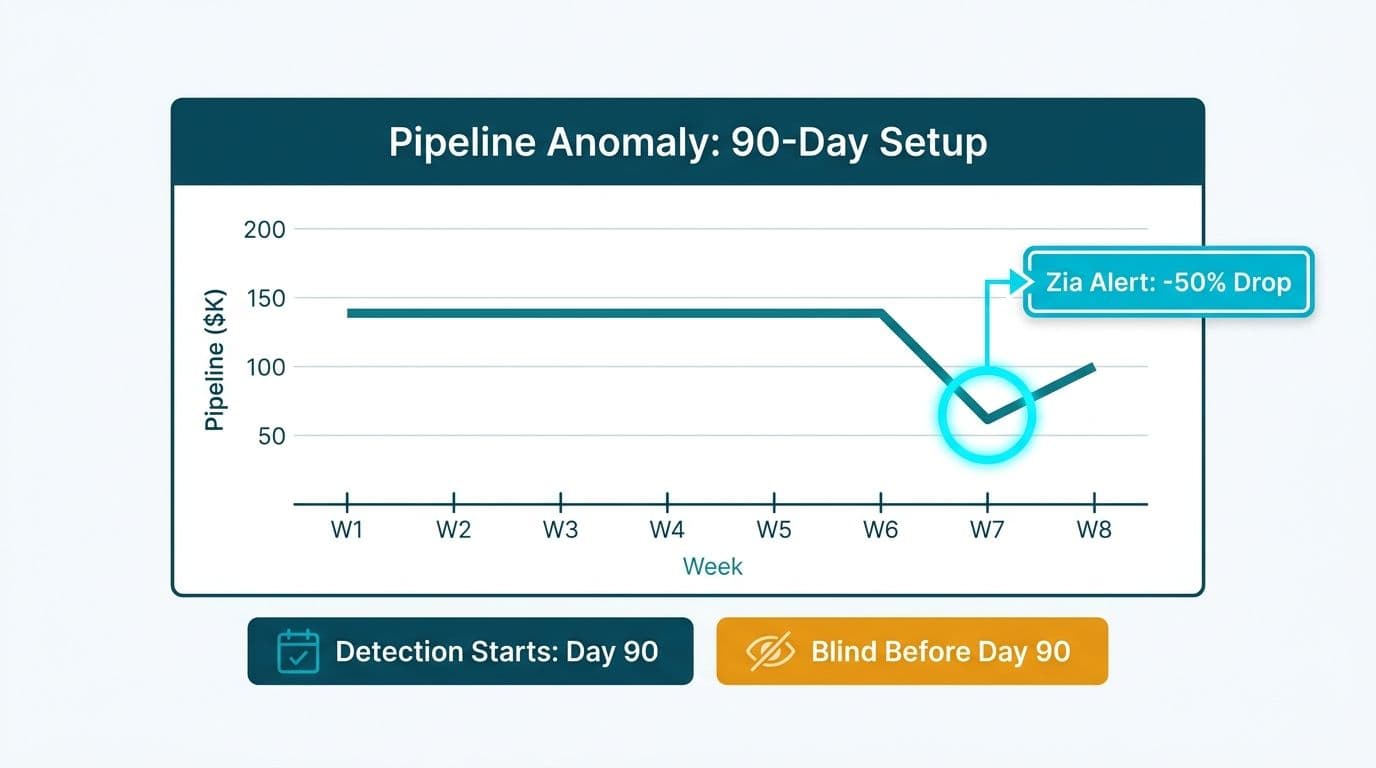
Zia's anomaly detection monitors pipeline and activity metrics continuously, then surfaces deviations from your team's established behavioral patterns. It can flag a sudden drop in call volume from a specific representative, an unusual week-over-week acceleration in deals moving backward through the pipeline, or an email response rate that falls outside normal variance for a given deal stage.
For sales operations leaders, this provides an early warning layer that does not require custom report builds or manual dashboard monitoring. One important caveat shapes its reliability: Zia establishes anomaly baselines from historical CRM activity data. During the first eight to twelve weeks after go-live, the system is calibrating from an incomplete record base. Anomaly alerts during this period frequently flag patterns that reflect inconsistent early-stage data entry habits rather than genuine pipeline problems - a dynamic that erodes trust in the feature if not managed proactively.
Practical recommendation: Suppress pipeline anomaly alerts for the first 90 days post-go-live. Activate the feature once CRM usage patterns have stabilized, validated through a data quality audit at the three-month mark. Measure call log completeness, email sync rates, and deal-stage update frequency against your targets before enabling alert delivery to managers.
Zoho's official documentation (2026) describes anomaly detection as operating across modules - CRM activities, deal stages, and revenue forecasts - with broader coverage available at the Enterprise tier than at Professional.
For teams in regulated industries, the access layer matters as much as the detection capability. Zoho CRM's roles and profiles setup determines which team members can view Zia's anomaly flags. In a US healthcare organization subject to HIPAA, or a Canadian company under PIPEDA, anomaly outputs that reference patient-adjacent or client-adjacent deal data require the same role-based access governance as any other sensitive CRM record. This configuration belongs in the initial deployment plan, not as a retrofit after go-live.
How Reliable Is Zia's Email Sentiment Analysis for Active Deals?
Zia's email sentiment analysis reads emails logged inside Zoho CRM and classifies the communication tone as positive, neutral, or negative. The primary use case is giving sales managers visibility into deals where the prospect's tone is cooling - a warning signal that arrives before a deal goes dark or is marked lost without explanation.
The binding constraint: Zia analyzes only emails that exist inside Zoho CRM at the time of processing. Emails exchanged through a Microsoft 365 inbox that are not synced into Zoho CRM via the Zoho CRM Microsoft 365 integration setup are invisible to the AI layer. A team that runs Zoho CRM but handles email entirely through an unsynced inbox will see no email sentiment data, regardless of plan tier.
Partial sync configurations create a more subtle problem: they produce incomplete sentiment data. Sentiment scored from 40 percent of a deal's email thread produces a systematically biased picture of deal health that is operationally worse than having no sentiment data at all. Before enabling email sentiment analysis, confirm that email sync coverage meets an acceptable threshold for the deals and contacts that matter most to pipeline management.
For a UK fintech firm processing client communications under GDPR, enabling email sync into Zoho CRM means personal data contained in those communications is stored and processed within the CRM environment. Data processing agreements need to reflect this new data flow before the integration goes live.
English-language sentiment accuracy is substantially higher than in other languages. Zoho's official documentation acknowledges multi-language support but does not publish per-language accuracy benchmarks. Teams serving French-speaking Canadian markets or EU markets with significant non-English communication volumes should treat Zia's sentiment scores as directional signals rather than reliable indicators in those language contexts.
A useful lesson from our practice: one B2B client's team built marketing lists by hand from their CRM. A scheduled sync job now runs every two hours inside Zoho, syncing 30 fields of sales context into four regional mailing lists and routing each contact by country. Manual list-building went to zero. The principle maps directly to email sentiment: Zia can only analyze data it can see. Getting emails into CRM through a well-configured sync is an architecture decision that necessarily precedes the AI feature decision.
Zia vs. Manual Processes: An Honest Comparison
| Capability | Zia's Role | Realistic Outcome | Data Requirement |
|---|---|---|---|
| Lead prioritization | Predictive conversion score per lead | Replaces manual scoring after 3-6 months | High - requires closed record history |
| Pipeline anomalies | Flags deviations from team baseline | Supplements manager reviews; does not replace | Medium - calibrates over 8-12 weeks |
| Deal health tracking | Email sentiment classification per deal | Directional signal for cooling deals | High - requires complete email sync |
| Forecast accuracy | AI-assisted forecast adjustment suggestions | Requires human validation; not autonomous | High - requires historical forecast data |
| Activity follow-up | Task, call reminders, next-action prompts | Reliable from day one with no training required | None |
The bottom row is the most underappreciated entry in this table. Zia's activity reminders, next-action suggestions, and call scheduling prompts are available immediately on go-live and require no historical training data. For teams in the early months of a new Zoho CRM deployment, these features deliver immediate productivity value and - critically - build the consistent activity logging habits that make every data-dependent AI feature reliable later. Ignoring day-one features while waiting for month-six AI capabilities misses the compounding benefit: the two objectives reinforce each other.
What Compliance Requirements Apply When Healthcare and Finance Teams Enable Zia?
US healthcare organizations operating under HIPAA face a specific question when enabling Zia: does Zia's AI inference processing create a new business associate relationship with Zoho? Zoho executes Business Associate Agreements for covered entities using Zoho CRM with protected health information. Healthcare sales leaders should verify a signed BAA is in place before enabling any Zia feature that processes patient-adjacent data logged in CRM records - this includes lead scoring, anomaly detection, and email sentiment if the underlying deal records touch clinical or patient context.
US financial services organizations subject to SOC 2 requirements should review how Zia's AI processing interacts with data classification policies. Deal records containing non-public financial information carry the same access control requirements as any other sensitive CRM data. Zia's outputs - scores, sentiment labels, anomaly flags - are CRM data and automatically inherit those access controls when roles and profiles are configured correctly.
For UK and EU organizations, GDPR's data minimization principle is directly relevant when configuring email sync scope. Syncing full email thread content into Zoho CRM to maximize Zia's visibility may conflict with data minimization expectations if that content includes personal data about individuals who are not the primary deal contact - for example, third-party advisers or decision-influencers copied on commercial correspondence.
Canadian organizations under PIPEDA should document the purpose for AI processing of personal data in CRM records before activating scoring and sentiment features. PIPEDA's purpose limitation requirements are explicit: using personal data for AI model training purposes requires documented justification, and that documentation should exist before the feature is enabled rather than after a compliance review surfaces the gap.
The Zoho CRM for Healthcare Practices: Compliance Configuration Guide covers specific configuration steps for US healthcare deployments in depth. For finance-focused analytics built on top of CRM data, Zoho Analytics Dashboard Examples for Sales and Finance covers the reporting infrastructure that complements and extends the AI outputs Zia surfaces within the CRM layer.
When Should a Mid-Market Team Enable Zia Features During Implementation?
Timing is the most underrated variable in Zoho CRM AI deployment. Activating AI features before consistent data entry habits are established produces unreliable outputs that erode trust in the AI layer - and trust, once lost in a new system, is difficult to rebuild within the same implementation cycle. A phased enablement approach tied to data maturity milestones is the standard recommendation for mid-market teams regardless of industry or geography.
Months 1-3 - Foundation phase: Enable Zia's activity reminders, next-action suggestions, and voice note capture. Set up Zoho CRM workflow rules to enforce data entry standards at each deal stage, and establish email sync through the Microsoft 365 or Gmail integration to begin populating the CRM with communication history. These steps work immediately and build the habits that power data-dependent AI features at month four and beyond.
Month 4 - Data quality review: Conduct a structured audit of call log completeness, email sync rates, deal-stage update frequency, and lead-closure tagging accuracy. If metrics meet target thresholds, activate Zia lead scoring. If adoption gaps exist, address them before enabling the scoring model - a sparse dataset produces a misleading model, which is operationally worse than no model.
Month 6 - Anomaly detection activation: By month six, sufficient CRM activity history has accumulated for Zia to calibrate meaningful anomaly baselines. Activate pipeline anomaly alerts and establish a weekly review cadence with sales managers to build shared judgment about what constitutes a genuine signal versus residual calibration noise.
Month 9 onward - Sentiment validation: Spot-check Zia's email sentiment flags against sales representative deal assessments for the same set of opportunities. If the correlation between sentiment signals and actual deal outcomes is acceptable, integrate sentiment into the standard pipeline review workflow. If not, investigate email sync completeness before drawing conclusions about model quality.
Whether the implementation runs through an in-house team or a certified Zoho partner, this phased sequence applies. What a Zoho partner adds is calibration experience from prior deployments across industries - the ability to anticipate where data quality gaps typically emerge for healthcare, financial services, and manufacturing teams, and to address those gaps proactively. For organizations with HIPAA, GDPR, or PIPEDA requirements layered on top of standard implementation complexity, that pattern recognition from prior rollouts compresses the timeline from deployment to reliable AI output significantly.
---
About Lets Viz: Lets Viz has delivered CRM and analytics consulting to clients across US healthcare, UK fintech, Canadian manufacturing, and global SaaS since 2020, holding a 5.0 Clutch rating. The firm's implementation engagements span compliance-sensitive deployments under HIPAA, GDPR, and PIPEDA, with a consistent focus on activating AI capabilities against clean, well-governed data rather than on vendor timelines alone.
Ready to map your team's current CRM data maturity to a realistic Zia enablement timeline? Our Zoho CRM consulting team works with mid-market organizations in the US, UK, and Canada to build AI-ready CRM foundations before day-one go-live.