How to Hire a Looker Studio Consultant: 2026 Buyer's Guide
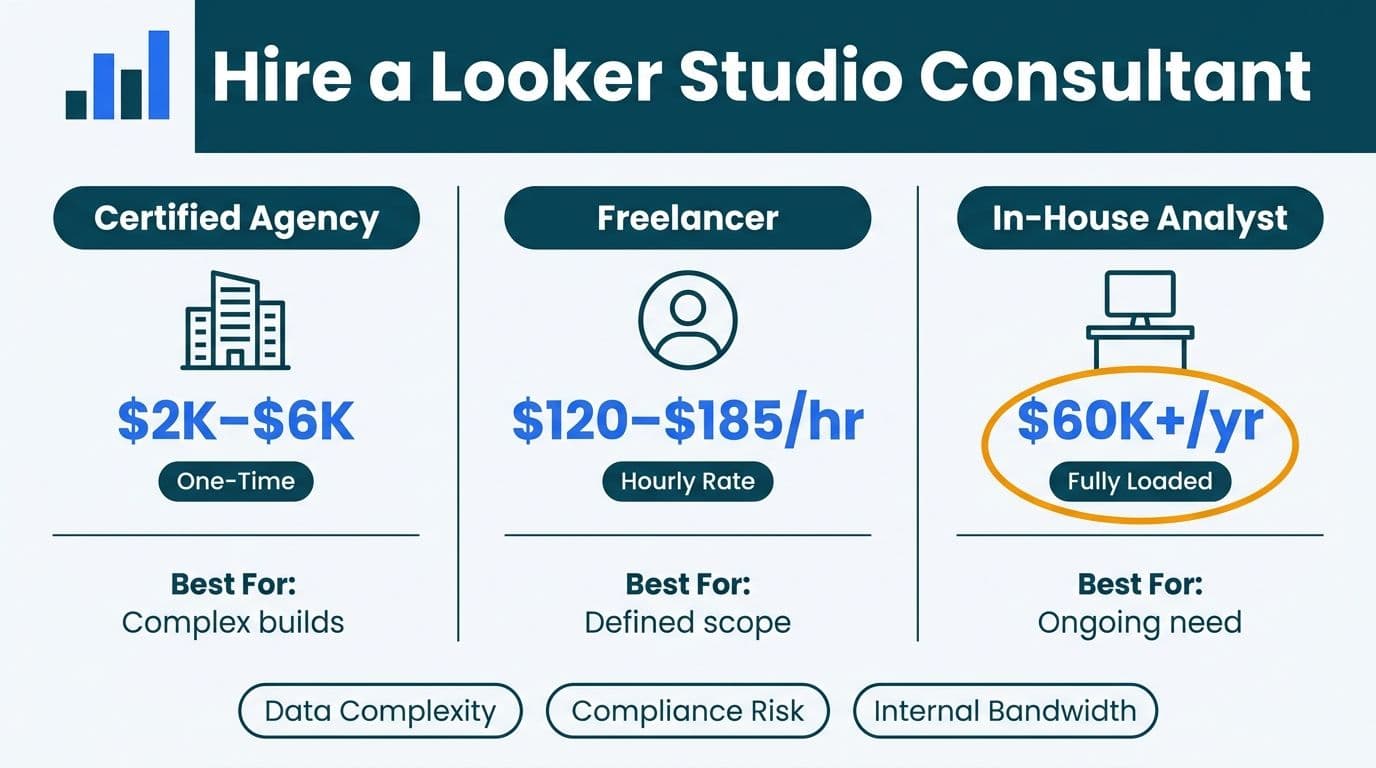
Hiring a Looker Studio consultant means choosing between a certified agency, an independent freelancer, or an in-house analyst - each with a different cost structure and risk profile. The right choice depends on your data complexity, compliance obligations, and how much internal bandwidth you have to manage the relationship.
Key Takeaways
- Three hiring paths: certified agency ($2,000–$6,000 one-time), freelancer ($120–$185/hr), in-house analyst ($60K+/yr fully loaded) - each carries a distinct coverage model and risk profile.
- Standard engagement timeline: a well-scoped project runs 5 weeks from discovery call to handover.
- Six vetting questions separate strong candidates from risky ones - the compliance walk-through is a hard disqualifier for regulated-industry work.
- Looker Studio has real limits: it is not suited for DAX-heavy analytics or enterprise semantic layer modeling at scale.
- Healthcare and finance projects require compliance documentation - HIPAA, GDPR, and PIPEDA sign-off must be in place before any build begins.
Who This Guide Is For
This fits your situation if:
- You are a CIO, data team lead, or finance director at a mid-market organization who needs dashboards pulling from multiple sources - Google Analytics 4, paid media platforms, Sheets, a CRM, or a cloud data warehouse - without building and maintaining data infrastructure from scratch.
- You work in healthcare or finance and need reporting that handles sensitive data responsibly: HIPAA-compliant data flows in the US, GDPR-compliant handling in the UK and EU, or PIPEDA-aligned pipelines in Canada.
- Your team needs operational dashboards it does not have capacity to build - a patient satisfaction analytics dashboard for a hospital system, an operating room utilization analytics dashboard, a social determinants of health analytics dashboard, or a revenue cycle view - and you want them running within weeks, not quarters.
- You have a healthcare analytics implementation roadmap and need a BI partner who can scope, build, and iterate alongside internal teams rather than hand off a finished product and disappear.
This is NOT the right fit if:
- Your primary analytics need is advanced DAX modeling: row-context calculations using the EARLIER function or complex filter manipulation with the CALCULATE function in Power BI DAX. These are Power BI capabilities with no Looker Studio equivalent; our managed Power BI services cover that path.
- You need the enterprise Looker platform (Google Cloud's full semantic layer BI tool, distinct from Looker Studio) - that is a separate engagement typically starting above $20,000.
Our certified Looker Studio consulting practice is built for organizations that fit the first group: connected data sources, compliance-aware industries, and a need to move without a lengthy procurement cycle.
How to Hire a Looker Studio Consultant: What the Options Actually Cost
For a standard project covering 3–5 connected reports, expect a one-time investment of $2,000–$6,000; a custom BigQuery data pipeline behind those reports adds $5,000–$15,000. The three hiring paths carry very different cost structures. Here is a direct comparison:
| Hiring Path | Typical Cost | Best For | Key Risks |
|---|---|---|---|
| **Certified agency** | $2,000–$6,000 one-time; $1,500–$3,500/mo retainer | Multi-source dashboards, compliance-sensitive industries, ongoing iteration | Higher initial cost than a freelancer |
| **Independent freelancer** | $120–$185/hr; most work quoted per project | Simple dashboards, one-time builds, tight budgets | No coverage model, single point of failure, variable quality |
| **In-house analyst** | $60,000–$90,000+/yr fully loaded | High-volume, always-on reporting with deep system integration | 3–6 month recruiting lag, turnover and PTO risk |
A note on hourly vs. project pricing. Certified Looker Studio consultants typically quote $120–$185/hr (2026 market rates), but reputable agencies convert to fixed-scope project or retainer pricing after a discovery call. If a consultant resists scoping and insists on pure time-and-materials billing, treat that as a risk flag.
BigQuery adds a separate cost layer. If your reporting stack requires pulling from an EHR, a revenue cycle system, or a proprietary database into BigQuery before Looker Studio can visualize it, budget an additional $5,000–$15,000 for the pipeline build - separate from the dashboard project itself. In either case, tool licensing is just one cost line; the data integration work is where most of the budget lives.
What Does Working With a Certified Looker Studio Consultant Look Like?
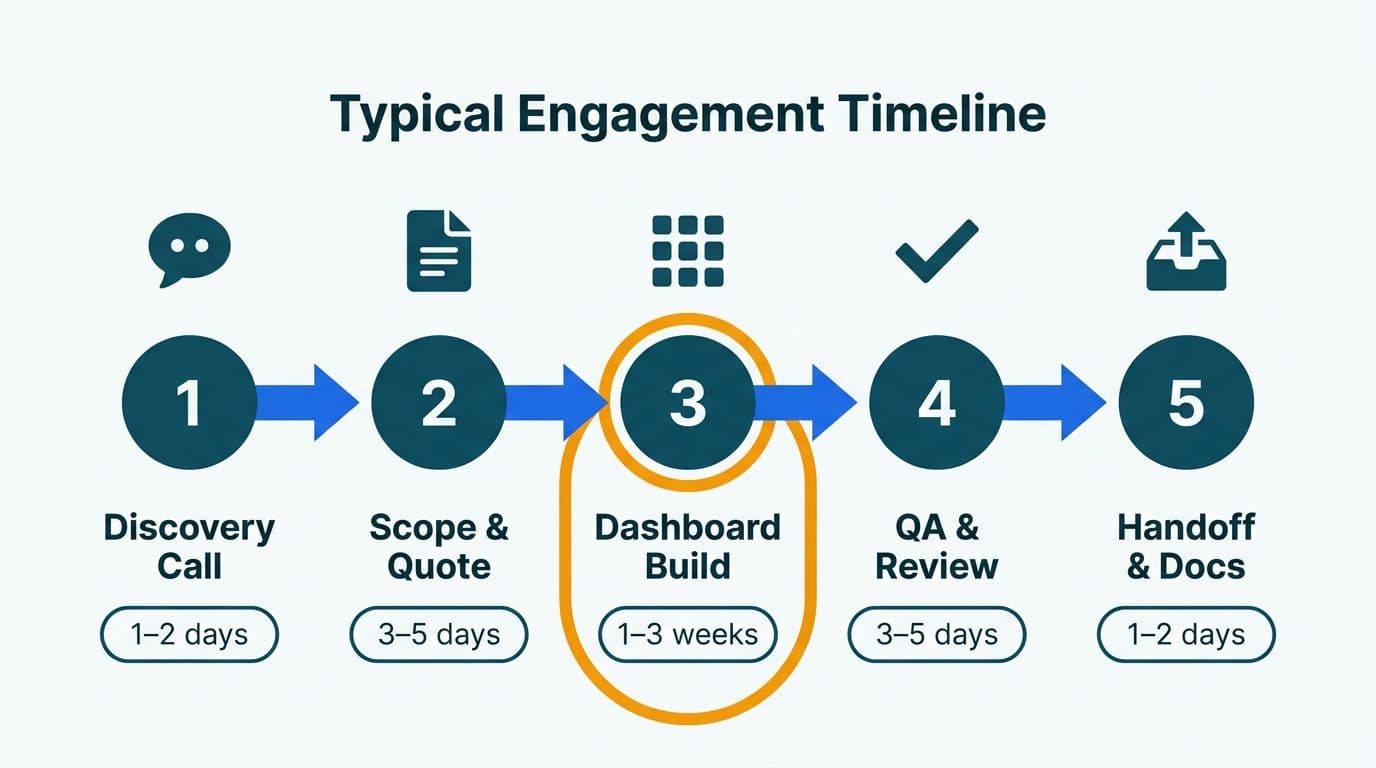
A well-run engagement follows a predictable 5-week sequence from discovery call to handover.
Week 1 - Discovery and Data Audit
Your consultant maps every data source the final reports will draw from - Google Analytics 4, Search Console, paid media feeds, CRM exports, or direct database connections. They confirm access credentials and flag any integration that will need a custom connector or a data prep step upstream.
Week 2 - Architecture and Schema Design
Standard connectors are configured and a blending strategy is confirmed. For complex sources - a custom API feed, a legacy EHR database, or a warehouse that needs transformation before reporting - this week produces a written scope document before any build begins.
Weeks 3–4 - Build and QA
Dashboard development, row-level QA against source data, and a first client review round. Revision cycles are defined upfront - typically two rounds are standard in a fixed-scope engagement.
Week 5 - Handover and Training
Full documentation, a live walkthrough for your team, and deployment. If you are moving to an ongoing maintenance retainer ($1,500–$3,500/month), the SLA and iteration cadence are agreed at this stage.
Healthcare and finance projects require one additional step: a compliance review confirming that data flows do not expose PHI through Google's shared infrastructure (US - HIPAA), that consent and data residency requirements are met (UK and EU - GDPR), or that cross-border transfer rules are addressed (Canada - PIPEDA). Ask any consultant candidate directly: "Walk me through how you handled PHI in a previous Looker Studio build." A vague answer is a disqualifier.
Agency vs. Freelancer vs. In-House: Which Path Is Right for You?
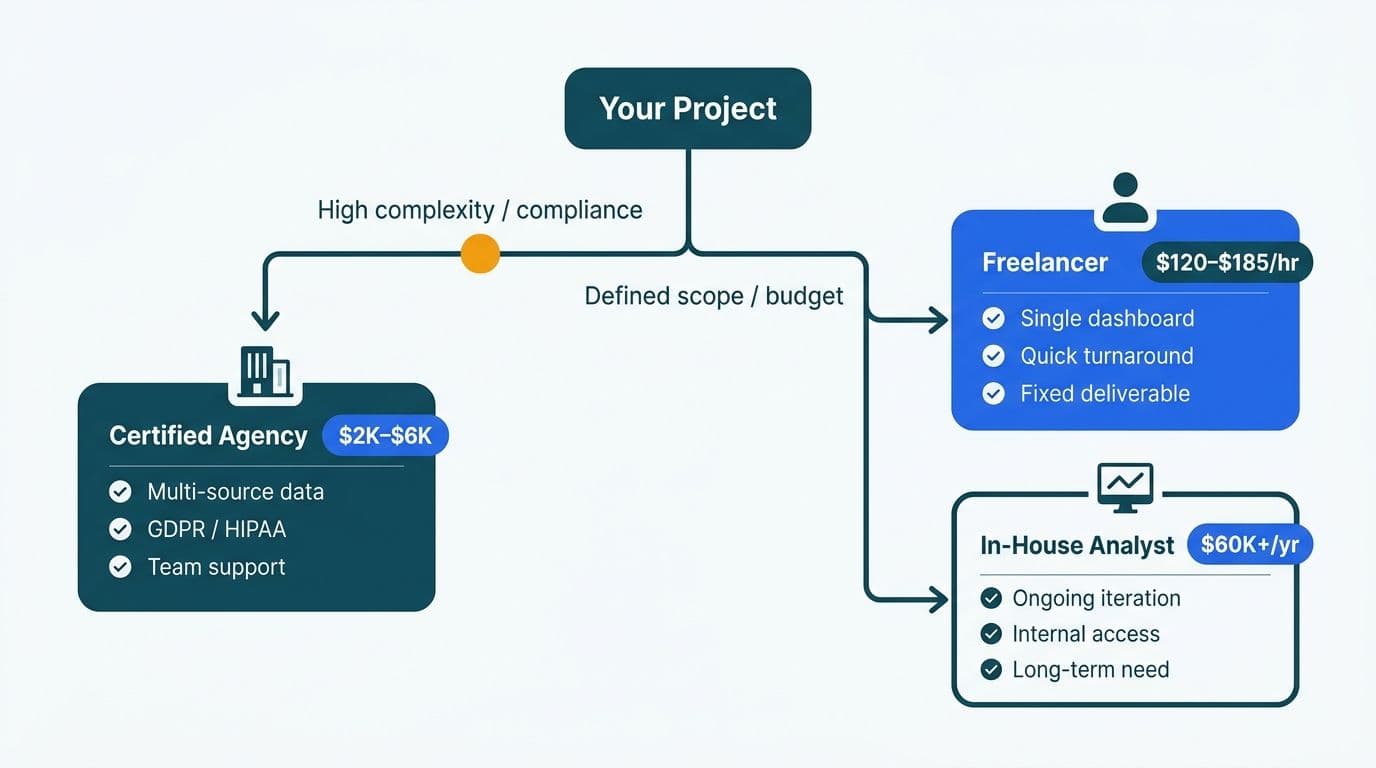
Choose an agency when your project touches multiple data sources, involves compliance documentation, or is likely to need ongoing iteration. An agency gives you a team rather than a single point of failure, a documented process, and an escalation path when something breaks after go-live.
Choose a freelancer when your scope is self-contained and low-complexity - three or fewer data sources, no sensitive data handling, no ongoing support requirement. Freelancers can be cost-effective for one-off builds; if your data is regulated, confirm they carry professional indemnity coverage before signing.
Keep it in-house when your reporting needs are genuinely high-volume and always-on, deeply integrated with internal systems, and you can hire within a realistic timeline. For most mid-market organizations, a fully loaded in-house analyst runs $60,000–$90,000/year (2026 US mid-market benchmark) at minimum - and a 3–6 month recruiting lag can stall a fiscal-year initiative before it starts. Our finance analytics outsourcing guide walks through the build-vs-buy calculation in detail.
One filter that applies across all three markets: ask any candidate whether they have executed HIPAA Business Associate Agreements in a Looker Studio context (US), operate under GDPR Article 28 data processor agreements (UK and EU), or handle PIPEDA-compliant cross-border data flows (Canada). These are not optional extras for regulated industries - they are baseline qualifications.
What to Include in Your Statement of Work
Before signing any contract - with an agency, freelancer, or interim hire - confirm the statement of work covers all of the following:
- Defined scope and deliverables: exact number of reports, named data sources, and the specific metrics each dashboard will surface.
- Number of revision rounds: how many rounds are included in the fixed fee. Two rounds is standard; anything beyond should be quoted separately before work begins.
- Data portability clause: explicit written confirmation that all connector configurations, data source credentials, and report assets transfer fully to you at project end.
- Post-launch SLA: a clear definition of what constitutes a broken report, the response window, and who is responsible for fixes when an upstream data source changes.
- Handover documentation package: a data dictionary, a connector map, and either a recorded walkthrough or a scheduled live training session for your internal team.
- Compliance obligations sign-off: written confirmation that HIPAA, GDPR, or PIPEDA requirements have been documented, agreed upon, and are reflected in the build before the project goes live.
A statement of work that covers these six points reduces post-launch disputes and preserves a clean exit option if the relationship does not work out.
When Is Looker Studio Not the Right Tool?
Looker Studio is a strong fit for organizations embedded in the Google ecosystem with moderate data complexity. It is not the right choice when:
- Your core analytics use case requires advanced DAX: row-context functions like EARLIER or complex filter manipulation using CALCULATE. Those are Power BI capabilities. If Power BI is the better fit, our managed Power BI services page covers both licensing paths.
- You need direct HL7 FHIR API connections for clinical EHR data: Power BI has a more mature integration path for hospital environments, as we cover in our guide on connecting EHR data to Power BI.
- You need enterprise semantic layer modeling with row-level security at scale - that points toward the full Looker platform or an enterprise-tier BI product, not Looker Studio.
Understanding these limits before you hire protects you from a consultant who will take the project and then silently work around Looker Studio's data blending limitations without disclosing them upfront.
The Vetting Checklist: Six Questions to Ask Before You Sign
Ask every Looker Studio consultant candidate these six questions before committing:
1. "Can you share a live Looker Studio report you have built?" - Not a screenshot. A shareable link you can interact with. If they cannot produce one, stop here.
2. "Which data connectors have you built or customized - not just used out of the box?" - A strong consultant will name specific connectors and describe the problem each one solved.
3. "Who owns the connector configurations and data source credentials after the project ends?" - You should own everything. A consultant who retains access creates dependency that serves their interests, not yours.
4. "What is your QA process before handover?" - Row-level validation against source systems, not visual inspection alone.
5. "Have you handled HIPAA, GDPR, or PIPEDA data in Looker Studio? Walk me through how." - Expect specifics: BAA documentation, data residency decisions, access controls applied. Vague answers are a disqualifier.
6. "What happens if we need to change a metric six months after launch?" - A retainer with defined revision SLAs is the clean answer. "We will quote it when you need it" is a yellow flag.
The sixth question pressure-tests production experience. Looker Studio reports require ongoing maintenance as underlying data sources evolve. A consultant who has not managed dashboards in production often does not realize this until it becomes a problem.
Three Objections Buyers Raise - And Honest Answers
"Can't we just hire someone in-house?"
You can. But even setting aside recruiting timelines, a fully loaded mid-level analyst runs $60,000–$90,000/year, is almost never Looker Studio-only, and comes with PTO, ramp time, and departure risk. If your Looker Studio need is scoped and periodic rather than daily, a retainer relationship is typically more cost-efficient and more flexible. If your volume genuinely demands always-on capacity, in-house may make sense - and a discovery call with an external consultant is a useful way to define that threshold before you commit to a hire.
"We are worried about lock-in if we use an agency."
A reputable agency hands over every asset at project end: connector configurations, data source credentials, report templates, and documentation. If a statement of work does not include a data portability clause, add one before signing. Lock-in risk is a contract problem, not an inherent agency problem. Ask for a sample handover checklist from a previous engagement before you commit.
"We have seen offshore quality issues before."
Offshore delivery is not a quality proxy - process discipline is. The right questions are: Does the agency validate dashboards row by row against source data before handover? Who is your named account lead, and what is the escalation path if a report breaks post-launch? If the answers are specific and documented, geography matters less than process maturity.
Whether you are building your first executive dashboard or replacing a fragile manual reporting process, our certified Looker Studio consulting team can scope your project and give you a clear answer in a single call. Book a free discovery conversation - no commitment required.
---
About Lets Viz: Written by [Author Name], Principal BI Consultant at Lets Viz, who has delivered Looker Studio implementations for healthcare, SaaS, and finance clients across the US, Canada, and UK/EU since 2020. Lets Viz holds a 5.0 rating on Clutch.