When Not to Use AI Finance Reports: The No-Go List
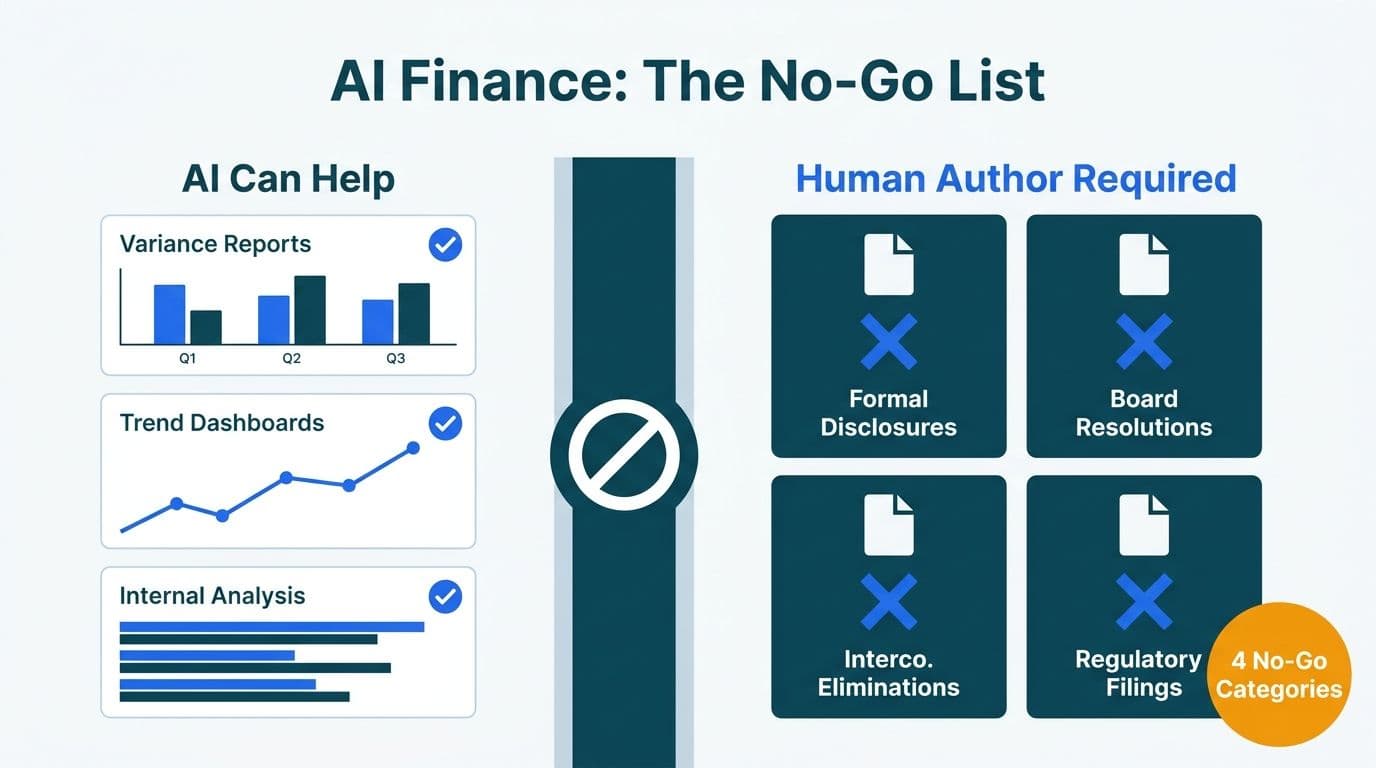
Knowing when not to use an AI finance report is as important as knowing when to deploy one. Four categories carry enough legal, audit, or regulatory weight that AI-generated output should never serve as the primary deliverable: formal disclosures with legal standing, board resolutions, intercompany eliminations subject to audit review, and documents tied to hard regulatory filing deadlines. In all four cases, human judgment must be the author of record.
Key Takeaways
AI finance tools excel at internal operational analysis, variance narratives, and trend dashboards - they are not reliable as sole authors of legally binding documents.
Formal regulatory disclosures (SEC filings in the US, FCA returns in the UK, SEDAR+ submissions in Canada) require human authorship and legal review before filing.
Board resolutions carry fiduciary and governance weight that no AI system can legally assume.
Intercompany eliminations with audit exposure require a qualified accountant to own the consolidation logic - AI can flag, but cannot certify.
Any document with a regulatory deadline and a material consequence for error is an explicit no-go for AI as sole author.
What Is an AI Finance Report?
AI finance reports use large language models (LLMs) or machine-learning pipelines to generate narrative summaries, variance analyses, and financial commentary directly from structured financial data. Microsoft Copilot integrated with Power BI, generative models connected to ERP platforms, and embedded AI narrators in financial planning tools can produce readable, data-grounded output in minutes.
Those strengths are real. The limits are equally real. AI models are probabilistic systems, not rule-bound accounting engines. They can misread schema relationships, confuse prior-period labels, apply outdated business rules silently, or generate plausible-sounding text from incorrect source data. When the output feeds an internal management dashboard reviewed by a human before any action is taken, those errors are catchable. When the output carries a legal signature or a regulatory submission timestamp, errors may not surface until an audit or enforcement action forces them to.
Finance leaders at mid-market companies - CIOs, data team leads, finance directors - are increasingly being asked to accelerate reporting cycles with AI. The question is not whether AI has a role in finance reporting. It does. The question is precisely where that role must stop.
Power BI consulting (Copilot-ready) engagements at Lets Viz regularly help finance teams draw this boundary cleanly, designing AI-assisted workflows where the machine accelerates analysis and the human retains full accountability for every signed artifact.
When Should You Not Use an AI Finance Report? The Definitive No-Go List
The test is straightforward: what happens if the AI-generated output is materially wrong, and who is accountable for that error? For internal management reporting, an AI error surfaces in the next review cycle. For the four categories below, an error can trigger regulatory penalties, audit qualifications, board liability, or all three.
The table below provides a quick reference for finance teams building or reviewing their AI governance policies:
| Document or Task | AI as Drafting Aid | AI as Author of Record |
|---|---|---|
| Internal management dashboard | Safe | Acceptable with human review |
| Variance analysis narrative (internal) | Safe | Acceptable with human review |
| Rolling forecast commentary (internal) | Safe | Acceptable with human review |
| Formal SEC 10-K / 10-Q filing | Acceptable with legal review | Never |
| FCA regulatory return or submission | Acceptable with compliance review | Never |
| SEDAR+ MD&A or OSFI submission (Canada) | Acceptable with compliance review | Never |
| Board resolution | Drafting aid only, with counsel review | Never |
| Intercompany elimination worksheet | Flagging support only | Never |
| Audit trail documentation | Flagging support only | Never |
| Document with hard regulatory deadline | Acceptable with human review | Never |
The distinction is not about AI capability. It is about who bears accountability when the number is wrong.
Why Formal Disclosures Are an Explicit No-Go
A formal disclosure carries legal standing the moment it is filed. A US 10-K or 10-Q submitted to the SEC, a UK filing with Companies House, a Canadian MD&A submitted through SEDAR+ - each creates legal obligations for the entity and its officers.
In the US, Sarbanes-Oxley Section 302 requires the CEO and CFO to personally certify the accuracy of periodic reports filed with the SEC. That certification is not a formality: it carries criminal liability for knowing misrepresentations. In Canada, National Instrument 52-109 imposes substantially equivalent officer certification requirements on public company executives. In the UK, the Financial Conduct Authority's Disclosure Guidance and Transparency Rules require that persons responsible for the disclosure confirm the information is correct to the best of their knowledge.
An AI system cannot be a signatory. It cannot be deposed. It cannot bear liability. That asymmetry is precisely why AI-generated text should serve only as a drafting aid for formal disclosures - with every word reviewed and approved by a qualified human before submission.
For a US healthcare company operating under both SEC reporting obligations and HIPAA-governed data environments, using AI to draft an initial variance narrative for the MD&A is a reasonable productivity tool. Using AI as the sole author, without controller and legal sign-off, is not. The same principle applies to a UK fintech firm submitting regulatory returns to the FCA: AI can accelerate the drafting workflow, but the compliance officer's review is a non-negotiable process gate.
Why Board Resolutions Cannot Be AI-Authored
Board resolutions create binding obligations for a legal entity. They authorize capital raises, approve acquisitions, amend bylaws, ratify financial statements, and direct management action. In most jurisdictions, the validity of a resolution depends on directors having actually exercised judgment in passing it.
Under Delaware corporate law in the US, the Companies Act 2006 in the UK, and the Canada Business Corporations Act, directors have fiduciary duties that attach to their decision-making process. A resolution that a board later discovers was AI-drafted without meaningful director deliberation creates a governance gap that external auditors, regulators, and opposing counsel will examine closely.
The safe boundary: AI can organize supporting materials, summarize meeting notes, draft agenda items, and flag missing disclosures for a governance or legal team. The resolution text itself must be drafted by counsel, reviewed by directors, and approved through a documented deliberative process. Mid-market companies with outside directors or audit committees are especially exposed - those individuals have personal liability for the accuracy of what they approve.
Finance directors who receive AI-drafted board materials without clear disclosure that AI was involved face an uncomfortable accountability gap. Building disclosure into the workflow - noting which documents were AI-assisted - is increasingly recommended by governance advisors in the US and Canada.
Intercompany Eliminations and Audit Risk: Where AI Quietly Fails
Intercompany eliminations - removing intra-group transactions from consolidated financial statements - require precise matching of counterpart entries across legal entities. A missed elimination overstates consolidated revenue. An over-elimination understates it. Both produce material misstatements, and both are precisely what external auditors target during consolidated audit procedures.
AI models working from ERP-exported data can flag potential elimination candidates, which is genuinely useful. What they cannot reliably do is confirm that the consolidation logic is correct across all entities, currencies, and accounting standards simultaneously - especially when the group spans US GAAP entities, IFRS subsidiaries common in UK and EU operations, and ASPE-reporting Canadian private companies.
Consider a Canadian manufacturing holding company consolidating four provincial subsidiaries and two US operating entities. Under PIPEDA-governed data environments, access restrictions may affect how AI systems can process the underlying financial data. The IFRS 10 consolidation standard requires judgment calls about control and attribution that a probabilistic model cannot make with audit-defensible certainty. A qualified CPA must own the final elimination table, and the external audit opinion rests on that human judgment - not on the confidence score of an AI output.
For finance teams managing multi-entity consolidation complexity, a governed Power BI environment provides a defensible audit trail without surrendering the speed benefits of data automation. Our Power BI governance best practices checklist covers the specific controls that support audit-ready consolidation workflows.
The Regulatory Deadline Problem
Regulatory filing deadlines add a dimension that makes the no-go list especially important: time pressure creates the conditions in which AI errors are most likely to slip through undetected.
A quarterly earnings deadline, a VAT return filing window, or an OSFI supervisory submission date all carry consequences for late or materially inaccurate filings. When finance teams are under deadline pressure, the temptation to accept AI-generated output without adequate review increases. That is precisely the moment the risk is highest.
The structural answer is to build review time into the workflow rather than treat AI as a last-minute acceleration tool. AI-assisted drafting should begin earlier in the reporting cycle, with human review gates built in before the filing window opens - not used to compress the final review step.
For US healthcare organizations under both SEC and HIPAA reporting timelines, UK firms under FCA reporting calendars, and Canadian organizations filing with the CRA or OSFI, the same principle applies: AI buys time earlier in the process. Using AI to compress the final step - the step closest to submission - converts a productivity tool into a liability.
What AI Finance Reports Do Well
Setting firm limits earns credibility when paired with an honest account of where AI adds genuine value. The no-go list is a precision instrument for deploying AI correctly - not an argument against it.
AI finance tools deliver real value in these contexts:
Internal variance analysis narratives. When a management accounts pack needs commentary explaining why costs exceeded plan in a given quarter, AI can draft an initial narrative from the variance data in minutes. A finance analyst reviews, edits, and approves before it enters the management pack.
Rolling forecast commentary. Synthesizing actuals against plan across multiple business units, identifying deviation patterns, and drafting scenario narratives are all tasks where AI accelerates work that would otherwise require manual reformatting across multiple source files.
Anomaly flagging in high-volume transaction data. AI-assisted scanning can surface exceptions - duplicate payments, misclassified entries, unusual patterns - that a human reviewer then investigates. This is the accounts payable use case explored in detail in our AI automation for accounts payable walkthrough.
Board pack supporting materials. Trend charts, market context summaries, and draft KPI commentary that directors review before a board meeting are appropriate uses of AI - clearly marked as supporting materials, not as resolutions or approved financial statements.
The consistent pattern: AI accelerates the work a human would otherwise do manually, and humans retain ownership of every output that carries legal or audit consequence.
How to Build an AI Finance Workflow That Stays Within Safe Limits
The goal is not to avoid AI in finance reporting. It is to design workflows where AI operates inside its safe envelope and humans own every output that carries legal or audit consequence.
A practical framework for mid-market finance teams:
Classify every output by accountability tier. Separate deliverables into internal-only (AI can author), human-reviewed (AI drafts, human approves before distribution), and signed or filed (AI assists, human is sole author of record). Complete this mapping before deploying any AI tool into the reporting stack.
Gate AI outputs before they reach submission queues. Build approval checkpoints so that no AI-generated text reaches a regulatory portal, audit file, or board packet without a controller or legal sign-off. In Power BI environments, workspace-level access controls and row-level security help enforce these gates at the data layer - as discussed in our guide on connecting AI workflow automation to Power BI.
Maintain documentation of AI-assisted work. Record which sections of a deliverable were AI-drafted versus human-authored. External auditors in the US, UK, and Canada are increasingly expecting this documentation, and professional accounting bodies are beginning to include it in formal guidance on AI use in finance.
Verify AI output against source data, not just the narrative. AI narrators can generate plausible text from incorrect underlying data. Finance teams should check AI output against the raw data model before human sign-off - as a process control, not a trust exercise.
Build a periodic review of the no-go list into your AI governance policy. As the SEC, FCA, PCAOB, and IFRS Foundation develop more specific guidance on AI in financial reporting, permitted boundaries will be refined. A quarterly review cadence keeps the policy current without requiring a full rewrite each cycle.
For finance directors building the broader business case, our AI automation ROI framework for finance leaders pairs well with this no-go list as a governance companion.
---
If your team is building AI-assisted finance reporting and needs a governed, audit-ready data environment, the Power BI consulting (Copilot-ready) practice at Lets Viz helps mid-market finance teams in the US, UK, and Canada design workflows that keep AI inside its safe envelope - and humans accountable for every signed deliverable.
---
About Lets Viz: Lets Viz has partnered with finance and data teams since 2020, delivering Power BI, analytics, and AI automation solutions across US healthcare, UK fintech, Canadian manufacturing, and global SaaS organizations. With a 5.0 Clutch rating and engagements spanning SOC 2, HIPAA, GDPR, and PIPEDA-governed environments, the team brings the compliance depth that mid-market finance leaders need when AI enters the reporting stack.
---