ServiceNow ITSM Implementation Checklist: Phase-by-Phase Guide
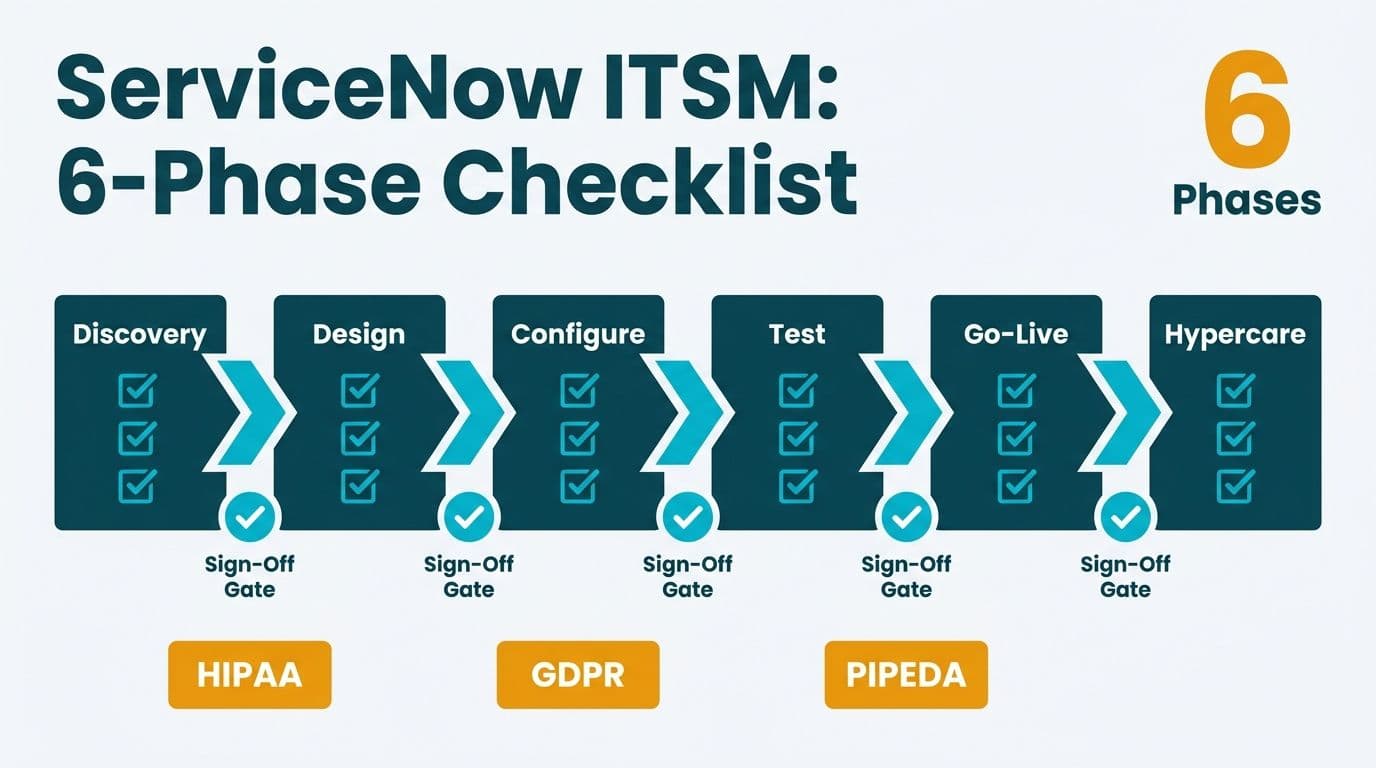
A ServiceNow ITSM implementation checklist gives IT directors a structured path from scoping through hypercare, reducing costly mid-project pivots. A disciplined checklist approach covers six distinct phases - discovery, design, configuration, testing, go-live, and hypercare - each with discrete sign-off gates. For healthcare and finance organizations in the US, UK/EU, and Canada, HIPAA, GDPR, and PIPEDA compliance checkpoints must be embedded across phases, not added at the end.
Key Takeaways
- A structured ServiceNow ITSM rollout spans six phases, each requiring its own approval gate and named owner.
- HIPAA, GDPR, and PIPEDA compliance checkpoints must be built into design and testing phases, not added post-go-live.
- Governance misalignment between IT and business stakeholders is the most common cause of delayed ServiceNow rollouts.
- Configuration scope creep - particularly around custom workflows and integrations - is the top budget risk for mid-market deployments.
- Hypercare is a distinct operational phase; plan for 30 to 60 days of active monitoring and rapid-response authority, not just the first week after go-live.
What Does a ServiceNow ITSM Implementation Checklist Cover?
A ServiceNow ITSM implementation checklist is a phase-gated document that defines what must be completed, tested, and approved before the project advances. Each item maps to a specific owner, a measurable acceptance criterion, and a compliance consequence if skipped.
For mid-market organizations - typically 500 to 5,000 employees - in healthcare or financial services, the checklist must account for regulated data flows from day one. A US hospital network handling electronic protected health information (ePHI) faces different configuration requirements than a Canadian financial institution subject to PIPEDA, even if both deploy identical ServiceNow ITSM modules. Engaging experienced ServiceNow consulting services at the scoping stage prevents costly retrofitting later, particularly around access control architecture and data residency decisions that become expensive to reverse after build begins.
The phases below assume a net-new implementation. Organizations migrating from a legacy ITSM platform will need additional data-mapping, parallel-run, and cutover phases not covered here.
Phase 1: Scoping and Discovery - ServiceNow ITSM Implementation Checklist
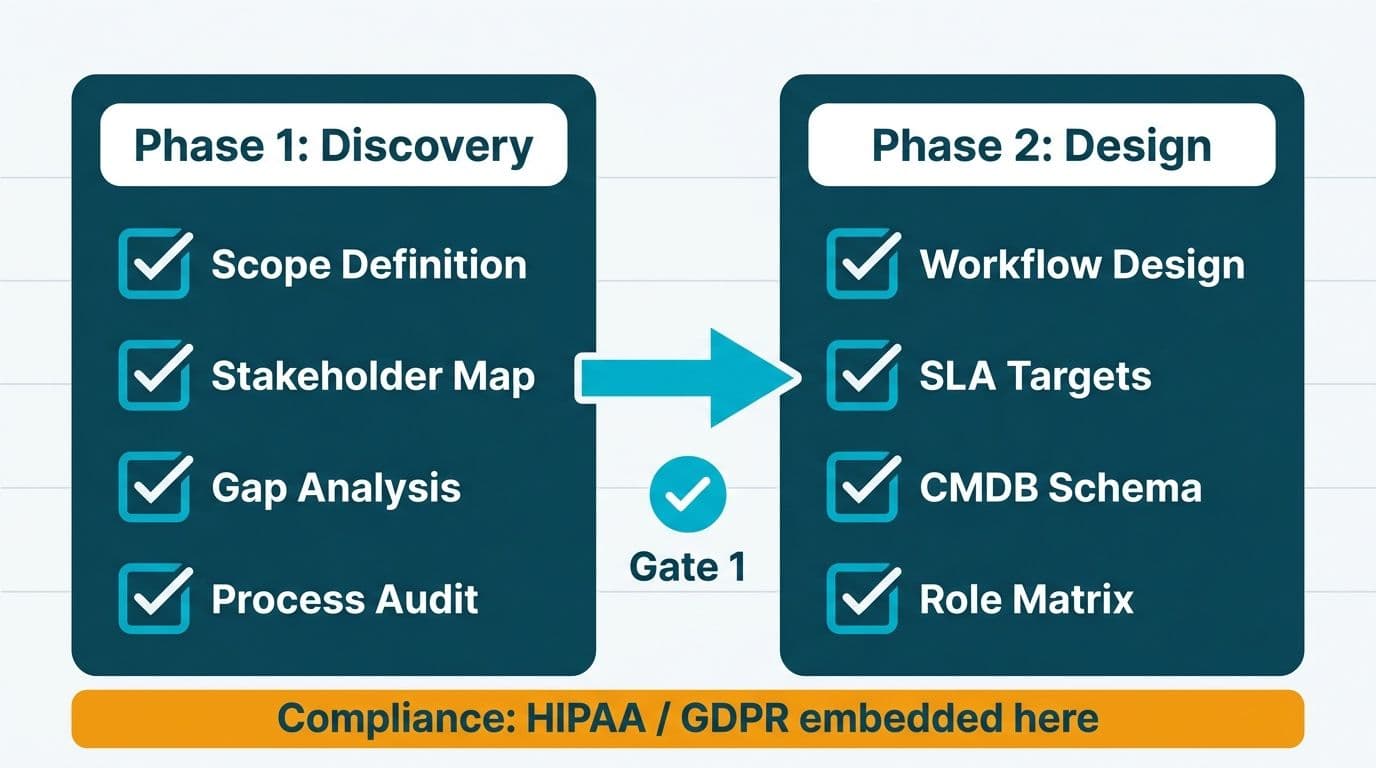
The discovery phase sets the project's entire risk profile. Rushed or incomplete scoping is the most common cause of mid-project budget overruns and compliance gaps.
Business and technical scoping:
- Define ITSM module scope: Incident Management, Problem Management, Change Management, Service Request Management, or the full ITIL suite
- Inventory existing integrations: Active Directory, monitoring platforms, HR systems, and financial ERP
- Document current ticket volumes, SLA thresholds, and escalation paths by support tier
- Identify data classification levels, particularly ePHI for US healthcare, PII under GDPR, and personal information under PIPEDA
- Map all organizational units that will consume ITSM services: IT, HR, Facilities, Finance, Legal
Governance and stakeholder alignment:
- Appoint a named ITSM programme owner with budget authority and escalation rights
- Establish a steering committee with representation from IT, Legal, Compliance, and Finance
- Define change management resources and an internal communications lead for the rollout
- Agree on a go-live date with at least 20% schedule contingency built in
Region-specific scoping checkpoints:
- US (HIPAA): Confirm the ServiceNow instance is hosted on HIPAA-eligible infrastructure; obtain a signed Business Associate Agreement (BAA) from ServiceNow before any ePHI enters the system
- UK/EU (GDPR): Document the lawful basis for processing employee and end-user personal data under GDPR Article 6; confirm EU data center selection within ServiceNow's infrastructure options
- Canada (PIPEDA): Confirm personal information flows comply with PIPEDA's accountability and purpose-limitation principles; identify provincial requirements such as Quebec Law 25 if applicable
Phase 2: Design and Configuration Checklist
Design decisions made in this phase are expensive to reverse. Scope creep most commonly originates here, driven by undocumented stakeholder requests that arrive after the project plan is baselined.
Process design:
- Create detailed process flow diagrams for each ITSM module in scope
- Define role and group structures: assignment groups, approval chains, and change advisory board (CAB) membership
- Agree on the service catalog taxonomy and self-service portal structure
- Document SLA definitions, measurement logic, and breach notification rules
- Establish naming conventions for all configuration items in the CMDB
Technical configuration:
- Configure the identity provider connection (SSO/SAML) and test authentication flows
- Set notification rules so PII is not embedded in notification bodies where regulations restrict it
- Define field-level security for records containing PHI, financial account data, or other regulated PII
- Produce integration specifications for each external system before build begins
- Stand up the instance hierarchy: development, UAT, and production, with promotion gates between each
Compliance design checkpoints:
- US (HIPAA): Enable audit logging on all tables storing ePHI; configure role-based access controls to the minimum-necessary standard per 45 CFR §164.312
- UK/EU (GDPR): Implement data retention schedules with automated purge workflows; add a Data Subject Access Request (DSAR) handling workflow to the service catalog
- Canada (PIPEDA): Document the stated purpose of collection for each personal data field captured in ServiceNow; design a consent-withdrawal workflow if personal data feeds downstream analytics
Organizations running Power BI reporting layers that ingest ServiceNow data should align data governance controls at this stage. The Power BI governance best practices checklist covers complementary data classification and access controls that apply when ITSM data flows into analytics platforms.
Phase 3: Testing and Training Checklist
In regulated environments, testing failures cluster around access control gaps and integration edge cases rather than core ITSM functionality. Allocate at least three weeks for this phase in a mid-market implementation.
Functional testing:
- Execute test scripts for every catalog item and all approval workflow paths
- Validate SLA timer behavior at business-hours boundaries and across time zones for distributed teams
- Test all escalation paths end-to-end from L1 through L3
- Confirm CMDB population accuracy against a known baseline of infrastructure records
Integration and security testing:
- Conduct a vulnerability scan or penetration test on the ServiceNow instance - required for US federal-adjacent and HIPAA-covered organizations
- Validate SSO login flows for all user populations, including service accounts and external vendors
- Test API integrations under realistic load conditions and confirm timeout and retry behavior
- Review audit logs to confirm all targeted events are captured correctly and completely
User acceptance testing and training:
- Run UAT with a representative cross-section of agents and end-users from each operational region
- Deliver role-based training for agents, approvers, and CMDB administrators
- Produce quick-reference guides for the self-service portal
- Train help desk leads on escalation procedures and documented rollback criteria
Compliance testing checkpoints:
- US (HIPAA): Execute an access-control matrix review; confirm minimum-necessary access for every role; run a test audit log extraction for a 90-day lookback period
- UK/EU (GDPR): Test the DSAR workflow end-to-end including data export and deletion branches; verify automated deletion fires correctly at configured retention milestones
- Canada (PIPEDA): Confirm the breach notification procedure is documented and a tabletop exercise has been completed; verify access logs meet PIPEDA accountability evidence requirements
For a detailed breakdown of regulatory obligations in healthcare ITSM contexts, the companion article on ServiceNow ITSM for healthcare IT teams: HIPAA, GDPR, and PIPEDA covers the compliance framework in depth.
Phase 4: Go-Live and Hypercare Checklist
Go-live is a milestone, not a finish line. The hypercare phase - typically 30 to 60 days - is when real adoption patterns reveal configuration gaps that controlled testing missed.
Go-live readiness gates:
- Freeze all non-critical configuration changes at least five business days before go-live
- Confirm the production cutover plan with documented rollback trigger criteria
- Communicate the go-live date and new submission channels to all affected users at least two weeks in advance
- Confirm instance health monitoring dashboards are active and alerting correctly
- Validate backup and disaster recovery procedures under the production configuration
Cutover execution:
- Disable legacy ITSM intake channels at the agreed cutover time
- Execute open-ticket migration per the agreed cutover script
- Confirm ServiceNow is receiving live incidents and routing them correctly within the first two hours
- Verify all integrations are passing live production data
Hypercare operations (Days 1 to 60):
- Assign a named hypercare lead with authority to apply configuration hotfixes without a full CAB review cycle
- Run daily stand-ups with IT, help desk, and business representatives for the first two weeks
- Track SLA breach rate, catalog adoption rate, and agent satisfaction scores on a weekly cadence
- Deploy automated end-user feedback surveys at 7, 30, and 60 days post-go-live
- Log all configuration changes made during hypercare in the formal change record
Suppose a 200-seat US financial services firm goes live on a Monday. By Wednesday, agents are manually rerouting tickets because an assignment group was renamed during design but the routing rules were not updated. A hypercare lead with configuration authority resolves this in hours. Without one, the issue persists for weeks and erodes the early adoption momentum that drives long-term return on investment.
How Do Governance Checkpoints Map Across HIPAA, GDPR, and PIPEDA?
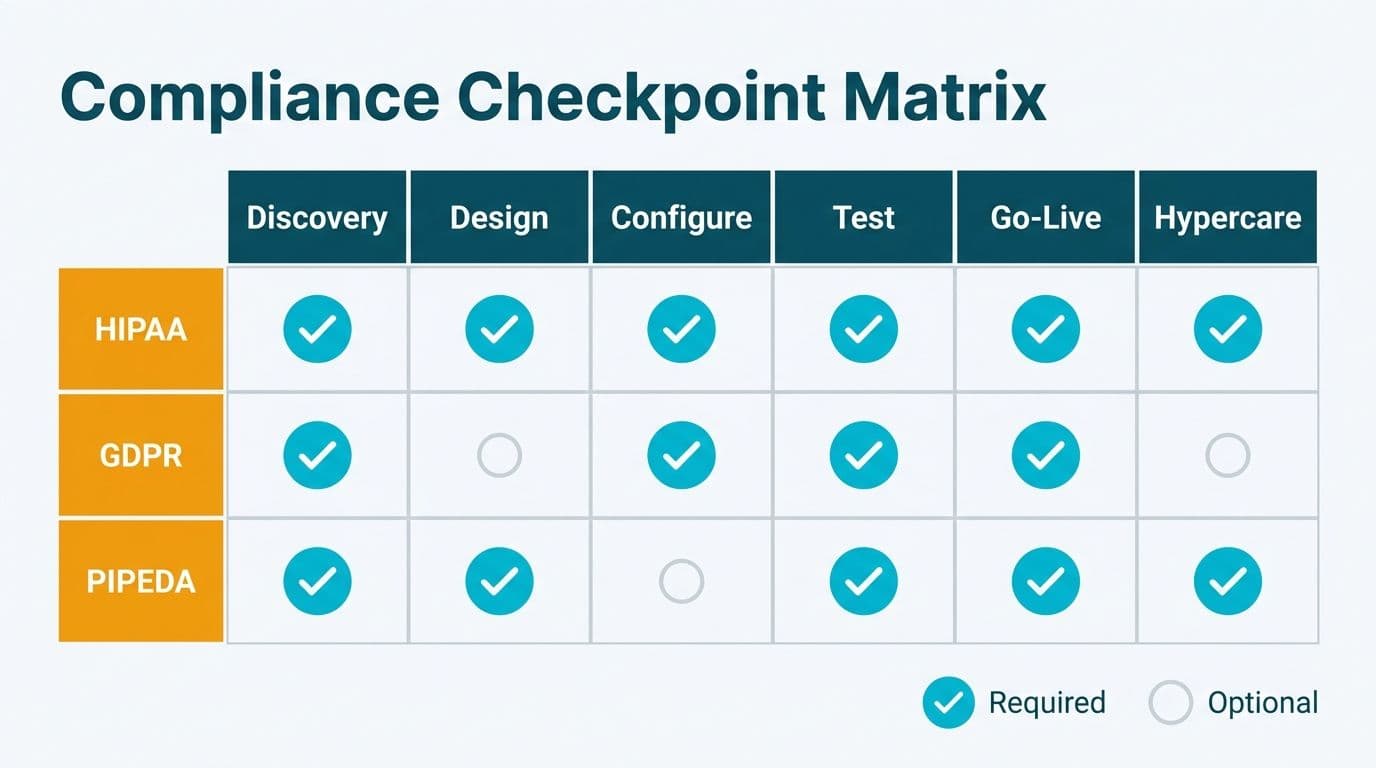
Region-specific compliance requirements are not optional annexes to the implementation checklist - they are phase-blocking gates that must be cleared before the project advances. The table below maps each key regulation to the phase where its primary controls must be verified.
| Regulation | Region | Primary Phase | Key Checkpoint | Risk if Missed |
|---|---|---|---|---|
| HIPAA | US | Scoping + Testing | BAA signed; ePHI audit logging enabled; minimum-necessary access controls configured | OCR audit exposure; mandatory breach notification obligation |
| GDPR | UK/EU | Scoping + Design | Lawful basis documented; EU data residency confirmed; DSAR workflow built in service catalog | DPA enforcement; fines up to 4% of global annual turnover |
| PIPEDA | Canada | Scoping + Design | Purpose of collection documented for each data field; breach notification procedure rehearsed | OPC investigation; mandatory public breach disclosure under federal regulations |
| Quebec Law 25 | Canada (QC) | Design | Privacy impact assessment completed for high-risk processing; data localization reviewed | CAI enforcement; provincial penalties under Act 25 |
A UK-based managed service provider running ServiceNow internally may face dual obligations: HIPAA requirements embedded in US customer contracts, and GDPR as the baseline for its own employee data processing. This layered compliance exposure makes scoping-phase governance mapping critical rather than optional.
A Canadian financial institution subject to both PIPEDA and Quebec Law 25 must complete a privacy impact assessment before enabling analytics integrations on ServiceNow data. Finance and IT leaders building the internal business case for this compliance investment may find the AI automation business case for finance leaders a useful framing reference.
What Should IT Directors Monitor After Hypercare Ends?
Post-hypercare governance prevents configuration drift and keeps the implementation audit-ready. A quarterly review cadence covering the following areas is sufficient for most mid-market deployments.
Operational health:
- Review SLA performance against the thresholds agreed during scoping
- Audit assignment group accuracy and reassignment rate trends
- Validate CMDB completeness against current infrastructure discovery output
- Review service catalog usage: retire low-adoption items, promote high-demand requests
Compliance maintenance:
- US (HIPAA): Annual access-control review; confirm the BAA with ServiceNow remains current if the contract renews
- UK/EU (GDPR): Review retention schedules as data volumes grow; update the DSAR process if new personal data categories are added to ServiceNow records
- Canada (PIPEDA): Review the breach incident log quarterly; confirm privacy officer contact details are current in instance documentation
Platform currency:
- Review ServiceNow release notes for each new version - ServiceNow publishes two major releases per year
- Test each upgrade in a non-production environment before promoting to production
- Confirm all customizations are documented and tested for upgrade compatibility
---
About Lets Viz: Lets Viz is a data and technology consulting firm serving US healthcare, UK fintech, Canadian manufacturing, and global SaaS organizations since 2020. Our practitioners hold a 5.0 Clutch rating across ServiceNow implementation, data analytics, and compliance-aware technology deployments.
Ready to run your ServiceNow ITSM rollout on time and in compliance? Our ServiceNow consulting services team guides IT directors through every phase of this checklist - from scoping and governance design through hypercare sign-off.