ServiceNow vs Jira Service Management: Full 2026 Comparison
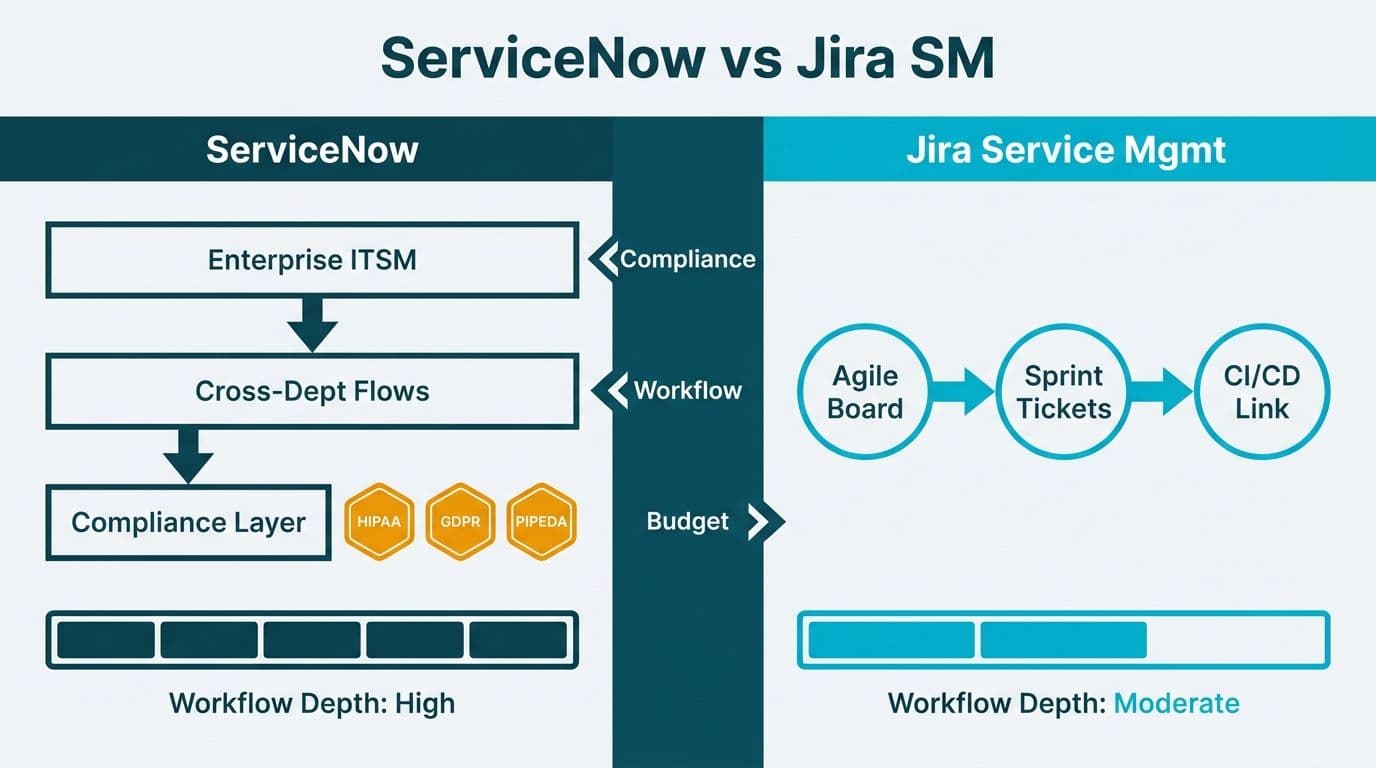
ServiceNow and Jira Service Management serve different needs at mid-market scale. ServiceNow is an enterprise-grade ITSM platform built for complex, cross-departmental workflows with native compliance tooling for HIPAA, GDPR, and PIPEDA environments. Jira Service Management suits dev-centric teams that need lightweight ticketing tightly integrated with software delivery pipelines. The right choice turns on compliance burden, workflow complexity, and budget ceiling.
Key Takeaways
- ServiceNow is the stronger choice for mid-market healthcare and financial services firms with heavy compliance requirements across the US, UK, and Canada.
- Jira Service Management excels for software-first IT teams that manage incidents alongside engineering backlogs.
- ServiceNow's total cost of ownership is higher, but its out-of-box compliance modules often eliminate the need for separate GRC and privacy management tools.
- Both platforms offer HIPAA-aligned and GDPR-ready configurations, but the depth of native tooling differs significantly.
- PIPEDA obligations for Canadian organizations are better addressed by ServiceNow's data-residency controls and audit trail features.
What Is the Core Difference Between ServiceNow and Jira Service Management?
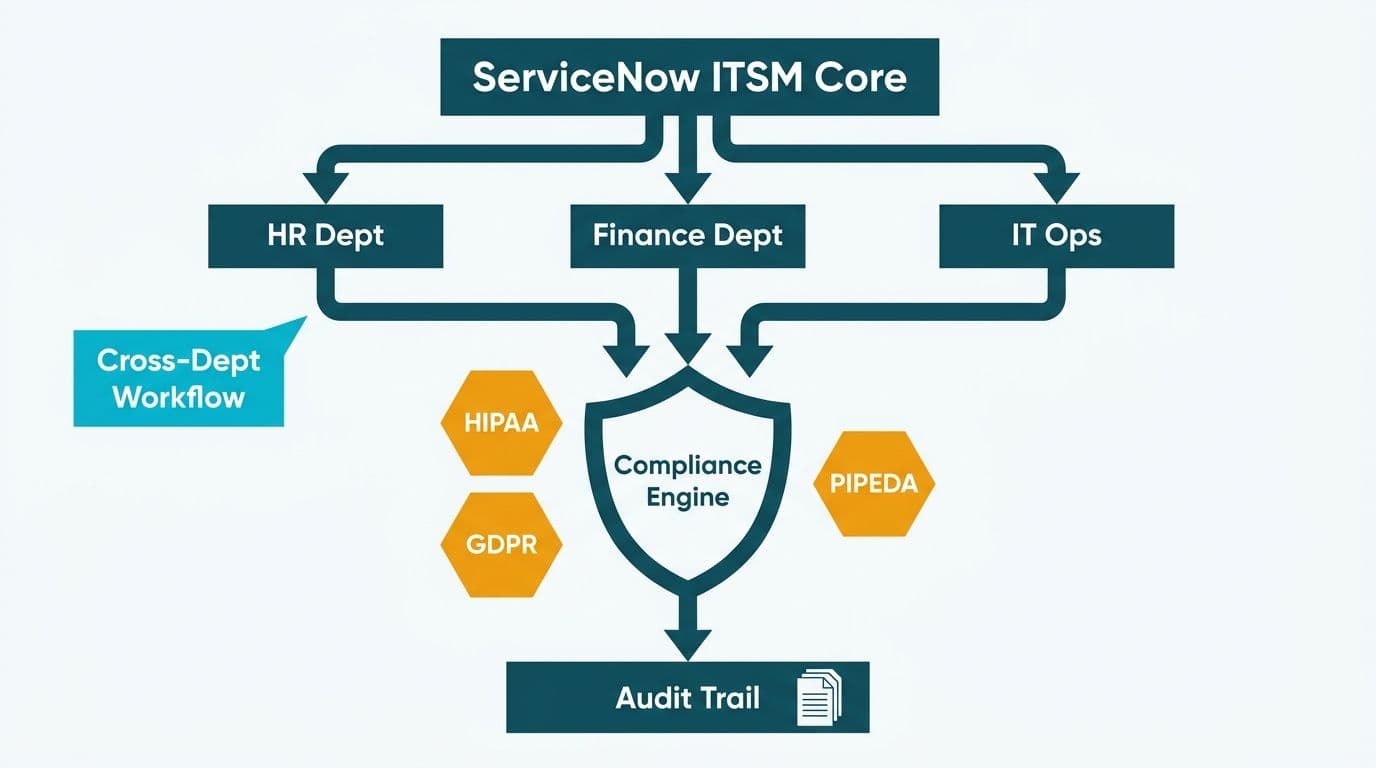
ServiceNow is a full-platform ITSM suite - it covers IT, HR, legal, and facilities service management from a single data model. Jira Service Management is Atlassian's ITSM layer built on top of its project-tracking engine, making it a natural fit for teams already running engineering work in Jira Software.
For a CIO at a US healthcare system or a Canadian financial institution, the distinction matters immediately. ServiceNow ships with dedicated modules - including its GRC (Governance, Risk, and Compliance) product - that map ITSM processes directly to regulatory control frameworks. Jira Service Management relies more heavily on marketplace apps and manual configuration to reach equivalent compliance depth.
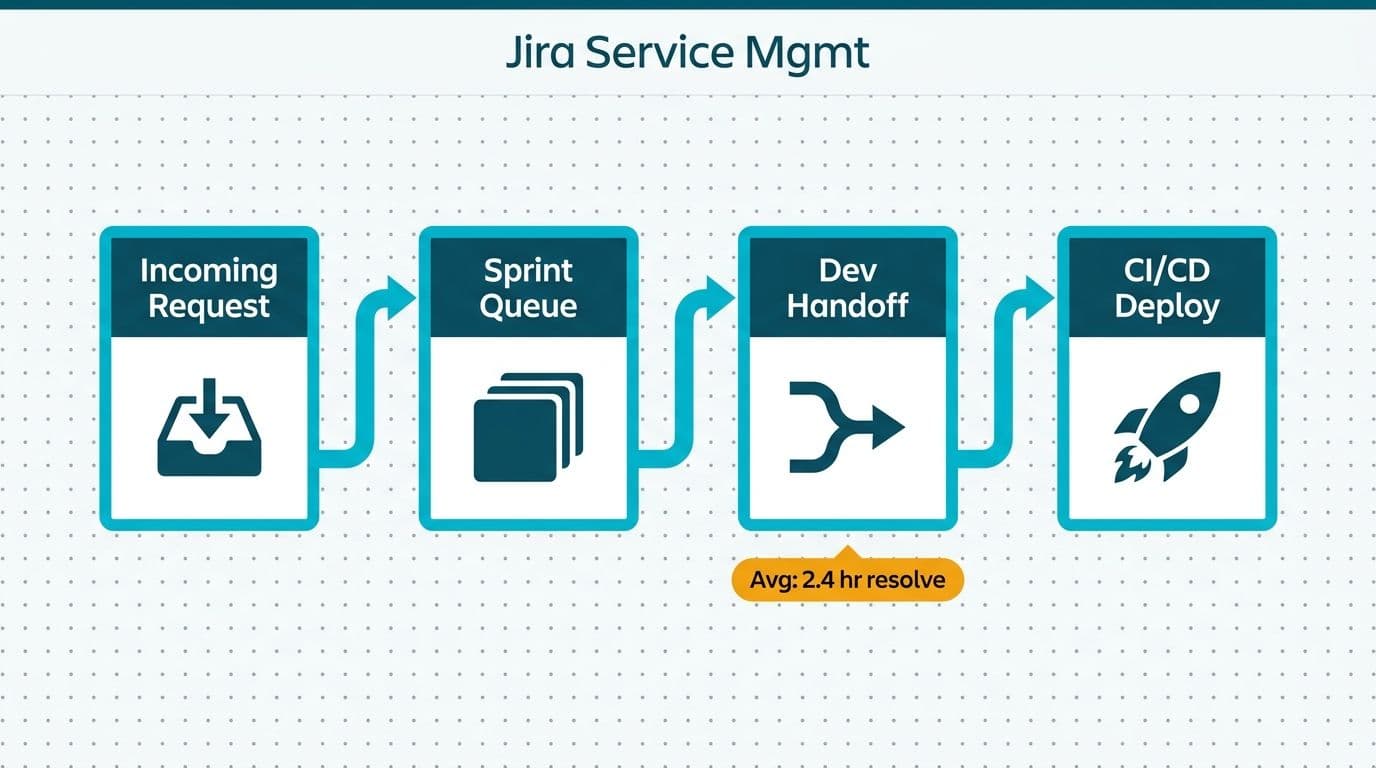
Both platforms support standard ITIL v4 practices: incident, problem, change, and asset management. Where they diverge is in breadth. ServiceNow's Now Platform extends to enterprise-wide service management across multiple departments, while Jira Service Management stays closer to its dev-ops roots and excels when incident management and software delivery are tightly coupled.
For a broader platform overview, see What Is ServiceNow? A CIO's Complete Platform Guide.
ServiceNow vs Jira Service Management: Feature Comparison
The table below covers the capabilities mid-market IT leaders ask about most often when evaluating these platforms for healthcare or financial services environments.
| Feature | ServiceNow ITSM | Jira Service Management |
|---|---|---|
| ITIL v4 alignment | Full suite out of box | Core practices; advanced features via apps |
| Native GRC / compliance modules | Yes - GRC, SecOps, Risk Management | Limited - relies on Marketplace add-ons |
| Asset management / CMDB | Enterprise-grade CMDB native | Basic CMDB; third-party integrations common |
| Multi-department service management | Yes - IT, HR, legal, facilities | IT-focused; HR add-ons available |
| Dev-ops pipeline integration | Via integrations (GitHub, Azure DevOps) | Native Jira Software integration |
| AI-assisted triage | Now Assist (GenAI, 2025) | Atlassian Intelligence (2025) |
| Multi-region data residency | Yes - EU, US, Australia, and additional regions | Yes - via Atlassian data residency controls |
| Performance analytics | Native Performance Analytics module | Basic dashboards; Atlassian Analytics at higher tiers |
| Pricing model | Negotiated subscription plus platform fee | Per-agent subscription; free tier available |
ServiceNow leads on cross-departmental scope and native compliance depth. Jira Service Management leads on dev-team integration and low entry cost for smaller teams.
Our ServiceNow consulting services team regularly helps mid-market organizations map these trade-offs against their specific regulatory requirements and workflow complexity before they commit to a platform.
How Do ServiceNow and Jira Service Management Pricing Compare?
Cost is consistently the first filter mid-market IT leaders apply. The true comparison is less straightforward than list prices suggest, because total cost of ownership includes tools each platform either provides natively or requires you to purchase separately.
Jira Service Management (Atlassian published pricing, 2026):
- Free: up to 3 agents
- Standard: approximately USD 22 per agent per month, billed annually
- Premium: approximately USD 48 per agent per month, billed annually
- Enterprise: custom pricing, unlimited agents
ServiceNow IT Service Management does not publish list pricing publicly. Licensing is negotiated based on user count, modules selected, and contract length. Entry-level mid-market deployments - covering 100 to 500 named users with core ITSM modules - typically land in six figures annually when implementation and first-year support are included.
For a 100-agent mid-market IT team, Jira Service Management's Premium tier runs roughly USD 57,600 per year in direct license cost. A comparable ServiceNow deployment, including implementation services and core modules, typically sits well above that figure, particularly when GRC, Performance Analytics, and Security Operations are in scope.
The cost gap narrows - and sometimes reverses over a three-year horizon - when you account for what ServiceNow consolidates. A US healthcare IT team using ServiceNow's native HIPAA Business Associate Agreement (BAA) controls and audit logging may avoid purchasing a separate GRC platform, a standalone CMDB tool, and compliance reporting add-ons. A UK fintech firm might similarly consolidate GDPR data-subject request workflows into ServiceNow rather than running a parallel privacy management product.
For a detailed breakdown of what mid-market rollouts actually cost by module and team size, see ServiceNow Implementation Cost 2026: A Mid-Market Breakdown.
Which Platform Meets HIPAA, GDPR, and PIPEDA Compliance Requirements?
Compliance posture is the decisive factor for most healthcare and financial services IT leaders in North America and the UK. Both platforms can be configured for regulated environments, but the configuration effort and native coverage differ substantially.
HIPAA (United States)
Both ServiceNow and Jira Service Management will execute a Business Associate Agreement (BAA) with covered entities - the minimum legal threshold under HIPAA for software that processes protected health information (PHI).
ServiceNow's depth is the differentiator. Its Security Operations and GRC modules support automated evidence collection mapped to HIPAA Technical Safeguard controls: access logging, audit controls, and transmission security. Teams can run compliance reports against these controls directly within the platform without custom scripting. Jira Service Management can be configured for HIPAA-aligned workflows but requires Atlassian's Enterprise tier plus marketplace tools to achieve comparable audit trail completeness.
A US hospital system evaluating both platforms should request each vendor's HIPAA implementation guide and map it against their Security Rule control inventory before finalizing a contract.
GDPR (United Kingdom and EU)
Both platforms offer EU-region data-residency options, which supports compliance with GDPR data-transfer requirements under Article 46 of the regulation.
ServiceNow's Data Privacy module (2025) automates GDPR data-subject access requests (DSARs), consent tracking, and data mapping across service records. A UK fintech firm managing incident tickets that contain customer PII will find this materially reduces manual compliance overhead compared to building equivalent workflows in a general-purpose ticketing tool.
Jira Service Management's GDPR posture is primarily managed through Atlassian's Data Residency controls and organizational administrator settings. This is adequate for many UK and EU environments but requires more manual process design for DSAR workflows and post-incident data-handling documentation.
PIPEDA (Canada)
PIPEDA - Canada's federal private-sector privacy law - requires organizations to protect personal information under reasonable safeguards and to provide individuals with access to their data upon request. Stricter provincial laws in Quebec (Law 25), British Columbia, and Alberta apply to many mid-market organizations operating in those provinces.
ServiceNow supports Canadian-region cloud hosting through its infrastructure partnerships, and its audit trail, role-based access controls, and configurable log retention policies map cleanly to PIPEDA's accountability principle. A Canadian financial institution can configure ServiceNow to generate audit-ready evidence that satisfies both federal and provincial privacy regulators.
Jira Service Management's Canadian data-residency option is available at the Enterprise tier but offers less granular logging controls than ServiceNow. Mid-market Canadian organizations subject to Quebec's Law 25 - which carries some of the strictest breach-notification and data-mapping requirements in North America - should carefully evaluate audit log depth before committing.
For a detailed look at how ServiceNow handles regulated healthcare environments across all three jurisdictions, see ServiceNow ITSM for Healthcare IT Teams: HIPAA, GDPR & PIPEDA.
When Should a Mid-Market IT Team Choose ServiceNow?
ServiceNow is the stronger fit when any of the following conditions apply:
- Multi-department scope: the platform must serve IT, HR, legal, and facilities from a single system of record with cross-departmental SLA reporting and unified data governance
- Heavy compliance burden: US healthcare (HIPAA, SOC 2), UK and EU financial services (GDPR), or Canadian firms under PIPEDA and provincial laws need native, auditable controls rather than marketplace add-ons
- Complex change management: the change advisory board (CAB) process involves multi-tier approval chains, risk scoring, and scheduling integration with production deployment pipelines
- Enterprise CMDB requirements: mapping relationships between services, applications, and infrastructure at scale requires a mature, native configuration management database
- AI-assisted service operations: Now Assist (ServiceNow's GenAI layer, 2025) provides case summarization, recommended next actions, and automated ticket categorization within the platform
Consider a 200-seat US health insurance firm that needs HIPAA-auditable IT change records, HR case management alongside IT ticketing, and cross-departmental SLA reporting rolled into one platform. That profile maps clearly to ServiceNow, even accounting for the higher upfront investment.
When Does Jira Service Management Make More Sense?
Jira Service Management earns its place when the following conditions hold:
- Software-first organizations: engineering and IT share the same toolchain; incidents, sprints, and production deployments live side by side in the Atlassian ecosystem, and context-switching between tools is a genuine productivity cost
- Smaller IT teams - under 25 agents: the Free or Standard tier provides genuine ITIL practice support without a six-figure implementation budget or a lengthy procurement cycle
- Dev-ops is the primary driver: post-incident reviews tied to Jira issues, change requests linked to development sprints, and on-call scheduling through Opsgenie are native Atlassian strengths
- Firm budget ceiling: a mid-market Canadian SaaS company with a 15-person IT team, no PHI in scope, and a dev-centric culture may find that the Standard tier delivers the core capability they need at a fraction of ServiceNow's total cost
Jira Service Management is not the weaker platform. It is a different platform optimized for a different buyer profile, and choosing it for the right reasons typically delivers faster time-to-value.
Implementation and Integration Considerations
Regardless of platform selection, mid-market IT leaders in healthcare and finance should plan for the following realities before go-live.
Data classification first: map every data element that will flow through the ITSM platform before any configuration work begins. PHI, PII, and financial account data require different field-level handling, encryption settings, and retention policies - both platforms need to be deliberately configured for these requirements, not just licensed.
Integration architecture: both platforms connect natively to Microsoft 365, Slack, PagerDuty, and major infrastructure monitoring tools. ServiceNow's native integrations are generally deeper for ERP and HRIS systems such as Workday, SAP, and Oracle HR. For executive visibility into operational data, the ServiceNow Power BI Integration: A Complete Guide explains how service management data can feed finance and operations dashboards without custom extract pipelines.
Training and change management: ServiceNow's configurability is simultaneously its greatest strength and its largest complexity risk. Without structured onboarding and configuration governance, teams accumulate technical debt that compounds over contract cycles. Jira Service Management has a noticeably shallower learning curve for organizations already operating within the Atlassian ecosystem.
Vendor negotiation: ServiceNow pricing is negotiated, not fixed. Multi-year commitments, module bundles, and standardized mid-market deployment packages are all legitimate levers. Arriving at the table with a precise scope document and a competing proposal meaningfully improves outcomes.
Three-year TCO modeling: the three-year total cost - license, implementation, training, integration development, and ongoing administration - almost always shifts the apparent pricing comparison. When compliance tool consolidation is included in the model, ServiceNow's three-year TCO sometimes narrows substantially relative to achieving equivalent capability through marketplace apps and manual process design.
---
About Lets Viz: Lets Viz is a data analytics and technology consulting firm serving US healthcare, UK fintech, Canadian manufacturing, and global SaaS organizations since 2020. Rated 5.0 on Clutch, our team helps mid-market IT leaders evaluate, implement, and optimize enterprise platforms across ServiceNow, Microsoft Fabric, Power BI, and Zoho.
If your organization is running a ServiceNow vs Jira Service Management evaluation and needs a compliance fit assessment or three-year TCO model tailored to your environment, our ServiceNow consulting services team can guide you from platform selection through go-live.