ServiceNow Self-Service Portal Best Practices (2026 Guide)
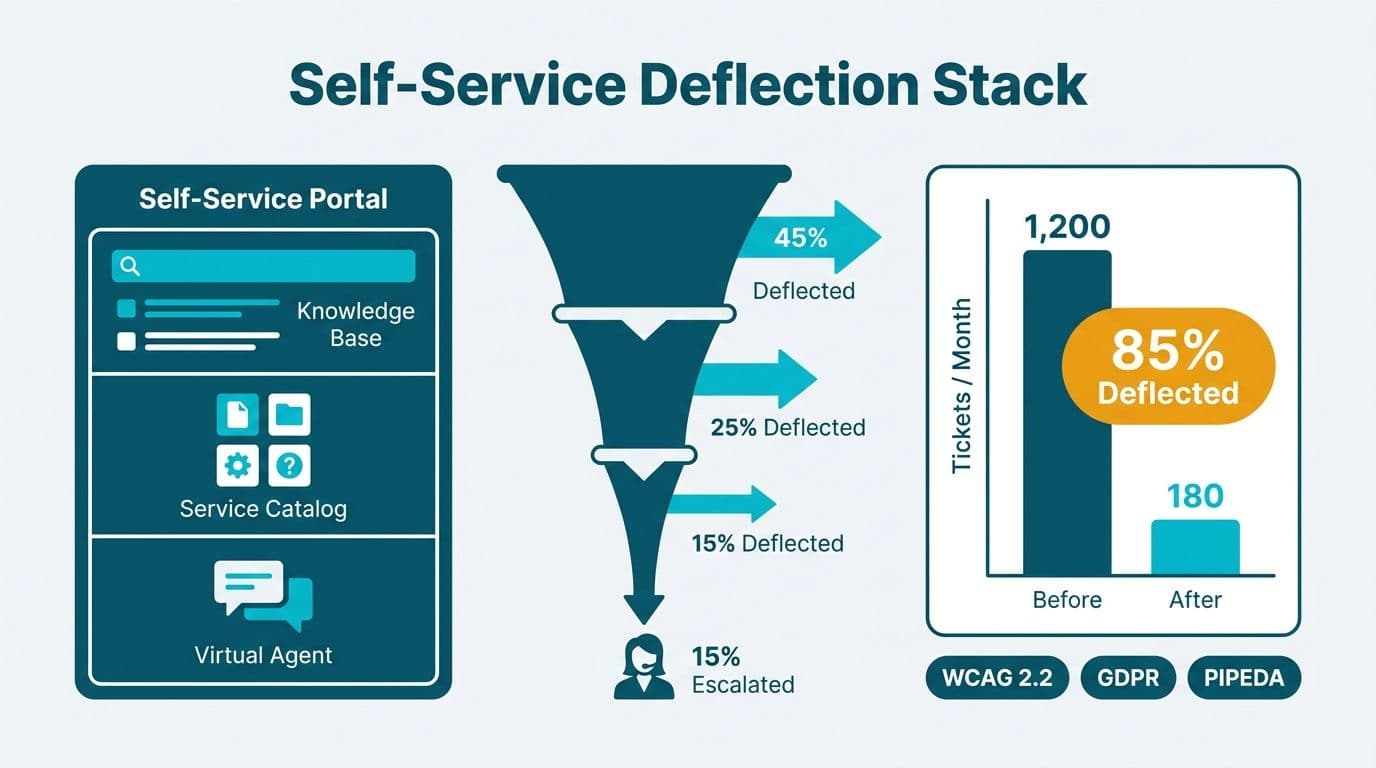
A well-configured ServiceNow self-service portal reduces IT ticket volume by routing end users to knowledge articles, automated catalog items, and virtual agent conversations before a human agent is needed. Mid-market IT teams achieve the deepest deflection gains by standardising catalog structure, investing in knowledge base quality, and designing for mobile - with additional configuration required to meet WCAG 2.2, GDPR, and PIPEDA obligations across US, UK, and Canadian deployments.
Key Takeaways
- Catalog structure drives more deflection than any single technology feature; organise items around employee tasks, not IT org charts.
- Knowledge base quality is the foundation of both portal search and virtual agent accuracy - stale, poorly titled articles undermine both.
- WCAG 2.2 Level AA compliance is the accessibility baseline for UK and EU deployments, and good practice everywhere.
- Compliance differs by region: HIPAA for US healthcare, GDPR Article 25 for UK and EU organisations, PIPEDA for Canadian companies.
- Quarterly governance - catalog audits, KB reviews, and deflection tracking - sustains performance after go-live.
What Exactly Is a ServiceNow Self-Service Portal?
The ServiceNow Service Portal and its successor surfaces - Employee Center and Now Mobile - form the user-facing layer where employees submit requests, search for answers, report incidents, and track request status without contacting an agent. The portal is a configured environment built on the catalog, knowledge base, and virtual agent modules underneath it, not a standalone feature.
Most mid-market teams benefit from engaging ServiceNow consulting services to design these layers before go-live. Retrofitting a poorly structured catalog after launch costs substantially more in rework than building the taxonomy correctly from the outset.
According to ServiceNow product documentation (2025), the Employee Center consolidates IT, HR, and facilities services into a unified portal on a single platform instance, removing the friction of directing employees to multiple department portals. For a full overview of the platform's module structure, see What Is ServiceNow? A CIO's Complete Platform Guide.
How Do ServiceNow Self-Service Portal Best Practices Reduce Ticket Volume?
Ticket volume reduction works through deflection: resolving the user's need before it generates a human-handled ticket. Three compounding mechanisms drive deflection.
Knowledge article deflection occurs when a user searches the portal, finds an accurate article, resolves the issue independently, and leaves without submitting anything. This requires high article quality and accurate metadata so portal search surfaces the right content reliably.
Catalog auto-fulfillment processes the request automatically via workflow. A user requesting VPN access receives provisioned credentials through a Flow Designer workflow with no agent involvement. A catalog item that still requires manual agent action after submission is a structured email form, not self-service.
Virtual agent containment handles conversational intake through the Now Assist interface. When integrated with a high-quality knowledge base, the virtual agent resolves standard requests without handoff. ServiceNow product documentation (2025) is explicit: virtual agent accuracy depends directly on the quality of the knowledge base underneath it.
The three mechanisms compound. Teams that invest in only one see modest results. Teams that build all three in parallel achieve the most sustained reduction in inbound volume.
How Do You Structure a ServiceNow Catalog That Deflects Tickets?
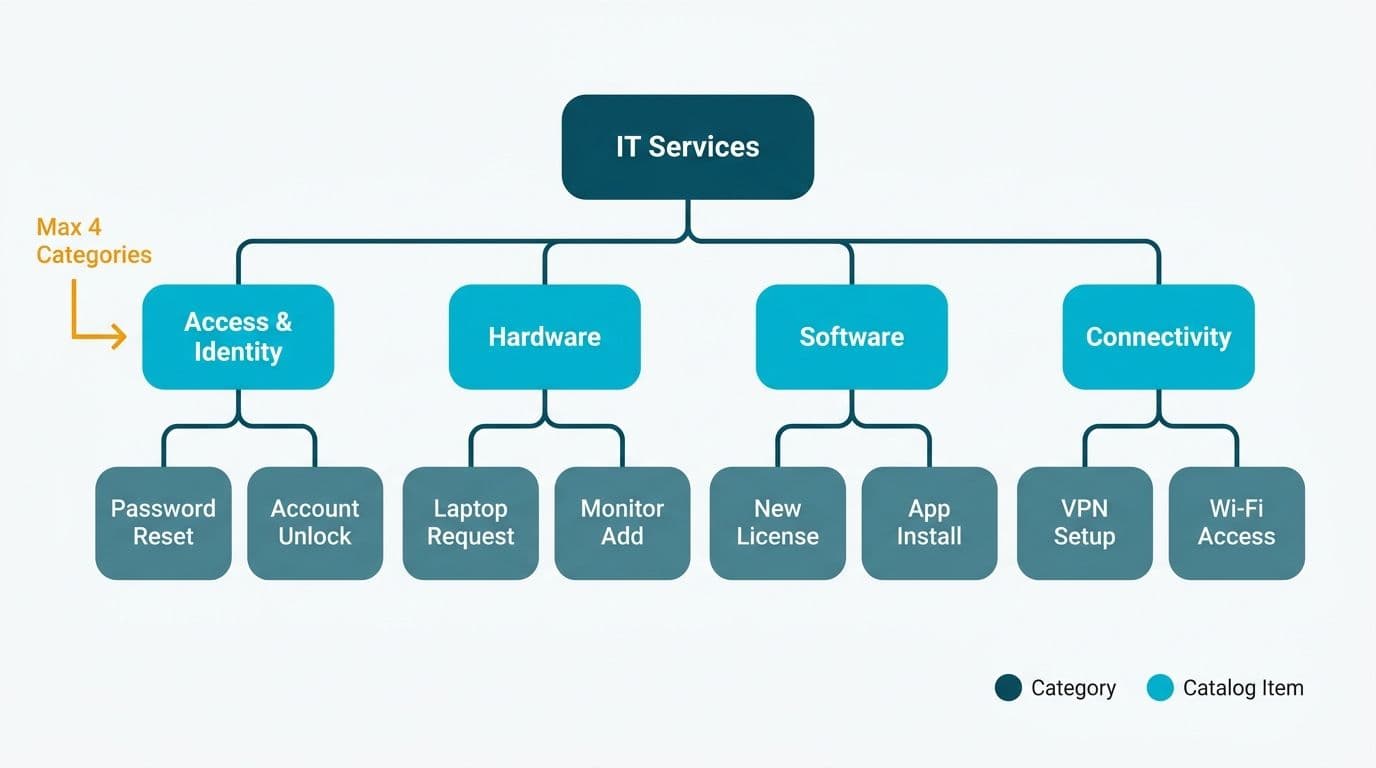
Catalog taxonomy is where most mid-market deployments stall. IT teams frequently mirror their org chart in the catalog - which maps to how IT is organised, not how employees describe their problems. A user with a broken laptop does not think "Infrastructure > Endpoints > Hardware Incident." They think "My laptop is broken."
Catalog structure comparison:
| Approach | What It Looks Like | Typical Outcome |
|---|---|---|
| IT-centric | "Networking > VLAN > Access Request" | Users cannot find items; call the desk instead |
| Task-centric | "New Employee Setup", "Software Access", "Remote Working" | Users self-serve; agent queue shrinks |
| Hybrid with search-first | Broad categories plus universal search and promoted items | Best deflection; strong on mobile |
Four steps that produce results:
Audit ticket volume by category first. The top 10 ticket types by volume become the first 10 catalog items built. For a 500-seat organisation, password reset, VPN access, software provisioning, and equipment requests typically represent the majority of repeatable volume.
Write titles in plain language. "Request Microsoft 365 License" is findable. "M365 - E3 - Provisioning (ITSM-CAT-0042)" is not. This applies equally to KB article titles and virtual agent topic names.
Configure auto-fulfillment for high-volume, low-complexity items. Flow Designer workflows fulfill access requests end-to-end and notify the requester at each stage - eliminating follow-up "where is my request?" tickets.
Retire stale items quarterly. ServiceNow's catalog analytics feature, available from the Washington DC release onward (per ServiceNow 2024 release documentation), surfaces item request rates natively. Items with zero requests in 90 days should be retired or consolidated.
What Knowledge Base Practices Drive Maximum Self-Service Deflection?
The knowledge base simultaneously serves portal search, the Now Assist virtual agent, and the AI search summary layer. Articles that are poorly structured fail across all three surfaces.
Task-based titles are the highest-impact single change most teams can make. ServiceNow's Knowledge Management documentation (2025) recommends titles that match the exact language a user would type into a search bar. "How to Reset Your Network Password" surfaces and gets used. "Password Reset - Network - IT-KB-0023" does not.
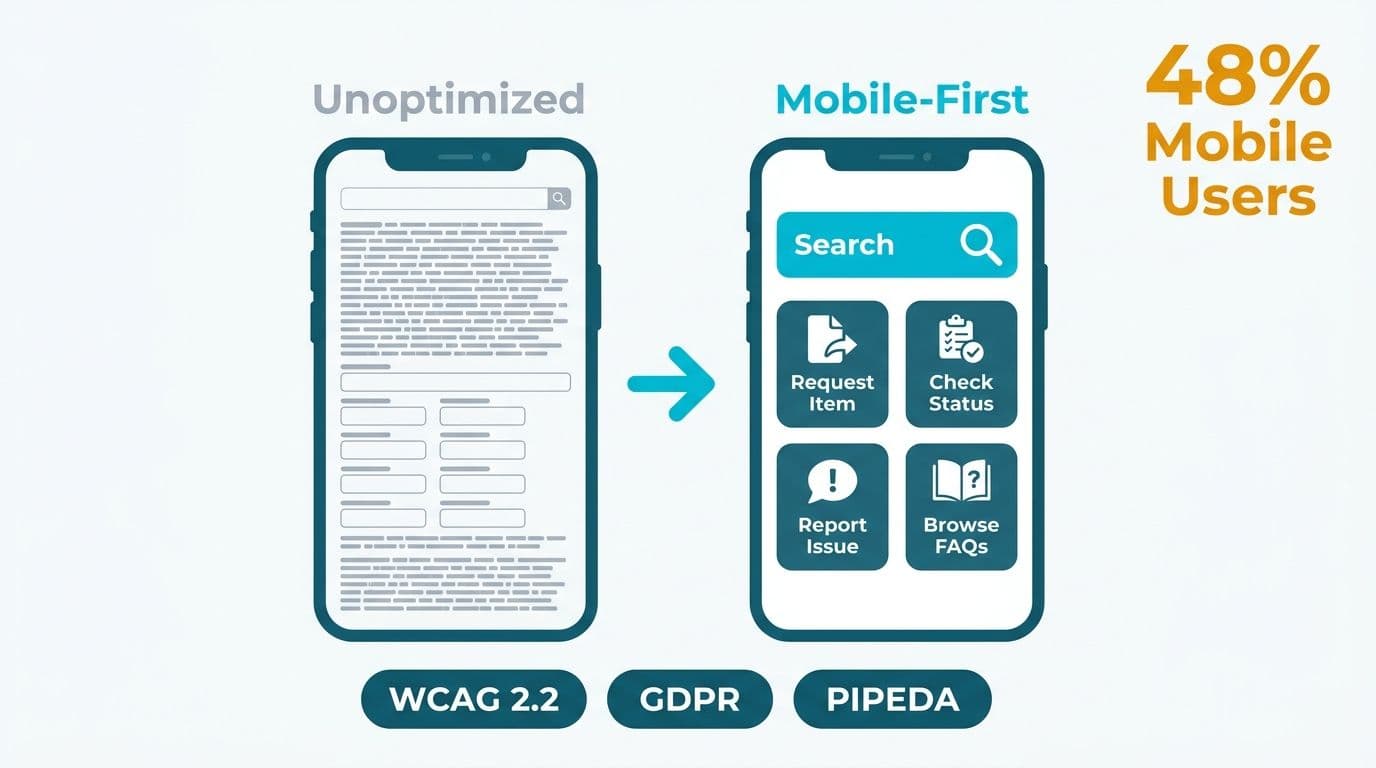
Numbered procedural steps outperform long paragraphs. End users skim on mobile; numbered steps with clear action verbs are both more usable and more accurately processed by the virtual agent's natural language layer.
Complete metadata - category, subcategory, and keyword tags on every article - determines search ranking. The Now Assist AI layer uses metadata to rank candidate articles before summarising them; an article with no metadata may exist in the knowledge base but will not surface reliably.
Article lifecycle governance prevents staleness. Auto-routing articles older than 12 months into a review queue keeps the knowledge base current. Enabling the "Was this article helpful?" feedback widget and routing negative responses to a named KB owner creates a continuous improvement loop at the article level rather than requiring periodic manual audits.
How Should Healthcare and Finance Teams Configure the Portal for Compliance?
Regulated industries require configuration layers that a standard deployment does not include by default. Requirements differ meaningfully by region.
US Healthcare - HIPAA
Any portal that handles or links to protected health information requires HIPAA technical safeguard configuration: field-level encryption on relevant tables, role-based access controls restricting portal visibility to the minimum necessary, and audit logging that captures record access events. ServiceNow's HIPAA compliance documentation (2025) frames this as a shared-responsibility model - the platform provides the controls; the customer and implementation partner configure and maintain them.
Role-based catalog visibility, configured through ServiceNow's user criteria feature, is especially important in healthcare. Clinical staff should see only IT catalog items relevant to their role. Scoping by role reduces both information security exposure and navigation complexity. For a combined treatment of HIPAA, GDPR, and PIPEDA in a single ITSM deployment, see ServiceNow ITSM for Healthcare IT Teams: HIPAA, GDPR & PIPEDA.
Canada - PIPEDA
A Canadian financial services firm deploying ServiceNow must satisfy PIPEDA obligations around consent and data residency. ServiceNow's Data Processing Addendum (2025) documents Canadian data center hosting options, meaning employee personal data collected through portal forms can be stored within Canada when the instance is provisioned on Canadian infrastructure. Portal registration flows must present clear consent language, and any change to the data fields collected should trigger a consent refresh for existing users.
UK and EU - GDPR
GDPR Article 25 (data protection by design and by default) requires that portal forms collect only the fields strictly necessary to fulfil the service request. A software access request does not need a personal mobile number. A hardware fault report does not need a home address. Reviewing every form against data minimisation requirements before go-live is standard practice for any UK or EU deployment.
WCAG 2.2 Level AA compliance is mandatory for UK public sector organisations under the Public Sector Bodies Accessibility Regulations, and increasingly expected by private sector UK and EU employers managing disability law and ESG reporting obligations. For any multi-region deployment, WCAG 2.2 should be the baseline portal theme requirement from day one.
How Do You Measure Self-Service Portal Success Over Time?
Most teams default to overall ticket volume as the primary success measure - which obscures deflection performance, because a well-performing portal shows stable ticket counts even as headcount grows while the per-employee ticket rate falls.
Core portal metrics:
| Metric | What It Measures | Location in ServiceNow |
|---|---|---|
| Deflection rate | Portal sessions ending without a ticket submitted | Portal Analytics (Washington DC+) |
| KB helpful rate | User-rated quality of knowledge content | Knowledge Management module |
| VA containment rate | % of virtual agent sessions resolved without handoff | Now Assist Analytics |
| Portal CSAT | Post-closure satisfaction by service channel | Customer Satisfaction Survey module |
| Auto-fulfillment rate | % of catalog submissions fulfilled without agent action | Performance Analytics |
Deflection rate is the headline metric. ServiceNow's Portal Analytics dashboard, available from the Washington DC release onward, calculates it natively without custom configuration. It measures the proportion of portal sessions that end without a ticket - the most direct proxy for agent workload reduction.
The most common measurement error is aggregating across all categories. A UK fintech firm processing payroll exception queries and IT hardware requests through the same portal sees an aggregate CSAT that masks wide variation between the two. Segment metrics by catalog category and KB article before drawing operational conclusions.
For teams routing ServiceNow analytics into a broader reporting environment, ServiceNow Power BI Integration: A Complete Guide covers connector and data model options.
What Ongoing Governance Keeps the Portal Performing After Go-Live?
Portal performance erodes without structured governance. The three most common degradation patterns are catalog sprawl (items accumulate without retirement), knowledge base staleness (articles go out of date as procedures change), and virtual agent stagnation (the topic library never expands beyond the launch set).
Quarterly governance checklist:
- Retire catalog items with zero requests in the past 90 days; consolidate related low-volume items.
- Auto-flag KB articles older than 12 months for author review, refresh, or retirement.
- Analyse the top 10 incoming ticket categories; verify a self-service option exists for each.
- Expand virtual agent topics to cover any new services launched in the quarter.
- Route low-scoring CSAT categories to the responsible service owner, not the general ITSM queue.
Effective governance requires a named ITSM Platform Owner - a specific individual accountable for portal health metrics and the quarterly review cadence. Without that accountability anchor, reviews slide and deflection rates erode within 18 months. A mid-market Canadian manufacturing company running a 300-seat ServiceNow deployment might assign this role to a senior IT analyst with a standing monthly check-in with the IT director on portal health metrics.
For teams scoping the budget for a governed portal deployment, ServiceNow Implementation Cost 2026: A Mid-Market Breakdown provides a structured mid-market reference.
---
When your team is ready to design or optimise a ServiceNow self-service portal - whether for HIPAA compliance in US healthcare, GDPR data minimisation in the UK and EU, or PIPEDA residency obligations in Canada - the ServiceNow consulting services page outlines how Lets Viz approaches catalog design, knowledge base structure, and governance framework setup for mid-market organisations.
---
About Lets Viz: Lets Viz has delivered data and ITSM platform implementations since 2020, serving US healthcare systems, UK fintech firms, Canadian manufacturing companies, and global SaaS organisations. With a 5.0 Clutch rating, the team brings hands-on implementation experience across regulated industries where platform configuration and compliance documentation carry equal weight.